


What Is Fueling the Next Wave of Cross Border Payments Innovation
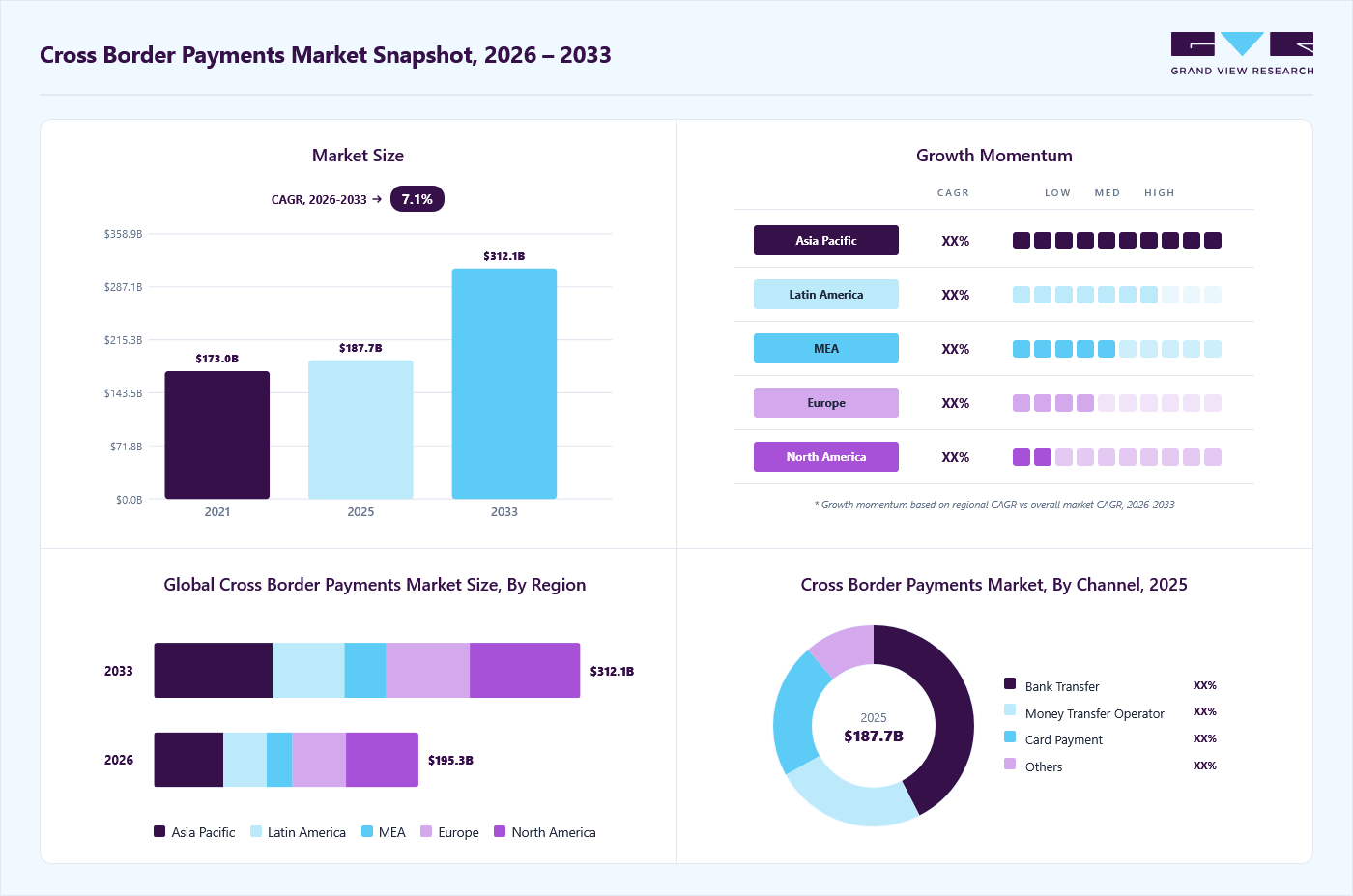
The cross border payments market was valued at USD 187.7 billion in 2025 and is projected to reach USD 193.5 billion in 2026. By 2033, the market is expected to reach USD 312.1 billion, expanding at a CAGR of 7.1% from 2026 to 2033.
Core Market Segments
The market spans multiple transaction types, channels, enterprise sizes, and end-use categories. Business-to-business (B2B) transactions represented the largest transaction type, accounting for 72.8% of revenue share in 2025. The segment benefits from international trade, supply-chain activity, and corporate payments involving suppliers, service providers, and subsidiaries.
Bank transfers remained the leading channel, with a 42.4% revenue share in 2025. Banks continue to serve as an important infrastructure layer for high-value international transactions, while modernization efforts are improving tracking, messaging, settlement, and interoperability.
By enterprise size, large enterprises held the largest share at 64.0% in 2025. These organizations typically require multi-currency accounts, treasury systems, liquidity management, and integration with enterprise financial platforms. At the same time, small and medium-sized enterprises are becoming an important growth opportunity as fintech platforms make international transactions more accessible.
Businesses represented the leading end-use segment, accounting for 74.8% of revenue share in 2025. Cross-border payments support international commerce, merchant transactions, supplier payments, and corporate transfers, while individuals contribute through remittances, travel, education, healthcare, and international purchases.
Key Growth Drivers
· Real-Time Rails:
The expansion of real-time payment infrastructure is creating new opportunities for cross-border transactions. More than 70 national fast-payment systems operate worldwide, and linking these domestic systems can enable faster international transfers. Interoperable payment networks can reduce settlement times while improving liquidity management and transaction experiences.
Real-time connectivity is particularly relevant as businesses increasingly require immediate payment confirmation and consumers become accustomed to instant digital transactions. The development of interconnected payment systems is therefore supporting the shift away from slower traditional processes.
· ISO 20022 Standards:
The adoption of ISO 20022 is becoming an important part of payment infrastructure modernization. Consistent messaging formats can improve the quality and structure of payment information, supporting smoother processing, fewer errors, and greater straight-through processing. The migration of established payment systems toward ISO 20022 is contributing to the modernization of international payment networks.
The standard also supports greater interoperability between financial institutions and payment systems. As cross-border transactions involve multiple institutions and jurisdictions, standardized data can help reduce friction throughout the payment chain.
· Embedded Finance:
Embedded finance is expanding the ways businesses can access cross-border payment capabilities. Payment functionality can increasingly be integrated into digital platforms, marketplaces, business applications, and other services, enabling users to complete international transactions without relying on separate payment journeys.
The expansion of digital marketplaces, subscription services, online freelancing platforms, and international e-commerce is strengthening demand for payment solutions that support multiple currencies, localized payment methods, transparent foreign exchange conversion, and secure processing.
Regional Trends
North America dominated the cross border payments market with a revenue share of 27.6% in 2025. Modernization of payment infrastructure and efforts to improve transaction speed and efficiency are supporting continued market development.
Europe is focused on improving interoperability between payment systems and reducing fragmentation, while Asia Pacific is seeing increasing collaboration between countries to connect domestic payment infrastructures. Initiatives linking instant payment systems are creating opportunities for faster and lower-cost international transfers.
The market is also being influenced by the continuing need to reduce transaction costs. Traditional cross-border payments can involve multiple intermediaries, foreign exchange expenses, manual checks, and differing compliance requirements. These factors can increase costs and slow settlement, particularly for smaller businesses and consumers.
Digital currencies, stablecoins, tokenized payments, mobile money, and blockchain-based payment networks are also being explored as potential additions to cross-border payment infrastructure. However, regulatory alignment remains important as financial institutions and policymakers assess how these technologies can be incorporated safely.
Digital Finance Platforms Enable Faster, More Connected Payments
Fintech-As-A-Service Market: The growth of real-time payments, open banking, embedded finance, and API-based platforms is helping businesses access scalable financial services without building complex infrastructure from scratch. These solutions are also supporting faster cross-border transactions, lending, fraud detection, and digital financial inclusion.
FAQs
1. What is driving cross border payments market growth?
Growth is being supported by expanding cross-border e-commerce, increasing international trade, rising remittance flows, digital marketplaces, fintech adoption, and demand for faster and more transparent payment experiences. The development of real-time payment networks and modernization through ISO 20022 are also strengthening market opportunities.
2. What challenges are affecting the cross border payments market?
High transaction costs, foreign exchange expenses, multiple intermediaries, manual processing, and differences in compliance and data requirements remain important challenges. These factors can increase the cost and complexity of international transactions, encouraging the industry to pursue more interoperable and efficient payment infrastructure.
Key Cross Border Payments Companies:
· PayPal
· Western Union Holdings
· Wise Payments Limited
· MoneyGram
About us:
Grand View Research, a market research and consulting company, provides syndicated research reports, customized research reports, and consulting services. Grand View Research database is used by the world's renowned academic institutions and Fortune 500 companies to understand the global and regional business environment. Our database features thousands of statistics and in-depth analysis on 46 industries in 25 major countries worldwide.

 English
 Arabic
 French
 Spanish
 Portuguese
 Deutsch
 Turkish
 Dutch
Dutch
 Russian
 Romaian
 Portuguese (Brazil)
 Greek
Greek