


Advanced Heat Pump Technology Opens New Paths for Water Heating Demand
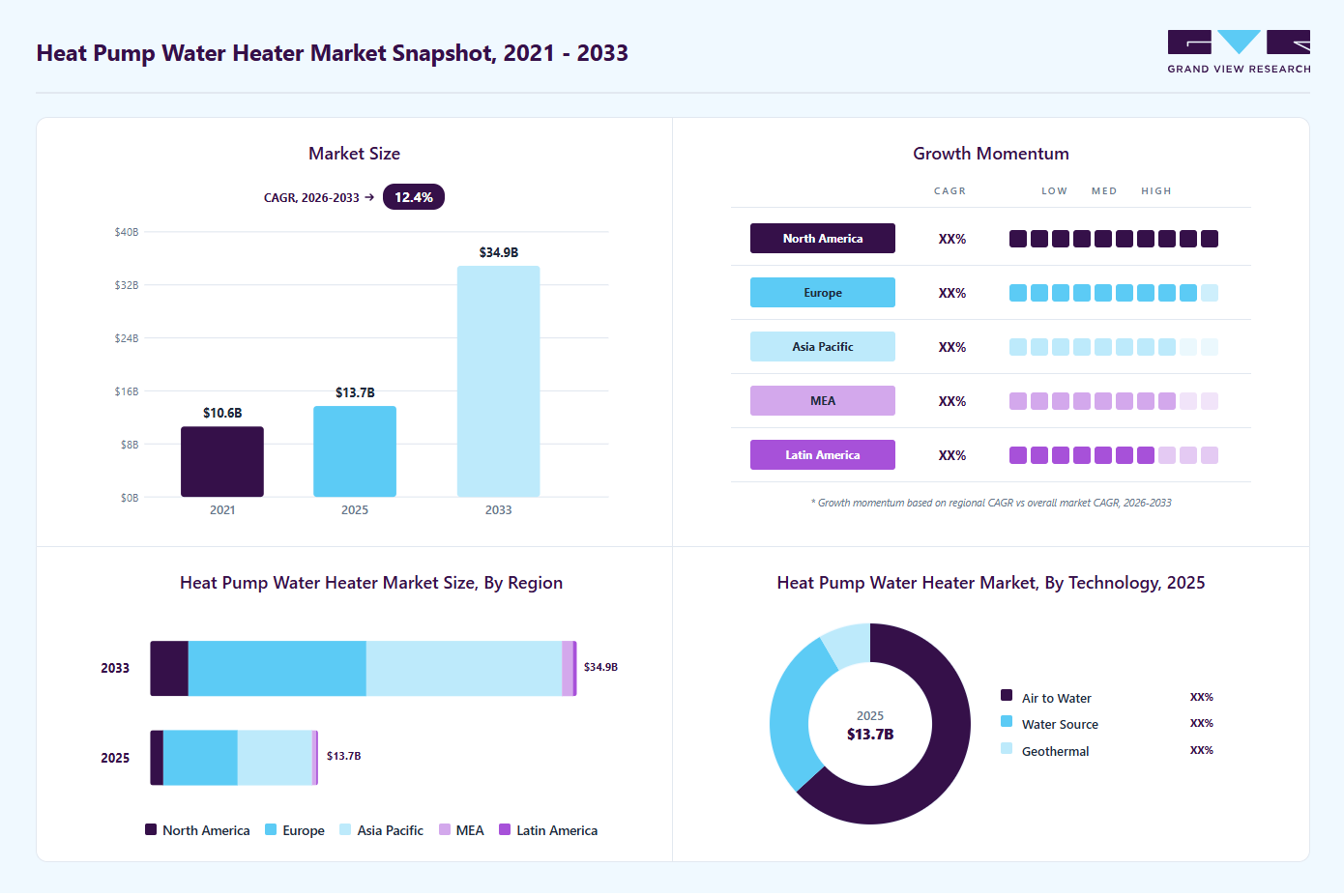
The heat pump water heater market is gaining momentum as households, businesses, and institutions increasingly seek efficient alternatives to conventional water heating systems. Rising energy costs, sustainability goals, technological improvements, and supportive incentives are encouraging greater adoption of heat pump water heaters across residential, commercial, and industrial applications.
Key Market Statistics
- Market size, 2025: USD 13.7 billion
- Estimated market size, 2026: USD 15.4 billion
- Projected market size, 2033: USD 34.9 billion
- CAGR, 2026–2033: 12.4%
- Largest regional share, 2025: 44.4%
Market Drivers & Restraints
· Energy Efficiency & Sustainability:
Demand for energy-efficient and environmentally friendly water heating solutions is a major growth driver. Heat pump water heaters transfer heat from surrounding air or other sources instead of generating heat directly, helping reduce energy consumption compared with conventional electric or gas water heaters. Growing attention to carbon emission reduction is further strengthening interest in these systems.
· Government Incentives:
Government incentives, rebates, tax credits, energy-efficiency programs, and sustainability initiatives are improving the attractiveness of heat pump water heaters. Such measures can help reduce the financial burden associated with adoption while supporting broader electrification and energy-efficiency objectives.
· High Initial Costs:
Higher equipment and installation expenses remain a significant restraint. Heat pump water heaters require advanced components such as compressors, heat exchangers, and control systems. Installation can also require additional space, ventilation adjustments, or electrical upgrades. These factors may discourage price-sensitive consumers despite the potential for long-term energy savings.
Technology Adoption Strengthens Market Potential
Technological advancement is transforming the performance and usability of heat pump water heaters. Inverter-driven compressors, smart temperature controls, renewable-energy integration, and improved product designs are helping manufacturers deliver more efficient and convenient systems. Quieter operation, compact designs, and smart-home connectivity are also expanding the appeal of these products.
Air-to-water technology represented the leading technology segment in 2025, accounting for 63.2% of revenue. Its energy efficiency and ability to transfer heat from ambient air make it attractive for consumers seeking lower-energy and lower-carbon water heating solutions. The water-source segment is also expected to grow at a CAGR of 12.2% from 2026 to 2033.
Capacity and Operation Trends
The 51 to 100 kW capacity segment led the market in 2025 with a revenue share of 43.5%. These systems are particularly suited to mid-to-large commercial and industrial facilities with consistent hot water requirements, including hotels, hospitals, and large residential complexes.
Electric operation accounted for 75.1% of revenue in 2025. Electric heat pump water heaters are widely adopted because they use electricity to transfer heat rather than generate it directly. Meanwhile, the hybrid segment is expected to expand at a CAGR of 11.6% from 2026 to 2033, offering flexibility by combining heat pump technology with conventional heating elements.
Residential Demand Creates a Strong Growth Base
Residential applications represented more than 56% of market revenue in 2025. Homeowners are increasingly considering heat pump water heaters as a way to reduce energy consumption and utility expenses while supporting more sustainable household infrastructure.
The tank capacity landscape also shows strong demand for larger systems. Above 500 L capacity accounted for 38.4% of revenue in 2025, supported by demand from hotels, hospitals, factories, apartment buildings, and other facilities requiring substantial hot water volumes. The up to 150 L segment is projected to grow at a CAGR of 13.2% from 2026 to 2033, reflecting opportunities in residential applications.
Regional Market Momentum
Europe held the largest market share at 44.4% in 2025, supported by environmental regulations, government incentives, energy-saving priorities, and growing consumer interest in efficient heating technologies. Germany held the largest country-level market share in 2025.
Asia Pacific also represented a substantial 44.2% revenue share in 2025, with economic growth, urbanization, expanding middle-class populations, and stricter energy-efficiency standards supporting adoption.
Energy-as-a-Service Models Are Accelerating Smarter Energy Adoption
- Energy As A Service (EaaS) Market: The growing adoption of service-based energy models is helping businesses improve energy efficiency, integrate renewable sources, and use AI and IoT for real-time energy optimization.
- Energy As A Service Market: Energy-as-a-service models are enabling organizations to adopt energy-efficient technologies with reduced upfront investment while shifting toward performance-based solutions that combine infrastructure, maintenance, and ongoing optimization.
FAQ
1. What trends are shaping the heat pump water heater market?
Major trends include increasing demand for energy-efficient appliances, smart-home integration, inverter-driven compressors, renewable-energy integration, quieter and more compact product designs, and greater adoption of air-to-water technology.
2. Which segment leads the heat pump water heater market?
Air-to-water technology led the technology segment with a 63.2% revenue share in 2025, while electric operation accounted for 75.1% and residential applications represented more than 56% of revenue.
Key Heat Pump Water Heater Companies:
· EcoTech Solutions
· Ariston Group
· Arctic Heat Pumps
· Carrier
About us:
Grand View Research, a market research and consulting company, provides syndicated research reports, customized research reports, and consulting services. Grand View Research database is used by the world's renowned academic institutions and Fortune 500 companies to understand the global and regional business environment. Our database features thousands of statistics and in-depth analysis on 46 industries in 25 major countries worldwide.

 English
 Arabic
 French
 Spanish
 Portuguese
 Turkish
 Dutch
Dutch
 Italiano
 Russian
 Romaian
 Portuguese (Brazil)
 Greek
Greek