


Why Telematics and IoT Matter for the Future of Ground Support Equipment
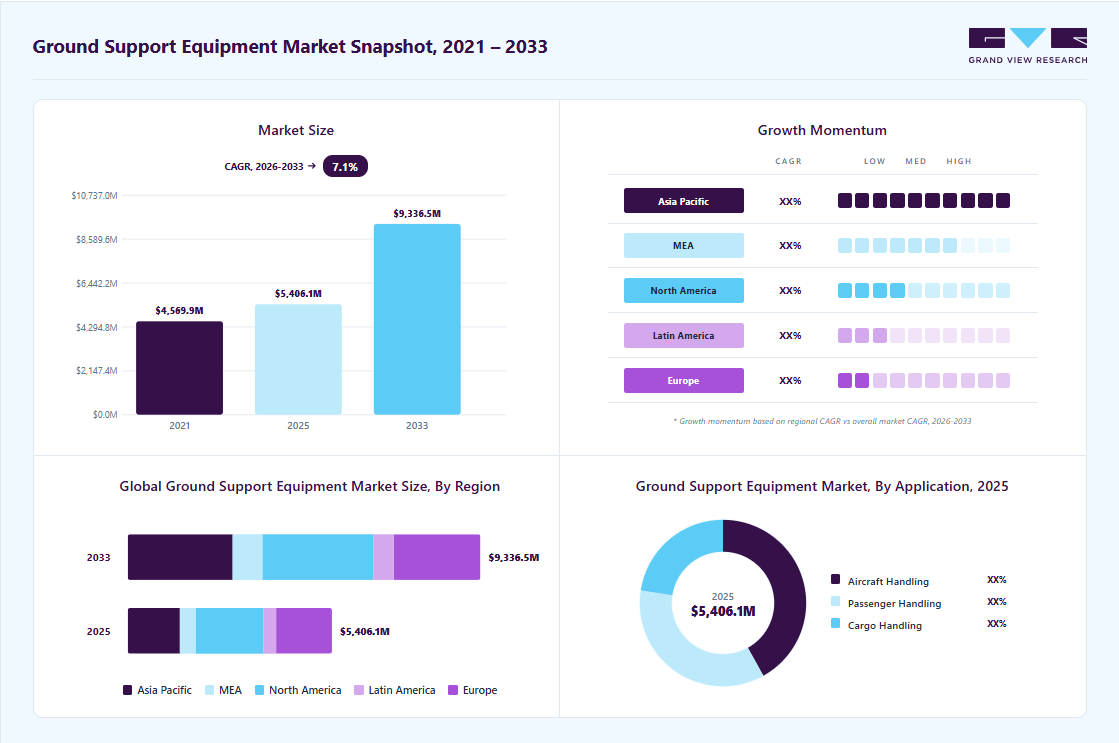
The ground support equipment market is becoming increasingly important as airports, airlines, and ground handling providers seek faster, safer, cleaner, and more efficient aircraft turnaround operations. The market was valued at USD 5.4 billion in 2025 and is projected to grow from USD 5.8 billion in 2026 to USD 9.3 billion by 2033, advancing at a CAGR of 7.1% from 2026 to 2033. North America held the largest share of 33.0% in 2025, while Asia Pacific is expected to record the fastest growth during the forecast period.
Market Breakdown at a Glance
The non-electric segment remained the largest equipment category, accounting for 64.0% of revenue in 2025. Its continued presence is supported by high-load and mission-critical operations, compatibility with existing airport infrastructure, and its ability to operate where charging infrastructure remains limited. However, electric GSE is gaining momentum and is expected to register a CAGR of 10.6% from 2026 to 2033 as airports invest in charging infrastructure and energy-management systems.
Aircraft handling represented the leading application, accounting for 41.0% of revenue in 2025. Its position reflects the importance of towing, refueling, ground power, and other equipment used to maintain efficient aircraft turnaround. Passenger handling is expected to record the fastest CAGR from 2026 to 2033 as airports adopt digitally enabled passenger processing, automated flow management, biometric systems, and intelligent queue optimization.
Airport-owned equipment led the ownership category with a 38.0% share in 2025. Leased equipment is expected to grow faster as airlines and ground handling companies increasingly seek flexible procurement models, reduced capital commitments, and access to maintenance and technology services.
Core Growth Drivers
· The Green Electrification Wave: Sustainability is becoming a major force behind GSE modernization. Airports and airlines are increasingly deploying electric and hybrid equipment to reduce emissions, fuel dependence, and maintenance costs. High-capacity charging systems, smart charging networks, renewable-energy integration, and improved battery technologies are supporting the transition toward cleaner airport operations.
Electric GSE is also becoming more practical as lithium-ion and next-generation solid-state battery technologies improve charging speed, reliability, and operating performance. This is encouraging operators to evaluate equipment based not only on acquisition price but also on total cost of ownership and lifecycle efficiency.
· Ramp Digitalization and Telematics: Connected GSE is transforming airport ground operations by providing real-time information about equipment location, performance, utilization, and maintenance requirements. Telematics, IoT sensors, and edge computing can support predictive maintenance and help operators identify potential problems before they lead to equipment downtime.
Cloud-based ground operations management platforms are also enabling centralized fleet coordination. These systems can help optimize equipment dispatching, workforce coordination, and turnaround activities, creating greater operational visibility across busy airport environments.
· GSE Pooling and Leases: Flexible ownership models are gaining attention as operators look for ways to modernize fleets without making large long-term capital investments. Leasing allows companies to scale equipment capacity according to seasonal demand, special events, or operational requirements. Service providers are increasingly offering bundled maintenance, upgrades, and technology integration, making equipment-as-a-service models more attractive.
· Skyrocketing Infrastructure Spending: Airport modernization and the expansion of aviation infrastructure are supporting demand for advanced GSE. Growing passenger traffic and cargo operations are increasing pressure on airports to improve turnaround efficiency and reduce operational bottlenecks. Dedicated air cargo terminals are also creating demand for high-capacity loaders, automated pallet handling systems, and temperature-controlled support equipment.
Key Segment Insights
The commercial end-use segment held the largest market share in 2025, supported by expanding airline networks and increasing flight frequencies. Airports and airlines are investing in efficient ramp support systems and integrated ground handling platforms to improve reliability and reduce turnaround delays. The defense segment is expected to witness significant growth as military organizations modernize airbase logistics and require ruggedized, mobile equipment for mission-ready operations.
The market is also moving toward modular and multifunctional equipment. Manufacturers are developing flexible configurations that can accommodate different aircraft types and changing airport layouts. Such adaptability can help airports maximize asset utilization while controlling maintenance and replacement costs.
Regional Highlights
North America dominated the market with a 33.0% revenue share in 2025. Strong airport modernization activity, high-traffic aviation hubs, advanced fleet analytics, predictive maintenance, and growing adoption of connected GSE are supporting demand. The expansion of e-commerce-driven air cargo networks is creating further requirements for specialized handling equipment.
Asia Pacific is expected to register the highest CAGR of 9.2% in 2025, supported by the emergence of secondary and regional airports, increasing demand for cost-efficient equipment, leasing and rental models, and greater adoption of digital fleet-coordination platforms. Robotics, automation, AI-driven scheduling, and smart airport initiatives are also creating new opportunities.
Europe is expected to grow at a CAGR of 5.7% from 2026 to 2033, with circular-economy practices, asset refurbishment, modular GSE, digital twins, and simulation-based airport planning contributing to market development.
Key Ground Support Equipment Companies:
· Oshkosh Aerotech LLC
· Textron Inc.
· TCR Group
· Tronair
About us:
Grand View Research, a market research and consulting company, provides syndicated research reports, customized research reports, and consulting services. Grand View Research database is used by the world's renowned academic institutions and Fortune 500 companies to understand the global and regional business environment. Our database features thousands of statistics and in-depth analysis on 46 industries in 25 major countries worldwide.

 English
 Arabic
 French
 Spanish
 Portuguese
 Deutsch
 Turkish
 Dutch
Dutch
 Italiano
 Romaian
 Portuguese (Brazil)
 Greek
Greek