


Ride-Hailing Service Market Size to Reach USD 398.4 Billion by 2034, Growing at 7.34% CAGR
Market Overview
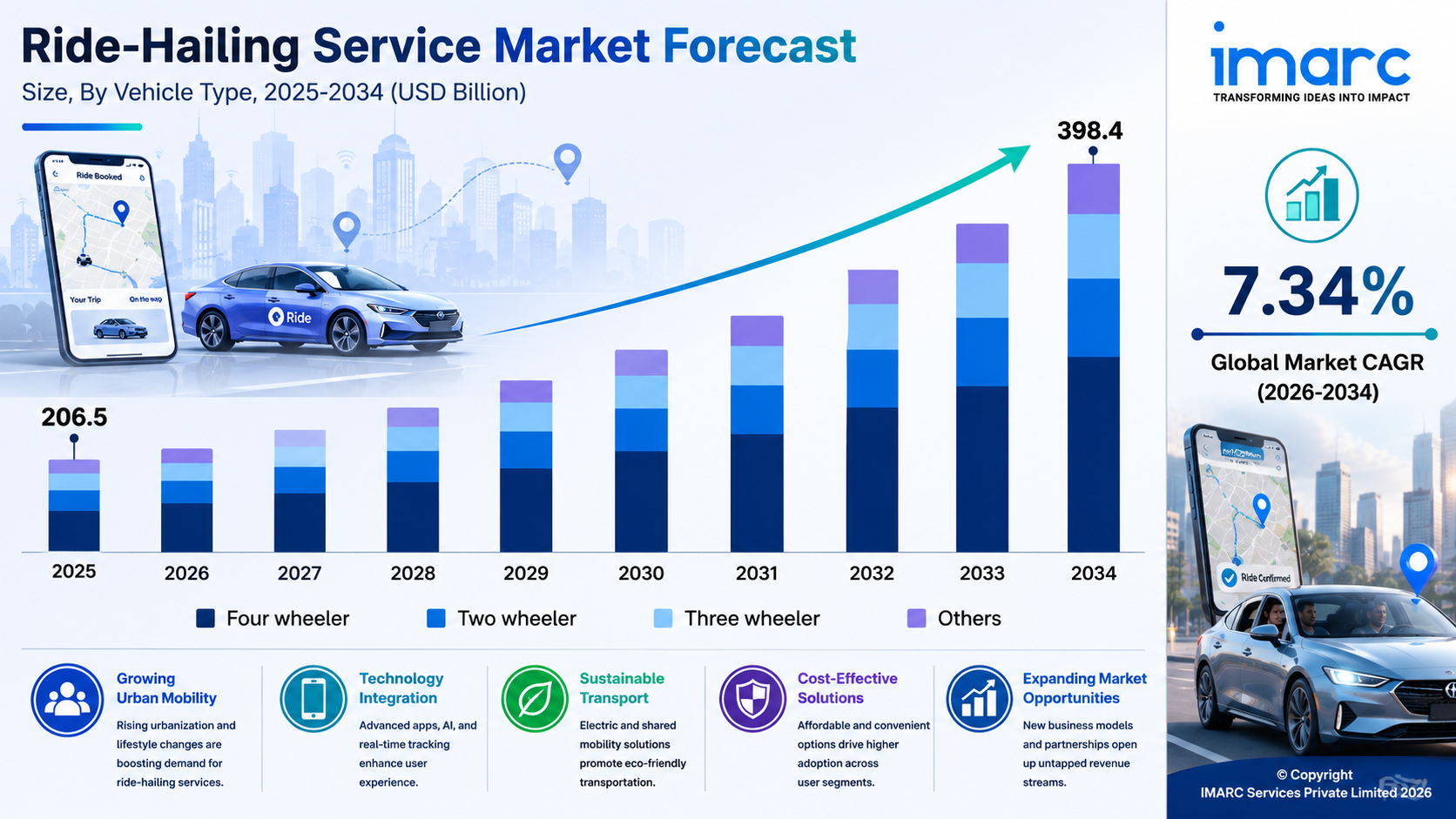
The global ride-hailing service market size was valued at USD 206.5 Billion in 2025. Looking forward, IMARC Group estimates the market to reach USD 398.4 Billion by 2034, exhibiting a growth rate (CAGR) of 7.34% during 2026-2034. Asia Pacific currently dominates the market, holding a market share of over 35.0% in 2025. Market growth is primarily driven by rapid urbanization, increasing smartphone penetration, rising disposable income, convenience and affordability, growing traffic congestion concerns, digital payment adoption, rising demand for shared mobility, fuel cost fluctuations, supportive government policies, sustainability initiatives, AI-driven route optimization, enhanced safety features, and the expansion of electric and autonomous vehicles.
Ride-Hailing Service Market Report: Key Highlights
-
Market Size & Growth: The global ride-hailing service market share was valued at USD 206.5 Billion in 2025 and is projected to reach USD 398.4 Billion by 2034, expanding at a CAGR of 7.34% during 2026-2034.
-
Regional Leadership: Asia Pacific leads the global market with a 35.0% share in 2025, supported by rapid urbanization, high smartphone penetration, growing disposable income, and expanding digital infrastructure.
-
Major Market Drivers: Increasing demand for convenient and cost-effective transportation, urban traffic congestion, smartphone adoption, digital payments, shared mobility, and growing EV adoption are supporting market expansion.
-
Key Market Trends: Strategic partnerships and collaborations, technological advancements, AI-driven route optimization, digital payment integration, electric mobility, autonomous vehicles, and sustainability initiatives are shaping the market.
-
Vehicle Type: Four-wheelers represent the largest segment, accounting for 67.5% of the market, supported by their comfort, safety, seating capacity, and suitability for daily commuting and business travel.
-
Service Type: E-hailing dominates the service type segment with a 58.5% share, driven by convenience, affordability, real-time ride matching, GPS tracking, and digital integration.
-
Payment Method: Online payments account for the majority of the market with a 67.5% share, supported by smartphone adoption, e-wallets, fintech solutions, and cashless transactions.
-
Location Type: Urban areas dominate the market with an 84.8% share due to high population density, traffic congestion, digital infrastructure, and demand for shared mobility.
-
Key Challenges: Regulatory issues, labor classification concerns, safety standards, driver retention, fluctuating fuel prices, and intense competition remain important challenges.
-
Emerging Opportunities: Growing adoption of electric and autonomous vehicles, corporate partnerships, public transit integration, subscription-based services, and multi-modal mobility solutions are creating new opportunities.
Request for a Sample Report for Detailed Evaluation: https://www.imarcgroup.com/ride-hailing-service-market/requestsample
What Is Driving Ride-Hailing Service Market Growth in 2026?
Rising Demand for Convenient and Cost-Effective Transportation
One of the major factors driving the ride-hailing service market is the growing demand for convenient, affordable, and flexible transportation solutions. Rapid urbanization and increasing traffic congestion are encouraging consumers to seek alternatives to traditional taxis and personal vehicles.
Ride-hailing platforms offer convenient app-based booking, real-time tracking, transparent pricing, and a broad range of vehicle options, enhancing the overall user experience. Younger consumers and professionals are increasingly favoring on-demand mobility solutions over car ownership, further supporting market expansion.
The integration of AI-based route optimization and dynamic pricing models is also improving operational efficiency and service availability. Furthermore, expanding internet connectivity and smartphone adoption are facilitating the widespread adoption of ride-hailing services across developed and emerging markets.
Increasing Smartphone Penetration and Digital Payment Adoption
The increasing penetration of smartphones and digital technologies is significantly contributing to ride-hailing market growth. Mobile applications allow consumers to request rides, track drivers, estimate fares, make cashless payments, and access multiple mobility options from a single platform.
The growing adoption of e-wallets and fintech solutions is accelerating the transition toward cashless ride-hailing transactions. In addition, loyalty programs, ride subscriptions, and corporate payment solutions are strengthening customer engagement and retention.
As digital infrastructure continues to expand, ride-hailing platforms are gaining greater accessibility across urban and semi-urban markets.
Growing Urbanization and Traffic Congestion
Accelerating urbanization is creating substantial demand for efficient transportation solutions. According to the United Nations, approximately 55% of the global population lives in cities, and this figure is expected to reach 68% by 2050.
The growing concentration of populations in urban areas is increasing traffic congestion and creating demand for convenient alternatives to private vehicle ownership. Ride-hailing services provide flexible transportation solutions that can help consumers navigate congested cities while offering convenient access to different vehicle categories.
As urban populations continue to expand, ride-hailing services are expected to become increasingly integrated into the broader urban mobility ecosystem.
Ride-Hailing Service Market Trends
Strategic Partnerships and Collaborations
Strategic partnerships and alliances are becoming increasingly important in the global ride-hailing service market as companies seek to improve service delivery, expand coverage, and enhance customer experience.
For instance, in April 2021, Gett partnered with Curb to improve post-pandemic business travel by providing corporate customers with access to services ranging from limousine and local taxi options to ride-hailing services such as Lyft. The partnership was designed to improve the convenience of business travel and respond to changing customer requirements.
Similarly, in June 2021, Hyundai Motor Group and Grab Holdings Inc. formed a strategic alliance aimed at accelerating electric vehicle adoption in Southeast Asia. The initiative focused on reducing barriers to EV adoption by lowering overall ownership costs and addressing range anxiety.
These partnerships demonstrate the increasing focus on integrated mobility solutions, sustainability, and cleaner transportation options.
Technological Advancements and Innovations
The ride-hailing services market is experiencing significant technological advancement through the adoption of mobile applications, GPS-enabled navigation, AI-based algorithms, and automated systems. These technologies are improving booking convenience, route optimization, service reliability, and operational efficiency.
The growing adoption of electric vehicles and autonomous cars is further transforming the market by creating opportunities to reduce operating costs and environmental impacts.
For instance, in November 2022, Motional and Lyft launched self-driving electric robotaxis in Los Angeles, marking an important development in autonomous and sustainable ride-hailing services. In December 2023, BluSmart raised USD 24 Million to scale its electric ride-hailing business through the construction of large-scale charging superhubs.
Growing Adoption of Electric and Autonomous Vehicles
The expansion of electric and autonomous vehicles is emerging as a significant trend in the ride-hailing industry. EVs can help ride-hailing operators address sustainability objectives while potentially reducing operating expenses.
Autonomous driving technology is also opening new possibilities for the industry by enabling self-driving ride-hailing services. The development and commercialization of autonomous mobility solutions are expected to encourage further innovation and competition across the global market.
Ride-Hailing Service Market Segmentation Analysis
IMARC Group provides an analysis of the key trends in each segment of the global ride-hailing service market, along with forecasts at the global, regional, and country levels from 2026-2034. The market has been categorized based on vehicle type, service type, payment method, location type, and end user.
By Vehicle Type
-
Two-wheeler
-
Three-wheeler
-
Four-wheeler
-
Others
Four-wheelers dominate the ride-hailing market, accounting for 67.5% of the total share. Their dominance is supported by superior comfort, safety, seating capacity, luggage space, and weather protection compared with two- and three-wheelers.
Consumers increasingly prefer four-wheelers for daily commuting, business travel, airport transfers, and family transportation. The availability of economy, premium, and shared ride categories allows platforms to meet diverse consumer preferences.
Corporate partnerships and airport transportation services are also supporting demand. Meanwhile, the increasing deployment of electric and hybrid vehicles within four-wheeler fleets is helping operators pursue sustainability objectives while reducing operating costs.
Growing urbanization, rising disposable income, real-time tracking, and digital payment features are further strengthening the position of four-wheelers in the ride-hailing market.
By Service Type
-
E-hailing
-
Car Sharing
-
Car Rental
-
Others
E-hailing holds the largest market share at 58.5%, driven by its convenience, affordability, and seamless digital integration.
App-based platforms provide real-time ride matching, GPS tracking, dynamic pricing, and convenient digital payments. Increasing smartphone penetration and digital payment adoption are further accelerating the use of e-hailing services, particularly in urban areas.
Consumers increasingly prefer on-demand mobility solutions because of transparent pricing, shorter response times, and flexible ride options. AI-based route optimization can further reduce waiting times and fuel consumption.
Corporate mobility partnerships, public transit integration, and the increasing availability of electric and shared mobility options are also contributing to continued e-hailing expansion.
By Payment Method
-
Cash
-
Online
Online payments account for the majority of the market with a 67.5% share, supported by widespread smartphone adoption, app-based booking systems, and integrated digital payment solutions.
The ability to request rides instantly, track drivers in real time, and receive transparent fare information is encouraging consumers to use digital payment methods. E-wallets and fintech solutions are accelerating the transition away from cash transactions.
Loyalty programs, ride subscriptions, corporate tie-ups, and expanding internet connectivity are further supporting online ride-hailing adoption. The emergence of super apps integrating multiple mobility services is also strengthening consumer reliance on digital platforms.
By Location Type
-
Urban
-
Rural
Urban areas dominate the ride-hailing market with an 84.8% share, primarily due to high population density, traffic congestion, and strong demand for shared mobility solutions.
The convenience of app-based transportation and declining car ownership among younger demographics are supporting ride-hailing adoption in cities. Urban markets generally have well-developed digital infrastructure, enabling seamless bookings, cashless payments, real-time tracking, and AI-based route optimization.
Corporate employee transportation, last-mile connectivity, and demand for alternatives to public transit are further supporting market expansion. Investments in electric and autonomous ride-hailing services are also aligning with urban sustainability initiatives aimed at reducing emissions and congestion.
By End User
-
Personal
-
Commercial
Personal users dominate the ride-hailing market as individuals increasingly seek convenient, cost-effective, and flexible alternatives to private vehicle ownership. Urban residents, tourists, and daily commuters rely on ride-hailing platforms for short-distance and routine transportation.
Features such as app-based bookings, real-time tracking, digital payments, and multiple vehicle categories are further improving convenience and supporting demand.
The commercial segment is expanding as businesses increasingly use ride-hailing platforms for employee transportation, corporate travel, and logistics. Companies can utilize ride-hailing services as cost-efficient mobility solutions while reducing fleet maintenance requirements.
Corporate partnerships, food delivery services, and e-commerce integration are further supporting commercial applications and improving operational efficiency.
By Region
-
North America
-
United States
-
Canada
-
-
Europe
-
Germany
-
France
-
United Kingdom
-
Italy
-
Spain
-
Russia
-
Others
-
-
Asia Pacific
-
China
-
Japan
-
India
-
South Korea
-
Australia
-
Indonesia
-
Others
-
-
Latin America
-
Brazil
-
Mexico
-
Others
-
-
Middle East and Africa
Asia Pacific leads the global ride-hailing service market with a 35.0% share, supported by rapid urbanization, high smartphone penetration, and growing disposable income among the middle-class population.
Countries such as China, India, and Southeast Asian nations have densely populated metropolitan areas where ride-hailing services offer affordable and efficient alternatives to private transportation. The presence of major regional platforms such as Didi, Ola, and Grab, along with aggressive expansion strategies, is supporting market growth.
Government initiatives promoting smart mobility and digital payment adoption are further enhancing service accessibility. Rising fuel prices and traffic congestion are also encouraging consumers to consider ride-hailing instead of private vehicle ownership.
The integration of electric and shared mobility solutions, corporate collaborations, and food delivery services is further strengthening ride-hailing expansion across Asia's urban and semi-urban markets.
Key Regional Takeaways
North America Ride-Hailing Service Market Analysis
The North American ride-hailing service market is driven by advanced digital infrastructure, high smartphone penetration, and strong consumer demand for convenient mobility solutions. Urban congestion and declining car ownership among younger demographics are contributing to market expansion.
The region is witnessing widespread adoption of AI-driven route optimization, dynamic pricing, seamless digital payment systems, and real-time tracking. These technologies are enhancing the customer experience and operational efficiency of ride-hailing platforms.
Regulatory challenges, including driver labor classification laws and safety standards, remain important considerations. However, strategic partnerships with corporate organizations, airports, and public transit systems are strengthening service accessibility.
The increasing adoption of electric and autonomous vehicles is also supporting sustainability initiatives. Demand for shared mobility, subscription-based services, and multi-modal transportation solutions is contributing to sustained market development.
United States Ride-Hailing Service Market Analysis
The United States ride-hailing market is driven by urbanization, consumer demand, strong digital infrastructure, and technological development. The market holds an 87.20% share according to the provided market analysis.
According to the Center for Sustainable Systems, nearly 89% of the U.S. population is expected to be urban by 2050, which is expected to increase demand for flexible and efficient transportation solutions.
Major platforms such as Uber and Lyft provide extensive coverage and diverse ride categories, including shared and premium services. Consumer spending data for March 2024 indicated that rideshare sales were increasing, with Uber sales rising 10% year-over-year and Lyft sales increasing 3% year-over-year.
The growing adoption of electric vehicles and the development of autonomous driving technology are expected to create additional opportunities. Corporate partnerships and integration with public transportation systems are also contributing to market expansion across U.S. cities and suburbs.
Europe Ride-Hailing Service Market Analysis
The European ride-hailing market is expanding amid increasing emphasis on sustainability and electric vehicle adoption. Governments and consumers are increasingly focused on reducing carbon emissions and improving the environmental performance of transportation.
Uber has set an objective of making every vehicle operating on its platform in London electric by 2025 and introduced the Uber Clean Air Plan to support drivers transitioning toward electric vehicles.
Increasing urbanization is further generating demand for convenient and cost-effective transportation. Stricter environmental regulations are expected to encourage ride-hailing companies to increase EV adoption within their fleets, making sustainability an important market driver across Europe.
Asia Pacific Ride-Hailing Service Market Analysis
The Asia Pacific ride-hailing industry is expanding rapidly due to urbanization, population growth, technological advancements, and government support for digital mobility solutions.
The integration of ride-hailing with public transportation is gaining importance. For instance, in November 2023, Uber partnered with the Transport Department of the Government of West Bengal to introduce a bus shuttle service in Kolkata.
In December 2023, the Karnataka government also planned to launch its own ride-hailing application, reflecting increasing competition and localization within the market.
Growing adoption of electric and autonomous vehicles is creating additional opportunities by supporting sustainability and potentially reducing operational costs. Government regulation and continued innovation in mobile technology are expected to remain important contributors to regional growth.
Latin America Ride-Hailing Service Market Analysis
The Latin American ride-hailing market is steadily expanding, with Brazil representing an important market. The regional market is supported by increasing smartphone and application adoption, rising internet penetration, and consumer demand for affordable and convenient transportation.
Brazil's large urban population and growing transportation requirements are creating favorable conditions for ride-hailing services. Sustainability and technological innovation are also influencing the market's development.
The increasing deployment of electric vehicles in ride-hailing fleets is creating opportunities for companies seeking to reduce operating costs and improve environmental performance. Government incentives for electric mobility and shared transportation initiatives are further supporting regional development.
Middle East and Africa Ride-Hailing Service Market Analysis
The Middle East and Africa ride-hailing market is benefiting from technological advancement, urbanization, and increasing smartphone connectivity. The region is expected to add nearly 200 million smartphone connections over a five-year period, reaching approximately 565 million by the end of 2025.
Increasing smartphone connectivity is facilitating greater access to app-based ride-hailing services. Urbanization in major cities is also increasing demand for affordable and convenient transportation solutions.
The increasing adoption of electric and autonomous vehicles represents an emerging opportunity, while government initiatives focused on competition and safety are contributing to a supportive environment for the development of ride-hailing services.
Competitive Landscape in the Ride-Hailing Service Industry
The global ride-hailing market is highly competitive, with companies focusing on technological innovation, service diversification, geographic expansion, and strategic partnerships to strengthen their positions.
Market participants are enhancing user experience through AI-driven route optimization, dynamic pricing, real-time tracking, and seamless payment integration. Loyalty programs, ride subscriptions, and multi-modal transportation services are also being introduced to improve customer retention.
Companies are increasingly investing in electric and autonomous vehicles to reduce operating costs and meet sustainability objectives. Partnerships with public transit systems, corporate organizations, airports, food delivery providers, and logistics companies are further strengthening market positioning.
At the same time, regulatory requirements, driver retention, fluctuating fuel prices, and intense competition are influencing market dynamics. Regional players continue to leverage localized strategies, while global platforms expand their presence across urban and semi-urban markets.
Key Ride-Hailing Service Market Players Include
-
Aptiv PLC
-
Be Group JSC
-
BlaBlaCar
-
Bolt Technology OÜ
-
FREE NOW
-
Gett
-
Grab
-
InDriver
-
Lyft Inc.
-
Ola Cabs
-
Ridecell Inc.
-
TomTom N.V.
-
Uber Technologies Inc.
Recent Developments
-
In April 2024, the government of Japan formally approved the use of private ride-hailing services, including services accessible through mobile applications such as Uber and Go.
-
In March 2024, Alphabet's autonomous driving division, Waymo, launched its ride-hailing service, Waymo One, in Los Angeles, California. The service was initially made available to the public at no cost following the successful completion of the Waymo One Tour program.
-
In December 2023, BluSmart, an electric mobility company, raised USD 24 Million in its latest fundraising round. The funds were intended to support the construction of large-scale charging superhubs and the expansion of its electric ride-hailing business.
-
In May 2023, Uber announced an agreement with fleet operators including Lithium, Everest, and Moove to launch 25,000 electric cars for the Indian market. The company also announced plans to launch 10,000 electric two-wheelers in Delhi by the end of 2024 in collaboration with EV startup Zypp Electric.
About the Author
IMARC Group is a leading global market research company providing data-driven insights and strategic consulting services across diverse industries. The company delivers comprehensive research reports covering automotive, technology, healthcare, chemicals, packaging, food & beverages, consumer goods, and industrial sectors, helping organizations make informed business decisions and identify emerging growth opportunities.
Media & Sales Contact
IMARC Group
United States: +1-201-971-6302
India: +91-120-433-0800
United Kingdom: +44-753-714-6104

 English
 Arabic
 French
 Spanish
 Portuguese
 Deutsch
 Turkish
 Italiano
 Russian
 Romaian
 Portuguese (Brazil)
 Greek
Greek