


Global Aircraft De-Icing Market Size to Reach USD 2.1 Billion by 2034, Growing at 4.14% CAGR
Market Overview
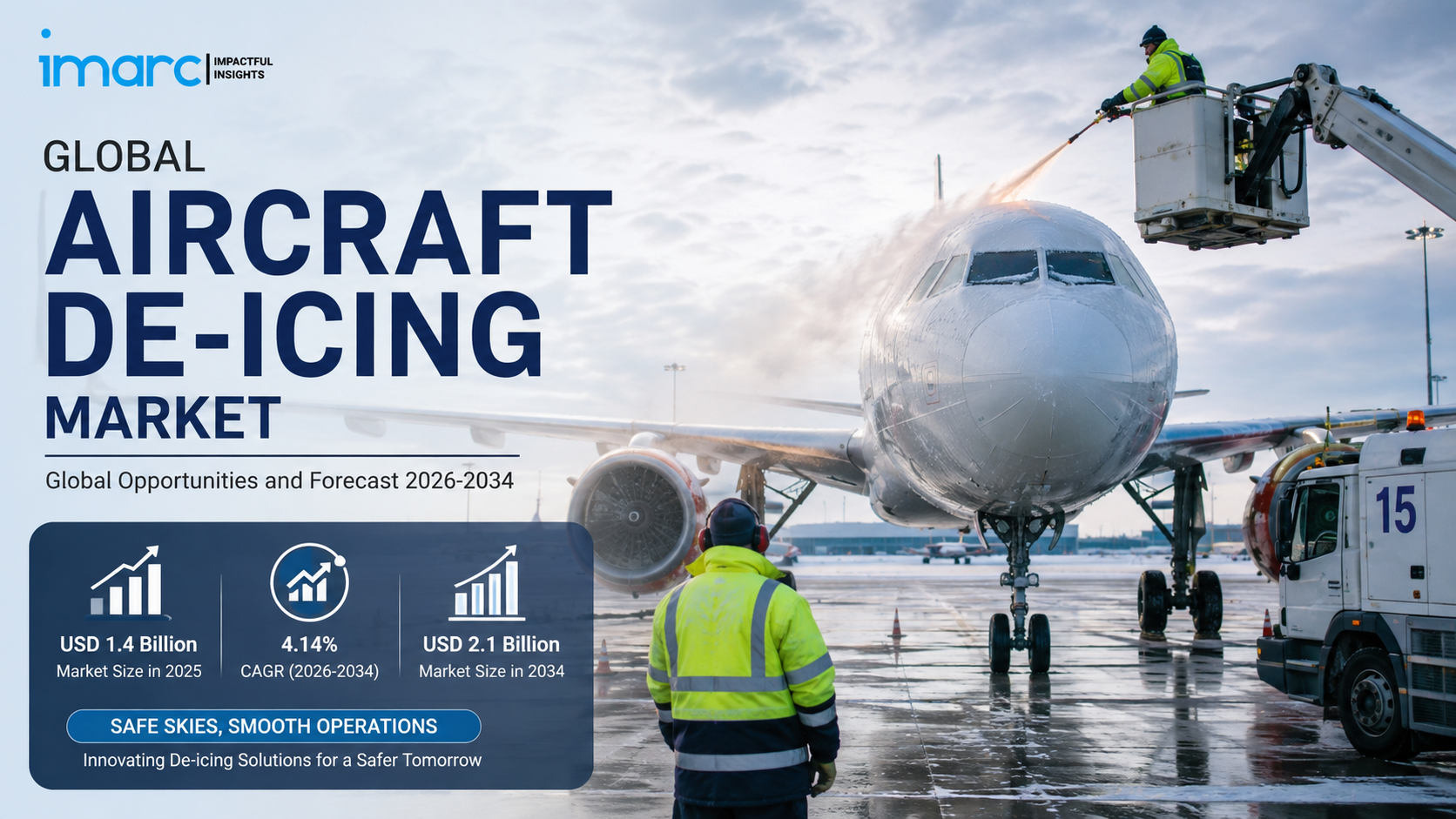
The global aircraft de-icing market size reached USD 1.4 Billion in 2025. Looking forward, IMARC Group expects the market to reach USD 2.1 Billion by 2034, exhibiting a growth rate (CAGR) of 4.14% during 2026-2034. The growing need for safe and efficient winter operations in aviation, innovations in de-icing technology, implementation of stringent safety regulations, and rising construction of airports in colder regions are some of the factors impelling market growth.
Aircraft De-Icing Market Key At a Glance
-
Base Year: 2025
-
Historical Years: 2020–2025
-
Forecast Years: 2026–2034
-
Market Size (2025): USD 1.4 Billion
-
Market Forecast (2034): USD 2.1 Billion
-
CAGR (2026–2034): 4.14%
-
Leading Region: North America
Aircraft De-Icing Market Report: Key Highlights
-
Market Size & Growth: The global aircraft de-icing market share reached USD 1.4 Billion in 2025 and is projected to reach USD 2.1 Billion by 2034, registering a CAGR of 4.14% during 2026-2034.
-
Major Market Drivers: Increasing implementation of stringent regulatory frameworks for aircraft safety during severe weather conditions and rising investments in airport infrastructure are supporting market growth.
-
Key Market Trends: Growing adoption of environment-friendly de-icing fluids and technologies, automated de-icing systems, and Internet of Things (IoT)-enabled monitoring and operational solutions are shaping the market.
-
Regional Leadership: North America dominates the market owing to its extensive airline network, harsh winter weather conditions, robust de-icing infrastructure, and high air traffic volumes.
-
By Fluid Type: The market is segmented into Type I, Type II, Type III, and Type IV, with Type I accounting for the largest share.
-
By Application: The market is divided into military and commercial applications, with commercial representing the dominant segment.
-
By Equipment: The market includes de-icing trucks, sweepers, and others, with de-icing trucks representing the leading segment.
-
Key Challenges: High costs associated with advanced de-icing technologies and the need for continuous innovation to comply with evolving regulatory standards are influencing market growth.
-
Emerging Opportunities: Development of more efficient and environmentally friendly de-icing methods and expansion into emerging markets with increasing air travel are creating new opportunities.
Request For a Sample: https://www.imarcgroup.com/aircraft-de-icing-market
What Is Driving Aircraft De-Icing Market Growth in 2026?
Increasing Need for Safe Winter Aviation Operations
The growing need to ensure safe and efficient aircraft operations during winter weather conditions represents one of the major factors driving market growth. Ice and frost accumulation on aircraft surfaces can affect flight safety and operational efficiency, making effective de-icing procedures essential at airports experiencing severe winter conditions.
Airlines and airports are therefore investing in advanced de-icing systems, equipment, and fluids to minimize weather-related disruptions while maintaining aircraft safety. The increasing focus on operational reliability during winter months is strengthening demand for aircraft de-icing solutions.
Implementation of Stringent Aviation Safety Regulations
The increasing implementation of stringent regulatory frameworks for aircraft safety during severe weather conditions is supporting market expansion. Aviation authorities and airport operators are emphasizing compliance with safety requirements designed to minimize risks associated with ice accumulation on aircraft.
These regulations are encouraging airlines and airports to adopt reliable and technologically advanced de-icing solutions. The need to comply with safety standards while maintaining efficient flight operations is expected to continue supporting demand for de-icing equipment and services.
Rising Investments in Airport Infrastructure
Increasing investments in airport infrastructure are also contributing to market growth. The development and expansion of airports, particularly in regions exposed to cold and snowy weather, are creating demand for dedicated winter-operation infrastructure.
As airports expand their capacity and airlines increase flight volumes, the need for efficient de-icing operations becomes increasingly important. Investments in advanced equipment and infrastructure are helping airports improve turnaround times, reduce weather-related delays, and maintain operational continuity.
Aircraft De-Icing Market Trends
Technological Advancements in De-Icing Methods
The development of innovative de-icing systems that reduce or eliminate the need for conventional chemical solutions represents a notable market trend. New technologies are being developed to remove ice using alternative methods, including high-frequency electric currents.
These systems can reduce reliance on traditional chemical de-icers, which may create environmental and logistical challenges. On December 5, 2023, Boston-based De-Ice™ disclosed that Air Canada would be the inaugural airline to implement its chemical-free de-icing solutions on Airbus A320 aircraft. The technology utilizes high-frequency electric current for de-icing and is designed to reduce winter departure delays and carbon emissions.
The development of these solutions is helping airlines improve operational efficiency while addressing environmental concerns. The transition toward innovative and eco-conscious de-icing technologies is consequently reshaping winter airport operations.
Improvements in Sustainable De-Icing Practices
Progress in sustainable de-icing practices is transforming the industry by emphasizing environmental responsibility while maintaining effective aircraft operations. Manufacturers and airport operators are developing environment-friendly de-icing fluids designed to decompose efficiently and reduce their impact on surrounding ecosystems.
Companies are also investing in more efficient de-icing equipment capable of delivering effective results with lower fluid consumption. Heated pavements and infrared de-icing systems are emerging as alternative approaches that can provide greener and more energy-efficient solutions compared with conventional chemical techniques.
In September 2023, Vilnius Airport began operating the first de-icing wastewater treatment plant in the Baltic States. The €2.9 million project, partially funded by the European Union (EU), was developed to improve sustainability by treating and reusing wastewater generated from aircraft de-icing operations.
Rising Frequency of Extreme Weather Events
The increasing frequency of extreme weather events associated with climate change is driving demand for aircraft de-icing solutions. More frequent and intense winter storms, heavy snowfall, and icy conditions are creating additional operational challenges for airlines and airports.
Airports and airlines are responding by investing in advanced de-icing technologies and equipment to address these conditions effectively. This trend is particularly important in areas where unpredictable winter weather can significantly affect flight schedules and operational continuity.
For instance, Canada experienced more than $3 billion in insured losses resulting from natural disasters and extreme weather events. According to Catastrophe Indices and Quantification Inc. (CatIQ), insured costs associated with extreme weather events exceeded $3.1 billion in 2023 nationally.
Aircraft De-Icing Market Segmentation Analysis
IMARC Group provides an analysis of the key aircraft de-icing market trends in each segment, along with forecasts at the global, regional, and country levels for 2026-2034. The market has been categorized based on fluid type, application, and equipment.
By Fluid Type
-
Type I
-
Type II
-
Type III
-
Type IV
Type I accounts for the majority of the market share.
The report provides a detailed breakup and analysis of the market based on fluid type, including Type I, Type II, Type III, and Type IV.
Type I
Type I represents the most prominent segment, largely because of its widespread use in removing ice and frost from aircraft surfaces before takeoff. This fluid contains a high concentration of glycol and has relatively low viscosity, making it effective for rapid de-icing during changing weather conditions.
Its affordability, simplicity, and quick results are major factors supporting its widespread use. Type I fluid is also compatible with various aircraft and can perform effectively across different temperature conditions, making it a leading product within the aircraft de-icing market.
By Application
-
Military
-
Commercial
Commercial holds the largest share of the industry.
The report provides a detailed breakup and analysis of the market based on application, covering military and commercial applications.
Commercial
The commercial segment dominates the market, driven by the extensive global network of commercial airlines and the large number of passenger and cargo flights operating worldwide.
The growing need for aircraft de-icing in regions experiencing severe winter weather is essential for maintaining flight safety and operational efficiency. Commercial airlines are making significant investments in advanced de-icing technologies and systems to reduce delays, improve passenger experiences, and comply with strict regulatory requirements.
Furthermore, the increasing focus on airport infrastructure development and the rising volume of flights are contributing to the commercial segment's market dominance.
Military
The military segment is supported by the need to maintain aircraft operational readiness and safety in challenging winter environments. Military aircraft operating in colder regions require effective de-icing solutions to ensure reliable performance and mission continuity.
The development of advanced aircraft technologies and the growing emphasis on operating aircraft under harsh weather conditions are supporting demand for specialized de-icing capabilities within the military sector.
By Equipment
-
De-Icing Trucks
-
Sweepers
-
Others
De-icing trucks represent the leading market segment.
The report provides a detailed breakup and analysis of the market based on equipment, including de-icing trucks, sweepers, and others.
De-Icing Trucks
De-icing trucks represent the largest segment because they play a crucial role in maintaining aircraft safety and operational efficiency during winter weather. These specially designed vehicles feature advanced spraying systems and heated fluid tanks that enable the rapid application of de-icing and anti-icing fluids to aircraft surfaces.
Their mobility and adaptability allow operators to service different aircraft across various areas of an airport, helping reduce turnaround times and maintain flight schedules. Their increasing adoption across large international airports and smaller regional hubs highlights their importance in modern airport operations.
On June 21, 2023, Equivu Capital Holdings introduced NextGen De-icing, which aimed to reduce winter operating expenses and flight interruptions for airlines by using less de-icing fluid and advanced equipment, including technologically enhanced de-icing trucks.
Sweepers
Sweepers represent another important category of aircraft de-icing equipment and are used as part of winter airport operations to help maintain suitable operating conditions. Their use supports efficient airport operations in areas affected by snow and ice accumulation.
Others
The others segment includes additional equipment and systems used to support aircraft de-icing operations. As airports increasingly adopt advanced technologies and integrated winter-operation solutions, demand for specialized equipment is expected to continue.
By Region
-
North America
-
United States
-
Canada
-
-
Asia Pacific
-
China
-
Japan
-
India
-
South Korea
-
Australia
-
Indonesia
-
Others
-
-
Europe
-
Germany
-
France
-
United Kingdom
-
Italy
-
Spain
-
Russia
-
Others
-
-
Latin America
-
Brazil
-
Mexico
-
Others
-
-
Middle East and Africa
North America currently dominates the global aircraft de-icing market, accounting for the largest market share. The region's leadership is primarily attributed to its extensive airline network and regular exposure to harsh winter weather conditions.
The presence of large international airports and high air traffic volumes creates a strong requirement for robust de-icing infrastructure and efficient winter operations. Strict aviation safety regulations and substantial investments in innovative technologies are also contributing to regional growth.
The strong presence of leading industry players and continuous advancements in de-icing solutions further strengthen North America's position in the global market. For instance, in 2023, Air Canada experimented with heated tape strips for aircraft de-icing as an alternative to glycol sprays. The technology, tested by Boston-based De-Ice, underwent regulatory testing to demonstrate its safety and durability.
Asia Pacific represents another important market, supported by increasing air travel, airport infrastructure development, and the expansion of aviation operations in countries such as China, Japan, India, South Korea, Australia, and Indonesia. Increasing investments in airport infrastructure and the need to maintain safe operations during colder weather conditions are supporting market opportunities.
Europe is supported by its significant aviation infrastructure and the presence of countries experiencing cold and snowy winter conditions. The region's emphasis on environmental sustainability is also encouraging the development and adoption of more eco-friendly aircraft de-icing methods.
Latin America is supported by expanding air travel and airport infrastructure, while selected regions with colder weather conditions create additional demand for winter aviation safety solutions.
The Middle East and Africa market is benefiting from expanding aviation infrastructure and increasing air travel. Although the region generally experiences less severe winter conditions than North America and Europe, airport development and growing aviation activity are creating opportunities for de-icing-related technologies and services.
Key Regional Insight: North America's Strategic Position
North America's leading position in the global aircraft de-icing market is supported by its extensive airline network, high air traffic volumes, large international airports, and frequent exposure to severe winter weather.
The region also benefits from robust de-icing infrastructure, strict aviation safety regulations, significant investments in advanced technologies, and the presence of major market participants. Continued innovation in de-icing systems is helping airlines and airports improve winter operational efficiency while maintaining aircraft safety.
Competitive Landscape in the Aircraft De-Icing Industry
The global aircraft de-icing market is characterized by the presence of established companies focusing on technological innovation, sustainable solutions, product development, and strategic expansion.
Leading companies are investing in research and development (R&D) to create more environmentally friendly and efficient de-icing solutions while addressing evolving regulatory requirements. Companies are also broadening their product portfolios through mergers, acquisitions, and partnerships to strengthen their competitive positions.
The adoption of automation and Internet of Things (IoT) technologies is helping improve the efficiency and effectiveness of de-icing operations. Market participants are also working closely with airports and airlines worldwide to provide customized equipment and de-icing services designed to ensure operational reliability and safety during winter weather.
On November 15, 2023, Syracuse Hancock International Airport inaugurated the United States' first glycol recycling plant to repurpose de-icing liquid. The initiative is designed to reduce wastewater and provide airlines with a more stable source of recycled glycol.
Key Aircraft De-Icing Market Players Include
-
B/E Aerospace Inc. (Rockwell Collins Inc.)
-
BASF SE
-
Clariant AG
-
General Atomic Technologies
-
Global Ground Support LLC (Air T Inc.)
-
JBT Corporation (FMC Technologies)
-
Kilfrost Ltd.
-
The Dow Chemical Company
-
Tronair Inc.
-
UTC Aerospace Systems (Collins Aerospace)
-
Vestergaard Company A/S
Recent Developments
-
February 2023: General Atomic Technologies-ASI successfully confirmed that the MQ-9B SkyGuardian could operate in cold weather, demonstrating its functionality under harsh temperature conditions and its de-icing capabilities. The validation supported the potential use of the aircraft by Nordic nations and enhanced its operational capabilities globally.
-
December 2023: Boston-based De-Ice™ disclosed that Air Canada would be the first airline to implement its chemical-free de-icing solution on Airbus A320 aircraft. The high-frequency electric current technology is designed to reduce winter departure delays and carbon emissions.
-
September 2023: Vilnius Airport began operating the first aircraft de-icing wastewater treatment plant in the Baltic States. The €2.9 million project was partially funded by the European Union and was designed to treat and reuse wastewater generated during aircraft de-icing operations.
-
November 2023: Syracuse Hancock International Airport inaugurated the United States' first glycol recycling plant, enabling the recycling of de-icing liquid while reducing wastewater and supporting a more stable glycol supply for airlines.
Aircraft De-Icing Market Drivers, Challenges & Opportunities
Major Market Drivers
-
Growing Need for Safe Winter Operations: The increasing requirement to maintain safe and efficient aircraft operations during severe winter conditions is driving demand for reliable de-icing systems and equipment.
-
Stringent Aviation Safety Regulations: Increasing implementation of aviation safety regulations is encouraging airports and airlines to invest in advanced de-icing technologies.
-
Rising Airport Infrastructure Investments: Construction and expansion of airports, particularly in colder regions, are creating demand for advanced winter-operation infrastructure.
-
Extreme Weather Events: Increasing frequency of severe winter storms, snowfall, and icy conditions is strengthening the need for effective aircraft de-icing solutions.
-
Technological Innovation: Development of chemical-free, automated, IoT-enabled, and other advanced de-icing technologies is supporting market expansion.
Key Challenges
-
High Technology Costs: Advanced aircraft de-icing technologies and equipment can require significant investments, which may constrain adoption among cost-sensitive operators.
-
Continuous Innovation Requirements: Companies must continuously improve their technologies to meet evolving regulatory standards and environmental requirements.
-
Environmental Concerns: Conventional chemical de-icing fluids can create environmental challenges, increasing pressure on companies to develop more sustainable alternatives.
Emerging Opportunities
-
Eco-Friendly De-Icing Solutions: Development of environmentally friendly fluids and chemical-free de-icing technologies represents a significant opportunity.
-
Advanced Automation and IoT: Increasing use of automation and IoT technologies can improve monitoring, efficiency, and operational reliability.
-
New Geographic Markets: Expansion into markets experiencing growing air travel and airport infrastructure development can create additional opportunities.
-
Recycling and Wastewater Treatment: Technologies for recycling glycol and treating de-icing wastewater can support sustainability objectives while creating new market opportunities.
Aircraft De-Icing Market FAQs
1. What is the current size of the aircraft de-icing market?
The global aircraft de-icing market reached USD 1.4 Billion in 2025 and is expected to reach USD 2.1 Billion by 2034, expanding at a CAGR of 4.14% during 2026-2034.
2. What is driving the growth of the aircraft de-icing market?
The market is primarily driven by the growing need for safe and efficient winter aviation operations, stringent aircraft safety regulations, rising airport infrastructure investments, technological advancements in de-icing systems, and increasing extreme weather events.
3. Which region dominates the aircraft de-icing market?
North America currently dominates the aircraft de-icing market, supported by its extensive airline network, harsh winter weather conditions, high air traffic volumes, robust de-icing infrastructure, and strict aviation safety regulations.
4. Which fluid type accounts for the largest share of the aircraft de-icing market?
Type I represents the largest segment. Its widespread use for removing ice and frost from aircraft surfaces, affordability, quick results, and suitability across different aircraft and temperature conditions support its market leadership.
5. Which application dominates the aircraft de-icing market?
The commercial segment accounts for the largest market share, driven by the extensive commercial airline network, high passenger and cargo flight volumes, and significant demand for de-icing services in regions experiencing severe winter conditions.
6. Which equipment segment leads the aircraft de-icing market?
De-icing trucks represent the leading equipment segment. Their mobility, advanced spraying systems, heated fluid tanks, and ability to rapidly service aircraft make them essential for winter airport operations.
Conclusion: Aircraft De-Icing Market Outlook to 2034
The global aircraft de-icing market is expected to witness steady growth through 2034, supported by the increasing need for safe and efficient winter aviation operations, stringent aircraft safety regulations, rising airport infrastructure investments, technological advancements, and the increasing frequency of extreme weather events.
The industry is also undergoing a transition toward more sustainable and technologically advanced solutions. Environment-friendly de-icing fluids, chemical-free technologies, automated systems, IoT-enabled monitoring, heated pavement solutions, infrared systems, and glycol recycling technologies are creating new opportunities while helping airlines and airports address environmental and operational challenges.
North America is expected to maintain its leading position due to its extensive airline network, harsh winter weather, robust airport infrastructure, high air traffic volumes, and strong presence of industry participants. Meanwhile, increasing air travel, airport development, and sustainability initiatives across other regions are creating additional growth opportunities.
Although high costs associated with advanced technologies and the need for continuous innovation remain key challenges, the development of efficient and eco-friendly de-icing methods is expected to support the industry's long-term evolution. Companies investing in sustainable technologies, automation, advanced equipment, and customized winter-operation solutions will be well positioned to capitalize on emerging opportunities through 2034.
About the Author
IMARC Group is a leading global market research company providing data-driven insights and strategic consulting services across diverse industries. The company delivers comprehensive research reports covering automotive, technology, healthcare, chemicals, packaging, food & beverages, consumer goods, and industrial sectors, helping organizations make informed business decisions and identify emerging growth opportunities.
Media & Sales Contact
IMARC Group
United States: +1-201-971-6302
India: +91-120-433-0800
United Kingdom: +44-753-714-6104

 English
 Arabic
 French
 Spanish
 Portuguese
 Deutsch
 Turkish
 Dutch
Dutch
 Italiano
 Russian
 Romaian
 Portuguese (Brazil)