


Why Nevada's Construction Boom Is Making Accurate Cost Estimates Non-Negotiable
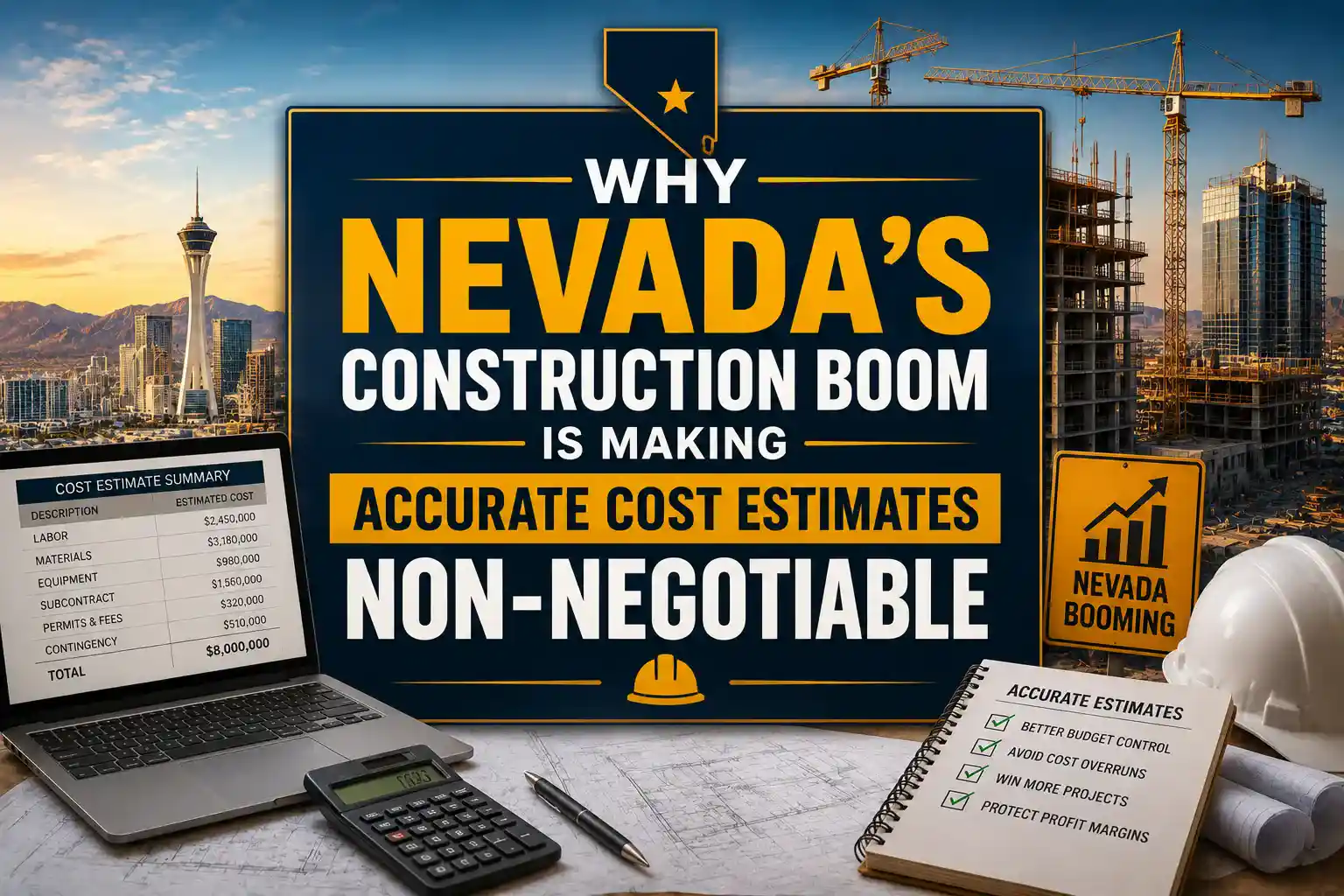
Drive through Las Vegas, Henderson, or Reno right now and you'll see cranes on nearly every skyline. Nevada has spent the last several years as one of the fastest-growing construction markets in the country, fueled by data centers, warehousing, resort expansions, and a steady stream of residential development. But rapid growth in a market brings a problem that doesn't get talked about enough: pricing volatility. And when material and labor costs are moving month to month, a shaky cost estimate can turn a profitable bid into a financial headache.
A Boom Market Isn't Always a Forgiving Market
It's tempting to assume that in a hot market, contractors can absorb small estimating mistakes because there's so much work to go around. In reality, the opposite tends to happen. When demand is high, suppliers raise prices faster, subcontractors get pickier about which jobs they take, and labor becomes harder to lock in at a stable rate. A cost estimate built on last quarter's numbers can be outdated by the time a bid is even submitted.
The Desert Doesn't Make Estimating Easier
Nevada's climate and geography add their own layer of complexity. Extreme summer heat affects concrete curing schedules and labor productivity. Water availability and haul distances for aggregate can swing site work costs significantly depending on the project's location, whether it's dense urban Las Vegas or a more remote site near Elko or Winnemucca. None of this shows up in a generic, one-size-fits-all cost estimate.
What Contractors Are Getting Wrong in Fast-Moving Markets
Relying on Historical Pricing Data Alone
Estimating software with a built-in cost database is useful, but only if that database reflects current regional pricing. In a market moving as fast as Nevada's, a database that's even a few months stale can throw a bid off by a meaningful percentage.
Underestimating Overhead in High-Growth Areas
As more projects break ground simultaneously, overhead costs like equipment rental, storage, and even temporary site security climb. These "soft costs" are often where estimates quietly fall short, especially on commercial and industrial jobs where multiple trades are competing for the same limited pool of subcontractors.
Skipping Value Engineering Early
Waiting until after a bid is awarded to look for cost-saving alternatives is a missed opportunity. In a competitive bidding environment, the contractors who build value engineering into the estimate from day one are usually the ones winning the job without giving away their margin.
Why More Nevada Contractors Are Turning to Specialized Estimating Support
Because of these pressures, a growing number of general contractors, developers, and trade contractors across the state have started outsourcing the estimating process rather than trying to keep pace with local pricing shifts in-house. It's a practical response to a market where accuracy has a very short shelf life.
For contractors weighing that option, this overview of professional Nevada construction estimating services breaks down how a dedicated estimating team approaches pricing across residential, commercial, and industrial projects throughout the state including how CSI divisions, current material costs, and regional labor rates are factored into a single, reliable number.
What a Reliable Cost Estimate Should Actually Include
A cost estimate that holds up under scrutiny from a lender, a client, or a competing bid typically covers more ground than most people expect:
-
A detailed quantity takeoff broken down by trade
-
Current material pricing tied to the actual project region
-
Labor cost analysis reflecting local market rates
-
Contingency and risk allowances for schedule or supply delays
-
Equipment and subcontractor cost breakdowns
-
A cash flow projection tied to the project timeline
Leaving any one of these out doesn't just create a rounding error. It creates a gap that shows up mid-project, usually at the worst possible time.
Signs Your Estimating Process Needs a Refresh
-
Bids are consistently coming in either too high to win or too low to be profitable
-
Change orders are increasingly tied to "unforeseen cost increases"
-
Your team is relying on pricing data that's more than a few months old
-
There's no formal risk or contingency planning built into the estimate
Any one of these on its own might be a minor issue. Together, they usually point to a process that hasn't kept up with how fast the local market is moving.
Final Thoughts
Nevada's construction industry isn't slowing down anytime soon, and that's good news for contractors who can price projects accurately in a shifting market. The firms that will come out ahead aren't necessarily the ones bidding the lowest; they're the ones whose numbers actually hold up once the project breaks ground. Getting there takes either a well-resourced in-house estimating team or a specialized partner who already knows the terrain, the pricing, and the pace of the region.

 Arabic
 French
 Spanish
 Portuguese
 Deutsch
 Turkish
 Dutch
Dutch
 Italiano
 Russian
 Romaian
 Portuguese (Brazil)
 Greek
Greek