


Latest Biodiesel Prices 2026: Chart, Trends & Regional Data
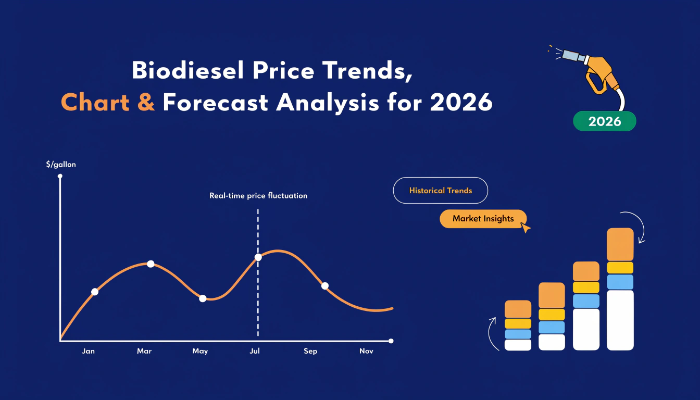
Global Biodiesel Price Trends & Updates – August 2026
Biodiesel Prices in August 2026 showed mixed regional movement, with three of the four reported benchmarks increasing while South America recorded a decline. Northeast Asia was priced at USD 1.28/KG, Europe at USD 1.64/KG, South America at USD 1.32/KG, and North America at USD 1.32/KG. The latest movements were +11.3%, +18.8%, -3.6%, and +0.8%, respectively. Because the supplied dataset does not provide a single global benchmark or Q2 2026 baseline, an overall quarterly percentage change cannot be calculated without introducing unsupported data. Buyers can use the Biodiesel Price Chart to compare regional benchmarks and historical movements. According to IMARC Group's August 2026 price-tracking database and methodology, biodiesel procurement conditions should be assessed alongside feedstock costs, renewable-fuel demand, energy expenses, freight, and regional supply availability.
Biodiesel Prices by Region – August 2026
- Northeast Asia: USD 1.28/KG — 11.3% ↑ Up
- Europe: USD 1.64/KG — 18.8% ↑ Up
- South America: USD 1.32/KG — 3.6% ↓ Down
- North America: USD 1.32/KG — 0.8% ↑ Up
The August benchmarks show a clear regional spread, with Europe recording the highest price and Northeast Asia the lowest. Europe's 18.8% increase represents the strongest reported monthly movement, while Northeast Asia also posted a significant 11.3% rise. South America moved in the opposite direction, declining 3.6%, whereas North America edged up 0.8%. The differences indicate varying feedstock economics, renewable-fuel demand, production availability, trade flows, and freight exposure. For procurement teams, the USD 0.36/KG gap between Europe and Northeast Asia highlights the importance of regional sourcing and delivered-cost comparisons.
Biodiesel Price Analysis by Region August 2026: What Do August Benchmarks Show?
North America Biodiesel Prices: What Is Driving the Latest Movement?
North America recorded USD 1.32/KG, with the latest benchmark increasing 0.8%. The modest rise suggests relatively stable procurement conditions compared with the stronger increases reported in Europe and Northeast Asia. Feedstock availability, renewable-fuel blending requirements, energy costs, and transportation expenses remain relevant to regional purchasing decisions.
Asia-Pacific Biodiesel Prices: What Is Happening in Northeast Asia?
Northeast Asia reached USD 1.28/KG, accompanied by an 11.3% increase. The stronger movement indicates greater upward pricing pressure than in North America, potentially reflecting changes in feedstock costs, regional demand, import requirements, and supplier availability. Country-level data for Japan, India, and China was not supplied, so individual country prices are not presented.
South America Biodiesel Prices: Why Did Prices Decline?
South America was assessed at USD 1.32/KG, with the latest movement declining 3.6%. The decrease contrasts with the other reported regions and may reflect softer regional procurement conditions, feedstock availability, or changes in trade flows. No Brazil-specific benchmark was provided in the supplied dataset.
Biodiesel Supply and Demand Overview – August 2026
Biodiesel demand is closely connected to blending mandates, transportation-fuel consumption, renewable-energy policies, and feedstock economics. Vegetable oils, animal fats, used cooking oils, and other renewable feedstocks influence production costs, while changes in refinery economics and blending requirements can affect purchasing activity. On the supply side, plant utilization, feedstock availability, inventories, imports, exports, and freight costs remain important. The regional divergence in August indicates that supply-demand conditions are not uniform across major producing and consuming areas.
Biodiesel Price Index & Historical Analysis: How Should August 2026 Be Read?
The Biodiesel Price Index can help buyers track monthly benchmark movements and compare current procurement conditions with previous periods. August data shows particularly strong increases in Europe and Northeast Asia, a modest rise in North America, and a decline in South America. However, the supplied information does not include the prior-quarter index value, so a precise comparison between August 2026 and Q2 2026 cannot be quantified. Buyers should combine historical benchmarks with feedstock costs, renewable-fuel policy changes, inventories, production rates, and freight conditions.
Biodiesel Price Forecast 2026: What Could Happen Over the Next 12 Months?
The outlook for the next 12 months will depend heavily on feedstock prices, renewable-fuel mandates, blending demand, energy costs, production capacity, and international trade. Continued strength in feedstock costs could maintain upward pressure on biodiesel procurement expenses, while improved availability or weaker fuel demand could moderate prices. Regional policy changes are also important because blending requirements can directly influence consumption. Procurement teams should monitor both feedstock benchmarks and biodiesel-specific supply conditions when developing purchasing scenarios.
Key Factors Affecting Biodiesel Prices Monthly: What Drives Changes?
Several factors can influence monthly biodiesel benchmarks:
- Feedstock costs: Vegetable oils, animal fats, and used cooking oils directly affect production economics.
- Renewable-fuel mandates: Changes in blending requirements can increase or reduce demand.
- Energy costs: Processing and transportation expenses influence producer margins.
- Freight rates: International and regional transportation costs affect delivered prices.
- Production capacity: Plant utilization, maintenance, and new capacity can alter supply availability.
- Trade flows: Imports, exports, tariffs, and regional sourcing patterns can shift procurement costs.
- Fuel demand: Changes in diesel consumption influence blending requirements and biodiesel demand.
- Policy changes: Renewable-energy incentives and regulatory requirements can materially affect consumption.
What Is Biodiesel and Where Is It Used?
Biodiesel is a renewable fuel produced from biological feedstocks such as vegetable oils, animal fats, and used cooking oils. It is primarily used as a diesel-fuel blend or, depending on applicable standards and infrastructure, as a higher-concentration renewable fuel. Commercial demand is influenced by transportation fuel consumption, emissions policies, blending mandates, feedstock availability, and fuel specifications.
Biodiesel Market Developments August 2026: What Changed?
The most significant development visible in the supplied August data is the divergence between regional benchmarks. Europe recorded the strongest increase at 18.8%, followed by Northeast Asia at 11.3%, while North America rose only 0.8% and South America declined 3.6%. The dataset does not provide verified details on individual supplier capacity additions, plant closures, major company announcements, or quantified trade shifts, so no unsupported company-specific development is included.
FAQs About Biodiesel Prices August 2026: What Buyers Need to Know
What Are Biodiesel Prices in August 2026?
August 2026 benchmarks were USD 1.28/KG in Northeast Asia, USD 1.64/KG in Europe, USD 1.32/KG in South America, and USD 1.32/KG in North America. Europe recorded the highest reported price and the strongest increase at 18.8%.
What Does the Biodiesel Price Index Show?
The Biodiesel Price Index helps procurement teams monitor monthly regional benchmark movements and identify differences between producing and consuming regions. The August data shows upward movement in three reported regions and a decline in South America, although a prior-quarter index value was not supplied for an exact comparison.
Where Can Buyers Find the Biodiesel Price Chart?
The Biodiesel Price Chart provides a practical way to compare regional benchmarks and historical movements. Buyers should evaluate chart data together with feedstock costs, blending requirements, freight, inventories, and supplier terms before finalizing procurement decisions.
How IMARC Group Helps Procurement Teams Track Biodiesel Costs
IMARC Group provides pricing intelligence for procurement teams, buyers, and analysts monitoring regional commodity costs. August 2026 data show strong upward movement in Europe and Northeast Asia, while North America remained comparatively stable and South America declined. The next 12 months will depend on feedstock availability, renewable-fuel policies, energy costs, production capacity, and trade flows. Historical and regional benchmarking can help buyers improve sourcing decisions and manage procurement risk.
Explore pricing coverage across 500+ commodities: https://www.imarcgroup.com/pricing-intelligence
Contact Us:
IMARC Group
134 N 4th St., Brooklyn, NY 11249, USA
Email: sales[@]imarcgroup.com
Tel No:(D) +91 120 433 0800
United States: +1-201971-6302

 English
 Arabic
 French
 Spanish
 Portuguese
 Deutsch
 Turkish
 Italiano
 Russian
 Romaian
 Portuguese (Brazil)
 Greek
Greek