


What Is Embryo Grading in IVF? Understanding 3AA, 4AA, 5AB and Other Grades
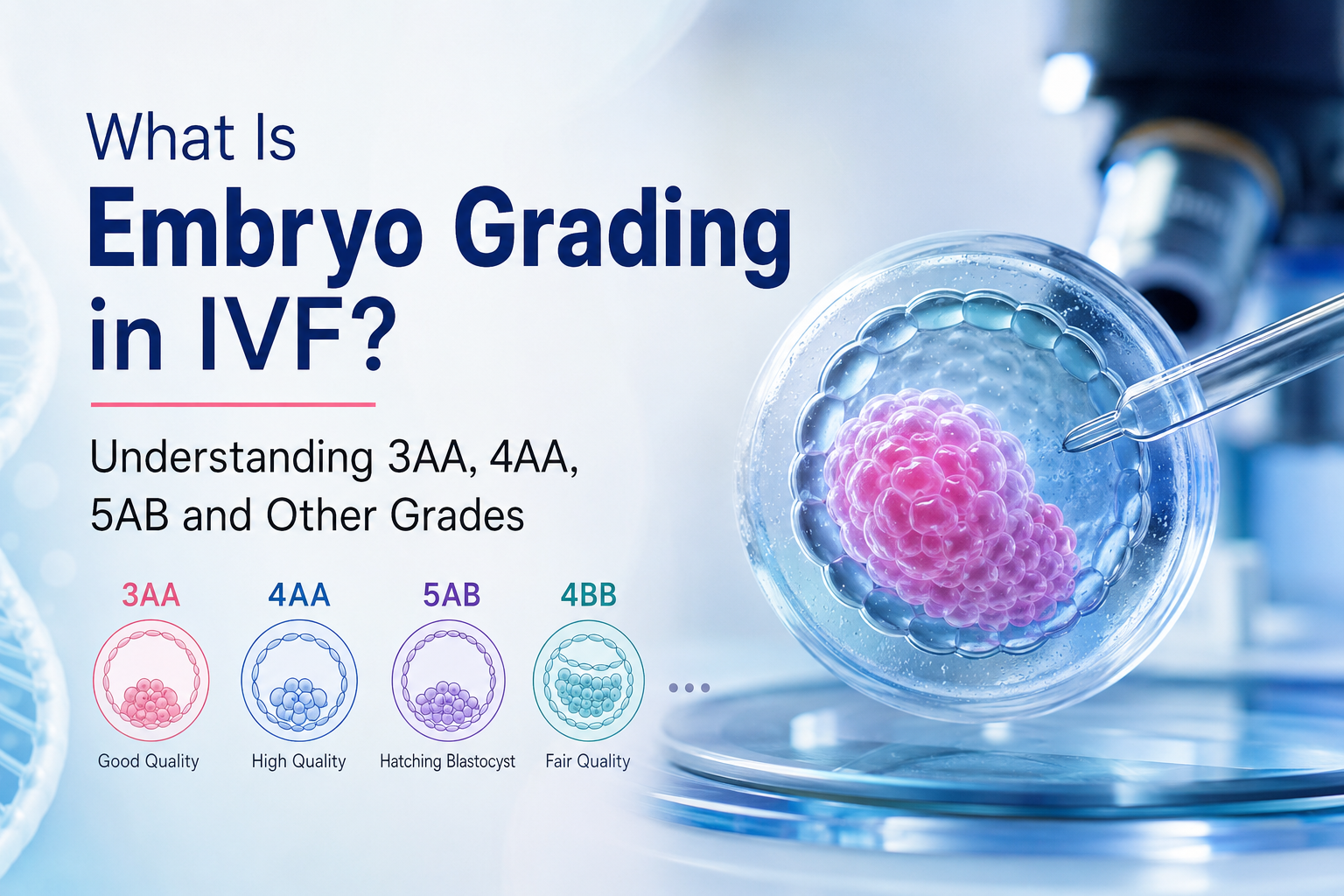
Embryo grading in IVF is a laboratory assessment used to describe how an embryo looks and develops under a microscope. During an IVF cycle, embryologists monitor embryos after fertilisation and evaluate their development before deciding which embryos may be suitable for transfer or freezing.
For patients, embryo grades such as 3AA, 4AA, 5AB, 4BB or 3BC can initially seem confusing. These numbers and letters provide information about the embryo's developmental stage and the appearance of specific cell structures. However, an embryo grade is not a guarantee of implantation, pregnancy or a healthy birth.
Understanding embryo grading in IVF can help patients interpret their laboratory reports and have more informed conversations with their fertility specialist.
What Is Embryo Grading in IVF?
Embryo grading in IVF is a method used by embryologists to assess the appearance and developmental progression of embryos, particularly when embryos reach the blastocyst stage, usually around day 5 or 6 after fertilisation.
Embryologists generally examine factors such as:
-
How much the embryo has expanded
-
The appearance of the inner cell mass
-
The appearance of the trophectoderm
-
Whether the embryo has reached the expected developmental stage
-
The overall organisation and appearance of the cells
The grading system is primarily a morphological assessment, meaning it evaluates what the embryo looks like rather than directly determining whether it is genetically normal.
This distinction is important. A high-quality-looking embryo may have chromosomal abnormalities, while an embryo with a lower morphological grade may still have the potential to result in pregnancy.
How Does the IVF Embryo Grading System Work?
The commonly used blastocyst grading system combines a number and two letters.
For example, an embryo may be reported as 4AA.
The three components describe different characteristics:
4 = degree of blastocyst expansion
First A = inner cell mass quality
Second A = trophectoderm quality
Therefore, 4AA does not mean that the embryo has a specific genetic status. It describes its appearance and developmental stage at the time of assessment.
What Does the Number in an Embryo Grade Mean?
The number in an embryo grade generally indicates the degree of blastocyst expansion and development.
A simplified explanation of the commonly used stages is:
| Grade | General description |
|---|---|
| 1 | Early blastocyst formation |
| 2 | Blastocoel cavity is developing |
| 3 | Full blastocyst |
| 4 | Expanded blastocyst |
| 5 | Hatching blastocyst |
| 6 | Hatched blastocyst |
The exact terminology and assessment criteria can vary between fertility laboratories.
What Is a 3AA Embryo?
A 3AA embryo is a full blastocyst. The first letter indicates the quality of the inner cell mass, while the second letter describes the trophectoderm.
In a 3AA embryo, both structures receive an A grade, indicating a favourable morphological appearance.
A 3AA embryo may therefore be considered a good-quality blastocyst based on morphology. However, its grade alone cannot determine whether it will implant or result in a successful pregnancy.
What Is a 4AA Embryo?
A 4AA embryo is an expanded blastocyst with an inner cell mass and trophectoderm that both receive an A grade.
The number 4 indicates that the blastocyst has expanded, while the two A grades describe the appearance of the two important cell groups.
Because of its favourable morphology, a 4AA embryo is often regarded as a high-quality blastocyst. Nevertheless, embryo grading in IVF should be interpreted alongside factors such as maternal age, embryo development, uterine factors and, where applicable, genetic testing.
What Is a 5AB Embryo?
A 5AB embryo is a hatching blastocyst.
The number 5 indicates that the blastocyst is beginning to hatch from its outer shell. The first letter, A, represents a favourable-looking inner cell mass, while B indicates a good but less optimal appearance of the trophectoderm compared with an A grade.
A 5AB embryo can therefore be considered a potentially good-quality embryo based on its morphology.
What Do the Letters A, B and C Mean?
The two letters in a blastocyst grade describe the appearance of two different cell groups.
First Letter: Inner Cell Mass
The inner cell mass (ICM) is the group of cells that develops into the fetus.
It is commonly graded as:
-
A: More favourable appearance, with many closely organised cells
-
B: Fair or intermediate appearance
-
C: Lower-quality appearance, with fewer or less organised cells
Second Letter: Trophectoderm
The trophectoderm (TE) is the outer layer of cells that contributes to the placenta.
It may also be graded A, B or C:
-
A: More favourable appearance and organisation
-
B: Intermediate appearance
-
C: Less favourable appearance
For example, in a 4AB embryo, the embryo is expanded, the inner cell mass has an A grade, and the trophectoderm has a B grade.
What Are Common IVF Embryo Grades?
Patients may encounter several different blastocyst grades in an IVF report.
4AA
A 4AA embryo is an expanded blastocyst with A-grade inner cell mass and A-grade trophectoderm. It is generally considered to have favourable morphology.
4AB
A 4AB embryo is also expanded. Its inner cell mass is graded A, while its trophectoderm is graded B.
4BA
A 4BA embryo has a B-grade inner cell mass and A-grade trophectoderm.
4BB
A 4BB embryo has B-grade morphology for both the inner cell mass and trophectoderm. It may still have implantation potential.
5AA
A 5AA embryo is a hatching blastocyst with favourable-looking inner cell mass and trophectoderm.
5AB
A 5AB embryo is a hatching blastocyst with an A-grade inner cell mass and B-grade trophectoderm.
These examples demonstrate why embryo grading in IVF should be read as a description rather than a simple pass-or-fail score.
Is a 4AA Embryo Better Than a 5AB Embryo?
It is tempting to compare embryo grades as though they were examination scores. However, the comparison is not always that straightforward.
A 4AA embryo and a 5AB embryo differ in both developmental stage and cell morphology. The 4AA embryo has A grades for both cell groups, while the 5AB embryo is more advanced in its expansion and hatching process but has a B grade for its trophectoderm.
Therefore, the higher number does not automatically mean a better embryo, and a B grade does not mean that an embryo cannot result in pregnancy.
Fertility specialists and embryologists consider the complete laboratory picture when evaluating embryos for transfer or cryopreservation.
Does Embryo Grading Predict Pregnancy Success?
Embryo grading can provide useful information, but it cannot predict pregnancy with certainty.
A visually favourable embryo may fail to implant, while an embryo with a lower morphological grade can sometimes result in a successful pregnancy.
Several factors influence IVF outcomes, including:
-
Age of the person providing the egg
-
Chromosomal status of the embryo
-
Uterine and endometrial factors
-
Sperm-related factors
-
Embryo development
-
Transfer technique
-
Overall reproductive health
This is why an embryo's morphological grade should be considered one part of the overall IVF assessment.
Does Embryo Grade Tell You If the Embryo Is Genetically Normal?
No. Embryo grading in IVF does not directly determine chromosomal normality.
Morphological grading examines the embryo's physical appearance and development. Genetic testing, when recommended and performed, uses a different approach to assess specific genetic or chromosomal characteristics.
For this reason, terms such as 3AA or 4AA should not automatically be interpreted as meaning that an embryo is genetically normal.
Patients considering genetic testing should discuss its potential benefits, limitations and relevance to their individual circumstances with a fertility specialist.
Can a Lower-Graded Embryo Still Result in Pregnancy?
Yes. A lower morphological grade does not necessarily mean that pregnancy is impossible.
Embryo development is complex, and morphology is only one indicator of developmental potential. Some embryos with B or C grades can continue developing and result in implantation and pregnancy.
This is one reason fertility clinics may preserve multiple suitable embryos rather than focusing only on the embryo with the highest grade.
Why Is Embryo Grading Important in IVF?
The primary purpose of embryo grading is to help embryologists and fertility specialists describe and compare embryo development.
It can assist with decisions involving:
-
Which embryo may be considered for transfer
-
Which embryos may be suitable for freezing
-
How embryos have developed during the laboratory period
-
Communicating embryo quality between the embryology laboratory and fertility team
However, embryo grading should not be viewed as a definitive prediction of IVF success.
Embryo Grading vs. Embryo Genetic Testing
These two concepts are sometimes confused.
Embryo grading evaluates morphology and developmental characteristics under a microscope.
Genetic testing evaluates genetic or chromosomal information using laboratory techniques.
An embryo can have a favourable morphological grade without necessarily being chromosomally normal. Likewise, an embryo with a less favourable morphological grade may still have genetic characteristics that differ from what its appearance might suggest.
Therefore, the two assessments provide different types of information.
Frequently Asked Questions About Embryo Grading in IVF
Is 3AA a good embryo?
A 3AA embryo is generally considered to have favourable morphology because both the inner cell mass and trophectoderm receive an A grade. The number 3 indicates a full blastocyst.
Is 4AA a high-quality embryo?
A 4AA embryo is generally described as a high-quality blastocyst based on morphology. It is expanded and has favourable-looking inner cell mass and trophectoderm.
What does 5AB mean in IVF?
5AB means the embryo is a hatching blastocyst, with an A-grade inner cell mass and B-grade trophectoderm.
Is 4BB a good embryo?
A 4BB embryo has intermediate B grades for both the inner cell mass and trophectoderm. It may still have implantation potential, and its suitability should be assessed by the fertility team.
Which embryo grade is best?
There is no single embryo grade that guarantees success. Grades such as 4AA and 5AA are generally considered favourable based on morphology, but embryo grade alone cannot predict implantation or live birth.
Does a higher embryo grade guarantee pregnancy?
No. Even a highly graded embryo may not implant or result in a pregnancy. Embryo grade is only one factor among several that influence IVF outcomes.
Final Thoughts
Understanding embryo grading in IVF can make fertility reports easier to interpret. Grades such as 3AA, 4AA and 5AB describe the embryo's developmental stage and the appearance of its inner cell mass and trophectoderm.
A favourable grade can provide encouraging information about embryo morphology, but it should not be interpreted as a guarantee of implantation, pregnancy or live birth. Genetic status, maternal age, uterine factors, sperm factors and other clinical considerations can also influence IVF outcomes.
If you receive an embryo grade such as 3AA, 4AA, 5AB or 4BB, your fertility specialist or embryologist can explain what that specific grade means in the context of your IVF cycle and treatment plan.

 English
 Arabic
 French
 Spanish
 Portuguese
 Deutsch
 Turkish
 Italiano
 Russian
 Romaian
 Portuguese (Brazil)
 Greek
Greek