


How Do Instant Loan Apps Verify a Borrower's Information?
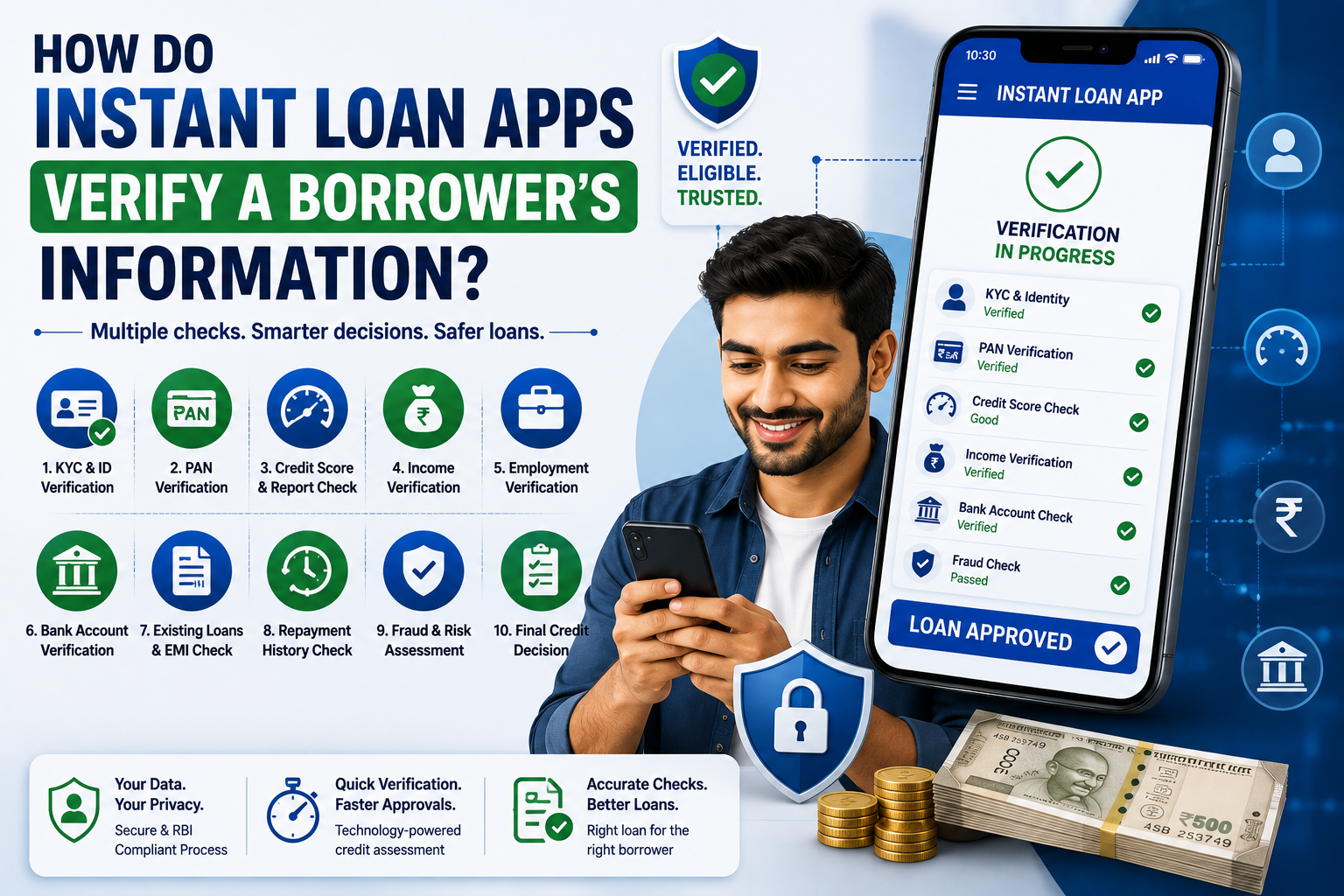
Applying for an instant loan online can take only a few minutes, but the lender may perform several checks before approving the application. Behind the simple app interface, lenders can verify your identity, credit history, income, bank details and existing financial obligations.
RBI's digital lending framework requires regulated entities to assess a borrower's creditworthiness and capture an economic profile that includes information such as age, occupation and income before extending digital loans.
This means an instant personal loan is not approved simply because you enter your Aadhaar number and select a loan amount. The lender still needs to determine whether your information is genuine and whether the proposed borrowing appears affordable.
What Information Do Instant Loan Apps Check?
The exact verification process varies by lender, but an application may involve:
- Identity and KYC details
- PAN and other identification information
- Credit history
- Income and employment
- Existing loans and EMIs
- Bank-account information
- Repayment history
- Loan amount and tenure
- Other information required for credit assessment
CIBIL says lenders commonly consider the CIBIL Score and Report, employment status, annual income and EMI payment behaviour when evaluating personal-loan applications.
1. KYC and Identity Verification
The first step is generally confirming that the person applying for the loan is actually the person represented by the submitted information.
Depending on the lender and applicable requirements, you may be asked for:
- Aadhaar
- PAN
- Passport
- Driving licence
- Voter ID
- Address details
- Mobile number
Digital KYC can make verification faster, but Aadhaar verification does not guarantee loan approval. It primarily helps establish identity under the applicable KYC process.
If your name, date of birth or other details don't match your documents, the lender may need additional verification.
2. PAN and Personal Details
PAN can form an important part of the loan application.
The lender may collect details such as:
- Full name
- Date of birth
- PAN
- Address
- Mobile number
- Employment type
- Income
These details may be compared with information used during credit assessment.
CIBIL reports can contain personal information, employment information, credit accounts and enquiry records reported by member institutions.
Therefore, don't enter incorrect information simply because you believe it will increase your chances of approval.
3. CIBIL Score and Credit Report
Your credit history can be one of the most important parts of the verification process.
When you apply for credit, a lender may access your credit report to understand your previous borrowing and repayment behaviour.
CIBIL reports can show:
- Existing loans
- Credit-card accounts
- Outstanding balances
- Payment history
- Account status
- Recent credit enquiries
CIBIL states that lenders use the CIBIL Score and Report as part of their assessment, but CIBIL itself does not approve or reject loans. The final decision belongs to the lender.
What If You Have No Credit History?
A person with limited credit activity may not have enough information to generate a conventional CIBIL score. CIBIL refers to this as a "No Hit."
This does not automatically mean that every lender will reject the application. Different lenders have different underwriting policies.
4. Income Verification
The lender also needs to determine whether you have sufficient repayment capacity.
For salaried borrowers, this may involve:
- Salary information
- Salary slips
- Bank statements
- Employment details
For self-employed professionals and freelancers, lenders may instead request:
- Bank statements
- ITRs
- Financial statements
- Business information
- Other income documents
CIBIL's indicative personal-loan documentation includes bank statements and income-related documents, with additional requirements potentially applying to self-employed applicants.
The exact documents vary by lender.
5. Bank Account Verification
Bank details are important because the lender needs to know where the approved loan should be disbursed.
Where permitted and properly authorised, financial information may also be used as part of the lender's assessment.
However, borrowers should not assume that every instant loan app can freely access all of their financial information.
RBI's digital lending requirements emphasize need-based data collection and prior, explicit borrower consent.
Before allowing an app to access financial information, understand exactly what you are consenting to.
6. Existing Loans and EMI Obligations
A lender may also look at your current debt.
For example, imagine you earn ₹50,000 per month and already pay:
- Personal loan EMI: ₹8,000
- Car loan EMI: ₹7,000
- Credit-card EMI: ₹4,000
The lender may consider these obligations when assessing whether another loan is affordable.
CIBIL states that lenders can consider the relationship between existing EMI obligations and income when evaluating a loan application.
This is why being eligible for a certain loan amount doesn't necessarily mean you should borrow the maximum available.
7. Repayment History
Lenders can also examine how you have handled previous credit.
A history of timely EMI payments generally presents a different credit profile from repeated missed or overdue payments.
CIBIL reports include repayment information for credit accounts, helping lenders understand previous credit behaviour.
If you want to improve your chances of future borrowing, paying existing EMIs and credit-card bills on time is one of the most important habits to maintain.
8. Employment and Occupation
Your occupation can also be part of the assessment.
You may apply as:
- Salaried employee
- Self-employed professional
- Freelancer
- Business owner
- Other eligible worker
RBI's digital lending framework specifically requires regulated entities to capture an economic profile that includes information such as occupation and income.
This information helps the lender understand your financial situation and repayment capacity.
9. Credit Enquiries
When you apply for credit, the lender may access your credit report, creating an enquiry record.
CIBIL explains that enquiries are recorded when banks or financial institutions access your credit report for loan or credit-card applications.
For this reason, avoid applying to many lenders simultaneously without comparing their eligibility criteria first.
A better approach is:
Research → Compare → Select → Apply
10. Fraud and Information-Matching Checks
Digital lenders may also look for inconsistencies in the information you provide.
For example, verification can become difficult if:
- Your name differs between documents.
- PAN information is incorrect.
- Bank-account details don't match.
- KYC cannot be completed.
- Income information appears inconsistent.
- Information changes between different application stages.
These issues may lead to additional verification or delay.
Can Instant Loan Apps Access Your Phone Contacts?
Borrowers should not assume that an app can access every piece of information on their phone simply because they are applying for a loan.
RBI's digital lending requirements say data collection should be need-based and based on prior, explicit consent. Digital lending apps and service providers must also maintain appropriate privacy policies.
Be cautious when an app requests broad access to:
- Contacts
- Photos
- Files
- Messages
- Call logs
- Microphone
- Location
Read the privacy policy and permission requests before granting access.
Does an Instant Loan App Check UPI Transactions?
It depends on the lender and the information you have authorised it to access.
You should not assume that every loan app automatically receives your complete UPI transaction history.
Where financial information is used for credit assessment, appropriate consent and regulatory requirements apply. RBI's framework emphasizes need-based collection rather than unrestricted access to borrower data.
Why Can Loan Verification Take Longer?
Even a digital application can require additional time.
Common reasons include:
KYC mismatch
Your application information does not match your documents.
Bank verification
Your account details require additional confirmation.
Income verification
The lender needs more evidence of your earnings.
Credit assessment
Your application requires additional underwriting.
Existing debt
The lender needs to assess your current repayment obligations.
Technical problems
OTP, document-upload or verification systems may temporarily fail.
Manual review
Additional checks are required before a decision can be made.
Therefore, instant loan processing does not necessarily mean instant approval or disbursal.
How Can You Make Verification Smoother?
You cannot control the lender's internal system, but you can avoid common mistakes.
Before applying:
- Keep your KYC documents ready.
- Use accurate personal information.
- Check your bank details.
- Keep income documents available.
- Review your credit report.
- Understand your existing EMI obligations.
During the application:
- Enter information carefully.
- Upload clear documents.
- Complete required verification promptly.
- Read consent notices.
- Review app permissions.
- Never provide false income information.
Accurate information can reduce avoidable verification problems.
Is It Safe to Give Personal Information to an Instant Loan App?
Only after verifying the lending arrangement.
RBI advises consumers to check whether a digital lending app is associated with an RBI-regulated bank or NBFC and recommends avoiding suspicious apps received through SMS or social-media links.
Before sharing Aadhaar, PAN or financial information:
- Identify the actual lender.
- Verify the lender independently.
- Check the app's association with the lender.
- Read the privacy policy.
- Review requested permissions.
- Understand why your information is being collected.
Never share your OTP, UPI PIN, password or other confidential authentication details with an unknown person.
Instant Loan Verification Checklist
Before applying, ask:
- Is the actual lender clearly identified?
- Can I verify the lender independently?
- Are my KYC details accurate?
- Have I checked my credit report?
- Can I provide income information if required?
- Are my existing EMIs manageable?
- Do I understand what information the app collects?
- Have I reviewed the privacy policy?
- Have I avoided suspicious loan links?
If you cannot determine who is actually providing the loan, don't rush to submit your documents.
Frequently Asked Questions
Do instant loan apps check CIBIL?
Many lenders may check your CIBIL Score and Report during credit assessment. However, the final lending decision belongs to the lender, not CIBIL.
Do loan apps verify income?
They may. Depending on the lender, income can be assessed using salary information, bank statements, ITRs or other financial documents.
Can I get an instant loan without a credit history?
Possibly. Having limited credit history does not automatically result in rejection. Lenders use their own eligibility and underwriting criteria.
Why is my instant loan verification pending?
It may be caused by KYC issues, bank verification, income assessment, credit checks, technical problems or additional manual review.
Does a good CIBIL score guarantee approval?
No. CIBIL says the lender makes the final lending decision and can consider multiple factors beyond the credit score.
Final Takeaway
An instant loan app may make borrowing look simple, but several checks can happen behind the scenes before a lender approves your application.
These can include KYC verification, credit-report checks, income assessment, employment information, bank-account verification, existing EMI analysis and repayment-history checks.
For borrowers, the safest approach is to provide accurate information, understand what data you are consenting to share, verify the actual lender and avoid giving unnecessary permissions.
A fast loan should make borrowing more convenient—not make you uncertain about who is lending the money, what information is being collected, or how much you will repay.

 English
 Arabic
 French
 Spanish
 Portuguese
 Deutsch
 Turkish
 Dutch
Dutch
 Italiano
 Russian
 Portuguese (Brazil)
 Greek
Greek