


Advanced SAP Course Full Form: Meaning, Benefits, Modules & Career Opportunities
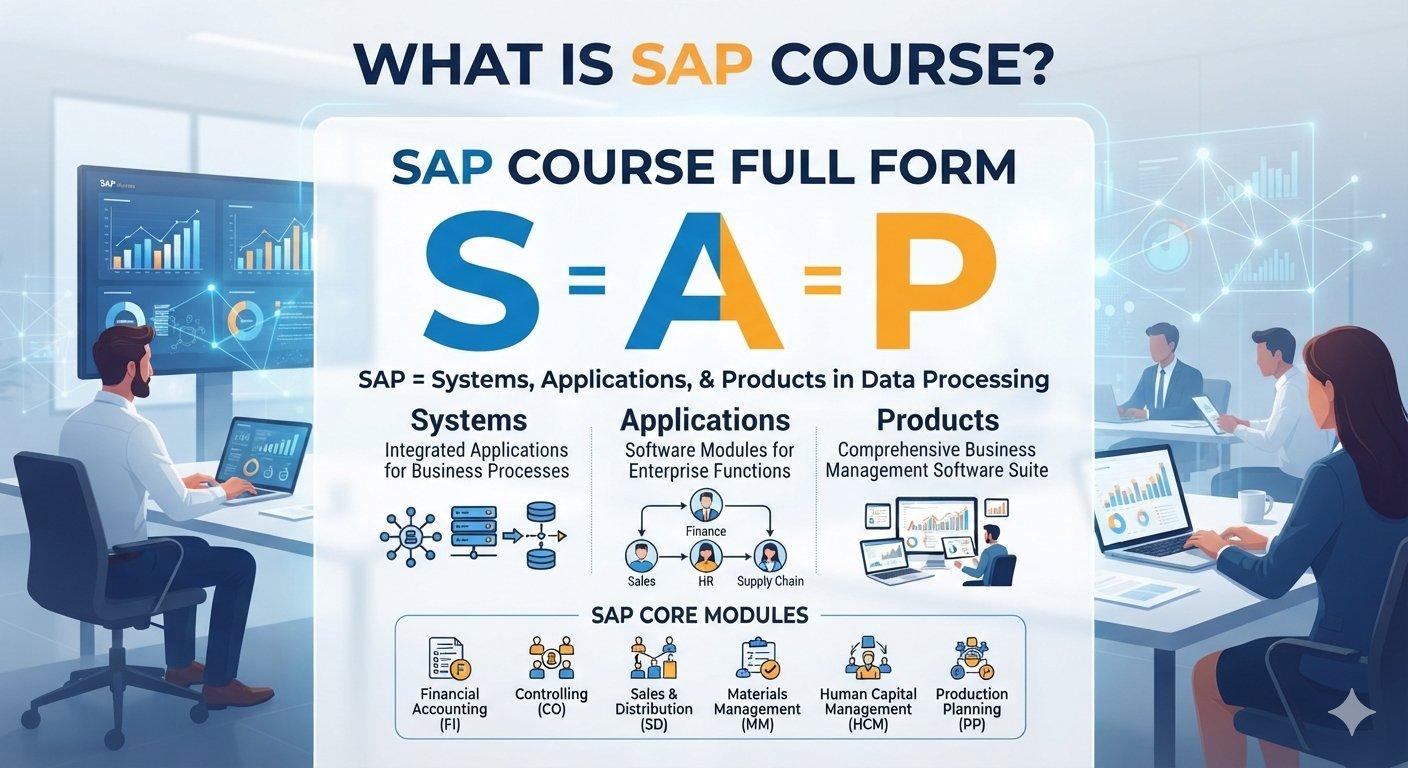
Learn the Advanced SAP course full form, key modules, benefits, career paths, and what affects the latest SAP course fees before you enrol.
Discover the SAP course full form, Systems, Applications, and Products in Data Processing. Learn about SAP modules, career opportunities, certification benefits, and industry applications. Explore how SAP training can help you develop in-demand skills and build a successful career.
The full form of SAP is Systems, Applications, and Products in Data Processing. An Advanced SAP course is a higher-level training programme that goes beyond basic navigation. It teaches you to configure, customise, and manage a specific SAP module (such as FICO, MM, SD, or ABAP) on platforms like SAP S/4HANA, often with hands-on projects and certification preparation.
What Is the Advanced SAP Course Full Form?
People often search for the Advanced SAP Course Full Form expecting a special acronym. There isn't one. "Advanced" is simply the level of the course. The acronym that matters is SAP itself.
SAP = Systems, Applications, and Products in Data Processing. The name comes from the German Systeme, Anwendungen, Produkte in der Datenverarbeitung. The company was founded in Germany in 1972 by former IBM engineers and is now one of the world's largest enterprise software providers.
So when an institute advertises an "Advanced SAP course", it means a programme that builds on foundation-level knowledge and prepares you for real project work.
What Does an Advanced SAP Course Actually Teach?
Many companies use SAP to run finance, purchasing, sales, production, HR, and logistics in one connected system. A beginner course shows you the screens and basic transactions. An advanced course goes deeper:
- Configuration: setting up the system to match how a business works (for example, defining company codes, plants, or pricing procedures).
- Integration: understanding how one module feeds another, such as a purchase order in MM creating an accounting entry in FICO.
- Customisation and reporting: building custom reports, forms, and enhancements, especially in ABAP.
- Troubleshooting: analysing errors, fixing master-data problems, and supporting live users.
- S/4HANA and Fiori: working with the current SAP platform and its modern user interface.
A practical example: A trainee in an advanced SAP MM course might create a vendor, raise a purchase requisition, convert it to a purchase order, post a goods receipt, and verify the invoice. They then trace how each step posts to the general ledger. Employers expect a junior consultant to understand that end-to-end flow.
Who Should Take an Advanced SAP Course?
This level suits you if you:
- Already know basic business processes (accounts, procurement, sales, or HR).
- Have completed a foundation SAP course or have some end-user experience.
- Work in IT, ERP support, or finance and want to move into consulting.
- Are a fresher with a commerce, engineering, or MBA background aiming at an ERP career.
If you have never seen SAP, start with a foundation course first. Jumping straight to advanced topics usually leads to gaps.
Key SAP Modules Covered in Advanced Training
You normally choose one module (or a small combination).
| Module | Full Name | Best For | Typical Focus |
|---|---|---|---|
| FICO | Financial Accounting & Controlling | Accountants, finance graduates | General ledger, accounts payable/receivable, cost centres, profit centres |
| MM | Materials Management | Procurement, supply chain | Purchasing, inventory, invoice verification |
| SD | Sales & Distribution | Sales, logistics | Order-to-cash, pricing, billing, delivery |
| PP | Production Planning | Manufacturing professionals | BOM, routing, MRP, production orders |
| HCM / SuccessFactors | Human Capital Management | HR professionals | Payroll, time management, talent processes |
| ABAP | Advanced Business Application Programming | Developers | Reports, interfaces, enhancements, CDS views |
| Basis | System Administration | IT administrators | Installation, user management, performance, transports |
| WM / EWM | Warehouse Management | Warehouse and logistics roles | Storage, picking, putaway |
Tip: Pick the module that matches your existing background. A finance graduate usually progresses faster in FICO, while a programmer is better placed in ABAP.
Benefits of Doing an Advanced SAP Course
- Job-relevant skills: Employers hiring for SAP roles look for configuration and project knowledge, not just theory.
- Wide industry use: SAP is used across manufacturing, retail, banking, pharma, oil and gas, and consulting, so your skills transfer between sectors.
- Career switch support: Professionals from accounting, purchasing, or IT can move into ERP consulting without starting from zero.
- Certification readiness: Good programmes align with SAP's official certification topics.
- Future relevance: Many companies are moving from older SAP ECC systems to S/4HANA, which keeps demand for trained people active. Check current job listings in your city to confirm demand for your chosen module.
Career Opportunities After an Advanced SAP Course
Common job titles include:
- SAP Functional Consultant (FICO, MM, SD, PP, or HR)
- SAP Technical Consultant / ABAP Developer
- SAP Support Analyst or Application Support Executive
- SAP Basis Administrator
- Business Analyst (ERP)
- SAP Project Team Member / Super User
You can find these roles at IT services firms, consulting companies, and in the in-house IT or finance teams of large businesses. Salaries differ widely by country, module, city, and experience, so check recent figures on job portals instead of relying on a single quoted number.
Latest SAP Course Fees: What to Expect
People searching for the latest SAP course fees want a single number, but fees vary a lot. They depend on the factors below, so confirm the current price directly with the training provider before you pay.
| Factor | How It Affects Fees |
|---|---|
| Module chosen | Technical and specialised modules often cost differently from functional ones |
| Training mode | Live online, classroom, and self-paced recorded courses are usually priced differently |
| Course duration | Longer programmes with projects generally cost more |
| Trainer profile | Training by working consultants may be priced higher |
| Inclusions | Practice server access, project work, placement help, or certification vouchers may or may not be included |
| Location and institute | Metro-city and international providers often differ from smaller local ones |
Before you pay, ask these questions:
- Is the fee all-inclusive, or are server access and exam costs extra?
- Do I get access to a real SAP S/4HANA practice system?
- How many hours are live, hands-on practice versus slides?
- Is the trainer a practising SAP consultant? Can I see their profile?
- What is the refund or demo-class policy?
Be careful with promises of guaranteed jobs. No training provider can ethically guarantee employment.
How to Choose the Right Advanced SAP Course
- Define your goal. Decide between functional or technical work, then pick one module.
- Check the syllabus. It should cover configuration, integration, and S/4HANA, not just screens.
- Look for hands-on practice. Real system access matters more than recorded slides.
- Verify the trainer. Ask about real project experience.
- Read independent reviews. Look beyond testimonials on the provider's own website.
- Confirm certification alignment. Compare the syllabus with SAP's official certification outline.
SAP Certification: Is It Necessary?
Certification is not always mandatory, but it can strengthen your profile, particularly for freshers with no project experience. SAP offers official certifications through its own learning platform, and exam topics and formats are updated from time to time. Check SAP's official certification pages for the current exam code, syllabus, and fee before booking.
Final Thoughts
The full form of SAP is Systems, Applications, and Products in Data Processing, and an advanced SAP course is the step that turns basic familiarity into job-ready skills. Choose one module that fits your background, insist on hands-on practice, compare the total cost carefully, and verify the latest SAP course fees directly with each provider. With the right training, SAP can open a stable, well-recognised career path in enterprise technology.
FAQ's
1. What is the full form of SAP?
SAP stands for Systems, Applications, and Products in Data Processing.
2. Does "Advanced SAP course" have a separate full form?
No. "Advanced" only describes the course level. The acronym refers to SAP itself.
3. What is the difference between a basic and an advanced SAP course?
A basic course teaches navigation and core concepts. An advanced course covers configuration, integration, troubleshooting, and project-style practice.
4. Which SAP module is best for beginners?
It depends on your background. Commerce graduates often choose FICO, supply chain candidates choose MM or SD, and programmers choose ABAP.
5. What are the latest SAP course fees?
Fees vary by module, mode, duration, trainer, and inclusions. Ask providers for a written, all-inclusive quote and compare syllabus and practice access, not just price.
6. Can a non-IT graduate learn SAP?
Yes. Functional modules like FICO, MM, SD, and HR are commonly learned by non-IT graduates with business knowledge.
7. How long does an advanced SAP course take?
Duration depends on the module and provider. Many programmes run for a few weeks to a few months, so check the schedule and total live hours.
8. Is SAP certification compulsory to get a job?
Not always. It can help freshers show verified knowledge, and many employers also value project experience.
9. Is SAP S/4HANA different from SAP ECC?
Yes. S/4HANA is SAP's newer platform built on the HANA database, with a simplified data model and Fiori interface. ECC is the older generation.
10. Can I learn SAP online?
Yes, if the course includes live sessions and access to a practice system. Recorded videos alone rarely give enough hands-on experience.

 English
 Arabic
 French
 Spanish
 Portuguese
 Turkish
 Dutch
 Italiano
 Russian
 Romaian
 Portuguese (Brazil)
 Greek