


Why E-Commerce Stores Serving North America Need Dedicated US VPS Hosting
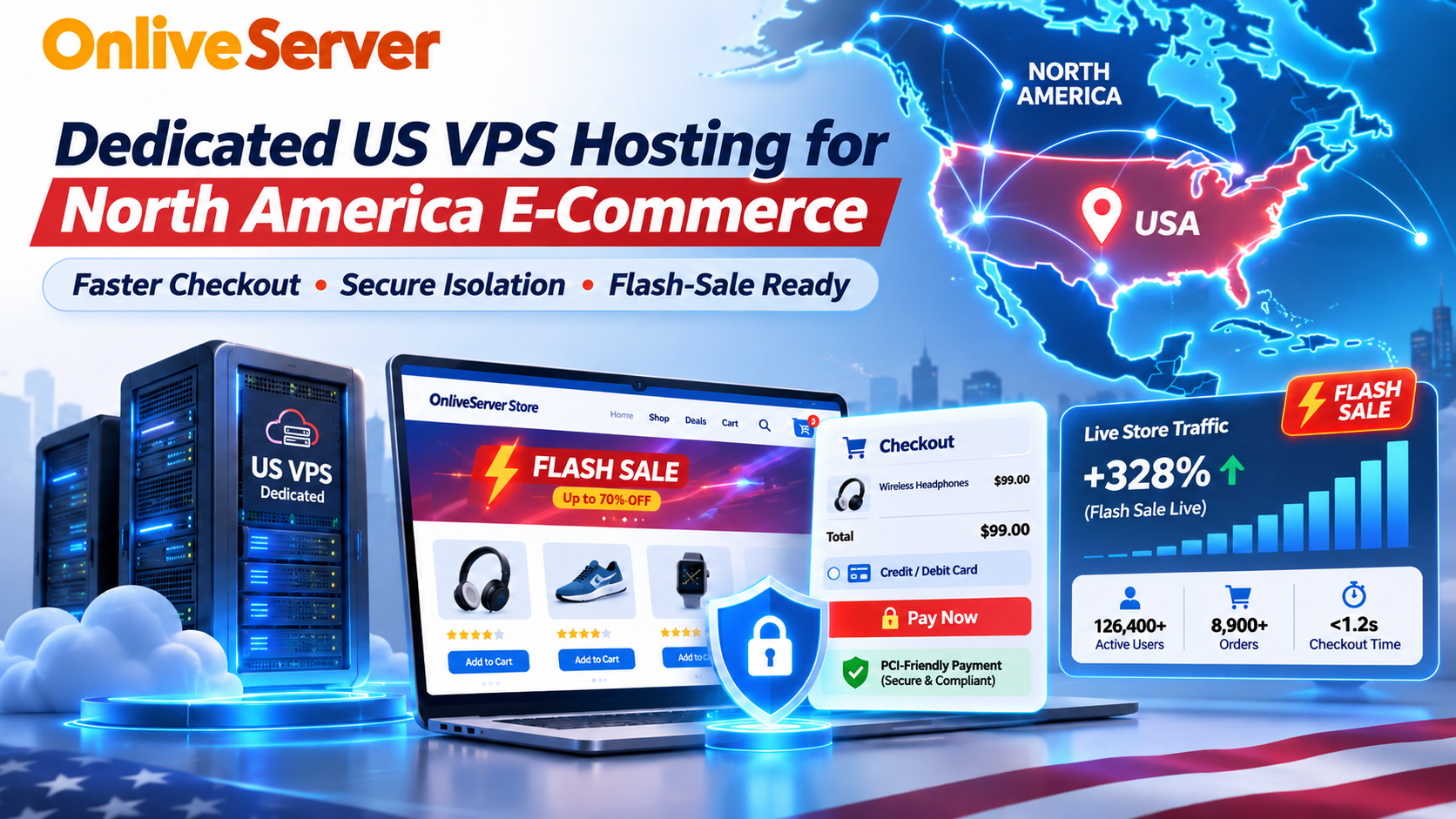
Running an e-commerce store involves much more than displaying products and accepting payments. Customers expect pages to load quickly, shopping carts to respond immediately, and checkout transactions to finish without unnecessary delays. For online businesses targeting customers across the United States, Canada, and Mexico, hosting infrastructure plays an important role in delivering that experience.
Dedicated US VPS hosting gives e-commerce businesses an isolated virtual server environment with allocated computing resources, greater control over security, and room to expand as traffic increases. Unlike traditional shared hosting, a VPS allows store owners to manage server configurations according to their application's requirements.
For growing online stores, choosing the right hosting environment can help reduce performance bottlenecks, support payment security practices, and prepare the website for seasonal shopping demand.
Why Server Location Matters for North American E-Commerce
The geographical location of a hosting server influences how quickly data travels between the website and its visitors.
An online store serving customers primarily in North America can benefit from hosting its application on a US-based server. Shorter network routes may reduce latency, particularly for dynamic requests that cannot be served from a content delivery network.
For example, an e-commerce business with customers in New York, Toronto, and Chicago may benefit from an eastern or central US datacenter. Stores targeting California, western Canada, and the western United States might prefer infrastructure closer to those regions.
Server location alone does not guarantee faster performance. Network routing, application optimization, database efficiency, and hosting resource availability also affect response times.
Businesses should therefore select their VPS location based on actual customer distribution and network performance measurements.
Faster Checkout Performance with Dedicated VPS Resources
Checkout performance directly affects the customer experience. When shoppers proceed to payment, the website may need to verify inventory, calculate shipping charges, apply discounts, and communicate with payment services.
These operations often require database queries and application processing.
On shared hosting, several websites compete for the underlying server's resources. Heavy activity from other accounts can sometimes affect performance, particularly when hosting providers impose strict CPU or memory limits.
A US VPS hosting environment provides allocated virtual CPU, RAM, and storage resources. This gives store owners greater control over how their applications handle requests.
Dedicated virtual resources can support:
- Faster processing of shopping cart operations.
- More consistent database response times.
- Efficient handling of customer login sessions.
- Better resource allocation for payment and order processing.
- Greater flexibility to configure server-side caching.
For WooCommerce, Magento, and other self-hosted e-commerce platforms, sufficient memory and CPU capacity are especially important when stores rely on numerous extensions or complex product catalogs.
A VPS cannot correct inefficient website software automatically, but it offers more flexibility to identify and resolve server-side performance problems.
PCI-Friendly Isolation and Payment Security
Online stores accepting card payments must understand their responsibilities under the Payment Card Industry Data Security Standard (PCI DSS).
A VPS provides an isolated operating system environment where administrators can configure access permissions, firewalls, security updates, and application services.
This separation can make it easier to manage security controls than a basic shared hosting account.
Businesses can strengthen their hosting environment through several practices:
- Installing trusted SSL/TLS certificates to protect data in transit.
- Restricting administrative access to authorized users.
- Maintaining current operating system and application updates.
- Configuring firewalls and monitoring suspicious activity.
- Using trusted payment gateways and tokenization.
- Maintaining encrypted backups and testing restoration procedures.
VPS isolation does not automatically make an online store PCI DSS compliant. Compliance depends on the payment architecture, applicable requirements, hosting provider responsibilities, and security controls implemented by the merchant.
Using a hosted payment solution can reduce direct exposure to cardholder data, although relevant PCI DSS obligations may still apply.
For e-commerce businesses handling sensitive customer information, a properly secured VPS provides a useful foundation for managing these responsibilities.
Handling Flash Sales and Seasonal Traffic Spikes
Black Friday, Cyber Monday, holiday promotions, and limited-time product launches can produce sudden increases in website traffic.
A store that handles ordinary daily activity without difficulty may struggle when hundreds of customers attempt to browse products or complete purchases simultaneously.
During these periods, insufficient CPU capacity, limited memory, or overloaded databases can create slow responses and failed requests.
Scalable US VPS hosting allows businesses to increase available resources as their requirements change, subject to the hosting provider's upgrade options.
Store owners can prepare for traffic spikes by increasing memory and CPU allocations, optimizing database queries, enabling object caching, and distributing static content through a CDN.
For particularly demanding campaigns, additional application servers or load balancing may be necessary.
It is also important to test the checkout process under simulated concurrent traffic before a major promotion. A successful homepage load test does not necessarily prove that inventory updates and payment processing will work reliably under pressure.
NVMe Storage and Database Performance
Storage performance is another consideration for online stores with large product catalogs and frequent order activity.
E-commerce databases regularly read and write information related to inventory, customer accounts, orders, and product availability.
NVMe SSD storage can provide low-latency disk access and high input/output performance when the surrounding infrastructure supports it.
This may help applications perform database-intensive tasks more efficiently.
However, storage technology is only part of the equation. Database indexing, available RAM, CPU performance, and query design can have an equally important influence on website responsiveness.
Businesses evaluating a VPS should consider actual disk performance rather than assuming that every NVMe-equipped server delivers identical results.
Why Growing Stores Need More Hosting Control
As an e-commerce business expands, its technical requirements often become more complex.
Store owners may need to install specialized software, adjust database settings, configure background jobs, or introduce custom security policies.
Traditional shared hosting generally limits these administrative options.
A VPS with root or administrator access gives technical teams greater control over the operating system and application environment.
Businesses can configure their preferred web server, manage PHP versions, optimize database services, and introduce monitoring tools.
This flexibility is especially useful for development teams maintaining customized storefronts or integrating external inventory, accounting, and fulfillment systems.
With additional control comes responsibility for maintenance, patching, monitoring, and backups unless those services are included in a managed hosting plan.
Choosing the Right US VPS Hosting Provider
Selecting a hosting provider requires more than comparing monthly prices.
E-commerce businesses should examine resource allocations, datacenter locations, storage performance, network connectivity, support availability, and upgrade policies.
Before purchasing, confirm whether the plan includes backups, DDoS protection, operating system management, and assistance with server-level issues.
Businesses exploring scalable US VPS hosting can review OnliveServer's available plans and compare them against their store's expected traffic, software requirements, and technical capabilities.
Starting with an appropriately sized server and monitoring actual usage is often more practical than purchasing excessive resources immediately.
Conclusion
For e-commerce stores serving North America, hosting decisions influence checkout responsiveness, security management, and the ability to handle increased shopping activity.
Dedicated US VPS hosting offers isolated virtual resources, flexible server configuration, and upgrade options that can support growing online businesses.
The strongest results come from combining suitable hosting infrastructure with efficient application software, secure payment processing, regular maintenance, and realistic traffic testing. A well-configured VPS gives store owners greater control over these essential parts of their online business.

 Arabic
 French
 Spanish
 Portuguese
 Deutsch
 Turkish
 Dutch
 Italiano
 Russian
 Romaian
 Portuguese (Brazil)
 Greek