


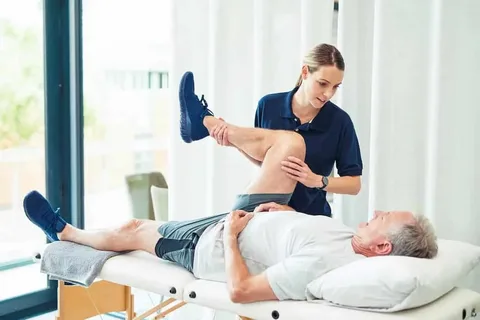
Knee pain is one of the most common reasons people seek rehabilitation, and it is also one of the most frequently misunderstood. The knee sits between the hip and the ankle, transferring force between them with every step, and it depends on muscular control from both above and below to remain stable under load. When something goes wrong, the site of pain is often not the source of the problem. A patella that tracks poorly may be responding to weak hip abductors. A knee that aches on stairs may be compensating for limited ankle mobility. Cartilage that has degenerated may be irritated by altered walking mechanics rather than by the degeneration itself. Treating the painful spot in isolation therefore produces relief that rarely lasts, because the mechanics that created the irritation remain unchanged.
This is why effective rehabilitation begins with a careful evaluation of how the entire lower body moves rather than a narrow focus on the joint itself. In everyday life, knee pain interferes with climbing stairs, kneeling, getting out of a car, and walking distances that once felt effortless, and those limitations erode independence and activity levels over time. Patients who pursue Knee Pain Physical Therapy with a structured, individualized approach typically recover more function and experience fewer recurrences than those who rest and hope for resolution. Understanding what that care involves, how assessment guides treatment, and what distinguishes quality rehabilitation helps patients make informed decisions about their recovery.
Understanding Knee Pain Physical Therapy and Its Importance
Knee pain physical therapy is a specialized area of rehabilitation focused on restoring strength, mobility, and movement quality around the knee joint while addressing the factors that contribute to pain. Its importance lies in the way it connects clinical findings to real function. A comprehensive evaluation examines knee range of motion, quadriceps and hamstring strength, hip and ankle mobility, balance, gait, and movement quality during tasks the patient actually performs, such as squatting, stair climbing, and rising from a chair. The therapist then identifies which impairments are primary and which are compensatory, designs a progressive plan that respects tissue healing, and establishes objective baselines so progress can be tracked. This matters because knee pain rarely exists in isolation, and rehabilitation that ignores contributing factors tends to produce temporary relief followed by recurrence. For patients who want to return to walking, work, and recreation without ongoing discomfort, this comprehensive approach is what makes therapy genuinely effective.
Why Knee Pain Requires a Movement-Based Approach
Knee pain requires a movement-based approach because the joint functions as part of a chain rather than as an independent structure. Every step involves force absorption and propulsion coordinated across the hip, knee, and ankle, and weakness or restriction anywhere in that chain alters the load the knee must tolerate. A patient with weak gluteal muscles may allow the knee to collapse inward during landing, increasing stress on the patellofemoral joint. Restricted ankle dorsiflexion may limit how far the knee can travel forward during squatting, shifting load onto structures that tolerate it poorly. Even trunk control influences knee mechanics, since poor core stability allows excessive motion that the knee must then manage. A movement-based approach identifies these relationships through functional testing and addresses them with targeted strengthening, mobility work, and neuromuscular retraining. This is why rehabilitation that focuses only on the knee frequently disappoints, while programs that treat the whole lower body produce durable improvement.
Identifying the Real Causes of Knee Pain
A thorough assessment is the foundation of effective treatment, and it begins with a detailed history covering the onset of symptoms, prior injuries, activity levels, and the specific movements that provoke discomfort. The physical examination evaluates knee range of motion, joint integrity, muscle strength and endurance, and swelling, alongside hip and ankle mobility and trunk control. Functional testing observes how the patient squats, climbs stairs, walks, and balances on one leg, revealing compensations that static testing misses. Special tests help identify involvement of ligaments, menisci, or the patellofemoral joint, and the therapist interprets findings to determine which impairments are primary. Baseline measurements are recorded so that progress can be measured objectively rather than assumed. The evaluation concludes with a clear explanation of findings and a proposed plan, including realistic timelines. Patients should leave understanding what is driving their pain and why the recommended approach addresses it.
Effective Rehabilitation Techniques for Knee Strength and Stability
Treatment combines several methods selected deliberately for the individual presentation rather than applied as a standard package. Manual therapy, including joint mobilization and soft tissue techniques, can reduce pain and restore mobility, but it is used to create conditions for active exercise to succeed rather than as the primary intervention. Strengthening is central to recovery, with particular attention to the quadriceps, hamstrings, gluteals, and calf complex, progressed from isolated activation through compound movements and eventually to loaded functional tasks. Neuromuscular re-education improves coordination and control, helping patients relearn patterns that pain has disrupted. Balance and proprioceptive training restore confidence on uneven surfaces and stairs. Patients recovering from surgery follow protocols coordinated with the surgeon, respecting weight-bearing and range-of-motion precautions while advancing steadily. Throughout, the therapist monitors pain, swelling, and movement quality, adjusting volume and intensity to keep progress steady without provoking setbacks.
Improving Movement Quality and Long-Term Functional Capacity
Restoring strength without restoring movement quality rarely translates into better function, which is why rehabilitation emphasizes how patients move rather than only how much they can lift. Therapists use cueing and video feedback to correct patterns such as knee valgus during squatting, excessive forward trunk lean during stair ascent, or asymmetric weight-bearing during gait. Functional training then progresses to the specific tasks the patient needs, whether that means carrying loads at work, kneeling in the garden, or returning to running. Gradual reintroduction of impact activity is structured carefully, with volume and intensity increased only after strength and mechanics meet objective criteria. Patients also receive education on activity modification, footwear, and load management so that daily habits support recovery rather than undermining it. This functional emphasis is what allows Knee Pain Physical Therapy to produce improvements that carry over into real life rather than remaining confined to the clinic.
Choosing the Right Provider, Quality, and Safety Standards
Selecting the right provider requires attention to credentials, experience, and communication rather than proximity alone. Patients should confirm that the therapist is licensed and experienced with their specific condition, whether that involves patellofemoral pain, osteoarthritis, ligament injury, or post-surgical recovery. It is reasonable to ask how treatment plans are developed, how progress is measured objectively, and whether the clinic communicates with referring physicians and surgeons. Quality and safety standards matter alongside these questions, because inappropriate loading can aggravate symptoms and delay recovery. Reputable providers follow established clinical guidelines, maintain licensure, pursue continuing education, and screen thoroughly for conditions requiring medical referral, such as fractures, infections, or ligament ruptures. They monitor pain, swelling, and movement quality during every session and document outcomes so that decisions rest on data rather than impression. Continuity of care with a consistent therapist allows subtle adjustments that accumulate into meaningful gains.
Benefits of Professional Rehabilitation and Future Trends
The benefits of professional rehabilitation extend well beyond pain reduction. Patients who complete structured programs typically regain strength and mobility more quickly, walk with greater confidence, and return to work and recreation with a lower risk of recurrence. Older adults gain balance and fall prevention skills that support independence, while athletes benefit from sport-specific progression and objective return-to-play testing. Education on load management and self-care empowers patients to maintain their gains after discharge. Meanwhile, the field continues to advance through wearable sensors that monitor gait and activity outside the clinic, telehealth follow-ups that extend care between visits, and video-based movement analysis that helps clinicians detect subtle impairments. Prehabilitation, which optimizes strength before surgery, is gaining attention for improving postoperative outcomes. These developments complement clinical judgment and make rehabilitation more precise and accessible for patients at every stage of recovery.
Conclusion
Knee pain is rarely a simple problem confined to a single joint, and effective rehabilitation reflects that complexity by addressing strength, mobility, coordination, and movement quality together. Thorough assessment, progressive loading, functional retraining, and objective measurement are the elements that separate lasting recovery from temporary relief. For patients who want to climb stairs, walk distances, and return to activity without ongoing discomfort, choosing Knee Pain Physical Therapy with attention to credentials and individualized planning ensures access to clinicians who prioritize long-term function. Whether the goal is recovering from surgery, managing arthritis, or overcoming pain that has limited activity for months, the right program provides a clear and structured path forward. Investing in professional rehabilitation is an investment in mobility, confidence, and quality of life.

 English
 Arabic
 French
 Spanish
 Portuguese
 Deutsch
 Turkish
 Dutch
 Italiano
 Russian
 Romaian
 Greek