


Artificial Intelligence in Mental Healthcare: Market Size, Trends and Opportunities
AI in Mental Health Market to Reach USD 11.9 Billion by 2034
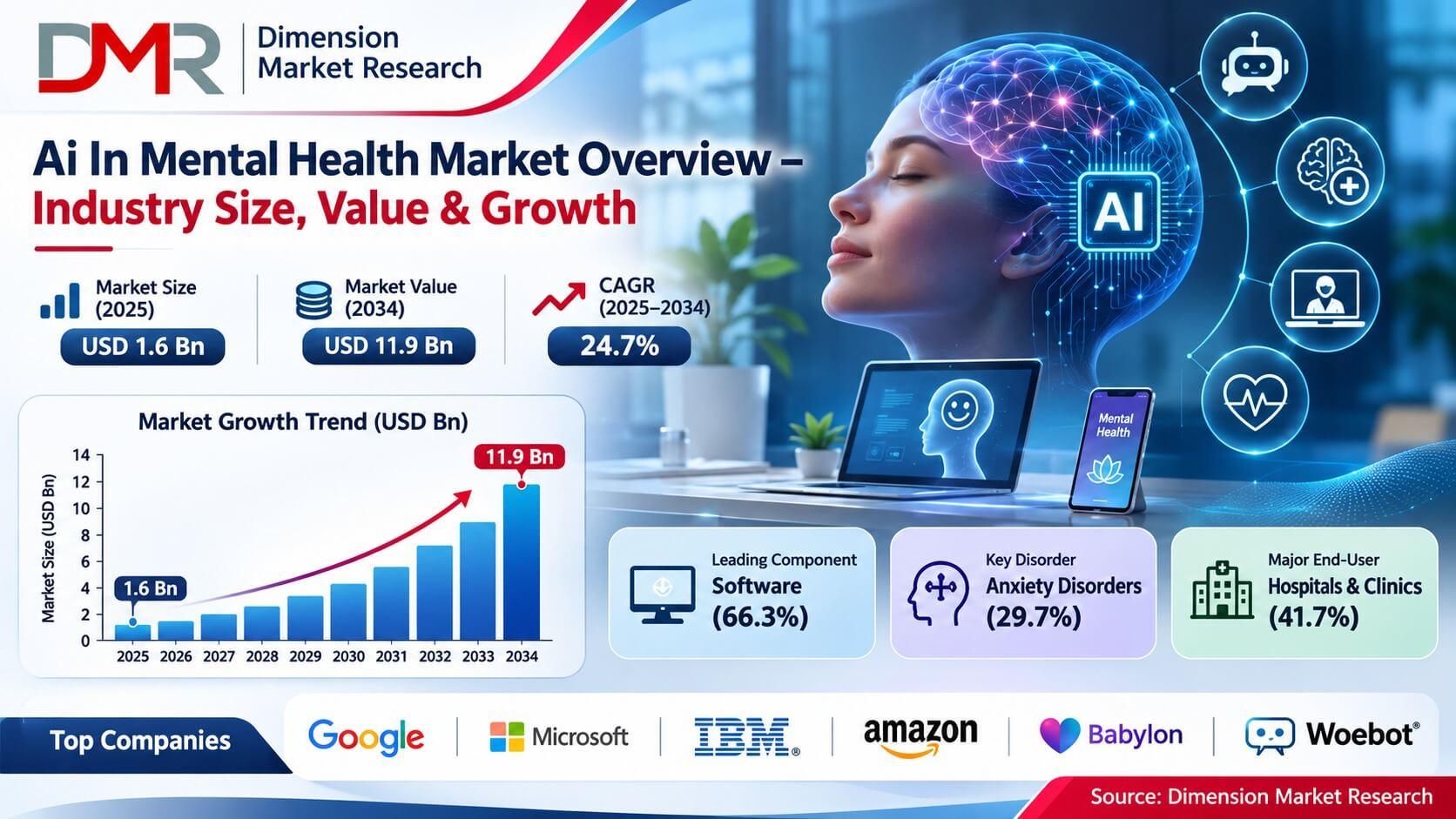
The global AI in Mental Health Market is experiencing substantial growth as healthcare providers increasingly adopt artificial intelligence for mental health assessment, diagnosis, treatment personalization, and patient monitoring. According to Dimension Market Research, the global AI in Mental Health Market size is estimated to reach USD 1.6 billion in 2025 and is projected to grow to USD 11.9 billion by 2034, registering a CAGR of 24.7% during 2025–2034. Increasing mental health awareness, rising demand for accessible healthcare services, and advancements in machine learning and natural language processing are creating new opportunities across the digital mental healthcare industry.
AI-powered mental health platforms are changing how individuals access psychological support. From virtual therapists and conversational chatbots to predictive analytics and remote patient monitoring, intelligent technologies are helping healthcare organizations improve accessibility, personalize interventions, and support clinical decision-making.
Request Sample PDF of This Report: https://dimensionmarketresearch.com/request-sample/ai-in-mental-health-market/
What Is the Current Overview of the AI in Mental Health Market?
The AI in Mental Health Market represents the growing use of artificial intelligence technologies to improve the identification, assessment, treatment, and ongoing management of mental health conditions. These solutions use machine learning, natural language processing, computer vision, and predictive analytics to evaluate clinical records, speech patterns, behavioral information, and physiological signals.
The market is gaining momentum as traditional mental healthcare systems face increasing patient demand and shortages of qualified professionals. AI-enabled chatbots, virtual mental health assistants, and mobile applications are expanding access to digital support, while hospitals and clinics are integrating intelligent diagnostic and monitoring tools into existing healthcare workflows.
Additionally, the growing adoption of smartphones, wearable devices, and telehealth platforms is strengthening the digital mental healthcare ecosystem. These developments are encouraging healthcare providers and technology companies to invest in scalable, data-driven, and personalized mental health solutions.
What Is the Expected Value of the AI in Mental Health Market by 2034?
According to Dimension Market Research, the global AI in Mental Health Market is expected to reach USD 11.9 billion by 2034, increasing from USD 1.6 billion in 2025 at a CAGR of 24.7%.
- The global market is valued at USD 1.6 billion in 2025.
- The market is projected to reach USD 11.9 billion by 2034.
- The market is forecast to expand at a 24.7% CAGR from 2025 to 2034.
- Software is expected to account for 66.3% of the market in 2025.
- NLP is projected to capture 35.1% of the market in 2025.
- Anxiety disorders are anticipated to hold a 29.7% share in 2025.
- Diagnostics and detection are expected to account for 31.6% in 2025.
- Hospitals and clinics are projected to capture 41.7% in 2025.
- North America is anticipated to contribute 42.5% of revenue in 2025.
What Are the Latest AI in Mental Health Market Research Findings?
The research findings highlight the increasing adoption of software-driven artificial intelligence solutions across mental healthcare. Software is expected to dominate the component segment with a 66.3% share in 2025, while natural language processing is projected to lead technology with 35.1%. Anxiety disorders are anticipated to account for 29.7% of the disorder segment, reflecting demand for accessible and continuous anxiety management solutions. Diagnostics and detection are expected to lead applications with 31.6%, supported by increasing demand for early identification of mental health conditions. Hospitals and clinics are projected to represent 41.7% of end-user revenue. Regionally, North America is expected to lead, while Asia Pacific is positioned to record the fastest growth.
Why Is the AI in Mental Health Market Growing?
The market is expanding primarily because of the increasing global burden of mental health disorders and the growing need for accessible, efficient, and scalable treatment options. Conventional mental healthcare services frequently experience workforce shortages, long appointment waiting periods, and unequal access across rural and underserved communities. AI-powered platforms can complement traditional healthcare delivery by providing continuous digital engagement, automated assessments, and personalized therapeutic recommendations.
Technological improvements in machine learning, NLP, deep learning, and predictive analytics are further supporting adoption. Integration with electronic health records, telehealth platforms, and wearable devices allows healthcare providers to analyze patient information more effectively. Growing investments in digital healthcare infrastructure and increasing acceptance of technology-assisted mental health services are also contributing to market expansion.
What Are the Key Growth Drivers of the AI in Mental Health Market?
- Rising global prevalence of anxiety, depression, and other disorders.
- Increasing demand for accessible and affordable mental healthcare.
- Growing adoption of AI-powered virtual therapists and chatbots.
- Advancements in machine learning and natural language processing.
- Increasing integration of AI with telehealth and electronic records.
- Growing use of predictive analytics for early mental health detection.
- Expansion of wearable devices and remote patient monitoring.
Which Region Is Expected to Witness the Fastest Market Growth?
Asia Pacific is projected to register the fastest CAGR in the global AI in Mental Health Market during the forecast period. Increasing mental health awareness, rising smartphone penetration, expanding digital healthcare infrastructure, and growing investments in artificial intelligence are supporting regional adoption. China, India, Japan, South Korea, and Australia are among the important markets contributing to this regional development.
North America is expected to maintain its leading position, accounting for approximately 42.5% of global market revenue in 2025. The United States and Canada benefit from advanced healthcare infrastructure, established digital health ecosystems, technology investments, and growing adoption of AI-supported clinical services.
Europe is also developing as an important market, supported by digital healthcare initiatives and increasing interest in technology-enabled behavioral health services. Germany, the United Kingdom, France, Italy, and other European countries are included in the regional market assessment. Latin America and the Middle East & Africa offer additional opportunities as healthcare digitization progresses.
Which Segment Shows the Highest Growth Potential Within the AI in Mental Health Market, and Why?
Software Component Segment
The software segment is expected to dominate the AI in Mental Health Market, accounting for approximately 66.3% of total market share in 2025. Its leadership is supported by increasing demand for AI-powered diagnostic applications, virtual mental health assistants, mobile wellness platforms, and intelligent teletherapy solutions. Software platforms offer scalability, flexibility, and compatibility with existing digital healthcare infrastructure, making them attractive to hospitals, clinics, healthcare startups, and independent practitioners.
The growing adoption of cloud-based delivery and Software-as-a-Service models is also reducing infrastructure requirements for healthcare organizations. These platforms can be updated continuously and integrated with electronic health records, enabling more efficient patient management.
- Increasing adoption of AI-enabled mental health applications.
- Growing demand for scalable cloud-based healthcare platforms.
- Expansion of virtual therapy and digital patient engagement tools.
Read More About This Market: https://dimensionmarketresearch.com/report/ai-in-mental-health-market/
Natural Language Processing Technology Segment
Natural Language Processing is anticipated to maintain its leading position in the technology segment, capturing approximately 35.1% of the market in 2025. NLP plays an important role in understanding human communication, analyzing written and spoken language, and identifying potential emotional or behavioral indicators associated with mental health conditions.
Conversational AI agents, virtual therapists, and mental health chatbots use NLP to interact with users and deliver structured digital support. Healthcare organizations are also exploring NLP-based clinical documentation and automated analysis of patient conversations to improve administrative efficiency and support clinical decision-making.
- Growing deployment of conversational AI and virtual assistants.
- Increasing use of language analysis for mental health screening.
- Expanding applications in clinical documentation and telehealth.
AI in Mental Health Market Dynamics
What Are the Major Trends Shaping the Market?
One of the major trends shaping the AI in Mental Health Market is the increasing adoption of predictive analytics for preventive mental healthcare. Healthcare providers and digital health companies are using AI to analyze patient histories, wearable data, sleep patterns, and behavioral indicators to identify potential changes in mental well-being. Another important development is the integration of artificial intelligence with virtual reality therapy. AI-enhanced VR platforms can adapt therapeutic environments based on patient responses, supporting applications such as exposure therapy, mindfulness training, and PTSD interventions. The growing use of conversational AI, personalized cognitive behavioral therapy applications, and remote monitoring technologies is also transforming digital mental health services.
What Are the Future Growth Opportunities in the AI in Mental Health Market?
Emerging economies represent significant opportunities for AI-powered mental healthcare providers. Countries with limited mental health professional availability can benefit from mobile applications, virtual counselors, and conversational platforms that extend access to digital support. Increasing internet connectivity and smartphone adoption are creating favorable conditions for these solutions. Another important opportunity lies in integrating AI with personalized and precision medicine. By analyzing patient histories, lifestyle information, genetic data, and treatment responses, AI platforms can help healthcare professionals develop more individualized treatment strategies. Partnerships between healthcare providers, pharmaceutical companies, research institutions, and technology developers may further accelerate innovation and commercialization.
What Challenges Are Affecting the Market?
Despite its growth potential, the AI in Mental Health Market faces challenges associated with data privacy, ethical concerns, algorithmic bias, and limited clinical validation. Mental health information is highly sensitive, requiring companies to establish strong data protection and security practices. Regulatory requirements, including HIPAA in the United States and GDPR in Europe, can increase development and compliance costs. Questions surrounding transparency, reliability, and the clinical effectiveness of AI-generated recommendations may also slow adoption. Additionally, mental healthcare depends heavily on human interaction, empathy, and professional judgment. Healthcare providers therefore need evidence-based systems that complement qualified clinicians rather than replace essential therapeutic relationships.
Who Are the Leading Companies in the AI in Mental Health Market?
The competitive landscape consists of digital mental health providers, AI technology developers, healthcare technology companies, and emerging startups. Market participants are focusing on product innovation, strategic acquisitions, partnerships, and the development of intelligent platforms for diagnosis, virtual therapy, patient engagement, and remote monitoring.
Some of the prominent companies operating in the global AI in Mental Health Market include:
- Woebot Health
- Ginger (now part of Headspace Health)
- Lyra Health
- Quartet Health
- Cognoa
- Marigold Health
- Mindstrong Health
- Spring Health
- Wysa
- Talkspace
- Ada Health
- Youper
- Koa Health
- BioBeats
- Flow Neuroscience
- Limbix
- Meru Health
- Ellipsis Health
- Eleos Health
- IBM
- Google (DeepMind)
- Microsoft
- Affectiva
- MindMaze
- Happify Health
Competition is increasingly centered on improving algorithm performance, expanding clinical applications, strengthening patient engagement, and establishing reliable data governance frameworks. Strategic developments are also shaping the market. For example, Headspace Health acquired Sayana in March 2024 to expand its AI-based mental wellness capabilities, while Eleos Health acquired Adaptive Telehealth in February 2024 to strengthen its behavioral healthcare technology portfolio.
Get 10% instant discount on report purchase
Related Reports:
- Ai Powered Mental Health Solution Market
- Digital Twin In Healthcare Market
- Ai Powered Surgical Monitor Market
FAQs
1. What is the current size of the global AI in Mental Health Market in 2025?
2. What will be the projected value of the AI in Mental Health Market by 2034?
3. What CAGR is expected for the AI in Mental Health Market during 2025–2034?
4. Which technology segment dominates the global AI in Mental Health Market?
5. Why is natural language processing important in AI-powered mental healthcare?
6. Which application segment holds the largest share of the AI in Mental Health Market?
7. Why is North America the leading region in the AI in Mental Health Market?
8. Which region is expected to register the fastest growth in AI mental healthcare?
9. What are the major challenges affecting AI adoption in mental healthcare services?
10. Who are the leading companies competing in the global AI in Mental Health Market?
About Us
Dimension Market Research (DMR) is a global market intelligence and consulting firm delivering data-driven insights that help organizations make informed strategic decisions. With expertise across 12+ industries and global markets, DMR provides syndicated reports, custom research, competitive analysis, white space analysis, and business strategy consulting.
Our research solutions combine analytical rigor, industry expertise, and forward-looking intelligence to identify opportunities, reduce risks, and support sustainable growth. Trusted by clients across diverse sectors, DMR is committed to delivering accurate, actionable insights that enable businesses to navigate evolving market landscapes with confidence.
Contact Us
Phone USA: +17323699777
Phone India: +919310023843
E-mail: [email protected]
Address USA: 957 Route 33, Suite 12 #308, Hamilton Square, NJ-08690
Address India: D44, Sector 6, Noida 201301, India

 English
 Arabic
 French
 Spanish
 Portuguese
 Deutsch
 Turkish
 Dutch
 Italiano
 Romaian
 Portuguese (Brazil)
 Greek