


Power Metering Market Size, Growth, Key Players and Forecast 2026-2034
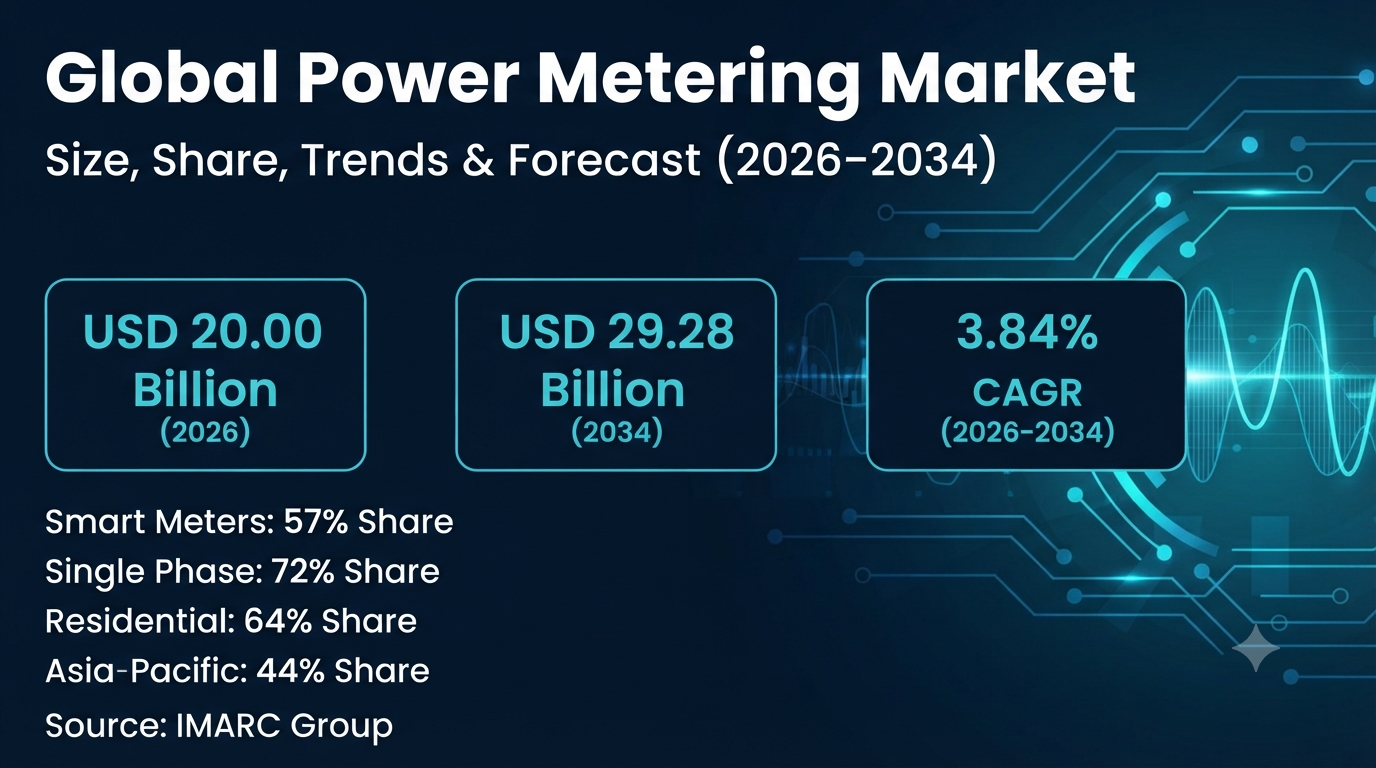
According to IMARC Group, the global power metering market size reached USD 20.00 Billion in 2025 and is projected to reach USD 29.28 Billion by 2034, expanding at a CAGR of 3.84% during 2026-2034. This steady expansion, detailed in IMARC Group's latest power metering market report, reflects rising electricity demand, government mandates to upgrade metering infrastructure, growing adoption of renewable energy, and increasing consumer awareness of energy costs and consumption.
Power Metering Industry Overview
Power metering encompasses the devices and systems used to measure electricity consumption and, increasingly, to transmit that data back to utilities and consumers in real time. Traditional analog and electromechanical meters are steadily giving way to electronic and smart meters that support two-way communication, remote reading, anomaly detection, and dynamic pricing. This transition allows utilities to improve billing accuracy, reduce non-technical losses, and manage distributed energy resources more effectively.
Power metering solutions are deployed across a broad range of use cases:
- Residential metering: Single-phase smart meters that give households accurate billing and insight into their energy use
- Commercial metering: Metering and monitoring for offices, retail, and public buildings to support cost control and efficiency goals
- Industrial metering: Three-phase and advanced monitoring solutions for power-intensive facilities and process operations
- Advanced Metering Infrastructure (AMI): Networked systems that enable real-time data collection, remote management, and demand response
- Distributed energy and microgrids: Metering that supports monitoring of solar, wind, storage, and microgrid assets
Global Power Metering Market Size & Key Statistics
Below are the key power metering market size statistics drawn from IMARC Group's comprehensive market analysis:
|
Report Attribute |
Key Statistics |
|
Base Year |
2025 |
|
Historical Period |
2020-2025 |
|
Forecast Period |
2026-2034 |
|
Power Metering Market Size in 2025 |
USD 20.00 Billion |
|
Market Forecast in 2034 |
USD 29.28 Billion |
|
Market Growth Rate (2026-2034) |
3.84% CAGR |
|
Largest Region |
Asia-Pacific (44% share in 2025) |
|
Leading Phase Segment |
Single Phase (72% share) |
|
Leading Technology Segment |
Smart Meters (57% share) |
|
Leading End-Use Segment |
Residential (64% share) |
Request for a Sample Report for Detailed Power Metering Market Share Evaluation: https://www.imarcgroup.com/power-metering-market/requestsample
Key Market Drivers & Power Metering Market Trends in 2026
Several powerful forces are shaping power metering market trends and fuelling sustained growth expectations across the global utilities, energy, and smart grid sectors:
1. Rising Global Electricity Demand
Industrialization, population growth, and the electrification of transport, heating, and industry in emerging economies are increasing electricity consumption worldwide. This growth is driving utilities to deploy accurate, scalable metering to measure, bill, and manage load effectively.
2. Government Mandates for Metering Infrastructure Upgrades
Governments and regulators are requiring utilities to modernize metering infrastructure with two-way communication and real-time data capabilities. Large-scale national rollout programs are accelerating the replacement of legacy meters, particularly in Asia-Pacific and other fast-developing regions.
3. Growing Adoption of Renewable Energy
Rooftop solar, wind power, and other distributed generation add complexity to grid operations, since power flows in both directions. Advanced meters capable of bidirectional measurement are essential for net metering, accurate settlement, and grid stability.
4. Expansion of Advanced Metering Infrastructure (AMI)
Utilities are replacing electromechanical meters with electronic, real-time systems that allow remote reading, outage detection, and better load management. AMI deployments are improving operational efficiency while reducing manual meter-reading costs.
5. IoT, Connectivity, and Data Analytics
IoT-enabled smart meters support anomaly detection, failure prediction, and dynamic pricing. Partnerships between meter manufacturers and telecom providers are expanding connected deployments and enabling more sophisticated, analytics-driven energy management.
6. Rising Consumer Awareness of Energy Costs
Households and businesses increasingly want visibility into when and how they consume electricity. Real-time consumption data helps consumers reduce waste, shift usage to lower-cost periods, and participate in demand response programs.
7. Sustainability Goals and Grid Modernization Investment
Accurate metering supports energy efficiency targets and the monitoring of distributed energy, microgrid, and storage assets. In markets such as the United States, an aging grid, dynamic pricing rules, EV and rooftop solar growth, and federal infrastructure funding are further accelerating smart meter deployment.
Key Market Segmentation
By Phase
Single Phase — Largest Segment: Single-phase meters account for approximately 72% of the market, driven by their widespread use in residential and small commercial connections where power requirements are modest and installation volumes are high.
Three Phase: Three-phase meters serve commercial and industrial consumers with higher and more balanced loads, where precise measurement and advanced monitoring capabilities are priorities.
By Technology
Smart Meters — Largest Segment: Smart meters hold approximately 57% of the market. Their ability to provide two-way communication, real-time data, remote reading, and support for dynamic pricing makes them central to utility modernization programs worldwide.
Analog Meters: Traditional analog meters remain in service in cost-sensitive and less-developed networks, though they are progressively being phased out in favor of electronic and smart alternatives.
Digital Meters: Digital meters offer improved accuracy and readability over analog devices and serve as a transitional technology in markets moving toward full smart meter deployment.
By End Use
Residential — Largest Segment: The residential segment accounts for approximately 64% of the market, supported by large-scale household smart meter rollouts, rising electricity consumption, and growing consumer interest in understanding and managing energy costs.
Commercial: Commercial users, including offices, retail, and public buildings, adopt advanced metering to monitor consumption, control costs, and meet efficiency and sustainability goals.
Industrial: Industrial facilities rely on advanced metering and power monitoring to track energy-intensive operations, improve efficiency, and support reliability.
Regional Power Metering Market Analysis
|
Region |
Key Highlights |
|
Asia-Pacific — Largest |
China, Japan, India, South Korea, Australia, Indonesia; 44% share in 2025; scale, urbanization, and supportive policy, with mass smart meter deployment in China and India |
|
North America |
United States & Canada; mature, well-regulated market; demand driven by bidirectional meters, demand response, grid resilience, and federal infrastructure funding |
|
Europe |
Germany, France, UK, Italy, Spain, Russia; over 60% of electricity customers in the EU27+3 had smart meters at the end of 2023, with countries at varying stages of deployment |
|
Latin America |
Brazil, Mexico; focus on reducing non-technical losses and improving billing efficiency |
|
Middle East & Africa |
GCC states (Saudi Arabia, UAE, Qatar) investing in smart meters; demand in Africa centered on basic and prepaid metering |
Asia-Pacific leads the global power metering market share, underpinned by the scale of its electricity networks, rapid urbanization, and large national smart meter programs in China and India, with Southeast Asia, South Korea, and Australia also active.
North America remains a mature and highly regulated market, where grid modernization, aging infrastructure, dynamic pricing rules, and the growth of EVs and rooftop solar continue to support demand for advanced metering.
Connect for Detailed Power Metering Market Report Segmentation Analysis — Speak to an Analyst: https://www.imarcgroup.com/power-metering-market
Leading Players in the Global Power Metering Industry
The global power metering market is moderately consolidated, with a few large multinationals alongside many regional players. Competition is intensifying as emerging Asian manufacturers offer lower-cost smart meters in price-sensitive markets, while regulatory scrutiny of cybersecurity is increasing and meter makers partner with telecom providers to expand connected offerings. Key companies covered in the IMARC Group report include:
|
Company |
Core Power Metering Focus |
|
ABB Ltd. |
Electrification, automation, and metering solutions |
|
Eaton Corporation PLC |
Power management and electrical monitoring |
|
General Electric Company |
Grid technology and energy solutions |
|
Holley Technology Ltd. |
Smart electricity meters and metering systems |
|
Honeywell International Inc. |
Smart energy and utility metering |
|
Itron Inc. |
Smart meters and advanced metering infrastructure |
|
Jiangsu Linyang Energy Co. Ltd. |
Smart meters and energy technology |
|
Ningbo Sanxing Medical Electric Co. Ltd. |
Electricity meters and smart grid equipment |
|
Schneider Electric SE |
Energy management and power monitoring |
|
Sensus USA Inc. (Xylem Inc.) |
Smart metering and AMI solutions |
|
Siemens AG |
Grid infrastructure and smart metering technologies |
|
Toshiba Corporation |
Energy systems and metering solutions |
Latest Power Metering Market Industry Developments
August 2025 — Vodafone Idea
Vodafone Idea's enterprise arm announced plans to connect 12 million IoT-enabled smart meters across India over a three-year period.
September 2025 — National Grid
National Grid accelerated its smart meter rollout across upstate New York.
December 2025 — India RDSS Program
India's Power Minister reported that about 4.03 crore smart meters had been installed under the Revamped Distribution Sector Scheme (RDSS).
February 2026 — Ubicquia
Ubicquia launched an AI-driven power monitoring solution designed for commercial and industrial customers.
Frequently Asked Questions (FAQs)
What is the Power Metering Market Size in 2025?
The global power metering market reached USD 20.00 Billion in 2025, supported by rising electricity demand, metering modernization mandates, and growing smart meter adoption.
What are the key Power Metering Market Trends shaping the industry?
Key trends include the rollout of smart meters and AMI, IoT-enabled connectivity, integration of renewable and distributed energy, dynamic pricing, and growing consumer interest in energy data.
What is the Power Metering Market growth forecast through 2034?
The market is projected to reach USD 29.28 Billion by 2034, growing at a CAGR of 3.84% during 2026-2034, driven by electrification, regulatory mandates, and grid modernization.
Which phase segment leads the Power Metering Market Share?
Single-phase meters lead the market with approximately 72% share, owing to their widespread use in residential and small commercial connections.
Which technology leads the Power Metering Market?
Smart meters lead the technology segment with approximately 57% share, supported by two-way communication, real-time data, and utility modernization programs.
Which region dominates the Power Metering Market Share?
Asia-Pacific dominates with a 44% share in 2025, driven by scale, urbanization, and large national smart meter programs in China and India.
Which end-use segment has the highest adoption?
The residential segment holds the largest share at approximately 64%, supported by large-scale household smart meter deployments.
Who are the top companies covered in the Power Metering Market Report?
Leading companies include ABB Ltd., Eaton Corporation PLC, General Electric Company, Holley Technology Ltd., Honeywell International Inc., Itron Inc., Jiangsu Linyang Energy Co. Ltd., Ningbo Sanxing Medical Electric Co. Ltd., Schneider Electric SE, Sensus USA Inc. (Xylem Inc.), Siemens AG, and Toshiba Corporation.
What is the future outlook for the global Power Metering Market?
The market is expected to sustain steady growth through 2034, driven by continued smart meter deployment, AMI expansion, renewable energy integration, and rising demand for real-time energy insights.
About Us
IMARC Group is a leading global market research company providing data-driven insights and expert consulting services to businesses seeking to achieve their strategic objectives. With a multi-disciplinary team of industry experts, IMARC delivers thorough, reliable market intelligence across sectors including Healthcare, Technology, Chemicals, Energy, Food & Beverages, and more.
Contact Us
IMARC Group
United States: +1-201-971-6302
India: +91-120-433-0800
United Kingdom: +44-753-714-6104

 English
 Arabic
 French
 Spanish
 Portuguese
 Deutsch
 Turkish
 Italiano
 Russian
 Romaian
 Portuguese (Brazil)
 Greek