


Meat and Fish Freezing Plant Setup 2026: Cost Analysis, Machinery Requirements, Raw Materials and ROI
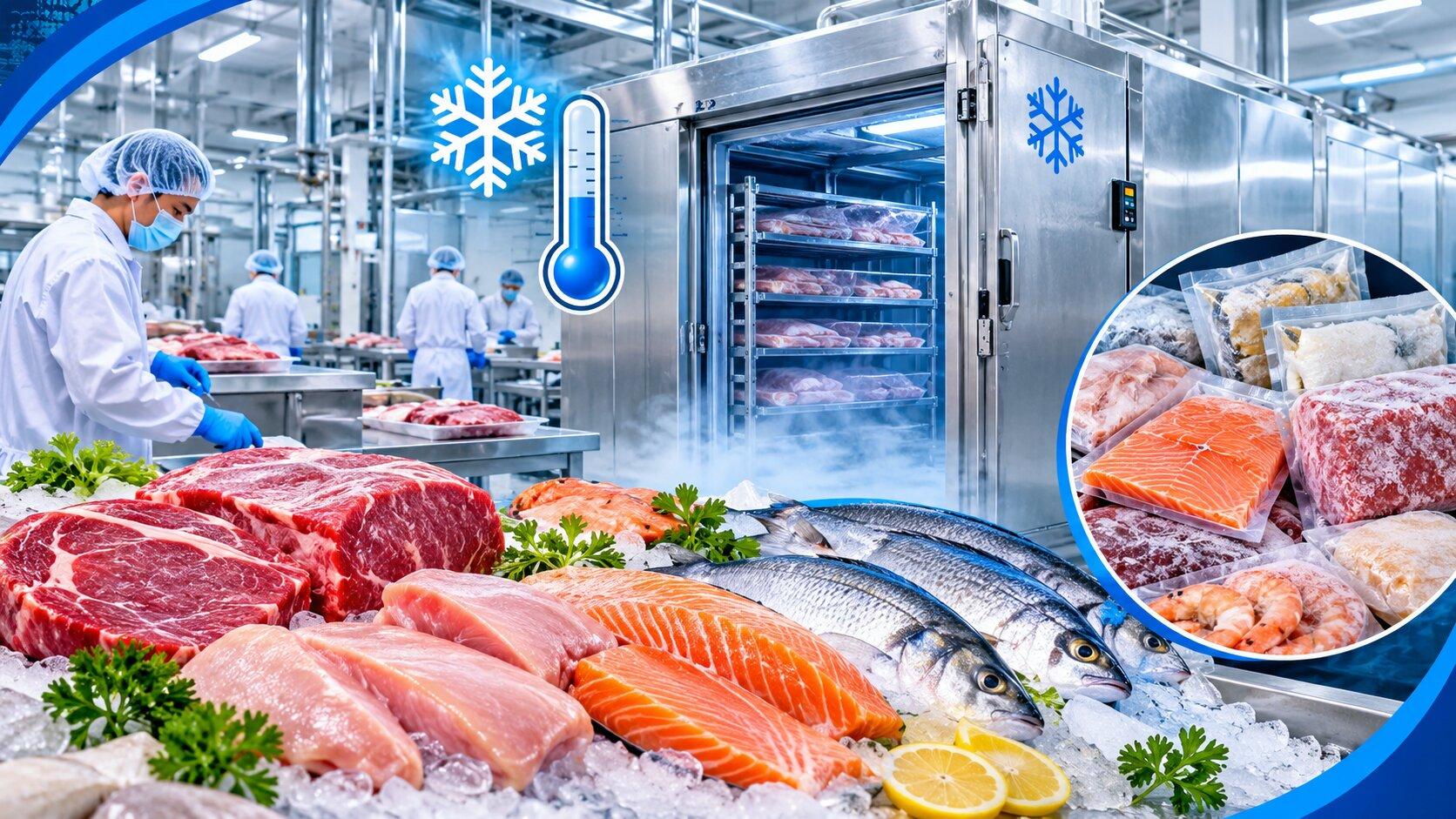
IMARC Group’s report, “Meat and Fish Freezing Plant Project Report 2026: Industry Trends, Plant Setup, Machinery, Raw Materials, Investment Opportunities, Cost and Revenue,” offers a comprehensive guide for establishing a plant. The meat and fish freezing plant setup cost report offers insights into the process, financials, capital investment, expenses, ROI, and more for informed business decisions.
Meat and Fish Freezing Plant Project Report Summary: -
- Comprehensive guide for setting up a meat and fish freezing plant.
- Covers market trends and industry outlook for 2026.
- Detailed project setup, including unit operations and processes.
- Raw material and utility requirements.
- Infrastructure and machinery specifications.
- Workforce and staffing requirements.
- Packaging and transportation details.
- Financial aspects: investment opportunities, cost analysis, and revenue projections.
In addition to covering operational aspects, the report offers detailed insights into the Meat and fish freezing plant process and project economics.
- Detailed insights into the meat and fish freezing plant
- In-depth project economics and financial metrics.
- Covers capital investments and project funding.
- Analysis of operating expenses and income projections.
- Breakdown of fixed and variable costs, direct and indirect expenses.
- Evaluation of ROI (Return on Investment) and NPV (Net Present Value).
- Profit and Loss account analysis.
- Comprehensive financial analysis for decision-making.
- Provides a roadmap for successfully establishing a meat and fish freezing manufacturing.
Request for a Sample Report: https://www.imarcgroup.com/meat-fish-freezing-plant-project-report/requestsample
What is Meat and Fish Freezing?
Meat and fish freezing is a food preservation technique that involves reducing the temperature of meat, poultry, and seafood products below their freezing point to inhibit microbial growth and slow down enzymatic reactions. This process helps preserve the products' freshness, texture, taste, and nutritional properties while extending their storage life. Common commercial freezing techniques include blast freezing, plate freezing, cryogenic freezing, and individual quick freezing (IQF), each designed to accommodate different product types and processing requirements. Frozen meat and seafood are distributed through supermarkets, restaurants, hotels, catering businesses, and international export channels in various forms, including whole cuts, fillets, minced meat, portions, and ready-to-cook products. By minimizing spoilage, reducing food losses, and maintaining product quality, meat and fish freezing plays an essential role in modern food processing and global cold-chain supply networks.
Market Trends and Drivers:
The global meat and fish freezing industry is experiencing steady growth, driven by increasing consumer demand for convenient, nutritious, and longer-lasting protein products. Rapid urbanization, evolving dietary preferences, and changing lifestyles are encouraging consumers to choose frozen meat and seafood that offer convenience, consistent quality, and easier storage. The expansion of organized retail, online grocery platforms, and international food distribution networks is further supporting market growth. Moreover, advancements in industrial refrigeration, automated freezing equipment, and energy-efficient cold storage technologies are improving processing efficiency and helping businesses maintain product quality. The growing presence of quick-service restaurants, hotels, catering companies, and food delivery operators is also contributing to the rising consumption of frozen meat and seafood. Additionally, greater emphasis on food safety, hygiene, and traceability is encouraging investments in advanced freezing, packaging, and temperature-controlled storage solutions. The expansion of livestock farming and aquaculture production is creating further opportunities for commercial freezing facilities, particularly those catering to domestic distribution and export markets. Furthermore, the adoption of sustainable refrigeration systems, environmentally friendly refrigerants, automated cold-chain operations, and smart temperature-monitoring technologies is transforming industry practices. Rising disposable incomes, expanding demand for processed seafood and meat products, and improvements in cold-chain infrastructure across emerging economies are expected to provide continued momentum to the global meat and fish freezing industry.
Key Insights Covered in the Meat and Fish Freezing Plant Report
Market Coverage:
- Market Trends: Analysis of current and emerging trends in the meat and fish freezing market.
- Market Segmentation: Breakdown of the market by different segments.
- Regional Analysis: Distribution and performance of the market across various regions.
- Price Analysis: Evaluation of pricing trends for meat and fish freezing.
- Impact of COVID-19: Examination of the effects of the COVID-19 pandemic on the meat and fish freezing market.
- Market Forecast: Outlook and projections for the meat and fish freezing industry.
Key Aspects Required for Setting Up a Meat and Fish Freezing Plant
Detailed Process Flow:
- Product Overview: Comprehensive description of the meat and fish freezing product and its characteristics.
- Unit Operations Involved: Step-by-step breakdown of the various operations in the production process.
- Mass Balance and Raw Material Requirements: Calculations for material inputs and outputs, along with required quantities of raw materials.
- Quality Assurance Criteria: Standards and procedures to ensure the quality of the final product.
- Technical Tests: Essential tests and evaluations to maintain product consistency and compliance.
Project Details, Requirements, and Costs Involved
- Land, Location, and Site Development: Assessment of land requirements, optimal location selection, and site development costs.
- Plant Layout: Design and layout planning for efficient plant operations.
- Machinery Requirements and Costs: Identification of machinery needed, along with the associated costs.
- Raw Material Requirements and Costs: Determination of the types and quantities of raw materials required and their costs.
- Packaging Requirements and Costs: Specifications for packaging materials and equipment, including associated expenses.
- Transportation Requirements and Costs: Logistics planning and cost estimation for the transportation of raw materials and finished products.
- Utility Requirements and Costs: Analysis of utility needs (such as water, electricity, and fuel) and their associated costs.
- Human Resource Requirements and Costs: Workforce planning, including staffing needs, roles, and costs for labor and management.
Project Economics
- Capital Investments: Initial costs required for setting up the meat and fish freezing plant, including land, equipment, and infrastructure.
- Operating Costs: Ongoing expenses for running the plant, such as raw materials, labor, utilities, and maintenance.
- Expenditure Projections: Detailed forecasts of all costs over the short and long term.
- Revenue Projections: Expected income generated from the sale of meat and fish freezing and by-products.
- Taxation and Depreciation: Analysis of tax obligations, incentives, and asset depreciation over time.
- Profit Projections: Estimated profitability based on costs, revenues, and market conditions.
- Financial Analysis: Comprehensive evaluation of the plant’s financial viability, including cash flow analysis, return on investment (ROI), and break-even point.
Ask Analyst for Customization: https://www.imarcgroup.com/request?type=report&id=39473&flag=C
Customization Options Available:
- Plant Location: Selection of optimal location for the plant.
- Plant Capacity: Customization based on desired production capacity.
- Machinery: Choice between automatic, semi-automatic, or manual machinery.
- List of Machinery Providers: Identification of suitable machinery suppliers.
Key Questions Addressed in This Report:
- How has the meat and fish freezing market performed so far and how will it perform in the coming years?
- What is the market segmentation of the global meat and fish freezing market?
- What is the regional breakup of the global meat and fish freezing market?
- What are the price trends of various feedstocks in the meat and fish freezing industry?
- What is the structure of the meat and fish freezing industry and who are the key players?
- What are the various unit operations involved in a meat and fish freezing plant?
- What is the total size of land required for setting up a meat and fish freezing plant?
- What is the layout of a meat and fish freezing plant?
- What are the machinery requirements for setting up a meat and fish freezing plant?
- What are the raw material requirements for setting up a meat and fish freezing plant?
- And more…
How IMARC Can Help?
IMARC Group is a global management consulting firm that helps the world’s most ambitious changemakers to create a lasting impact. The company provide a comprehensive suite of market entry and expansion services. IMARC offerings include thorough market assessment, feasibility studies, company incorporation assistance, factory setup support, regulatory approvals and licensing navigation, branding, marketing and sales strategies, competitive landscape and benchmarking analyses, pricing and cost research, and procurement research.
Services:
- Plant Setup
- Factoring Auditing
- Regulatory Approvals, and Licensing
- Company Incorporation
- Incubation Services
- Recruitment Services
- Marketing and Sales
Contact Us:
IMARC Group
134 N 4th St. Brooklyn, NY 11249, USA
Email: [email protected]
Tel No:(D) +91 120 433 0800
United States: +1-201971-6302

 English
 Arabic
 French
 Spanish
 Portuguese
 Deutsch
 Dutch
 Italiano
 Russian
 Romaian
 Portuguese (Brazil)
 Greek