


Calculate Your ACT Score at Home A Guide for Self-Studying Students
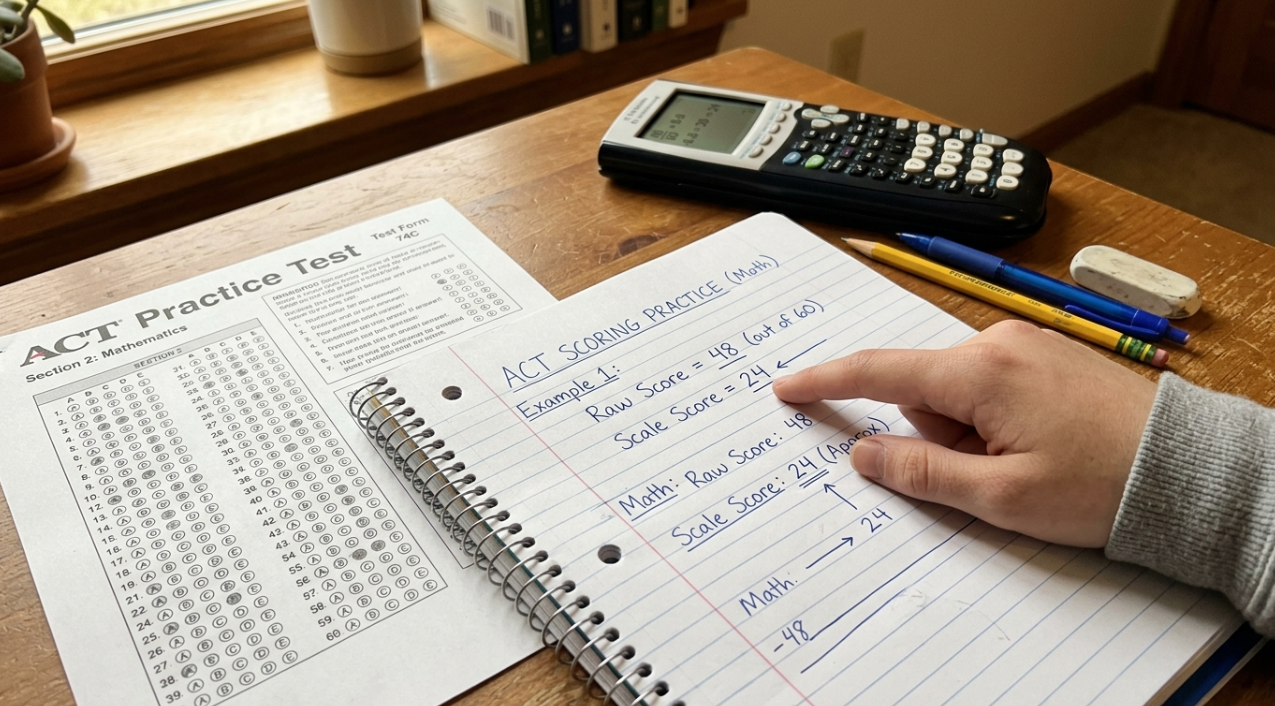
Preparing for the ACT at home has become a practical option for students who want to manage their own study schedules and improve their academic performance. Self-studying allows students to learn at their own pace, choose suitable preparation materials, and practice whenever they have time. However, independent preparation also requires students to monitor their progress and understand how well they are performing.
One important part of this process is learning how to Calculate Your ACT Score without depending on a teacher or coaching center. Understanding your results helps you identify academic strengths, recognize weaknesses, and decide which subjects need more attention.
Fortunately, students can calculate their estimated ACT scores at home using practice test results, scoring formulas, and online tools. This guide explains the process and shares practical tips for making ACT preparation more organized and effective.
Why Self-Studying Students Should Track Their ACT Scores
When preparing independently, students do not always have someone available to evaluate their performance after every practice test. This makes personal score tracking especially important.
Regularly checking your ACT results provides useful information about your academic development. Instead of studying without a clear direction, you can use your scores to understand which subjects require additional practice.
For example, if your English performance is improving while your Math results remain unchanged, you may need to adjust your study schedule. Spending additional time on difficult mathematical concepts could help you achieve more balanced results.
Score tracking also helps students set realistic academic goals. By reviewing previous practice tests, you can measure your progress and determine whether your preparation strategy is working.
Understand the ACT Scoring System Before Calculating Your Results
Before attempting to calculate your results, it is important to understand the current ACT scoring structure.
The enhanced ACT format includes three required sections, English, Math, and Reading. Science is available as an optional section.
Each of the three required sections receives a scaled score ranging from 1 to 36. These individual scores are used to determine the Composite score.
The Composite score is calculated by adding the English, Math, and Reading scores and dividing the total by three. The result is then rounded to the nearest whole number.
For example, imagine a student receives the following section scores.
-
English 24
-
Math 28
-
Reading 26
The calculation would be:
(24 + 28 + 26) ÷ 3 = 26
The estimated Composite score is 26.
Remember that the optional Science score is reported separately and is not included in the current Composite score calculation. Understanding this distinction helps prevent common scoring mistakes.
How to Calculate Your ACT Score at Home
Students do not need expensive software or professional tutoring to estimate their ACT results. With the right information, they can complete basic score calculations at home.
Step 1 Complete a Full ACT Practice Test
Start by taking a reliable ACT practice test that follows the current examination format.
Try to complete the test under realistic conditions. Set a timer, avoid distractions, and answer questions without checking the solutions during the examination.
Practicing under timed conditions helps you understand how well you manage the available time and handle different question types.
Once you finish, check your answers using the official answer key or scoring information provided with the practice test.
Step 2 Record Your Correct Answers
After checking your responses, record the number of correct answers in each section.
These numbers represent your raw scores. A raw score tells you how many questions you answered correctly, but it is not automatically the same as your final scaled score.
Keep your English, Math, and Reading results separate to avoid confusion.
Step 3 Convert Raw Scores Into Scaled Scores
The next step is estimating your scaled scores.
ACT scoring uses conversion methods to translate raw performance into scores ranging from 1 to 36. These conversions can differ between test forms, so students should use the appropriate scoring guide for their practice examination.
Avoid assuming that the same number of correct answers always produces an identical scaled score.
Once you have the estimated scaled scores for the required sections, you can calculate your Composite score.
Step 4 Calculate Your Composite Score
Add your English, Math, and Reading scores together and divide the total by three.
For example, if your section scores are 27, 25, and 29, the calculation will be:
(27 + 25 + 29) ÷ 3 = 27
Your estimated Composite score is 27.
This simple formula makes it possible to Calculate Your ACT Score independently without complicated mathematical procedures.
Step 5 Review Your Performance
After calculating your result, review each section separately.
Do not focus entirely on your Composite score. Your individual results provide valuable information about your preparation.
If you perform well in English but struggle with Reading, consider practicing comprehension exercises and learning how to identify important details in passages.
Similarly, if your Math score is lower than your other section scores, focus on the mathematical concepts you find challenging.
Use an Online ACT Score Calculator to Save Time
Although manual calculations are useful for understanding the scoring process, online tools can make score estimation faster and more convenient.
An online ACT Score Calculator allows students to enter their section scores and estimate their Composite results without repeatedly performing calculations.
For self-studying students, this can be especially helpful because it makes regular performance tracking easier.
Exam Predictor offers an online ACT Score Calculator that students can use to simplify the score estimation process.
After completing a practice examination, you can use the calculator to review your results and better understand your performance.
However, remember that an online calculator does not automatically determine your raw-to-scaled score conversion. You should first obtain accurate section scores using the appropriate scoring information before entering them.
Create a Personal ACT Score Tracking Routine
Self-studying requires consistency. Calculating your score once is useful, but reviewing your results regularly provides a better understanding of your progress.
Create a simple routine that allows you to evaluate your performance after every practice examination.
Start by recording your section scores and Composite score. Next, compare them with your previous results to identify improvements or areas where your performance has declined.
You should also maintain notes about difficult questions. For example, write down the mathematical concepts you struggled with or the reading passages that took too much time.
Reviewing these notes before your next practice test can help you avoid repeating similar mistakes.
Try to focus on gradual improvement rather than expecting major score increases after every study session. Consistent learning and regular practice are more valuable than rushing through multiple examinations without reviewing your mistakes.
Common Mistakes Self-Studying Students Should Avoid
Independent learners sometimes make mistakes when calculating or interpreting their ACT results.
One common mistake is confusing raw scores with scaled scores. Remember that the number of correct answers must be converted using the appropriate scoring information.
Another mistake is using outdated ACT scoring guides. Always choose resources that match the examination format you are preparing for.
Some students also include the optional Science score when calculating their Composite score. Under the current enhanced format, only English, Math, and Reading contribute to the Composite.
Additionally, avoid comparing practice test results without considering the conditions under which each test was completed. Completing one examination with extra time and another under official timing conditions can produce misleading comparisons.
Finally, do not treat an estimated result as an official score. Online calculators and practice tests are useful preparation resources, but official ACT score reports remain the authoritative record of your examination performance.
How Accurate Score Tracking Improves Your Study Strategy
Accurate score tracking helps transform self-study from an unstructured activity into a more organized learning process.
When you regularly Calculate Your ACT Score, you can identify patterns in your performance and make informed decisions about your preparation.
For instance, if your Reading score remains lower than your other results across several practice tests, you can dedicate more time to reading comprehension and passage analysis.
If your scores are improving consistently, you can continue using the strategies that are producing positive results.
You should also set achievable goals. Instead of expecting an immediate increase of several points, focus on improving specific skills and gradually strengthening your overall performance.
This approach makes ACT preparation more manageable and helps students stay motivated throughout their learning journey.
Final Thoughts
Preparing for the ACT at home gives students flexibility and control over their learning schedules. However, successful self-study requires more than completing practice questions. Understanding your results and tracking academic progress are equally important.
By learning the scoring system, completing realistic practice tests, converting raw scores correctly, and reviewing individual section performance, you can estimate your results with greater confidence.
An online ACT Score Calculator can also simplify the process and save time during preparation. With Exam Predictor, students can conveniently estimate their results and stay informed about their progress.
Learning how to Calculate Your ACT Score at home allows you to take greater responsibility for your preparation, identify opportunities for improvement, and work toward your college admission goals with a clearer study strategy.

 English
 Arabic
 French
 Spanish
 Portuguese
 Deutsch
 Turkish
 Dutch
 Italiano
 Russian
 Portuguese (Brazil)
 Greek