


Global Space Robotics Market Size to Reach USD 10.6 Billion by 2034, Growing at 7.32% CAGR
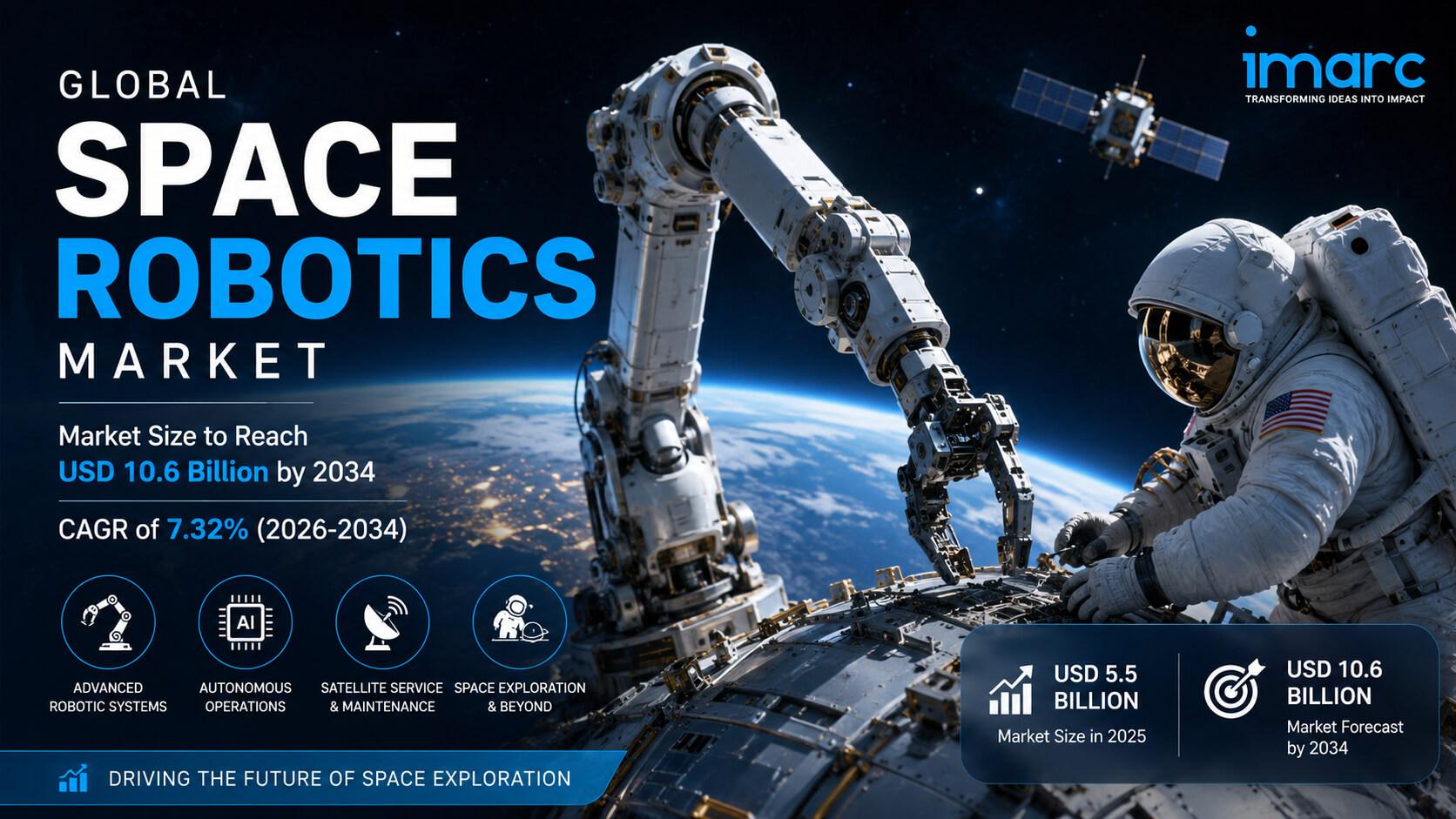
Global Space Robotics Market Outlook to 2026-2034
According to a research report by IMARC Group, the global space robotics market size reached USD 5.5 Billion in 2025. Looking forward, IMARC Group expects the market to reach USD 10.6 Billion by 2034, exhibiting a growth rate (CAGR) of 7.32% during 2026-2034. Space robotics is increasingly being adopted across assembling, maintenance, satellite servicing, transportation, and space exploration activities, particularly for operations in extremely hostile space environments. Market growth is primarily supported by the growing need for efficient satellite repair and maintenance, technological advancements, increasing utilization of autonomous systems, expanding space programs, and the integration of artificial intelligence (AI) and deep learning (DL) into robotic systems.
Space Robotics Market Key At a Glance
-
Base Year: 2025
-
Historical Period: 2020–2025
-
Forecast Period: 2026–2034
-
Market Size (2025): USD 5.5 Billion
-
Market Forecast (2034): USD 10.6 Billion
-
CAGR (2026–2034): 7.32%
Space Robotics Market Report: Key Highlights
-
Market Size & Growth: The global space robotics market share reached USD 5.5 Billion in 2025 and is projected to reach USD 10.6 Billion by 2034, registering a CAGR of 7.32% during 2026–2034.
-
Major Market Drivers: Growing demand for efficient repair, servicing, and maintenance of geostationary satellites, technological advancements, increasing adoption of autonomous systems, and the rising number of space programs are supporting market expansion.
-
Key Market Trends: Increasing use of autonomous robotic systems, growing integration of artificial intelligence (AI) and deep learning (DL), and the development of robots capable of performing complex tasks with minimal human assistance are shaping the market.
-
By Solution: The market is segmented into remotely operated vehicles (ROV), rovers/spacecraft landers, space probes, remote manipulator systems (RMS), robotic arms/manipulator systems, gripping and docking systems, software, and services.
-
By Application: The market covers deep space, near space, and ground applications, with applications including space transportation, space exploration, and in-space maintenance.
-
By End Use: The market is divided into commercial and government segments.
-
Key Market Opportunities: Growing requirements for satellite servicing, expanding space exploration activities, increasing autonomous operations, and advancements in AI-enabled robotics are creating opportunities for market participants.
Request for a Sample Report for Detailed Evaluation: https://www.imarcgroup.com/space-robotics-market/requestsample
What Is Driving Space Robotics Market Growth in 2026?
Growing Need for Satellite Repair, Servicing, and Maintenance
The significant need for efficient repair, servicing, and maintenance of geostationary satellites represents one of the key factors catalyzing the demand for space robotics across the globe. Space robots can support maintenance and servicing activities in challenging environments while reducing the need for direct human intervention.
The utilization of robotic systems for satellite-related operations can help minimize risks, improve operational capabilities, and support more efficient space missions. As the requirement for reliable satellite servicing continues to grow, space robotics is gaining importance across a range of applications.
Technological Advancements and Increasing Use of Autonomous Systems
Various technological advancements, combined with the increasing utilization of autonomous systems in space, are contributing to market growth. Space robotics enables operators to perform activities in environments where conventional human-led operations can be difficult or risky.
These systems can extend the capabilities of astronauts by providing greater handling capabilities and supporting operations that require precision and extended duration. The growing development of autonomous robotic technologies is therefore strengthening the role of robotics across space exploration and servicing missions.
Growing Number of Space Programs
The increasing number of space programs worldwide is supporting demand for advanced robotic systems. Government agencies and space organizations are developing technology roadmaps and programs focused on advancing space robotics capabilities.
For instance, the European Commission funded PERASPERA and SpacePlan 2020, which is coordinated by the European Space Agency (ESA) for planning technology roadmaps in space robotics. Project PERASPERA aims to develop an integrated plan for space robotics technology during 2023-2024. Such initiatives are contributing to the development and advancement of space robotics technologies.
Integration of Artificial Intelligence and Deep Learning
Emerging technologies such as deep learning (DL) and artificial intelligence (AI) are being increasingly utilized in the robotics industry, supporting the development of more capable space robotic systems.
Key players are introducing AI-based robots designed to enhance mobility in space and provide greater exploration capabilities. These robots can perform highly complex tasks for longer durations while operating with minimal human assistance, creating a positive outlook for the space robotics market.
Space Robotics Market Trends
Increasing Adoption of Autonomous Space Robotics
The growing adoption of autonomous systems is emerging as a significant trend in the space robotics industry. Autonomous robots can support space operations while reducing reliance on continuous human intervention.
Their ability to operate for extended periods and perform complex activities is particularly valuable in environments where direct human access is difficult. This is encouraging the development of increasingly capable autonomous robotic platforms.
Growing Demand for In-Space Maintenance
The increasing requirement for maintenance and servicing activities in space is creating new opportunities for robotic systems. Space robotics can assist in repairing, maintaining, and servicing satellites and other space assets.
As space missions become increasingly sophisticated, robotic systems capable of handling maintenance tasks are expected to play an increasingly important role in extending the operational capabilities of space infrastructure.
Advancements in AI-Based Robotic Systems
The integration of AI and deep learning technologies is supporting the development of advanced robotic systems with improved mobility, handling capabilities, and autonomy.
AI-enabled robots can perform complex tasks with reduced human assistance, making them increasingly suitable for exploration and operations in challenging space environments.
Expansion of Space Exploration Activities
The growing focus on space exploration is contributing to the demand for robotic systems capable of operating on planetary surfaces and in other hostile environments. Space robotics can extend human capabilities by providing greater handling and exploration capabilities while reducing operational risks.
Space Robotics Market Segmentation Analysis
IMARC Group provides an analysis of the key trends in each segment of the global space robotics market, along with forecasts at the global, regional, and country levels for 2026-2034. The market has been categorized based on solution, application, and end use.
By Solution
-
Remotely Operated Vehicles (ROV)
-
Rovers/Spacecraft Landers
-
Space Probes
-
Others
-
Remote Manipulator System (RMS)
-
Robotic Arms/Manipulator Systems
-
Gripping and Docking Systems
-
Others
-
Software
-
Services
The market includes a broad range of robotic solutions designed to support space exploration, transportation, servicing, and other mission requirements.
Remotely Operated Vehicles (ROV)
Remotely operated vehicles support space missions by enabling robotic operations in environments where direct human intervention can be difficult or risky. Their application can help improve operational capabilities while minimizing risks associated with hostile space environments.
Rovers/Spacecraft Landers
Rovers and spacecraft landers support exploration activities, particularly on planetary surfaces. These systems extend human capabilities by enabling operations and exploration in environments that may not be immediately accessible to astronauts.
Space Probes
Space probes are used to support exploration and scientific activities in space. Their ability to operate remotely and collect information from challenging environments makes them an important component of space exploration missions.
Remote Manipulator System (RMS)
Remote manipulator systems support handling and manipulation activities in space. These systems can provide astronauts with enhanced handling capabilities and assist in complex operations requiring precision.
Robotic Arms/Manipulator Systems
Robotic arms and manipulator systems are designed to perform complex handling and manipulation tasks. Their ability to operate with precision and provide greater reach supports their application across a variety of space missions.
Gripping and Docking Systems
Gripping and docking systems support the connection, handling, and servicing of space assets. Their use can facilitate robotic operations involving spacecraft and other space infrastructure.
Software
Software forms an important part of space robotics by supporting the control and operation of robotic systems. Advancements in autonomous technologies, AI, and deep learning are contributing to the development of increasingly capable robotic software systems.
Services
Space robotics services support the deployment and utilization of robotic systems across different mission requirements, including exploration, transportation, and maintenance activities.
By Application
Deep Space
-
Space Transportation
-
Space Exploration
-
Others
Deep-space applications involve robotic systems operating beyond near-space environments. Space robotics can support transportation and exploration activities while enabling operations in extremely hostile environments.
Near Space
-
Space Transportation
-
Space Exploration
-
In-Space Maintenance
-
Others
Near-space applications include transportation, exploration, and in-space maintenance activities. The growing need for efficient satellite servicing and maintenance is supporting the use of robotics across this application area.
Ground
Ground applications support space missions and robotic systems through activities conducted on Earth. These applications complement space-based operations and contribute to the broader deployment and management of space robotics technologies.
By End Use
-
Commercial
-
Government
The space robotics market serves both commercial and government end users. Government space programs represent an important area of application, while the increasing utilization of space technologies is also supporting commercial opportunities.
By Region
-
North America
-
United States
-
Canada
-
-
Asia Pacific
-
China
-
Japan
-
India
-
South Korea
-
Australia
-
Indonesia
-
Others
-
-
Europe
-
Germany
-
France
-
United Kingdom
-
Italy
-
Spain
-
Russia
-
Others
-
-
Latin America
-
Brazil
-
Mexico
-
Others
-
-
Middle East and Africa
The market report provides a comprehensive analysis of the major regional markets, covering North America, Asia Pacific, Europe, Latin America, and the Middle East and Africa.
Competitive Landscape in the Space Robotics Industry
The competitive landscape of the space robotics industry is characterized by the presence of companies developing robotic platforms, autonomous systems, manipulation technologies, and other solutions for space exploration, transportation, maintenance, and servicing applications.
Leading players are focusing on technological development and the introduction of advanced robotic systems capable of performing increasingly complex activities with minimal human assistance. The integration of artificial intelligence and deep learning is also supporting the development of more autonomous and capable robotic solutions.
Key Space Robotics Market Players Include
-
Altius Space Machines (Voyager Space Holdings Inc.)
-
Astrobotic Technology Inc.
-
GITAI Inc.
-
Honeybee Robotics (Ensign-Bickford Industries)
-
Intuitive Machines LLC
-
Made In Space Inc. (Redwire LLC)
-
Maxar Technologies Inc.
-
Metecs LLC
-
Motiv Space Systems Inc.
-
Northrop Grumman Corporation
-
Oceaneering International Inc.
-
Olis Robotics
Market Drivers, Challenges & Opportunities
Major Market Drivers
-
Growing Need for Satellite Servicing: Increasing requirements for efficient repair, servicing, and maintenance of geostationary satellites are supporting demand for space robots.
-
Technological Advancements: Continued advances in robotics technology are enabling more capable and efficient robotic systems for space missions.
-
Increasing Adoption of Autonomous Systems: Autonomous robotics can perform complex tasks with minimal human assistance, expanding their role in space operations.
-
Growing Number of Space Programs: Increasing space programs and technology development initiatives are contributing to demand for advanced robotic solutions.
-
Artificial Intelligence and Deep Learning: The integration of AI and DL is enhancing the capabilities, mobility, and autonomy of space robotic systems.
Key Challenges
The supplied report content identifies several market growth factors and opportunities but does not provide a specific detailed breakdown of key market challenges. Therefore, no additional challenges have been added beyond the information provided.
Emerging Opportunities
-
In-Space Maintenance: Increasing requirements for satellite repair, servicing, and maintenance are creating opportunities for robotic systems.
-
Autonomous Operations: The development of robots capable of performing complex activities with minimal human assistance is opening new application opportunities.
-
AI-Based Robotics: Growing adoption of AI and deep learning technologies is supporting the development of more advanced space robots.
-
Space Exploration: Increasing exploration activities are creating demand for robotic systems capable of operating on planetary surfaces and in hostile environments.
Space Robotics Market FAQs
1. What is the current size of the space robotics market?
The global space robotics market reached USD 5.5 Billion in 2025 and is expected to reach USD 10.6 Billion by 2034, expanding at a CAGR of 7.32% during 2026–2034.
2. What is driving the growth of the space robotics market?
The market is driven by the growing need for satellite repair, servicing, and maintenance, technological advancements, increasing utilization of autonomous systems, the growing number of space programs, and the integration of artificial intelligence and deep learning.
3. What are the major solutions in the space robotics market?
The market includes remotely operated vehicles (ROV), rovers/spacecraft landers, space probes, remote manipulator systems, robotic arms/manipulator systems, gripping and docking systems, software, and services.
4. What are the major applications of space robotics?
The major applications include deep space, near space, and ground, with deep- and near-space applications covering areas such as space transportation, space exploration, and in-space maintenance.
5. Who are the key players in the space robotics market?
Major players include Altius Space Machines, Astrobotic Technology Inc., GITAI Inc., Honeybee Robotics, Intuitive Machines LLC, Made In Space Inc., Maxar Technologies Inc., Motiv Space Systems Inc., Northrop Grumman Corporation, Oceaneering International Inc., and Olis Robotics, among others.
Conclusion: Space Robotics Market Outlook to 2034
The global space robotics market is set for steady growth through 2034, supported by the increasing need for efficient satellite repair, servicing, and maintenance, technological advancements, growing utilization of autonomous systems, and the expansion of space programs.
The increasing integration of artificial intelligence and deep learning is further enhancing the capabilities of space robots, enabling them to perform complex tasks for longer durations with minimal human assistance. These developments are strengthening the role of robotics across space transportation, exploration, maintenance, and other mission-critical activities.
As space exploration and satellite-related activities continue to evolve, the demand for robotic systems capable of operating in extremely hostile environments is expected to increase. Companies developing advanced autonomous, AI-enabled, and highly capable robotic solutions will be well positioned to benefit from the continued evolution of the space robotics industry through 2034.
About the Author
IMARC Group is a leading global market research company providing data-driven insights and strategic consulting services across diverse industries. The company delivers comprehensive research reports covering automotive, technology, healthcare, chemicals, packaging, food & beverages, consumer goods, and industrial sectors, helping organizations make informed business decisions and identify emerging growth opportunities.
Media & Sales Contact
IMARC Group
United States: +1-201-971-6302
India: +91-120-433-0800
United Kingdom: +44-753-714-6104

 English
 Arabic
 French
 Spanish
 Deutsch
 Turkish
 Dutch
Dutch
 Italiano
 Russian
 Romaian
 Portuguese (Brazil)
 Greek
Greek