


How to Complete a Degree in One Year in India: Admission Guide 2027
Introduction
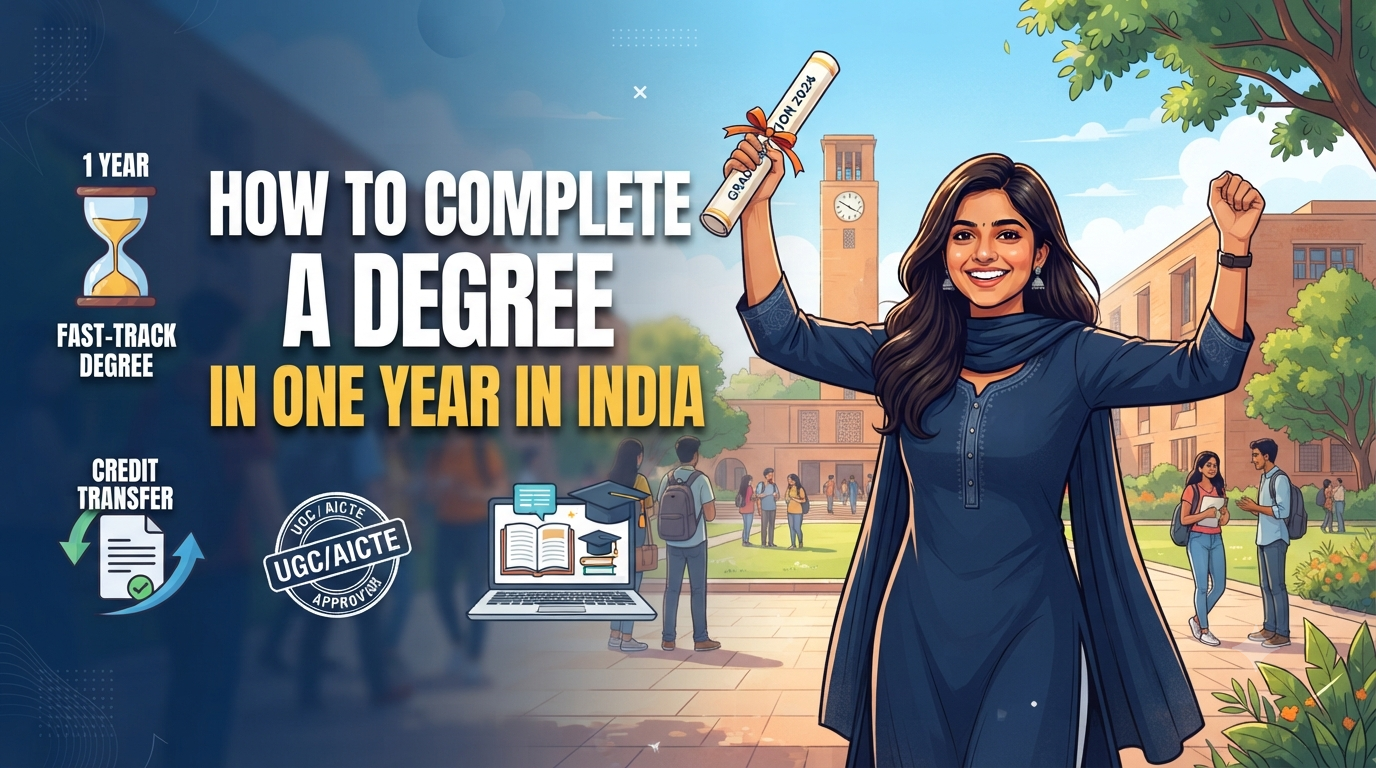
Completing a graduation degree is an important milestone for students who want to build a successful career, pursue higher education or improve their professional qualifications. However, many students are unable to finish their education within the expected time. Some discontinue college because of financial difficulties, family responsibilities, employment opportunities or personal circumstances. Others have completed a few semesters but could not continue their studies.
For such learners, returning to education and exploring flexible degree-completion options can be a valuable opportunity. In 2027, students can investigate different academic pathways, including credit transfer, re-admission, online education and distance learning, depending on their previous qualifications and university regulations.
The answer depends on the student's previous academic record, accumulated credits, course requirements and the admission rules of the university. Although the term Degree in One Year is frequently used in education searches, completing a recognized bachelor's degree in one year is not automatically permitted for every student.
1. What Does Completing a Degree in One Year Mean?
A Degree in One Year generally refers to an educational opportunity promoted towards students who want to complete their unfinished graduation or explore a shorter academic pathway.
It is particularly relevant to people who have previously attended college, earned academic credits or discontinued their education before completing the required qualification.
For example:
-
A student completed the first year of BA but discontinued studies.
-
A BCom student passed several semesters but could not finish the programme.
-
A working professional wants to resume an incomplete graduation.
-
A student has a study gap and wants to continue higher education.
-
A college dropout wants to understand whether previously earned credits can be recognised.
In these situations, the student may explore credit recognition, credit transfer or re-admission, subject to the applicable academic regulations.
It is important to understand that a short-duration course or an advertisement promising a degree in one year does not automatically mean that the qualification is valid. The university must follow applicable regulatory requirements and award the degree through an approved academic pathway.
2. Who Can Apply for Degree Completion in 2027?
Students from different educational backgrounds may explore degree-completion opportunities. However, eligibility depends on the programme, university admission policy and previous academic achievements.
The following categories of students can investigate suitable options.
1. College Dropout Students
Students who left college after completing one or two years may be able to continue their education. Their previous marksheets, examination records and earned credits can help the university assess their eligibility.
2. Students with a Study Gap
Some students discontinue their education for several years because of personal or professional responsibilities. They can approach universities to understand re-admission rules, credit validity and available academic pathways.
3. Working Professionals
Many employees want to complete graduation to qualify for promotions, apply for new positions or pursue postgraduate education. Flexible learning options may help them manage education alongside their jobs.
4. Students with Incomplete Graduation
Students who have passed some semesters but could not complete the remaining examinations can explore whether their previous academic work is eligible for recognition.
5. Students Seeking Credit Transfer
Learners who have completed courses or semesters at another recognised institution may enquire about transferring eligible credits to a new programme. Acceptance is subject to the receiving university's rules.
3. Understanding Degree Completion Through Credit Transfer
Credit transfer is one of the important concepts for students exploring Degree Completion Through Credit Transfer.
Under this process, a university may recognise eligible academic credits earned by a student at another institution. Instead of repeating all previously completed subjects, the student may receive credit for qualifying coursework, depending on academic equivalence and institutional regulations.
The University Grants Commission (UGC) has introduced the Academic Bank of Credits (ABC) framework to facilitate academic mobility and the digital storage and transfer of credits between higher education institutions.
How does credit transfer work?
-
The student collects previous university marksheets and academic records.
-
The student applies to a university offering the relevant programme.
-
The receiving university reviews previous qualifications and credits.
-
Academic authorities evaluate subject equivalence and credit eligibility.
-
The university informs the student about accepted credits and remaining requirements.
-
The student completes the prescribed examinations, coursework and other academic requirements.
For example, a student who previously completed several semesters of BCom may request an evaluation of those credits. If the receiving university accepts the eligible credits, the student may continue from an appropriate academic stage rather than starting the entire programme again.
However, credit transfer does not guarantee graduation within one year. The remaining credits, programme duration and university regulations determine the actual completion timeline.
4. What Is Fast Track Degree Admission 2027?
Fast Track Degree Admission 2027 is a commonly searched term among students looking for flexible ways to complete their graduation.
It generally refers to exploring admission routes that may help eligible students continue their unfinished education without unnecessarily repeating previously completed academic work.
Students should understand the difference between faster academic progression and an unauthorised shortened degree programme.
A legitimate admission process must follow the university's approved curriculum, minimum duration requirements, credit structure and examination rules.
Important points about fast-track admission:
-
Previous academic records may be considered for credit evaluation.
-
Admission depends on eligibility and programme availability.
-
Credit transfer must be approved by the receiving institution.
-
Students must complete all remaining compulsory credits.
-
Examinations and assessments must follow university regulations.
-
The final degree must be awarded by a legally authorised university.
Before applying, students should ask the university for written confirmation of the admission route, course duration, accepted credits and degree-awarding arrangements.
5. Popular One Year Degree Courses in India
Students searching for One Year Degree Courses in India often want to know which graduation programmes are available through flexible learning or credit-based admission.
Some popular undergraduate programmes include:
Bachelor of Arts (BA)
BA is a popular undergraduate programme for students interested in humanities, languages, social sciences and related subjects. Students with previous BA credits can enquire about re-admission or credit recognition.
Bachelor of Commerce (BCom)
BCom is suitable for learners interested in accounting, finance, business and commerce. Working professionals and students with incomplete commerce education can explore eligible degree-completion routes.
Bachelor of Business Administration (BBA)
BBA focuses on management, marketing, business communication and organisational studies. Students interested in business careers can consider this programme according to their qualifications.
Bachelor of Computer Applications (BCA)
BCA is designed for students interested in computers, software development, programming and information technology. Applicants should check programme-specific eligibility and delivery-mode recognition.
Bachelor of Science (BSc)
BSc programmes cover scientific subjects and related disciplines. Practical components, laboratory requirements and programme-specific regulations should be checked before admission.
Important: These are popular degree programmes, not a list of courses universally available for completion in one year. Students must verify the approved duration and credit requirements of their chosen programme.
6. Can You Complete Graduation in One Year After a Study Gap?
Yes, students with a study gap can explore opportunities to resume their education. However, whether they can complete their graduation within one year depends on their previous academic progress and the applicable university rules.
A study gap does not automatically make a student ineligible for further education.
Consider these examples:
-
A student who discontinued BA after the first year may enquire about re-admission and credit validity.
-
A student who completed two years of BCom may request an evaluation of previously earned credits.
-
A student who left BBA midway may ask about programme continuity and subject equivalence.
-
A working professional with an incomplete degree may explore recognised online or distance-learning options.
The first step is to obtain previous academic documents and approach the university for an official eligibility assessment.
Students should avoid admission offers that promise a guaranteed degree without checking previous qualifications or academic requirements.
7. Important UGC Rules and Regulations for 2027
Understanding university recognition and regulatory requirements is essential before choosing a Degree in One Year programme.
The UGC Minimum Standards of Instruction for the Grant of Undergraduate Degree and Postgraduate Degree Regulations, 2025 provide an important framework for undergraduate and postgraduate education.
Under these regulations, undergraduate programmes generally have a duration of three or four years, with provisions for multiple entry and exit and certain shorter or longer pathways as specified in the regulations.
For example, the regulations describe a three-year undergraduate degree requiring 120 credits and a four-year Honours or Honours with Research pathway requiring the prescribed higher credit requirements. They also provide for students to resume eligible studies within the permitted credit-validity period.
Students should keep the following points in mind:
-
Choose a university legally authorised to award the relevant degree.
-
Verify the university's approved programme and admission pathway.
-
Check whether the programme is recognised for the intended academic session.
-
Confirm the applicable course duration and credit requirements.
-
Understand the university's credit transfer and re-admission policy.
-
Obtain written confirmation before paying admission fees.
For online and distance education, check the UGC Distance Education Bureau (DEB) recognition status for the specific university, programme and admission session. Recognition in one academic session does not automatically establish recognition in another.
You can check the official resources here:
8. Documents Required for Degree Completion Admission
Students should prepare their educational documents before applying for admission. The exact requirements may differ between universities.
Commonly requested documents include:
-
Class 10 marksheet and certificate.
-
Class 12 marksheet and certificate.
-
Previous university marksheets.
-
Previous college transfer or migration certificate, if required.
-
Provisional certificate, if applicable.
-
Academic Bank of Credits details, where relevant.
-
Government-issued identity proof.
-
Passport-size photographs.
-
Previous enrolment or registration details.
-
Any additional documents requested by the university.
Students applying for credit transfer should pay particular attention to semester-wise marksheets, course details and credit information. These documents help academic authorities assess previous learning.
9. Step-by-Step Process for Fast Track Degree Admission 2027
Students can follow a systematic process to identify a suitable degree-completion option.
Step 1: Identify Your Previous Qualification
First, determine whether you completed Class 12, one year of graduation, two years of graduation or several semesters of an undergraduate programme.
Step 2: Select Your Preferred Course
Choose a programme according to your academic background and future career plans. Popular choices include BA, BCom, BBA, BCA and BSc.
Step 3: Research Recognised Universities
Shortlist universities that offer the required programme through an approved mode of education.
Step 4: Check Credit Transfer Eligibility
If you have previously studied at another university, request an official assessment of your academic credits.
Step 5: Understand the Admission Structure
Ask about course duration, remaining subjects, examinations, attendance, practical requirements and applicable fees.
Step 6: Submit the Application
Complete the admission form and provide accurate academic documents. Do not submit incorrect or incomplete information.
Step 7: Receive Official Admission Confirmation
Proceed only after receiving confirmation from the university regarding your eligibility and admission status.
Step 8: Complete the Academic Requirements
Attend prescribed classes or learning activities, complete assignments and appear for examinations as required.
Step 9: Obtain Your Degree
After successfully fulfilling all academic and administrative requirements, the university awards the relevant degree.
10. Online Degree vs Distance Education: Which Is Better?
Students looking for flexible education often compare online learning and distance education. Both options can support learners who cannot attend regular college, but their teaching methods are different.
|
Feature |
Online Education |
Distance Education |
|
Learning method |
Digital classes and online resources |
Self-learning materials and study resources |
|
Study flexibility |
Flexible |
Flexible |
|
Student interaction |
Online classes and discussions |
Depends on university arrangements |
|
Assignments |
Usually online |
Online or offline, depending on programme |
|
Examinations |
As prescribed by university |
As prescribed by university |
|
Suitable for |
Working professionals and students |
Independent learners and working students |
The right option depends on your learning preferences, available time, internet access and academic requirements.
Before enrolling, verify that the particular university and programme have the required UGC recognition for the relevant admission session.
11. Benefits of Completing Your Graduation
Completing graduation can create several academic and professional opportunities.
Better Career Opportunities: Many private-sector and government-sector positions require a recognised bachelor's degree as a minimum educational qualification.
Higher Education Opportunities: Graduation can help students become eligible to apply for postgraduate programmes such as MBA, MA, MCom, MSc and MCA, subject to admission requirements.
Professional Development: A degree can strengthen your educational profile and support long-term career planning.
Personal Achievement: Returning to education after a study gap can help students achieve an important personal goal.
Career Growth for Working Professionals: Employees who previously discontinued college may improve their eligibility for certain promotions and professional opportunities.
12. How to Choose the Right University for a One Year Degree Programme?
Selecting the right university is one of the most important decisions in the admission process. Students should not choose an institution simply because it advertises a short completion period.
Consider these factors before applying:
-
University Recognition: Check whether the institution is legally authorised to award the degree.
-
Programme Recognition: Verify the specific programme and mode of education.
-
Credit Transfer Policy: Understand how previously earned credits are evaluated.
-
Academic Duration: Confirm the minimum permitted duration of the programme.
-
Examination System: Ask about examinations, assignments and practical assessments.
-
Fee Structure: Request complete information about tuition fees, examination charges and other expenses.
-
Student Support: Check whether academic guidance and administrative assistance are available.
-
Degree Verification: Understand how the university verifies and issues its final qualification.
A genuine university should provide clear information about the programme, eligibility conditions, admission process and academic requirements.
13. Common Mistakes to Avoid During Degree Completion Admission
Students should be careful when choosing a programme advertised as a Fast Track Degree.
Some common mistakes include:
-
Trusting advertisements that promise a guaranteed graduation degree in one year.
-
Joining an institution without checking its recognition status.
-
Ignoring the university's minimum course-duration requirements.
-
Paying admission fees without receiving official confirmation.
-
Applying without checking previous credit eligibility.
-
Assuming that every distance or online programme is automatically recognised.
-
Choosing a course without considering future higher-education requirements.
Always verify the admission details directly with the university before making a decision.
14. Frequently Asked Questions (FAQs)
Q1. How can I complete a degree in one year in India?
You should first review your previous educational qualifications and academic credits. Contact a recognised university to understand whether re-admission, credit transfer or another approved academic pathway is available. A one-year completion period cannot be guaranteed.
Q2. Is a Degree in One Year valid in India?
A degree's validity depends on the university's legal authority, applicable UGC regulations, programme approval and compliance with the prescribed academic requirements. A shortened duration alone does not establish validity.
Q3. Can college dropout students complete graduation?
Yes, college dropout students can explore re-admission and credit recognition opportunities. Their eligibility depends on previous academic records and university regulations.
Q4. Can I complete graduation after a five-year study gap?
A study gap does not automatically disqualify a student. The university will assess previous credits, their validity and the applicable admission rules.
Q5. What is Degree Completion Through Credit Transfer?
It is a process through which a receiving university may recognise eligible academic credits earned at another institution, subject to its credit-transfer policy and applicable regulations.
Q6. Which courses are popular for degree completion?
BA, BCom, BBA, BCA and BSc are popular undergraduate options. Availability and eligibility depend on the university and the approved programme structure.
Q7. Can working professionals apply for degree completion?
Yes. Working professionals can explore recognised online, distance or other approved learning options according to their academic qualifications and programme eligibility.
Q8. What is the admission process for Fast Track Degree Admission 2027?
The process generally involves reviewing previous qualifications, selecting a suitable university, checking credit-transfer eligibility, submitting documents and completing the prescribed admission formalities.
Conclusion
Completing graduation is an important step towards achieving academic and professional goals. Students who discontinued college, experienced a study gap or started working before completing their education should not assume that their academic journey has ended.
In 2027, students can explore different educational pathways, including re-admission, credit transfer, online learning and distance education, depending on their qualifications and the university's regulations.
If you are searching for How to Complete a Degree in One Year, begin by understanding your previous academic credits and identifying a recognised university that offers an appropriate degree-completion pathway.
Remember that a valid graduation degree must meet the prescribed academic standards, credit requirements and duration rules. Rather than focusing only on a shorter completion period, choose an educational route that supports your long-term academic and career goals.
Take the first step towards completing your graduation by reviewing your previous academic records and exploring the right admission options for 2027.
https://www.mcmacademy.in/degree-in-one-year/
https://www.mcmacademy.in/graduation-degree-in-one-year-in-delhi/
https://www.mcmacademy.in/blog/
https://justpaste.it/distance-bca-course
https://janjaonline.mn.co/posts/ma-distance-education-admission-specializations-and-career-scope
https://penposh.com/blogs/28870/MCom-Distance-Education-Course-Benefits-Eligibility-Career-Scope
https://chodilinh.com/threads/msc-distance-education-admission-2027-eligibility-fees-process.692839/
https://www.mcmacademy.in/blog/doctorate-in-organizational-leadership/

 English
 Arabic
 French
 Spanish
 Portuguese
 Deutsch
 Turkish
 Dutch
 Italiano
 Russian
 Romaian
 Portuguese (Brazil)