


RNA Interference (RNAi) Drug Delivery Market Size, Share, In-Depth Insights and Forecast 2026-2034
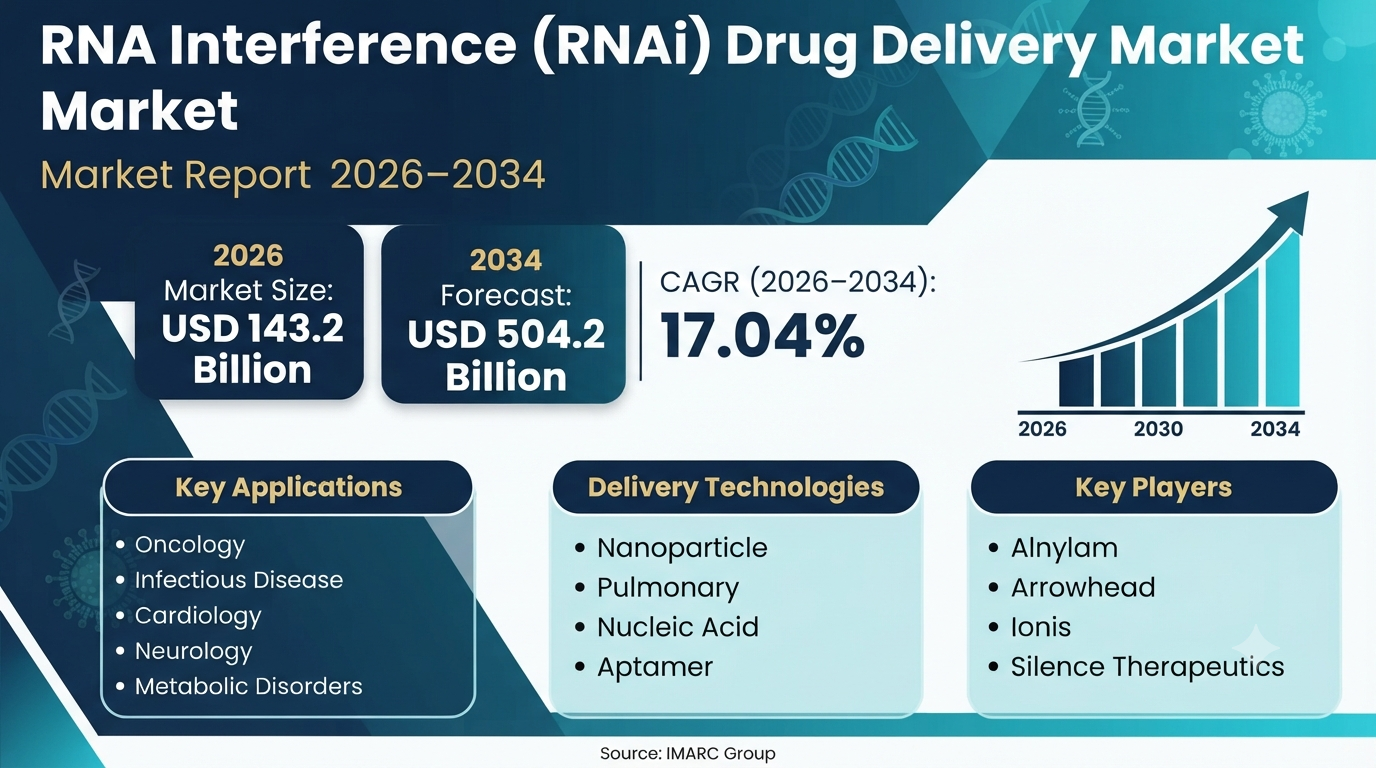
According to IMARC Group, the global RNA interference (RNAi) drug delivery market size reached USD 117.5 Billion in 2025 and is projected to reach USD 504.2 Billion by 2034, expanding at a CAGR of 17.04% during 2026-2034. This rapid expansion, detailed in IMARC Group's latest RNA interference (RNAi) drug delivery market report, reflects the rising prevalence of chronic and genetic disorders such as cancer and cardiovascular diseases, a growing geriatric population, continued innovation in synthetic delivery carriers and bio-vectors, and increasing research and development in nanotechnology and molecular diagnostics.
RNA Interference (RNAi) Drug Delivery Industry Overview
RNAi drug delivery is a therapeutic approach used to monitor and regulate gene expression or mutations. It is applied to analyze gene function in eukaryotes and to develop gene-silencing therapies that target the root cause of disease at the molecular level. Because naked RNA molecules are fragile and difficult to move into target cells, the delivery system is as important as the RNA payload itself, and it is where much of the industry's innovation is concentrated.
RNAi drug delivery solutions are administered and engineered through a broad range of routes and platforms:
· Administration routes: Intravenous, intradermal, and intraperitoneal injection, as well as topical delivery
· Nanoparticle drug delivery: Nanocarriers that transport siRNA or microRNAs (miRNA) to target cells and support personalized medicine
· Pulmonary drug delivery: Delivery of RNAi therapeutics directly to the respiratory system
· Nucleic acid drug delivery: Direct delivery platforms built around therapeutic nucleic acids
· Aptamer drug delivery: Targeted delivery systems, including those used for antiviral drugs that use siRNA to inhibit viral antigen expression
Global RNA Interference (RNAi) Drug Delivery Market Size & Key Statistics
Below are the key RNA interference (RNAi) drug delivery market size statistics drawn from IMARC Group's comprehensive RNA interference (RNAi) drug delivery market analysis:
|
Report Attribute |
Key Statistics |
|
Base Year |
2025 |
|
Historical Period |
2020-2025 |
|
Forecast Period |
2026-2034 |
|
RNA Interference (RNAi) Drug Delivery Market Size in 2025 |
USD 117.5 Billion |
|
Market Size in 2026 |
USD 143.2 Billion |
|
Market Forecast in 2034 |
USD 504.2 Billion |
|
Market Growth Rate (2026-2034) |
17.04% CAGR |
|
Largest Region |
North America |
|
Segments Covered |
Application, Technology, Region |
Request for a Sample Report for Detailed RNA Interference (RNAi) Drug Delivery Market Share Evaluation: https://www.imarcgroup.com/rna-interference-drug-delivery-market/requestsample
Key Market Drivers & RNA Interference (RNAi) Drug Delivery Market Trends in 2026
Several powerful forces are shaping RNA Interference (RNAi) Drug Delivery Market Trends and sustaining strong growth expectations across the global biopharmaceutical and life sciences landscape:
1. Rising Prevalence of Chronic and Genetic Disorders
The growing burden of cancer, cardiovascular diseases (CVDs), and other genetic conditions is increasing demand for therapies that act at the gene level. RNAi's ability to silence disease-causing genes makes it an attractive option where conventional small-molecule drugs have limited reach.
2. Growing Geriatric Population
Older adults are more susceptible to chronic and degenerative conditions, expanding the patient pool for advanced therapeutics and strengthening long-term demand for RNAi-based treatments.
3. Innovation in Synthetic Delivery Carriers and Bio-Vectors
Continued development of synthetic delivery carriers and bio-vectors is improving the stability and targeting of RNAi payloads, addressing one of the central technical challenges in bringing gene-silencing drugs to market.
4. Nanocarriers Supporting Personalized Medicine
Nanocarriers carrying siRNA or microRNAs (miRNA) enable the identification of altered cellular molecules and support personalized treatment approaches, aligning RNAi delivery with the broader shift toward precision medicine.
5. Targeted Delivery for Antiviral Applications
Aptamer-based and other targeted delivery systems are being used for antiviral drugs that rely on siRNA to inhibit viral antigen expression, broadening the infectious disease application base. Demand for RNAi technologies also received a boost during the COVID-19 pandemic.
6. Rising R&D in Nanotechnology and Molecular Diagnostics
Expanding research in nanotechnology and molecular diagnostics is accelerating the development of next-generation delivery platforms and improving the precision of RNAi-based therapies.
7. Government Funding, Investment, and Strategic Collaborations
Government funding for RNAi research, growing investment, strategic collaborations, regulatory approvals, and improving healthcare infrastructure are collectively strengthening the commercial pathway for RNAi therapeutics.
Key Market Segmentation
IMARC Group's RNA Interference (RNAi) Drug Delivery Market Report segments the market by application, technology, and region.
By Application
Oncology: Cancer remains a major target for gene-silencing therapies, with RNAi used to suppress genes that drive tumor growth.
Cardiology: Rising cardiovascular disease prevalence is driving interest in RNAi approaches to modulate disease-related gene expression.
Infectious Disease: RNAi therapeutics, including siRNA-based antivirals, aim to inhibit viral antigen expression.
Neurology: RNAi delivery is being explored for neurological conditions where precise gene-level intervention is valuable.
Ophthalmology: Targeted RNAi delivery supports the treatment of eye disorders.
Urology: Urological conditions represent an additional therapeutic area for RNAi-based treatments.
Metabolic Disorders: Gene-silencing approaches are applied to metabolic conditions linked to specific gene expression pathways.
Others: Covers additional and emerging therapeutic areas.
By Technology
Nanoparticle Drug Delivery: Nanocarriers transport siRNA or miRNA to target cells, improving stability and supporting personalized medicine.
Pulmonary Drug Delivery: Enables delivery of RNAi therapeutics directly to the lungs and respiratory system.
Nucleic Acid Drug Delivery: Delivery platforms built around therapeutic nucleic acids for gene silencing.
Aptamer Drug Delivery: Aptamer systems provide targeted delivery, including for antiviral drugs that use siRNA to inhibit viral antigen expression.
Regional RNA Interference (RNAi) Drug Delivery Market Analysis
|
Region |
Key Highlights |
|
North America — Largest |
United States & Canada; strong biotech sector, advanced healthcare infrastructure, supportive regulation, high R&D investment, strategic collaborations, and presence of major pharmaceutical players |
|
Europe |
Germany, France, United Kingdom, Italy, Spain, Russia, and others |
|
Asia Pacific |
China, Japan, India, South Korea, Australia, Indonesia, and others |
|
Latin America |
Brazil, Mexico, and others |
|
Middle East & Africa |
Covered as a region in the IMARC Group report |
North America leads the global RNA Interference (RNAi) Drug Delivery Market Share, underpinned by a strong biotechnology sector, advanced healthcare infrastructure, supportive regulatory frameworks, high R&D investment, growing demand for targeted therapies, and the presence of major pharmaceutical players.
Connect for Detailed RNA Interference (RNAi) Drug Delivery Market Report Segmentation Analysis — Speak to an Analyst: https://www.imarcgroup.com/request?type=report&id=2758&flag=C
Leading Players in the Global RNA Interference (RNAi) Drug Delivery Industry
The competitive landscape is shaped by specialized RNAi therapeutics developers and large pharmaceutical and biotechnology companies investing in delivery technologies, research partnerships, and clinical programs. Key companies covered in the IMARC Group report include:
· Alnylam Pharmaceuticals
· Arrowhead Pharmaceuticals
· Calando Pharmaceuticals
· Ionis Pharmaceuticals
· Phio Pharmaceuticals
· Silence Therapeutics
· Sirnaomics
· Switch Therapeutics
Other major players referenced in IMARC Group's analysis include CureVac AG, Dicerna Pharmaceuticals, Gradalis, Merck & Co., Moderna, and Quark Pharmaceuticals (SBI ALApharma).
Frequently Asked Questions (FAQs)
What is the RNA Interference (RNAi) Drug Delivery Market Size in 2025?
The global RNA interference (RNAi) drug delivery market reached USD 117.5 Billion in 2025, supported by the rising prevalence of chronic and genetic disorders and continued innovation in delivery technologies.
What is the RNA Interference (RNAi) Drug Delivery Market growth forecast through 2034?
The market is projected to reach USD 504.2 Billion by 2034, growing at a CAGR of 17.04% during 2026-2034.
What are the key RNA Interference (RNAi) Drug Delivery Market Trends shaping the industry?
Key trends include improved delivery stability and targeting, innovation in synthetic carriers and bio-vectors, nanocarrier-enabled personalized medicine, government funding for RNAi research, strategic collaborations, and regulatory approvals.
How is the RNA Interference (RNAi) Drug Delivery Market segmented?
The market is segmented by application (infectious disease, cardiology, oncology, neurology, ophthalmology, urology, metabolic disorders, and others), technology (nanoparticle, pulmonary, nucleic acid, and aptamer drug delivery), and region.
Which region dominates the RNA Interference (RNAi) Drug Delivery Market Share?
North America dominates the market, supported by a strong biotech sector, advanced healthcare infrastructure, supportive regulation, high R&D investment, and the presence of major pharmaceutical players.
Who are the top companies covered in the RNA Interference (RNAi) Drug Delivery Market Report?
Leading companies include Alnylam Pharmaceuticals, Arrowhead Pharmaceuticals, Calando Pharmaceuticals, Ionis Pharmaceuticals, Phio Pharmaceuticals, Silence Therapeutics, Sirnaomics, and Switch Therapeutics, along with CureVac AG, Dicerna Pharmaceuticals, Gradalis, Merck & Co., Moderna, and Quark Pharmaceuticals (SBI ALApharma).
What factors are driving growth in the RNA Interference (RNAi) Drug Delivery Market?
Growth is driven by the rising burden of cancer and cardiovascular disease, a growing geriatric population, better delivery stability and targeting, R&D in nanotechnology and molecular diagnostics, government funding, and strategic collaborations.
What is the future outlook for the global RNA Interference (RNAi) Drug Delivery Market?
The market is expected to sustain strong growth through 2034, driven by innovation in delivery carriers, personalized RNAi therapies, and rising investment in gene-silencing therapeutics worldwide.
About Us
IMARC Group is a leading global market research company providing data-driven insights and expert consulting services to businesses seeking to achieve their strategic objectives. With a multi-disciplinary team of industry experts, IMARC delivers thorough, reliable market intelligence across sectors including Healthcare, Technology, Chemicals, Energy, Food & Beverages, and more.
Contact Us
IMARC Group
United States: +1-201-971-6302
India: +91-120-433-0800

 English
 Arabic
 French
 Spanish
 Portuguese
 Deutsch
 Turkish
 Dutch
 Italiano
 Russian
 Romaian
 Greek