


Anatomic Pathology Track and Trace Solutions Market Growth: Why Lab Integration Matters
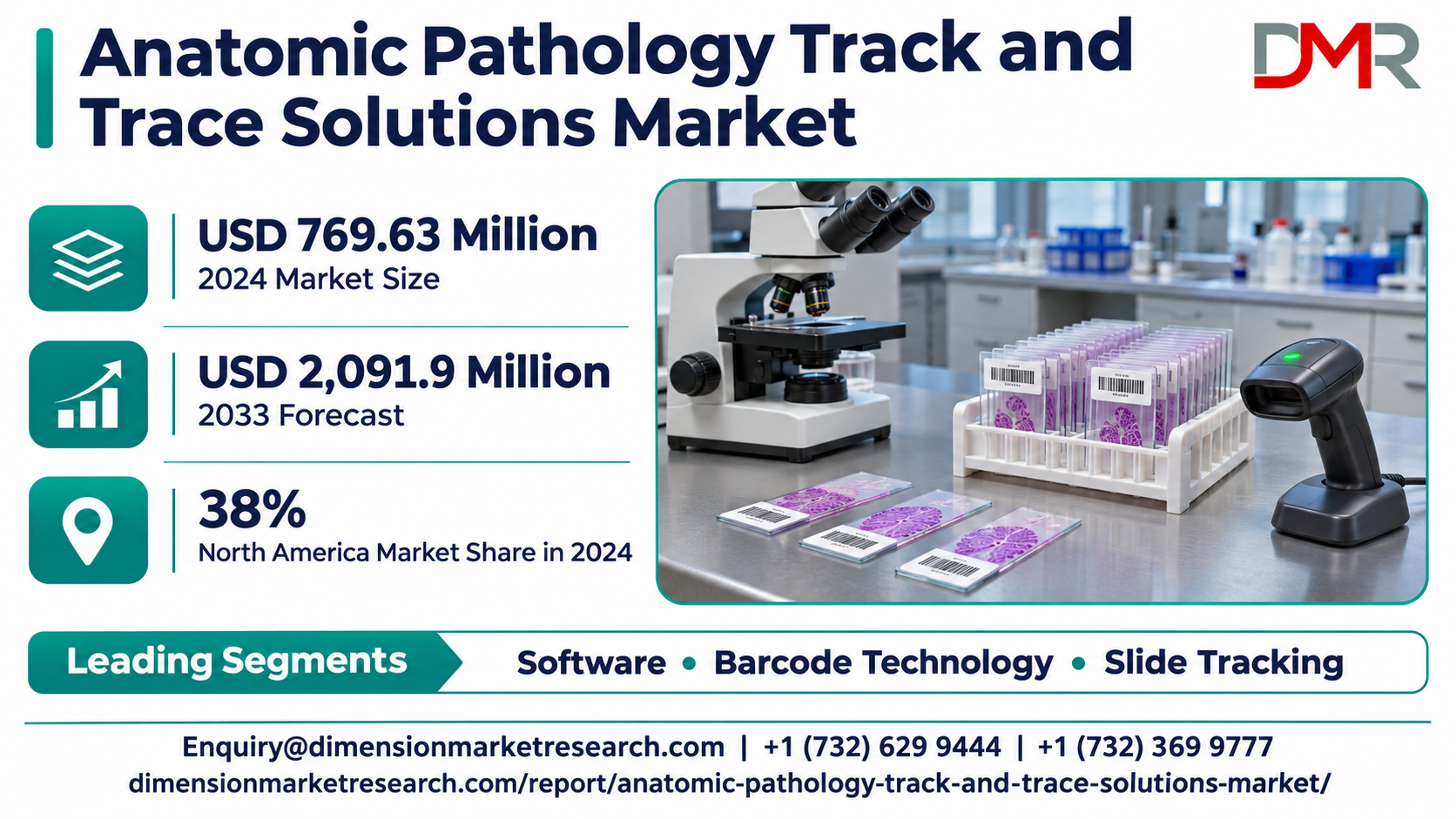
The Anatomic Pathology Track and Trace Solutions Market Growth outlook reflects a practical challenge for laboratories. A single tissue specimen can generate multiple cassettes, blocks, and slides, each of which needs to stay linked to the original case. Labels, scanners, and tracking software help staff record where those materials are and what has happened to them. The Digital Pathology Market extends that workflow into slide scanning, image management, and remote review.
According to Dimension Market Research, the global market was valued at USD 769.63 million in 2024 and is projected to reach USD 2,091.9 million by 2033. Demand is supported by laboratory automation and the need to maintain specimen records across processing and reporting. Integration is also a barrier. A tracking system has to exchange information with the laboratory’s existing software and fit the way staff handle physical materials at each step.
What do anatomic pathology track and trace solutions do?
These systems record the identity, location, and status of specimens and related materials. A laboratory can use a barcode on a tissue cassette to link it to a case, then record its progress as staff process the tissue and prepare slides. A laboratory information management system, or LIMS, can bring those records together so staff can check the status of materials without relying solely on handwritten logs or separate records.
The market covers software, hardware, and consumables. Software maintains tracking records and connects with other laboratory systems. Printers, scanners, and readers let staff apply and capture identifiers at workstations. Labels, tags, cassettes, and slides carry those identifiers through the physical workflow. Each component has a role when a case moves between staff, instruments, or sites.
Get a Free Customized Sample of This or Any Other Market Research Report
Which segments lead the market?
● Software accounted for more than 45% of the product segment in 2024. The report links its position to LIMS integration and the ability to follow specimens from collection through reporting.
● Independent and reference laboratories accounted for at least 55% of the end-user segment in 2024. These labs often handle specimens from multiple healthcare providers, making it important to maintain consistent case records across intake and processing.
● North America led with a 38% market share in 2024. Europe also represents an adoption opportunity, with the report highlighting Germany, France, and the United Kingdom.
Why do barcodes remain the leading technology?
Barcodes have an established place in pathology labs because they are relatively inexpensive and compatible with many existing workflows. Staff can scan an identifier at a workstation to record that an item has reached a processing step. The value of the scan depends on what happens next. If the tracking event updates the case record, staff can see the handoff in the system they already use. If the event stays in a separate application, staff may still need to reconcile records manually.
The report identifies radio-frequency identification, or RFID, as an option for workflows that benefit from longer read ranges or the ability to read multiple tags. Higher implementation costs can limit adoption. For a lab comparing the two technologies, the practical question is where those capabilities would make a difference. A high-volume handoff involving many items has different requirements from a workstation where staff already scan each item individually.
How does digital pathology change the buying decision?
When a slide is scanned, the lab has a physical item and a digital image associated with the same case. Track and trace software records the physical slide’s identity and status. Digital pathology systems make the image available for viewing, management, or consultation. For a lab adopting both, a shared case identifier helps staff connect the image a pathologist reviews with the slide and specimen it came from.
The primary report identifies interoperability and staff training as factors that can affect implementation. Procurement teams can assess these together by examining an ordinary workflow, from specimen receipt to slide scanning and reporting, and checking where staff have to re-enter information. The report lists suppliers including Thermo Fisher Scientific, Leica Biosystems, Roche’s Ventana Medical Systems, Agilent Technologies, and Zebra Technologies.
Frequently Asked Questions
What was the Anatomic Pathology Track and Trace Solutions Market size in 2024?
The report valued the global market at USD 769.63 million in 2024.
What is the market forecast for 2033?
The report overview projects a market value of USD 2,091.9 million by 2033.
Which product category led the market?
Software led with more than 45% of the product segment in 2024.
Which laboratories account for the largest end-user share?
Independent and reference laboratories led with at least 55% of the end-user segment in 2024.
Why do pathology labs use barcode tracking?
Barcodes give staff a relatively low-cost way to identify specimens and record their movement through existing laboratory workflows.
Conclusion
As pathology labs automate more steps and adopt digital slide review, tracking systems have to preserve the connection between physical materials, digital images, and case records. For laboratories evaluating suppliers, a useful test is whether the system can capture each handoff and update the existing case record without adding manual work.
Related Pathology Market Research
The global Digital Pathology Market Size was estimated at USD 1.1 billion in 2023 and is projected to reach USD 2.2 billion by 2032, at a reported CAGR of 8.0%. Devices led the 2023 product breakdown, supported by adoption of slide scanners and slide management systems.

 Arabic
 French
 Spanish
 Portuguese
 Deutsch
 Turkish
 Dutch
 Italiano
 Russian
 Romaian
 Portuguese (Brazil)
 Greek