


Sponsorluk
Difference Between Legal Right and Fundamental Right
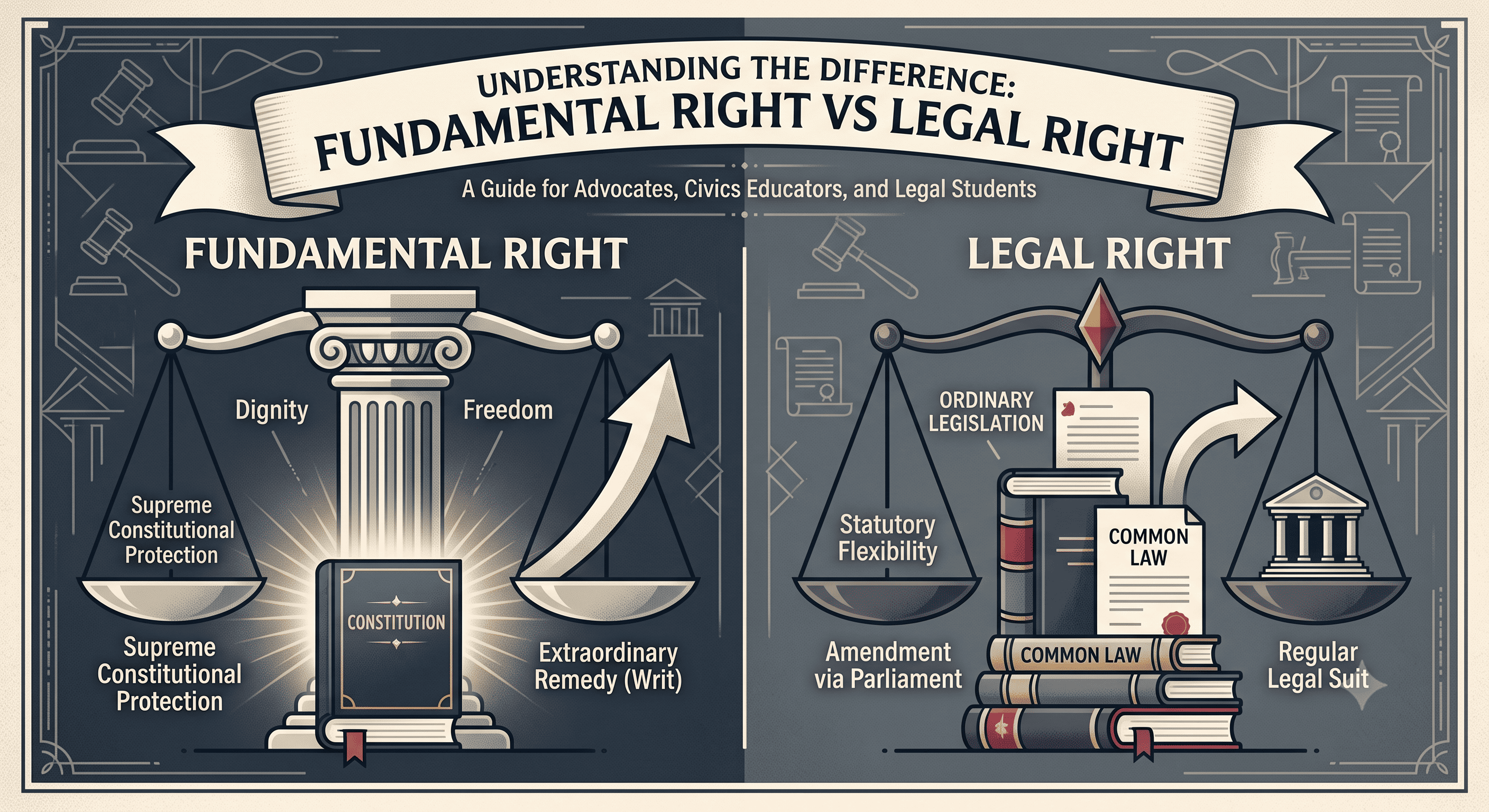
Understanding your rights is one of the most powerful tools you can have as a citizen. When legal conflicts occur or new legislation hits the news, terms like civil liberties, statutory claims, and constitutional safeguards get tossed around constantly. However, confusing a statutory privilege with a core constitutional guarantee often leads to misunderstandings about how the justice system actually protects you.
Every modern democracy protects individual liberties, but not all rights hold the same legal weight. When legal experts break down protections, they draw a strict line between rights granted by ordinary legislation and those protected directly by a constitution. This brings us to a fundamental question: what is the true difference between a statutory entitlement and an entrenched constitutional guarantee?
When legal practitioners, advocates, and legal content creators build informational resources to educate the public on these matters, utilizing dedicated WordPress themes for Lawyer platforms helps present complex statutory distinctions in an accessible, structured format. Whether you are studying constitutional law, preparing for an exam, or simply seeking clarity on your civil liberties, this guide breaks down the essential legal distinctions clearly.
What Is a Legal Right?
A legal right refers to any claim, power, or privilege recognized, protected, and enforced by an act of ordinary legislation or common law precedent. These rights originate from specific statutes passed by a parliament, congress, state assembly, or municipal governing body.
Because ordinary legislative bodies create legal rights, those same bodies retain the authority to modify, restrict, amend, or completely repeal them through regular legislative procedures. A legal right is binding against other private individuals, corporations, or specific state agencies, depending on the scope defined by the statute.
Consider the right to vote in many jurisdictions, consumer protection rights, property ownership rights, or the rights granted under employment labor laws. If an employer violates your right to minimum wage or overtime compensation, they have infringed upon an ordinary statutory right created under labor law statutes.
What Is a Fundamental Right?
A fundamental right represents a basic human freedom that is considered essential for individual dignity, intellectual growth, and democratic participation. Unlike ordinary statutory rights, fundamental rights are not granted by standard parliamentary acts; they are enshrined directly within a country's supreme constitution.
Constitutional framers place these guarantees beyond the easy reach of day-to-day political majorities. Fundamental rights act as direct shields against arbitrary state action, authoritarian overreach, and discriminatory executive or legislative conduct.
Because they form the bedrock of civil society, ordinary laws passed by a legislature cannot contradict or dilute fundamental protections. Any statutory law that violates a core constitutional guarantee is routinely declared null, void, and unconstitutional by judicial review. Examples include freedom of speech, freedom of conscience, the right to life and personal liberty, and the guarantee of equality before the law.
Key Difference Between Legal Right and Fundamental Right Explained
To see how these two categories operate in practice, we must evaluate their origins, methods of judicial enforcement, flexibility, and the legal remedies available when violations occur.
Source and Constitutional Status
The primary divergence lies in where each right derives its authority. A legal right stems from ordinary statutory legislation, executive orders, contracts, or judicial case law. It operates beneath the constitution in the legal hierarchy.
A fundamental right derives its ultimate authority directly from the constitution itself. It sits at the absolute apex of the legal system, meaning all lower statutes and administrative regulations must conform to it without exception.
Vulnerability to Legislative Amendments
The ease with which a government can alter a right highlights another critical difference. A standard legal right can be amended, curtailed, or removed entirely through a simple majority vote in a legislative session. If the legislature decides to alter consumer protection rules, it simply passes an amending bill.
In contrast, fundamental rights enjoy special protection. Modifying or restricting a constitutional guarantee generally requires a complex constitutional amendment process, which usually demands a special supermajority, state ratifications, or judicial review to ensure the basic structure of the constitution remains intact.
Direct Judicial Enforcement and Writs
The remedy mechanisms available when a violation occurs differ significantly between the two classifications. When someone violates your ordinary legal right, your legal recourse lies in filing a regular civil or criminal suit before a lower trial court or specialized tribunal. The process follows standard, often lengthy, procedural codes.
When a fundamental right is violated by the state, citizens usually have the extraordinary privilege of petitioning the highest courts directly such as a Supreme Court or High Court. In many constitutional systems, these apex courts possess special writ jurisdictions (such as Habeas Corpus, Mandamus, Prohibition, Quo Warranto, and Certiorari) to order immediate enforcement and protect individual liberty without forcing the victim to navigate years of lower-court delays.
Law firms, legal aid clinics, and legal educators often discuss these writ jurisdictions online, making use of professional themes to structure case summaries and clarify procedural steps for readers seeking urgent legal help.
Practical Examples of Legal vs Fundamental Rights
Examining real-world applications helps clarify where one category ends and the other begins.
- Right to Property: In many modern legal systems, property ownership was once a fundamental right that became an ordinary legal right. Today, while you have a legal right to own property and receive fair compensation if the state acquires it under eminent domain, the state can regulate property transactions through ordinary zoning and tax laws.
- Right to Equality: The guarantee that the government cannot arbitrarily discriminate against a citizen based on religion, race, caste, sex, or place of birth is a fundamental right. Any statute attempting to introduce arbitrary state-backed discrimination is immediately struck down by constitutional courts.
- Consumer Rights: The right to receive a refund for a defective appliance is a statutory legal right governed by consumer protection acts. You can demand a refund through specialized consumer courts, but you cannot approach the Supreme Court via a constitutional writ petition for a broken microwave.
Frequently Asked Questions
Can a legal right ever become a fundamental right?
Yes, constitutional amendments or landmark judicial interpretations can elevate a statutory claim to a fundamental guarantee. For instance, in several jurisdictions, statutory education rights were later recognized as fundamental human rights through constitutional amendments and apex court precedents.
Can fundamental rights be suspended during a state of emergency?
In many constitutional frameworks, certain fundamental rights, such as freedom of assembly or movement, may be temporarily restricted during declared national emergencies or wartime threats. However, core protections like the right to life and protection against unlawful detention often remain non-derogable.
Against whom are these rights enforceable?
Fundamental rights are primarily enforceable against the state, its administrative agencies, and public institutions to prevent government overreach. Ordinary legal rights are enforceable against both private individuals, corporations, and state entities, depending entirely on the wording of the governing statute.
Why do some legal rights lack constitutional status?
If every administrative, procedural, and commercial regulation were given constitutional status, governing would become impossibly rigid. Standard legal rights allow elected legislatures to adapt policies quickly to changing social, economic, and technological conditions.
Conclusion
Understanding the difference between legal right and fundamental right is critical for anyone navigating the modern legal landscape. While legal rights provide essential protections for day-to-day interactions like commerce, tenancy, and employment, fundamental rights safeguard our most essential human liberties against state overreach and authoritarian laws. Recognizing where your statutory privileges end and where your entrenched constitutional guarantees begin ensures you know precisely which legal remedies to pursue when your freedoms are challenged.
Sponsorluk
Sponsorluk

 English
 Arabic
 French
 Spanish
 Portuguese
 Deutsch
 Dutch
Dutch
 Italiano
 Russian
 Romaian
 Portuguese (Brazil)
 Greek
Greek