


Tonic Water Market Outlook 2026-2034: Size, Share, Trends, Demand and Forecast
Tonic Water Market Overview
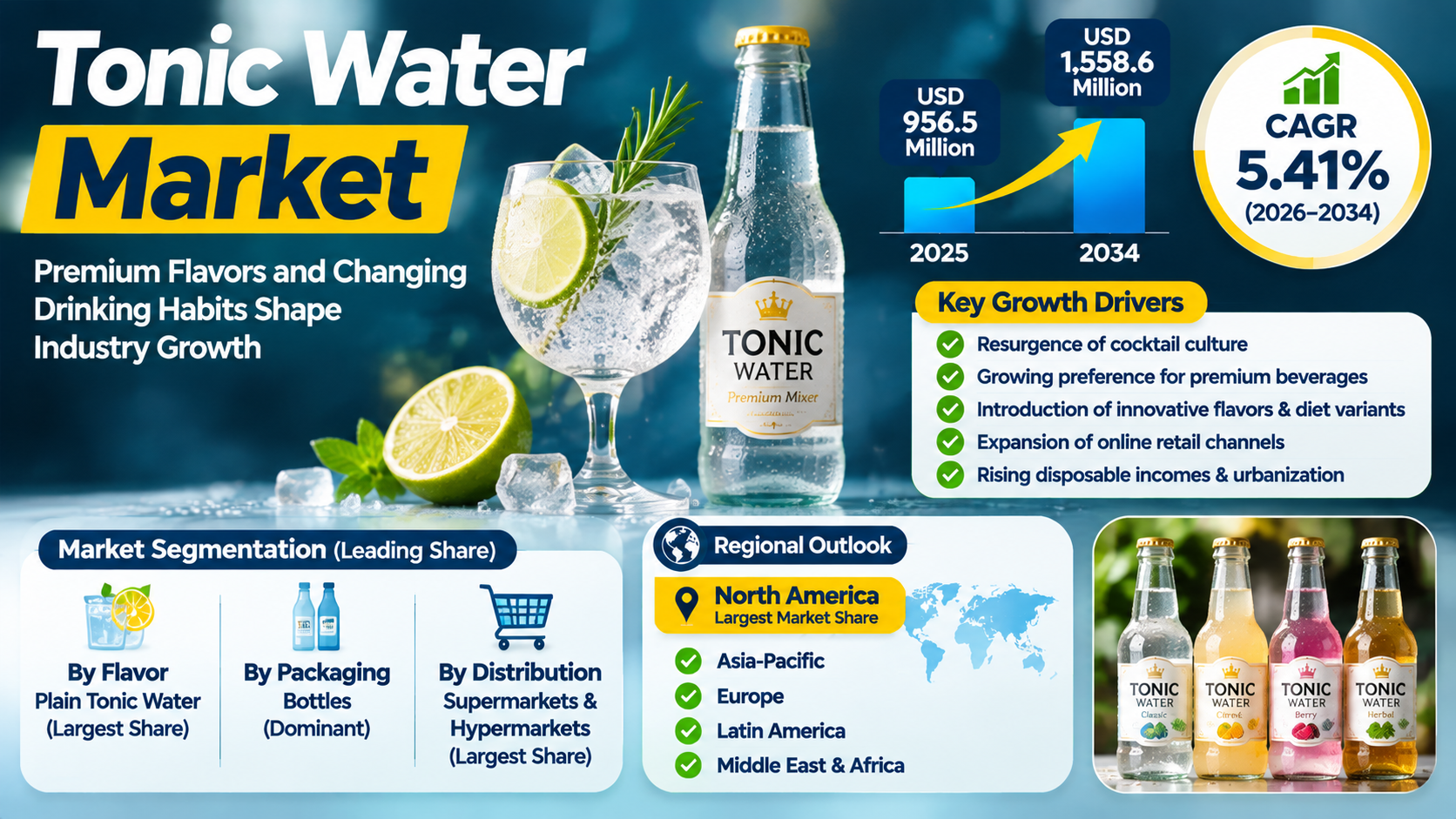
According to IMARC Group's latest research, the global tonic water market size reached USD 956.5 million in 2025 and is expected to reach USD 1,558.6 million by 2034, exhibiting a CAGR of 5.41% during 2026–2034. The market is benefiting from the resurgence of cocktail culture, increasing consumption of premium spirits, changing socializing habits and the introduction of innovative beverage variants.
Tonic water, also known as Indian tonic water, is a carbonated beverage containing small amounts of quinine derived from the bark of the cinchona tree. Traditionally associated with its use as a prophylactic drink against malaria, it is now widely consumed for its distinctive bitter flavor and as a mixer in gin-based drinks and other cocktails.
The science of beverage formulation is only one part of the story. Changing consumer preferences, premiumization and expanding retail distribution are creating new opportunities for manufacturers. We will explore how these factors are shaping the industry's growth below.
What Is Driving the Growth
Five forces explain most of the momentum:
-
Resurgence of cocktail culture. The growing popularity of cocktails, particularly gin-based drinks, is supporting demand for tonic water. The increasing number of bars, pubs, clubs and breweries serving alcoholic beverages is further contributing to consumption.
-
Growing preference for premium beverages. Consumers are increasingly developing a taste for premium spirits and distinctive beverage experiences. This is encouraging manufacturers to introduce innovative tonic water variants with unique flavor profiles and premium characteristics.
-
Introduction of innovative product variants. Manufacturers are expanding their portfolios with flavored tonic water and diet formulations containing less sugar. These products are designed to address changing consumer preferences and attract individuals seeking different beverage options.
-
Expansion of online retail channels. Increasing internet penetration and smartphone adoption have supported the growth of online beverage sales. Supermarkets, hypermarkets and convenience store operators are also expanding their e-commerce presence, making tonic water more accessible to consumers.
-
Rising disposable incomes and urbanization. Increasing income levels, a growing middle-class population and rapid urbanization are strengthening purchasing power and supporting demand for premium beverage products. The expanding young population and growing socializing trend are also contributing to market expansion.
Want the segment-level numbers behind this? Get a free sample of the report.
Where the Market Stands Today
By flavor, the market is divided into plain tonic water and flavored tonic water. Plain tonic water currently accounts for the largest market share, supported by its established position as a conventional mixer in cocktails and other beverages. Flavored variants are also gaining attention as manufacturers introduce products with distinctive taste profiles to address evolving consumer preferences.
By packaging form, the market is segmented into bottles and cans. Bottles exhibit a clear dominance, reflecting their established presence in the retail beverage market and their widespread use for packaging tonic water. Cans represent another packaging option within the industry.
By distribution channel, the market is categorized into supermarkets and hypermarkets, convenience stores, online stores and others. Supermarkets and hypermarkets account for the majority of the market share, supported by their extensive product availability and established retail presence. Convenience stores and online platforms also contribute to product accessibility, while the expansion of e-commerce is creating additional opportunities for market participants.
Our Take: Premiumization Is Changing the Beverage Mix
Tonic water has evolved beyond its traditional role as a carbonated mixer. The resurgence of cocktail culture and increasing consumer interest in premium spirits are encouraging manufacturers to differentiate their products through innovative flavors and distinct characteristics.
This shift is creating opportunities for brands to expand their portfolios beyond conventional tonic water. The introduction of flavored variants and diet tonic water with reduced sugar content reflects manufacturers' efforts to address changing consumer preferences.
At the same time, the expansion of online retail platforms is changing how consumers purchase beverage products. Supermarkets, hypermarkets and convenience stores are strengthening their e-commerce presence, allowing consumers to access a wider range of products through digital channels.
Our view is that companies combining product innovation, premium positioning and broader distribution capabilities will be better positioned to capitalize on the market's expansion. As consumers increasingly seek distinctive beverage experiences, manufacturers that respond to changing taste preferences and purchasing habits can strengthen their competitive position.
Regional Outlook
-
North America holds the largest market share, supported by the established consumption of tonic water and its association with cocktail culture.
-
Asia-Pacific includes major markets such as China, Japan, India, South Korea, Australia and Indonesia, with the region representing an important part of the global market landscape.
-
Europe encompasses established beverage markets, including Germany, France, the United Kingdom, Italy, Spain and Russia, which are covered in the report's regional analysis.
-
Latin America includes Brazil, Mexico and other markets, contributing to the geographical diversification of the global tonic water industry.
-
Middle East and Africa represents another regional market covered in the report, reflecting the geographical scope of the industry's global expansion.
Who Is Competing
The global tonic water market features established beverage manufacturers and specialized tonic water brands competing through product innovation, flavor differentiation, premium positioning and distribution expansion.
The report profiles Bradley's Tonic Co., East Imperial Beverage Corporation, El Guapo Bitters, Fentimans Ltd., Fever-Tree Drinks plc, Franklin & Sons Ltd., Keurig Dr Pepper Inc., Q Tonic LLC, The Coca-Cola Company, The London Essence Company, White Rock Products Corporation and Zevia.
Competition revolves around the development of distinctive product variants, changing consumer preferences and the ability to strengthen market presence through established retail and online distribution channels. Manufacturers are also focusing on premium and reduced-sugar formulations to address the evolving requirements of consumers.
Opportunities and Challenges
Opportunities. The growing popularity of cocktail culture and increasing demand for premium spirits are creating opportunities for tonic water manufacturers. The introduction of flavored variants offers companies an opportunity to differentiate their products and attract consumers seeking distinctive beverage experiences. Diet tonic water with lower sugar content also provides an avenue for manufacturers to address changing consumption preferences.
The expansion of online retail channels represents another important opportunity. Growing internet penetration, smartphone adoption and the increasing e-commerce presence of supermarkets and convenience stores are improving product accessibility. Rising disposable incomes, urbanization and the expanding middle-class population are also supporting market opportunities.
Challenges. Manufacturers must continuously adapt their product offerings to changing consumer tastes and preferences. Maintaining product differentiation in a market featuring established beverage companies and specialized brands also requires ongoing attention. In addition, companies need to strengthen their distribution capabilities across traditional retail and online channels to reach a wider consumer base.
What This Means for You
-
If you are an investor, look beyond conventional beverage consumption trends and examine opportunities associated with premium tonic water, flavored variants and changing retail distribution.
-
If you are a beverage manufacturer, consider expanding product portfolios through distinctive flavors and reduced-sugar formulations to address evolving consumer preferences.
-
If you work in retail or distribution, the expansion of online beverage sales and the growing e-commerce presence of supermarkets and convenience stores present opportunities to strengthen product accessibility.
-
If you are a beverage brand, focus on product differentiation, premium positioning and changing cocktail consumption habits to strengthen your competitive presence.
Tonic Water Market FAQs
How big is the global tonic water market? According to IMARC Group, the global tonic water market reached USD 956.5 million in 2025.
What is the future outlook for the tonic water market? The market is expected to reach USD 1,558.6 million by 2034, exhibiting a CAGR of 5.41% during 2026–2034.
What is driving the tonic water market? The resurgence of cocktail culture, growing consumption of premium spirits, innovative flavored products, reduced-sugar formulations and expanding online retail channels are among the major growth drivers.
Which flavor segment leads the tonic water market? Plain tonic water currently holds the largest market share, while flavored tonic water represents another important segment.
Which packaging form dominates the market? Bottles currently exhibit a clear dominance over cans in the global tonic water market.
Which distribution channel accounts for the largest market share? Supermarkets and hypermarkets account for the majority of the market share.
Which region dominates the global tonic water market? North America currently holds the largest market share.
Who are the key companies in the tonic water market? Major players include Bradley's Tonic Co., East Imperial Beverage Corporation, El Guapo Bitters, Fentimans Ltd., Fever-Tree Drinks plc, Franklin & Sons Ltd., Keurig Dr Pepper Inc., Q Tonic LLC, The Coca-Cola Company, The London Essence Company, White Rock Products Corporation and Zevia.
Conclusion
The global tonic water market is expected to continue expanding as cocktail culture, premium beverage consumption and changing consumer preferences support demand. Plain tonic water currently leads by flavor, bottles dominate packaging, and supermarkets and hypermarkets account for the majority of distribution channel sales. North America remains the largest regional market.
At the same time, flavored product innovation, reduced-sugar formulations and expanding online retail channels are creating additional opportunities for manufacturers. Companies that combine distinctive product offerings with effective distribution strategies will be better positioned to participate in the market's growth.
The full report covers historical trends from 2020, uses 2025 as the base year and provides forecasts through 2034, including analysis across flavor, packaging form, distribution channel and regional markets.
About the Author
IMARC Group is a leading global market research company providing data-driven insights and expert consulting services to businesses seeking to achieve their strategic objectives. With a multi-disciplinary team of industry experts, IMARC delivers thorough, reliable market intelligence across sectors including Healthcare, Food and Beverages, Chemicals and Materials, Consumer Goods, and more.
Media & Sales Contact
IMARC Group
United States: +1-201-971-6302
India: +91-120-433-0800
United Kingdom: +44-753-714-6104

 English
 Arabic
 French
 Spanish
 Portuguese
 Deutsch
 Turkish
 Dutch
 Italiano
 Russian
 Portuguese (Brazil)
 Greek