


Autonomous Aircraft Market Size, Share, Growth Factors and Forecast 2026-2034
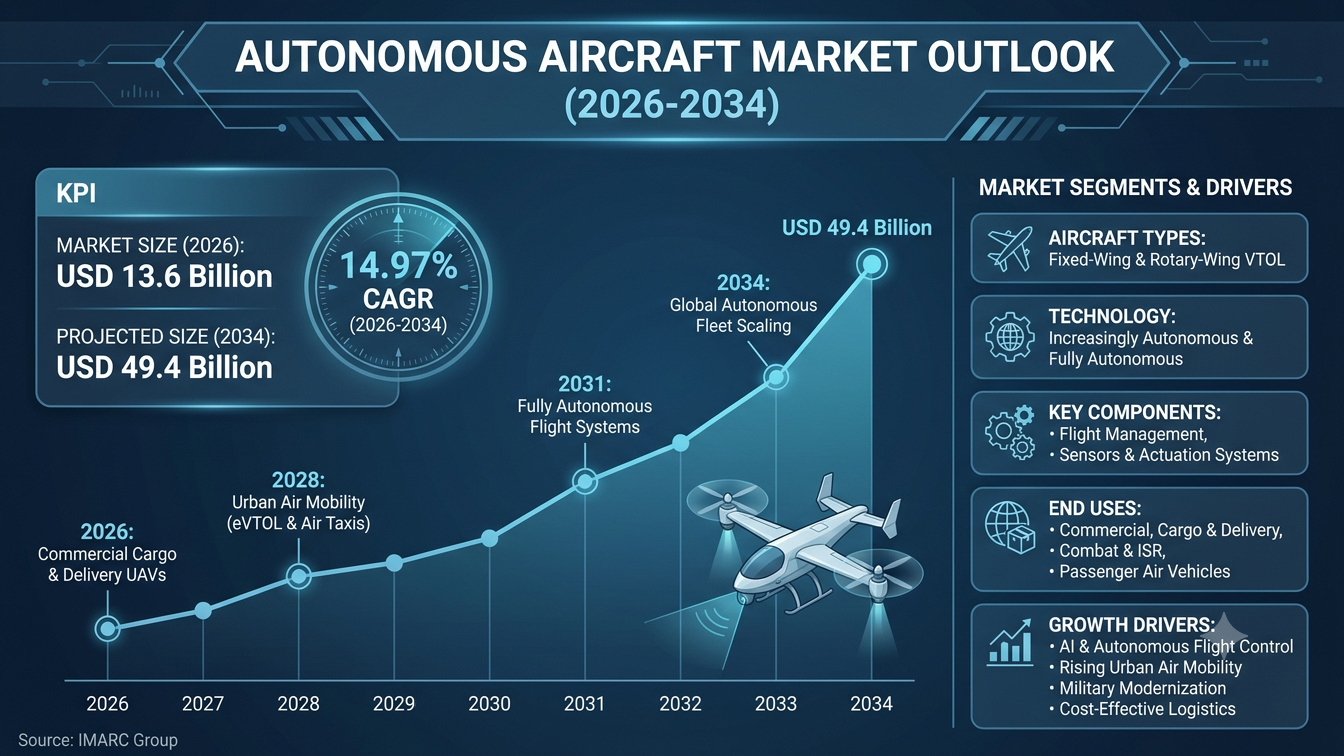
According to IMARC Group, the global autonomous aircraft market size reached USD 13.6 Billion in 2025 and is projected to reach USD 49.4 Billion by 2034, expanding at a CAGR of 14.97% during 2026–2034. North America currently dominates the market, holding a share of over 38.2% in 2025. This robust trajectory reflects rising safety concerns around exposing pilots to hazardous environments, the push for more efficient and cost-effective aerospace and defense operations, and surging demand for unmanned aerial vehicles (UAVs) across a wide range of end-use applications.
Autonomous Aircraft Industry Overview
An autonomous aircraft is a flight vehicle capable of operating, navigating, and completing missions with little to no direct human intervention. By combining flight management computers, advanced sensors, and machine-learning algorithms, these platforms can interpret real-time data, adjust flight paths, avoid obstacles, and execute precise maneuvers independently. This level of automation delivers a combination of safety, cost efficiency, and operational flexibility that conventional piloted aircraft cannot match in high-risk, repetitive, or remote missions.
Autonomous aircraft are deployed across a broad continuum of use cases:
- Defense and surveillance: Reconnaissance, intelligence gathering, jamming, and combat support alongside manned fighter jets
- Cargo and delivery: Pilotless freight transport for e-commerce, remote logistics, and disaster relief supply chains
- Urban air mobility (UAM): Electric vertical takeoff and landing (eVTOL) air taxis for congested metropolitan transport
- Air medical services: Rapid, round-the-clock transport of critical patients and medical supplies to remote areas
- Agriculture and infrastructure monitoring: Crop surveillance, pipeline inspection, and environmental data collection
Request for a Sample Report for Detailed Autonomous Aircraft Market Share Evaluation: https://www.imarcgroup.com/autonomous-aircraft-market/requestsample
Global Autonomous Aircraft Market Size & Key Statistics
Below are the key statistics drawn from IMARC Group's comprehensive market analysis:
|
Report Attribute |
Key Statistics |
|
Base Year |
2025 |
|
Historical Period |
2020–2025 |
|
Forecast Period |
2026–2034 |
|
Autonomous Aircraft Market Size in 2025 |
USD 13.6 Billion |
|
Market Forecast in 2034 |
USD 49.4 Billion |
|
Market Growth Rate (2026–2034) |
14.97% CAGR |
|
Largest Region |
North America (38.2% share) |
|
Leading Component Segment |
Flight Management Computers |
|
Leading Technology Segment |
Fully Autonomous |
|
Leading Aircraft Type |
Rotary Wing (57.8% share) |
|
Leading End-Use Segment |
Commercial Aircraft (25.0% share) |
Key Market Drivers & Autonomous Aircraft Market Trends in 2026
Several powerful forces are shaping autonomous aircraft market trends and fuelling sustained growth expectations across global defense and aerospace markets:
1. Escalating Demand for Autonomous Cargo Aircraft
The rapid expansion of e-commerce is driving demand for cost-effective, 24/7 cargo operations that are not constrained by human crew limitations. Autonomous cargo aircraft can access remote or hard-to-reach areas, helping fill the gap created by pilot shortages. In May 2023, Xwing received a contract from the U.S. Air Force to perform pilotless cargo trials, coordinating best-use-case identification for autonomous flight operations and conducting test flights that fused flight control systems, auto takeoff/landing, Detect-and-Avoid (DAA) systems, auto braking, and auto taxi on the Cessna 208B platform.
2. Rising Investment in Research and Development
Aerospace companies, startups, and research institutions are investing heavily in artificial intelligence, sensor technology, and autonomous algorithms to enhance capability and reliability. In December 2022, under the Skyborg Program, the U.S. Department of Defense tested the autonomous F-16 jet VISTA X-62A for more than 17 hours of autonomous flight, with AI outperforming a human pilot in simulated dogfights. The U.S. military also conducted the inaugural autonomous flight of a Black Hawk helicopter in November 2022, supported by Lockheed Martin's model-following algorithm and autonomous control simulation systems.
3. Growing Adoption in Air Medical Services
Autonomous aircraft equipped with advanced medical equipment are enabling rapid transport for critical patients, particularly in remote or disaster-affected areas. In April 2024, Windracers partnered with Purdue University as a founding member of the Center on AI for Digital, Autonomous, and Augmented Aviation (AIDA), which aims to fly nearly 1 million commercial uncrewed aircraft systems throughout the U.S. by 2027 to support emergency services, defense, humanitarian aid, and healthcare.
4. Expansion of Urban Air Mobility and Advanced Air Mobility Infrastructure
Ongoing advancements in urban air mobility (UAM) and the push for air taxis are fuelling demand for efficient transportation solutions in congested cities. On January 14, 2025, ANRA Technologies and Future Flight Global partnered to develop digital infrastructure for advanced air mobility (AAM), focusing on a real-time airspace management system to support eVTOLs and drones.
5. Rising Defense Investment in Unmanned Systems
Significant government funding for defense and military technologies is accelerating product innovation. The U.S. Department of Defense planned to invest more than USD 2.6 Billion in unmanned systems in fiscal year 2023 alone, with at least 29 programs focused on procurement of unmanned aerial systems, reinforcing the dominance of established autonomous aircraft companies in the defense segment.
6. Regulatory Developments Supporting Autonomous Flight
Regulatory bodies are increasingly supporting autonomous flight operations through advanced airspace management systems, helping streamline certification pathways for new entrants and expanding the commercial viability of unmanned platforms across both defense and civilian applications.
Restrictive Factors
The complex process of designing, testing, and certifying autonomous aircraft slows market growth. These platforms require advanced components and software for monitoring and situational awareness, which must comply with strict government regulations to ensure safety in harsh conditions. As autonomous drones are a relatively new concept, many countries have introduced specific standards that manufacturers must follow, and software requires thorough testing and certification before commercial use. Additional challenges, including limited battery life, low load-carrying capacity, and the need for long-distance travel, continue to hinder broader market expansion.
Key Market Segmentation
By Component
Flight Management Computers (FMCs) – Largest Segment: FMCs oversee navigation, flight planning, and system management, using advanced algorithms to interpret sensor data, optimize routes, and render real-time adjustments during flight. They integrate with autopilot systems to execute precise maneuvers, maintain safe separation from obstacles, and adhere to air traffic control instructions, making them central to the reliability and fault tolerance required for autonomous operations.
Other components covered include Air Data Inertial Reference Units, Sensors, Actuation Systems, Software, Intelligent Servos, Cameras, Radars and Transponders, and Propulsion Systems.
By Technology
Fully Autonomous – Largest Segment: Fully autonomous aircraft operate and navigate through airspace without direct human intervention, utilizing advanced artificial intelligence, sensor systems, and automation technologies to perform all flight functions, including takeoff, navigation, obstacle avoidance, and landing. In December 2023, Reliable Robotics achieved a significant milestone by piloting a fully autonomous flight using a Cessna 208B Caravan with no crew on board, supervised remotely from a control center 50 miles away.
The Increasingly Autonomous segment covers platforms that retain partial human oversight while automating select flight functions.
By Aircraft Type
Rotary Wing – Leading Segment (57.8% Share): Rotary wing autonomous aircraft, commonly known as drones or UAVs, utilize rotating blades to generate lift and propulsion, enabling versatile use in reconnaissance, surveillance, cargo delivery, and search and rescue missions. Their maneuverability makes them well suited to challenging terrain and urban environments. For instance, AIIMS Bhubaneswar used a drone to transport a blood bag over a 60 km route in 35 minutes.
The Fixed Wing segment serves longer-range missions requiring greater endurance and payload capacity.
By End Use
Commercial Aircraft – Leading Segment (25.0% Share): Commercial applications are pivotal in modern global transportation, facilitating efficient movement of passengers and cargo while supporting economic growth, tourism, and international trade. Other end-use segments covered include Combat and ISR, Cargo and Delivery Aircraft, Passenger Air Vehicle, Personal Air Vehicle, Air Medical Services, and Others.
Regional Autonomous Aircraft Market Analysis
|
Region |
Key Highlights |
|
North America – Largest (38.2% Share) |
United States & Canada; significant defense investment, continual technological advancements, strong presence of leading autonomous aircraft companies, growing adoption of autonomous cargo aircraft |
|
Europe |
Germany, France, UK, Italy, Spain; record EUR 279 Billion defense commitment in 2023, EDF funding of USD 7.8 Billion (2021–2027), players like Airbus and Leonardo developing autonomous platforms |
|
Asia Pacific |
China, Japan, India, South Korea, Australia, Indonesia; rising defense budgets, China's USD 229 Billion defense spend, India's 'Make in India' push for domestic autonomous systems |
|
Latin America |
Brazil, Mexico; Brazil's Moya Aero launched a heavy-duty autonomous cargo eVTOL prototype with commercial service targeted from 2026 |
|
Middle East & Africa |
UAE, Saudi Arabia, South Africa; EHang's first autonomous passenger-carrying eVTOL flight in Abu Dhabi and urban air mobility partnerships |
In 2025, North America accounted for the largest autonomous aircraft market share of over 38.2%, driven by continual technological advancement, strong growth in aerospace and defense spending, rising disposable income levels, and the presence of prominent market players. The United States held 80.00% of the North America market, supported by a planned U.S. Department of Defense investment of more than USD 2.6 Billion in unmanned systems in fiscal year 2023, at least 29 dedicated procurement programs, and continued Federal Aviation Administration regulatory support.
Asia Pacific is witnessing strong momentum as well, with China's substantial defense budget prioritizing unmanned aerial systems for surveillance and combat, and India's defense budget supporting domestic production of advanced autonomous systems under its 'Make in India' initiative.
Connect for Detailed Autonomous Aircraft Market Share Segmentation Analysis -- Speak to an Analyst: https://www.imarcgroup.com/request?type=report&id=7041&flag=C
Leading Autonomous Aircraft Companies
The competitive landscape of the autonomous aircraft market features an amalgamation of established aerospace giants, technology innovators, and emerging startups. Leading autonomous aircraft companies are heavily investing in autonomy technologies to capture growing demand for unmanned aerial vehicles and autonomous flight systems. On January 13, 2025, XTI Aerospace entered a strategic partnership with ReadyMonitor, acquiring a 30% stake in the autonomous Drone-as-a-Service company to integrate AI-powered drones with VTOL technologies.
Key autonomous aircraft companies covered in the IMARC Group report include:
|
Company |
Core Focus Area |
|
Aerovironment Inc. |
Small UAVs and tactical unmanned systems for defense and commercial use |
|
Airbus S.A.S. |
Unmanned combat systems and AI-driven autonomy (Wingman program) |
|
BAE Systems plc |
Autonomous defense platforms and unmanned combat aircraft |
|
Bell Textron Inc. (Textron Inc.) |
Autonomous rotorcraft and urban air mobility platforms |
|
Elbit Systems Ltd. |
Tactical UAVs and ISR autonomous systems |
|
Kitty Hawk Corporation |
Electric and autonomous personal air vehicles |
|
Lockheed Martin Corporation |
Autonomous military helicopters and the MATRIX autonomy system |
|
Northrop Grumman Corporation |
High-altitude long-endurance unmanned aircraft |
|
Saab AB |
Defense-focused unmanned aerial systems |
|
The Boeing Company |
Autonomous flight trials and Air Launched Effect UAV systems |
Latest Autonomous Aircraft Market Industry Developments
December 2024 – Sikorsky (Lockheed Martin)
Sikorsky will fly the Optionally Piloted Black Hawk helicopter for the U.S. Marine Corps, demonstrating the MATRIX autonomy system as part of its Aerial Logistics Connector program exploring autonomous resupply in contested environments.
July 2024 – Boeing
Boeing conducted its second phase of autonomous flight trials in Wales, demonstrating Air Launched Effect (ALE) missions using Albatross UAVs with advanced platform-to-platform teaming and multispectral vision, in collaboration with Phantom Works Global and the University of Manchester.
June 2024 – Joby Aviation Inc.
Joby Aviation acquired Xwing Inc.'s autonomy division to expedite current U.S. Department of Defense contract obligations and strengthen opportunities for future autonomy-related contracts.
June 2024 – China's HH-100
China's HH-100 unmanned transport aircraft completed its first flight in the country's northwestern Shaanxi Province, marking a milestone for domestic cargo autonomy development.
Frequently Asked Questions (FAQs)
What is the autonomous aircraft market size in 2025?
The global autonomous aircraft market reached USD 13.6 Billion in 2025, supported by rising defense investment, expanding urban air mobility initiatives, and growing adoption of autonomous cargo and medical-service aircraft.
What are the key autonomous aircraft market trends shaping the industry?
Key trends include the rapid rise of autonomous cargo aircraft for e-commerce logistics, increasing R&D investment in AI and sensor technologies, growing adoption in air medical services, expansion of urban air mobility and eVTOL platforms, and rising defense spending on unmanned systems worldwide.
What is the market growth forecast through 2034?
The market is projected to reach USD 49.4 Billion by 2034, growing at a CAGR of 14.97% during 2026–2034, driven by rising defense investments, urban air mobility expansion, and advancements in AI-driven autonomous flight systems.
Which component leads the autonomous aircraft market?
Flight Management Computers lead the component segment, owing to their central role in navigation, flight planning, and real-time decision-making across autonomous platforms.
Which aircraft type holds the largest market share?
Rotary wing aircraft hold the largest share at around 57.8% in 2025, reflecting their versatility across reconnaissance, cargo delivery, and search-and-rescue missions in challenging terrain.
Which region dominates the autonomous aircraft market share?
North America dominates with a share exceeding 38.2%, anchored by substantial U.S. defense investment, technological leadership, and a concentration of major autonomous aircraft companies.
Who are the top autonomous aircraft companies?
Leading autonomous aircraft companies include Aerovironment Inc., Airbus S.A.S., BAE Systems plc, Bell Textron Inc., Elbit Systems Ltd., Kitty Hawk Corporation, Lockheed Martin Corporation, Northrop Grumman Corporation, Saab AB, and The Boeing Company.
What is the future outlook for the global autonomous aircraft market?
The market is expected to sustain strong growth through 2034, driven by continued defense modernization, expansion of urban air mobility and cargo delivery applications, regulatory support for autonomous flight, and ongoing advances in AI, sensor fusion, and battery technology across the global autonomous aircraft industry.
About Us
IMARC Group is a leading global market research company providing data-driven insights and expert consulting services to businesses seeking to achieve their strategic objectives. With a multi-disciplinary team of industry experts, IMARC delivers thorough, reliable market intelligence across sectors including Aerospace and Defense, Technology, Healthcare, Chemicals, Energy, Food & Beverages, and more.
Contact Us
IMARC Group
United States: +1-201-971-6302
India: +91-120-433-0800
United Kingdom: +44-753-714-6104

 English
 Arabic
 French
 Spanish
 Portuguese
 Deutsch
 Turkish
 Dutch
 Italiano
 Russian
 Romaian
 Portuguese (Brazil)