


Thermoplastic Composites Market Outlook 2026-2034: Size, Share, Trends, Demand and Forecast
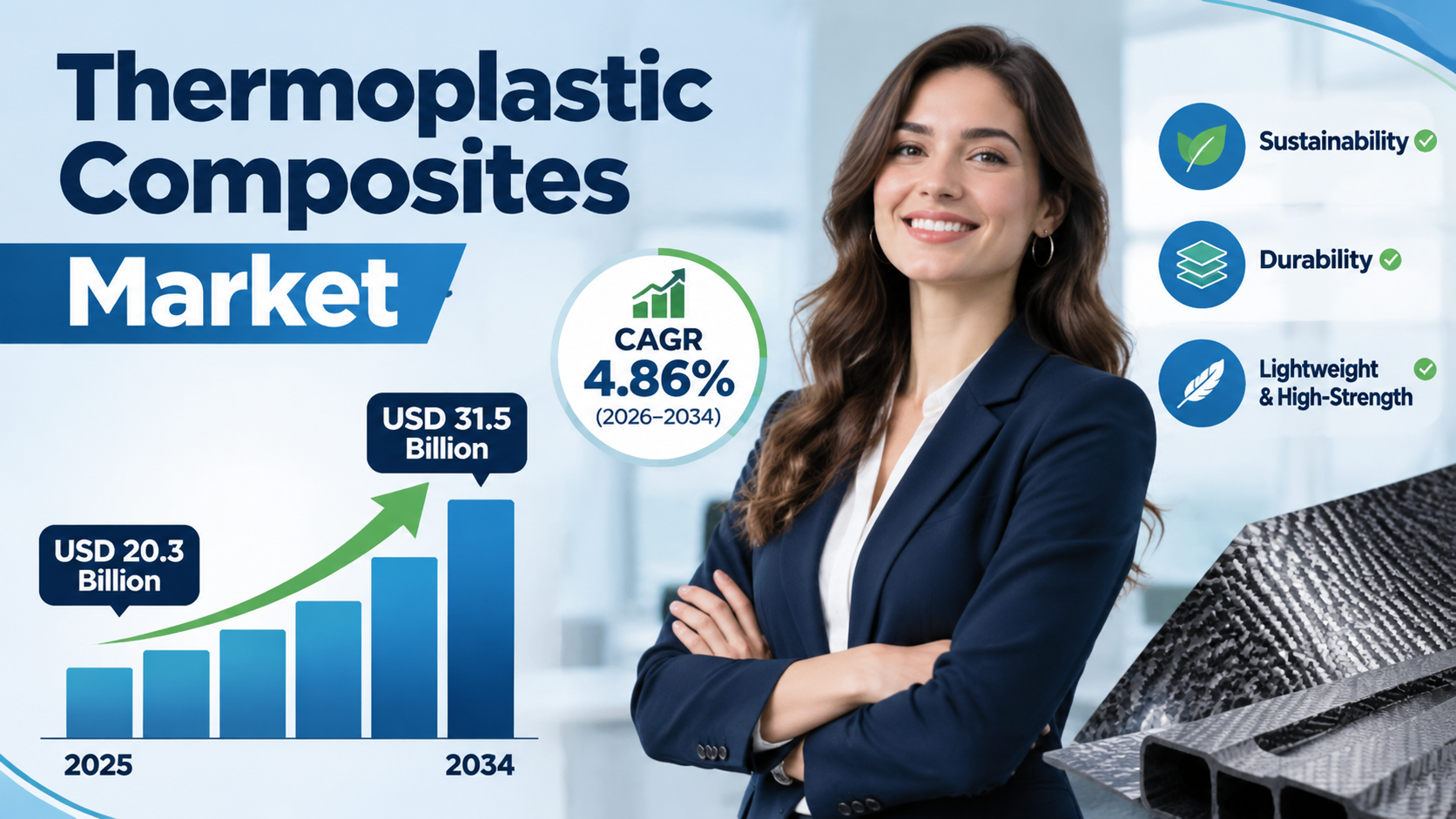
According to IMARC Group's latest research, the global thermoplastic composites market size reached USD 20.3 billion in 2025 and is expected to reach USD 31.5 billion by 2034, growing at a CAGR of 4.86% during 2026–2034. The market is witnessing steady expansion as industries increasingly seek lightweight, high-strength and durable materials that offer improved processing efficiency and resistance to corrosion.
Thermoplastic composites are gaining importance across automotive, aerospace and defense, construction, oil and gas, and medical applications. Their ability to combine strength with reduced weight, recyclability and design flexibility is encouraging manufacturers to explore alternatives to conventional materials. At the same time, innovations in reinforcement fibers, resin formulations and manufacturing technologies are expanding their application potential.
The performance benefits get much of the attention. But the market's growth also reflects a broader shift toward materials that can improve manufacturing efficiency while supporting sustainability objectives. We will get to that below.
What Is Driving the Growth
Five forces explain most of the momentum:
-
Growing demand for lightweight and high-strength products. Automotive and aerospace manufacturers are increasingly adopting thermoplastic composites to reduce component weight while maintaining structural strength. In vehicles, lighter materials contribute to improved fuel efficiency and reduced emissions. In aerospace, they support better fuel economy and increased payload capacity.
-
Increasing awareness about durability and corrosion resistance. Thermoplastic composites offer resistance to corrosion and environmental conditions, making them suitable for demanding applications. Their utilization in construction, marine structures, chemical equipment and pipelines is supporting demand for materials that offer longer service life and lower maintenance requirements.
-
Rising cost-effectiveness and process efficiency. Manufacturing techniques such as injection molding and thermoforming offer shorter production cycles and reduced material wastage compared with traditional manufacturing approaches. Their ability to be molded into complex shapes also supports efficient production and lower transportation costs through weight reduction.
-
Growing focus on environmental sustainability. The recyclability of thermoplastic composites is encouraging their adoption across industries seeking to reduce environmental impact. Automotive and packaging manufacturers are increasingly exploring these materials to support sustainability objectives, while environmental regulations are encouraging the adoption of more sustainable manufacturing practices.
-
Rapid innovations in material technology. Continuous R&D efforts are improving the mechanical properties and performance characteristics of thermoplastic composites. Developments in glass fiber, carbon fiber, hybrid composites and advanced thermoplastic matrices are expanding their applications in industries requiring improved heat resistance, flame retardancy and chemical resistance.
Want the segment-level numbers behind this? Get a free sample of the report.
Where the Market Stands Today
By fiber type, the market is divided into glass fiber, carbon fiber and others. Glass fiber accounts for the largest market share, supported by its cost-effectiveness, strength-to-weight ratio and versatility. It is widely used in automotive components, including panels, interior parts and under-the-hood applications, as well as construction materials such as reinforcement products and structural panels. Carbon fiber-based composites are also gaining importance in high-performance applications, particularly aerospace, sports and recreational activities, and wind energy.
By product, the market is segmented into glass mat thermoplastics (GMT) and advanced thermoplastic composites (ATC). Glass mat thermoplastics hold the largest share, owing to their versatility, moldability and cost-effectiveness. They are widely utilized in automotive interior components, including door panels and instrument panels, as well as construction applications. Advanced thermoplastic composites are preferred in high-performance industries such as aerospace and defense, where exceptional mechanical properties and lightweight characteristics are important.
By resin type, the market includes polypropylene (PP), polyamide (PA), polyether ether ketone (PEEK) and others. Polypropylene represents the leading segment, supported by its wide range of applications and cost-effectiveness. PP-based composites are extensively used in automotive components, consumer goods and packaging. Polyamide-based composites serve applications requiring high-temperature resistance and mechanical strength, while PEEK-based composites are utilized in demanding oil and gas and medical applications.
By end-user industry, the market is categorized into automotive, aerospace and defense, oil and gas, construction, medical and others. Automotive accounts for the largest market share, driven by the need for lightweight materials that improve fuel efficiency, reduce emissions and provide greater design flexibility.
Our Take: Lightweight Materials Are Becoming a Manufacturing Priority
The growing adoption of thermoplastic composites is driven by the increasing demand for advanced materials that offer an optimal balance of mechanical strength, lightweight properties, durability, and processing efficiency. Manufacturers across various industries are progressively shifting from conventional materials toward high-performance polymer-based composites to improve product performance, reduce component weight, and enhance manufacturing flexibility.
This trend is particularly significant in the automotive sector, where the automotive thermoplastic polymer composite market is gaining traction as automakers focus on vehicle lightweighting, fuel efficiency, reduced emissions, and improved design flexibility. Additionally, the short fiber thermoplastic composite market is expanding due to the growing use of these materials in structural and semi-structural automotive components, owing to their favorable strength-to-weight ratio, impact resistance, cost-effectiveness, and compatibility with high-volume manufacturing processes.
Automotive manufacturers are using these composites in interior components, exterior panels and structural elements to support vehicle weight reduction and improved fuel efficiency. Aerospace and defense applications are also benefiting from their strength-to-weight characteristics, while construction and oil and gas industries are utilizing their durability and resistance to demanding environmental conditions.
Two recent industry developments highlighted in the report illustrate how manufacturers are focusing on material innovation and expanding application opportunities. In September 2021, Mitsubishi Chemical Corporation and Mitsubishi Chemical Advanced Materials Japan Ltd. announced the development of Filled and Reinforced Thermoplastics (FRTP), a thermoplastic composite material offering flame retardancy, high production performance and recyclability.
Earlier, in April 2023, Hexcel presented a range of composite innovations for aerospace and urban air mobility customer applications. In October 2023, Avient Corporation also announced the launch of its ThermoBallistic Thermoplastic Composite Panels, designed for ballistic-resistant applications.
These developments highlight the industry's continued focus on improving material performance and identifying new applications. Our view is that companies combining advanced material formulations, efficient manufacturing processes and sustainability initiatives will be better positioned to respond to evolving industrial requirements.
Regional Outlook
-
Asia-Pacific holds the largest market share, supported by its thriving automotive and construction industries. Rapid industrialization, urbanization and increasing demand for lightweight automotive components are supporting the adoption of thermoplastic composites across the region.
-
Europe represents a significant market, driven by its established automotive and aerospace industries. The growing emphasis on lightweight materials, emission reduction and environmental regulations is encouraging manufacturers to adopt advanced composite solutions.
-
North America remains an important market due to the presence of strong aerospace, automotive and oil and gas industries. The increasing use of lightweight and durable materials in aircraft structures is supporting regional demand.
-
Latin America is witnessing growing adoption across automotive and construction applications. Demand for thermoplastic composites in vehicle body panels, roofing materials and infrastructure applications is contributing to market expansion.
-
Middle East and Africa are gradually adopting thermoplastic composites across construction and oil and gas industries. Infrastructure development and exploration activities are supporting demand for materials that can withstand extreme temperatures and environmental conditions.
Who Is Competing
The global thermoplastic composites market features established chemical companies and advanced materials manufacturers competing through product innovation, research and development, capacity expansion and strategic collaborations.
The report profiles Arkema S.A., Avient Corporation, BASF SE, Celanese Corporation, DuPont de Nemours Inc., Hexcel Corporation, Koninklijke DSM N.V., Lanxess AG, Mitsubishi Chemical Advanced Materials (Mitsubishi Chemical Holdings Corporation), PPG Industries Inc., SABIC (Saudi Arabian Oil Co.) and Solvay S.A., among others.
Competition revolves around improving material performance, developing advanced reinforcement solutions, enhancing manufacturing processes and expanding applications across end-user industries. Companies are also investing in sustainable manufacturing practices and recyclability to address changing customer requirements and environmental regulations.
Opportunities and Challenges
Opportunities. The increasing demand for lightweight and high-strength materials across automotive and aerospace industries is creating opportunities for thermoplastic composite manufacturers. Advanced thermoplastic composites offer further potential in high-performance applications, particularly aerospace and defense. The growing use of glass fiber and carbon fiber reinforcements, along with improvements in resin formulations, is expanding the range of possible applications.
Medical and electronics applications also offer opportunities for specialized materials with improved performance characteristics. Furthermore, increasing emphasis on recyclability and efficient manufacturing processes is encouraging companies to develop sustainable thermoplastic composite solutions.
Challenges. High initial investments in manufacturing and processing equipment remain an important challenge for the industry. The requirement for skilled labor to operate specialized manufacturing processes can also affect production capabilities. Manufacturers must continue investing in material innovation, processing technologies and production infrastructure to meet the requirements of different end-user industries.
What This Means for You
-
If you are an investor, look at companies investing in advanced thermoplastic composites, manufacturing capabilities and sustainable material technologies.
-
If you are an automotive manufacturer, lightweight composites offer opportunities to reduce vehicle weight, improve fuel efficiency and support lower emissions.
-
If you work in aerospace and defense, advanced thermoplastic composites provide opportunities for lightweight and high-performance aircraft components.
-
If you are a material supplier or manufacturer, developments in glass fiber, carbon fiber, polypropylene and advanced resin formulations represent important areas of market opportunity.
Thermoplastic Composites Market FAQs
How big is the thermoplastic composites market? According to IMARC Group, the global thermoplastic composites market reached USD 20.3 billion in 2025.
What is the future outlook for the thermoplastic composites market? The market is expected to reach USD 31.5 billion by 2034, growing at a CAGR of 4.86% during 2026–2034.
What is driving the thermoplastic composites market? Increasing demand for lightweight and high-strength materials, durability and corrosion resistance, manufacturing efficiency, environmental sustainability and material technology innovations are among the major growth drivers.
Which fiber type leads the thermoplastic composites market? Glass fiber accounts for the largest market share, supported by its cost-effectiveness, versatility and strength-to-weight ratio.
Which product segment dominates the market? Glass mat thermoplastics (GMT) hold the largest market share.
Which resin type leads the market? Polypropylene (PP) represents the leading resin type, owing to its cost-effectiveness and wide range of industrial applications.
Which end-user industry accounts for the largest market share? The automotive industry holds the largest share, driven by demand for lightweight components and improved fuel efficiency.
Which region dominates the thermoplastic composites market? Asia-Pacific accounts for the largest market share, supported by its expanding automotive and construction industries.
Conclusion
The global thermoplastic composites market is expected to continue expanding as industries increasingly prioritize lightweight materials, durability, manufacturing efficiency and sustainability. Glass fiber, glass mat thermoplastics and polypropylene currently lead their respective segments, while automotive remains the largest end-user industry. Asia-Pacific continues to dominate the regional landscape.
At the same time, advancements in reinforcement materials, resin formulations and manufacturing technologies are creating opportunities across aerospace and defense, construction, oil and gas, medical and other applications. Companies that combine material innovation with efficient production capabilities and sustainable solutions will be better positioned to capture opportunities in this evolving market.
The full report covers historical trends from 2020, uses 2025 as the base year and provides forecasts through 2034, with detailed analysis across fiber type, product, resin type, end-user industry and regional markets.
Need the numbers behind this analysis? Speak to an analyst.
This article is for informational purposes only.
About the Author
IMARC Group is a leading global market research company providing data-driven insights and expert consulting services to businesses seeking to achieve their strategic objectives. With a multi-disciplinary team of industry experts, IMARC delivers thorough, reliable market intelligence across sectors including Healthcare, Food and Beverages, Chemicals and Materials, Consumer Goods, and more.
Media & Sales Contact
IMARC Group
United States: +1-201-971-6302
India: +91-120-433-0800
United Kingdom: +44-753-714-6104

 English
 Arabic
 French
 Spanish
 Portuguese
 Deutsch
 Turkish
 Dutch
 Italiano
 Romaian
 Portuguese (Brazil)
 Greek