


Gas Pipeline Infrastructure Market 2026: Size, Industry Overview, Latest Insights and Forecast to 2034
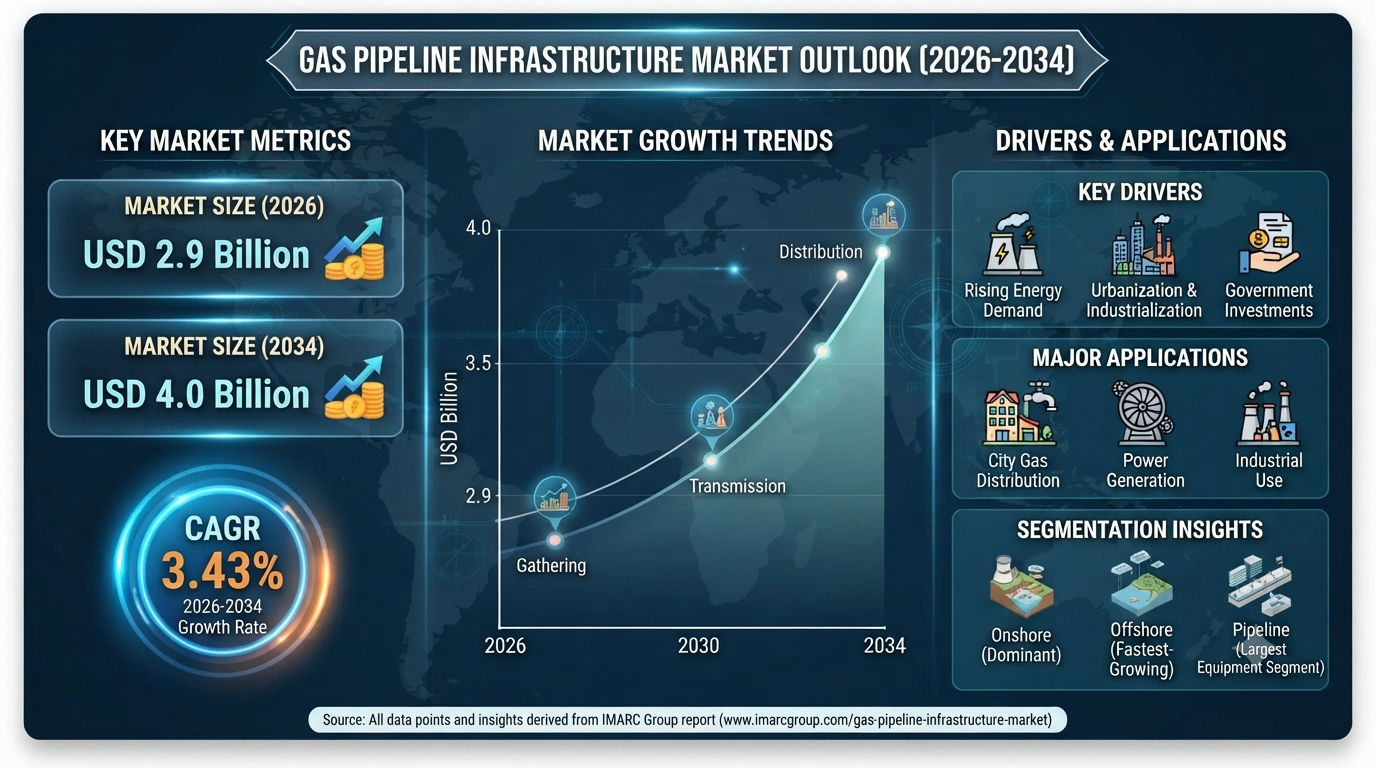
According to IMARC Group, the global gas pipeline infrastructure market size reached USD 2.9 Billion in 2025 and is projected to reach USD 4.0 Billion by 2034, expanding at a CAGR of 3.43% during 2026-2034. This steady gas pipeline infrastructure market growth reflects rising demand for natural gas across residential, commercial, and industrial uses, the growing preference for natural gas over coal and oil, technological advances in pipeline construction and inspection, supportive government policies and incentives, expanding international gas trade, and rapid urbanization and industrialization worldwide.
Gas Pipeline Infrastructure Industry Overview
Gas pipeline infrastructure is the network of pipelines that moves natural gas from production points to distribution points such as homes, businesses, and power plants. The infrastructure spans long-distance transmission pipelines that carry gas across regions and distribution pipelines that deliver it to end users. Pipelines can also serve as a form of storage during periods of peak demand, helping utilities and industrial consumers balance supply with fluctuating consumption.
Compared with trucking or shipping, pipelines can carry natural gas, hydrogen, and other gases with minimal losses and uninterrupted service, which is why they remain the backbone of gas delivery as economies expand their energy access and diversify their fuel mix.
Global Gas Pipeline Infrastructure Market Size & Key Statistics
The table below summarizes the core statistics behind the current gas pipeline infrastructure market size and its forecast trajectory through 2034, drawn from IMARC Group's comprehensive market analysis:
|
Report Attribute |
Key Statistics |
|
Base Year |
2025 |
|
Historical Period |
2020-2025 |
|
Forecast Period |
2026-2034 |
|
Gas Pipeline Infrastructure Market Size in 2025 |
USD 2.9 Billion |
|
Market Forecast in 2034 |
USD 4.0 Billion |
|
Market Growth Rate (2026-2034) |
3.43% CAGR |
|
Largest Region |
North America |
|
Leading Operation Segment |
Distribution |
|
Leading Equipment Segment |
Pipeline |
|
Leading Application Segment |
Onshore |
Request a Sample Report for a Detailed Gas Pipeline Infrastructure Market Share Evaluation: https://www.imarcgroup.com/gas-pipeline-infrastructure-market/requestsample
Key Market Drivers & Gas Pipeline Infrastructure Market Trends in 2026
Several forces are shaping gas pipeline infrastructure market trends and underpinning sustained growth expectations across mature and emerging energy economies:
1. Rising Demand for Natural Gas
Natural gas demand is climbing across residential, commercial, and industrial uses, and the fuel is increasingly chosen over coal and oil. Every additional unit of demand has to be moved from production points to consumption centers, which directly translates into investment in transmission and distribution pipelines and strengthens the overall gas pipeline infrastructure market share of the energy midstream segment.
2. Technological Advances in Pipeline Construction and Inspection
Improvements in pipeline construction methods and inspection technologies are making it possible to build and maintain networks in remote and difficult terrain. Alongside lower raw material production costs and product innovations, these advances are supporting expansion in emerging economies and sustained research and development (R&D) activity across the industry.
3. Favorable Government Policies and Incentives
Governments are backing gas infrastructure through supportive policies, initiatives, and incentives. This policy tailwind helps de-risk long-lifecycle pipeline projects and encourages both public and private investment in new capacity.
4. Growth in International Gas Trade and Cross-Border Pipelines
Expanding international gas trade and the development of cross-border pipelines are opening new corridors between producing and consuming regions, creating fresh demand for pipes, valves, compressor stations, and metering equipment.
5. Urbanization, Industrialization, and Smart Cities
Construction and infrastructure development projects, rising urbanization and industrialization, and the emergence of smart cities all require reliable energy supply. Combined with a gradual consumer shift toward renewable energy resources and the ability of pipelines to carry hydrogen and other gases, these trends are widening the role of pipeline networks in the future energy system.
Key Market Segmentation
By Operation
- Gathering
- Transmission
- Distribution
Distribution represents the leading operation segment, reflecting the continued need to deliver natural gas to homes, businesses, and industrial users as urban and industrial demand expands.
By Equipment
- Pipeline
- Valves (Ball, Gate, Plug)
- Compressor Station (Turbine, Motors)
- Metering Skids
Pipeline is the leading equipment segment, as the pipe network itself forms the core of every gas transmission and distribution project.
By Application
- Onshore
- Offshore
Onshore is the leading application segment, supported by the extensive onshore transmission and distribution networks that connect production areas with consumers.
Regional Insights
The report analyzes the market across North America, Europe, Asia Pacific, Latin America, and the Middle East and Africa. The table below summarizes the regional landscape:
|
Region |
Representative Countries |
Key Highlights |
|
North America - Largest |
United States, Canada |
Technological advancements, rising natural gas demand, presence of key players, and rising disposable income |
|
Europe |
Germany, France, United Kingdom, Italy, Spain, Others |
Covered at regional and country level in the IMARC Group report |
|
Asia Pacific |
China, Japan, India, South Korea, Australia, Indonesia, Others |
Covered at regional and country level in the IMARC Group report |
|
Latin America |
Brazil, Mexico, Others |
Covered at regional and country level in the IMARC Group report |
|
Middle East & Africa |
Regional markets |
Covered at regional level in the IMARC Group report |
North America leads the global Gas Pipeline Infrastructure Market Share, supported by technological advancements, rising natural gas demand, the presence of key players, and rising disposable income.
Connect for Detailed Gas Pipeline Infrastructure Market Share Segmentation Analysis -- Speak to an Analyst: https://www.imarcgroup.com/request?type=report&id=7166&flag=C
Leading Gas Pipeline Infrastructure Companies
The competitive landscape includes pipeline operators, engineering and construction specialists, and equipment suppliers. Some of the key Gas Pipeline Infrastructure companies profiled in the IMARC Group report include:
- APA Group
- CRC Evans Pipeline
- Enagás S.A.
- Enbridge Inc.
- Europipe GmbH
- GAIL (India) Limited
- MRC Global Inc.
- Saipem S.p.A.
- TC Energy Corporation
This list represents only a partial view of the competitive set; the full IMARC Group report covers market structure, market share by key players, player positioning, winning strategies, a competitive dashboard, and a company evaluation quadrant.
Frequently Asked Questions (FAQs)
What is the Gas Pipeline Infrastructure Market Size in 2025?
The global gas pipeline infrastructure market reached USD 2.9 Billion in 2025, supported by rising natural gas demand, technological advances in pipeline construction, and favorable government policies.
What are the key Gas Pipeline Infrastructure Market Trends shaping the industry?
Key trends include rising natural gas use in residential, commercial, and industrial applications, a shift from coal and oil toward natural gas, advances in pipeline construction and inspection, growth in international gas trade and cross-border pipelines, and expanding urbanization, industrialization, and smart-city projects.
What is the Gas Pipeline Infrastructure Market Growth forecast through 2034?
The market is projected to reach USD 4.0 Billion by 2034, growing at a CAGR of 3.43% during 2026-2034, driven by rising natural gas demand, supportive government policies, and continued investment in pipeline networks.
Which operation segment leads the Gas Pipeline Infrastructure Market?
Distribution is the leading operation segment, ahead of gathering and transmission.
Which equipment and application segments hold the largest Gas Pipeline Infrastructure Market Share?
Pipeline is the leading equipment segment, while onshore is the leading application segment.
Which region dominates the Gas Pipeline Infrastructure Market?
North America dominates the global market, supported by technological advancements, rising natural gas demand, the presence of key players, and rising disposable income.
Who are the leading Gas Pipeline Infrastructure companies?
Leading companies include APA Group, CRC Evans Pipeline, Enagás S.A., Enbridge Inc., Europipe GmbH, GAIL (India) Limited, MRC Global Inc., Saipem S.p.A., and TC Energy Corporation, among others.
What is the future outlook for the global Gas Pipeline Infrastructure Market?
The market is expected to sustain steady gas pipeline infrastructure market growth through 2034, driven by continued natural gas adoption, technological progress in pipeline construction and inspection, growth in cross-border gas trade, and supportive government initiatives.
About Us
IMARC Group is a leading global market research company providing data-driven insights and expert consulting services to businesses seeking to achieve their strategic objectives. With a multi-disciplinary team of industry experts, IMARC delivers thorough, reliable market intelligence across sectors including Retail, Healthcare, Technology, Chemicals, Energy, Food & Beverages, and more.
Contact Us
IMARC Group
United States: +1-201-971-6302
India: +91-120-433-0800
United Kingdom: +44-753-714-6104

 English
 Arabic
 French
 Spanish
 Portuguese
 Deutsch
 Turkish
 Dutch
 Italiano
 Russian
 Portuguese (Brazil)
 Greek