


C_THR86 Questions: Business Cases, Decision Points and Explained Answers
Quick Summary
C_THR86 tests SAP SuccessFactors Compensation skills through a scenario-based assessment. Strong answers connect a business requirement to the right configuration and a clear validation step. This guide offers five original business cases with explained answers.
Introduction
Compensation consultants rarely receive a neatly defined technical problem. HR describes a business goal, and the consultant works out which settings and processes serve it.
Take a company that wants promotion-based salary increases in its annual cycle, with eligibility, budgets, and manager approvals still undecided. The consultant clarifies the requirement first and proposes a configuration second.
That order of thinking shapes how to prepare for C_THR86 Questions. Knowing features helps, and knowing how they support real implementation decisions helps more.
What are C_THR86 questions?
C_THR86 questions are scenario-based prompts about SAP SuccessFactors Compensation. Each one describes a business situation and asks the candidate to identify the relevant configuration, explain a suitable solution, and describe how to validate it.
What makes a strong answer?
A strong answer shows subject knowledge, practical reasoning, and awareness of the business need. Take a question about eligibility. A basic answer mentions eligibility rules. A stronger answer names the employee details to check, explains how the configured conditions affect participation, and describes how to confirm the result.
Configuration decisions also ripple outward. A change to an employee group can shift worksheet populations, budget calculations, and reports, so a good answer explains why each check is needed.
How to analyze a compensation business case
Split every situation into four parts:
- Business requirement: what the organization wants to achieve.
- System configuration: plan settings, eligibility rules, budgets, worksheets, permissions, or import tables.
- Potential impact: effects on other employees, managers, approval stages, or results.
- Validation: the test that confirms the solution meets the requirement.
Read the whole situation before choosing an answer, because a familiar keyword can point in the wrong direction.
Original business cases with explained answers
These cases are independently written practice examples that illustrate consultant decision-making. SAP's assessment content stays separate.
Merit and promotion decisions in one cycle
Situation: Managers recommend merit increases and also consider promotions for selected employees.
Question: What should the consultant clarify before proposing a configuration?
Answer: I would identify the policies for merit and promotions, and confirm whether each component needs its own eligibility, budget controls, guidelines, and approval responsibilities. Then I would compare those needs with the existing plan structure and agree how approved results reach employee records.
Why it works: Business rules come first. Applying identical conditions to every component would create avoidable configuration problems.
Unexpected guideline recommendations
Situation: Some employees receive recommendations outside their expected salary adjustment ranges.
Question: Which areas should the consultant investigate?
Answer: I would review guideline configuration, employee information, salary ranges, performance inputs, and the conditions attached to each guideline. I would confirm the right rules reach the affected groups, then test any correction with representative records.
Why it works: Guideline results depend on both configured rules and employee data, so both deserve a look before anyone changes a percentage.
Changes in the management hierarchy
Situation: A reporting structure change lands shortly before planning begins, and managers wonder which employees will appear under them.
Question: What should the team verify?
Answer: I would examine the updated manager relationships, the plan population, worksheet ownership, and approval requirements. Then I would test representative manager views to confirm each manager sees the intended employees.
Why it works: Organizational changes affect how planning is distributed, and early checks prevent confusion mid-cycle.
Rejected import records
Situation: Several records fail validation during a compensation import while the rest process successfully.
Question: How should the consultant investigate?
Answer: I would read the error messages and compare rejected records with the expected structure, checking required fields, employee identifiers, field mappings, and data formats. I would correct a controlled sample and repeat validation before processing the remaining records.
Why it works: Comparing successful and failed records reveals the actual source of the problem.
Currency requirements across countries
Situation: A multinational reviews compensation in several countries, and employees need figures in their local currency.
Question: What should the consultant consider?
Answer: I would clarify the currency requirements and check how the plan, employee data, and statement configuration handle currency. Then I would verify conversion settings and test records from different countries for consistent display.
Why it works: Local data and currency presentation vary by country, so a single assumption can break several results.
How the configuration areas connect
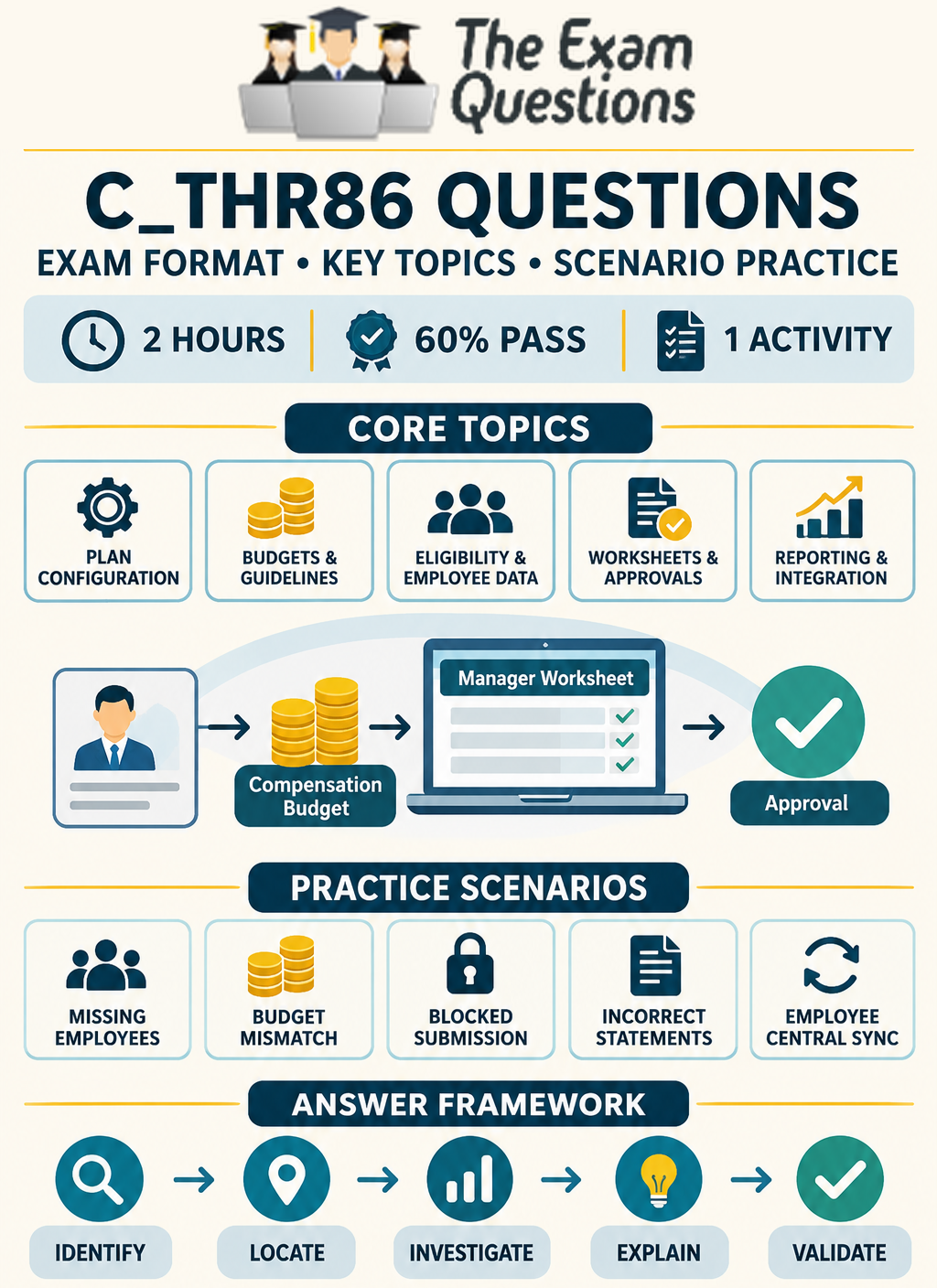
Employee-specific data influences eligibility, and eligibility shapes the worksheet population. Budgets and guidelines then frame what managers can recommend. After planning, worksheets move through approval, and results reach employees through statements or publishing.
Seeing this chain lets you investigate a problem without touching unrelated settings. SAP's competency information lists plan settings, plan guidelines, worksheets, employee-specific data, permissions, reports and workflows, import tables, implementation testing, and statements. The SAP official certification page carries the current requirements.
How to improve answer quality
Review every practice answer against one standard. Does it identify the business problem, name the configuration area, explain a reasonable solution, and include a validation step? Answers that list several features gain strength once they explain how each feature fits the situation.
Speak your answers aloud without a script. This reveals whether you understand the situation or recall memorized sentences. When an answer names the right area but skips the investigation, practise adding the missing reasoning.
Common mistakes in scenario preparation
Recommending a change before understanding the requirement is the most frequent slip. Revised eligibility conditions can reach more employees than intended, so check the impact first. Eligibility, user permissions, and approval responsibilities may appear together in one situation while serving different purposes. Independently published practice material reflects its author's view, so confirm product behavior and certification requirements in current SAP documentation.
Frequently asked questions
What should candidates expect from the exam?
Expect practical compensation situations covering plan settings, guidelines, employee information, worksheets, budgets, permissions, reporting, and implementation activities.
Are practice cases based on real business situations?
SAP uses a scenario-based format, and independently written cases help candidates become familiar with realistic implementation decisions. Actual assessment content remains separate from any practice material.
Is knowledge of compensation worksheets required?
Yes. Worksheets are a core competency area, so candidates should understand their purpose and their link to planning and approval.
How can candidates practise explaining technical decisions?
Choose a business situation, name the relevant settings, explain the solution, and describe the validation. Speaking the response aloud works especially well for AI-guided assessment.
What is the current pass score?
SAP publishes a 60% pass score and a two-hour duration, and lists the assessment as scenario-based.
Conclusion
Preparing for a compensation certification means learning how business requirements become system configuration and practical decisions. The most useful practice cases push you to examine a situation, find the relevant configuration areas, and explain why a solution fits.
Build that habit across many scenarios and your technical understanding and communication will grow together. For more SAP SuccessFactors Compensation practice, visit The Exam Questions and browse the preparation material.

 English
 Arabic
 French
 Spanish
 Portuguese
 Turkish
 Dutch
 Italiano
 Russian
 Romaian
 Portuguese (Brazil)
 Greek