


Hair Transplant: Guide to Hair Restoration, Techniques, Benefits, and Recovery
Hair loss is a common concern that affects millions of people worldwide. It can occur due to genetics, hormonal changes, medical conditions, nutritional deficiencies, stress, or aging. For many individuals, losing hair can affect confidence, appearance, and quality of life.
A hair transplant is one of the most established surgical options for restoring hair in areas affected by thinning or baldness. Modern techniques allow surgeons to move healthy hair follicles from a donor area to areas where hair growth has reduced or stopped.
However, a hair transplant is not suitable for everyone, and results depend on several factors, including the cause of hair loss, donor hair availability, the surgeon's experience, and long-term hair-loss management.
This guide explains everything you need to know about hair transplantation, including available techniques, candidacy, procedure steps, recovery, benefits, risks, costs, and frequently asked questions.
What Is a Hair Transplant?
A hair transplant is a surgical procedure in which healthy hair follicles are taken from a donor area of the scalp or another suitable body area and implanted into regions experiencing hair loss.
The donor area is commonly located at the back or sides of the head because hair follicles in these regions are often more resistant to the effects of androgenetic alopecia, commonly known as pattern hair loss.
Once transplanted successfully, these follicles can continue producing hair in their new location.
Hair transplantation is commonly used to address:
-
Receding hairlines
-
Male pattern baldness
-
Female pattern hair loss in selected patients
-
Thinning at the crown
-
Hair loss caused by certain injuries or scars
-
Hairline irregularities
-
Selected cases of eyebrow or beard hair loss
The procedure redistributes existing hair follicles rather than creating new ones. Therefore, the amount and quality of donor hair are important factors when planning treatment.
What Causes Hair Loss?
Understanding the cause of hair loss is essential before considering transplantation. Different conditions require different treatment approaches.
1. Genetic Hair Loss
Androgenetic alopecia is one of the most common causes of hair loss. It affects both men and women and is influenced by genetic and hormonal factors.
In men, it often causes a receding hairline and thinning at the crown. In women, it commonly produces gradual thinning across the top of the scalp.
2. Hormonal Changes
Hormonal fluctuations can contribute to temporary or progressive hair shedding. Pregnancy, menopause, thyroid disorders, and other hormonal conditions may affect hair growth.
3. Nutritional Deficiencies
Insufficient iron, protein, zinc, and certain vitamins may contribute to hair shedding. Correcting an underlying deficiency may improve hair health without surgery.
4. Stress and Illness
Physical or emotional stress, major surgery, severe illness, and rapid weight loss can trigger a condition called telogen effluvium. This often causes temporary, widespread hair shedding.
5. Medical Conditions
Certain autoimmune disorders, scalp infections, and inflammatory conditions can cause hair loss. Some scarring forms of hair loss permanently damage follicles and require specialist assessment before any transplant is considered.
6. Medication and Treatment Side Effects
Some medications and medical treatments can affect hair growth. Anyone experiencing unexpected hair loss should discuss possible causes with a qualified healthcare professional.
Types of Hair Transplant Techniques
Hair transplantation has developed significantly over the years. Several techniques are available, and the most appropriate option depends on the patient's needs, donor characteristics, and the surgeon's assessment.
1. Follicular Unit Extraction (FUE)
<PRIVATE_PERSON>Follicular Unit Extraction, commonly called FUE, involves removing individual follicular units from the donor area using a small extraction instrument.
The extracted follicles are then prepared and implanted into the recipient area.
Advantages of FUE:
-
Does not require a long linear incision
-
Usually leaves small dot-like scars
-
Allows relatively short hairstyles in many patients
-
Often involves a manageable recovery period
-
Can be suitable for different patterns of hair loss
Limitations of FUE:
-
Requires careful extraction to avoid damaging follicles
-
May take several hours or more than one session
-
Overharvesting can reduce donor-area density
-
Results depend heavily on surgical skill
2. Follicular Unit Transplantation (FUT)
Follicular Unit Transplantation, also known as FUT or strip surgery, involves removing a narrow strip of scalp from the donor area.
The strip is divided into individual follicular units under magnification. These grafts are then placed into the recipient area.
Advantages of FUT:
-
Can provide a substantial number of grafts in selected patients
-
May preserve surrounding donor follicles efficiently
-
Can be useful when a larger number of grafts is required
Limitations of FUT:
-
Leaves a linear scar in the donor area
-
Requires stitches or another closure method
-
May cause more discomfort during early recovery
-
Very short hairstyles may reveal the scar
3. Direct Hair Implantation (DHI)
Direct Hair Implantation is a method of placing extracted follicular units using a specialized implantation device.
The follicles are loaded into the device and implanted into the recipient area according to the planned direction, angle, and distribution.
Potential advantages of DHI:
-
Allows controlled placement of individual grafts
-
Can be useful for detailed hairline work
-
May help the surgeon manage implantation angles
-
Can be suitable for selected areas requiring precision
Limitations of DHI:
-
Requires specialized training and equipment
-
Can be time-consuming
-
Does not guarantee better growth than other techniques
-
Suitability depends on the patient's individual condition
Hair Transplant Technique Comparison
| Feature | FUE | FUT | DHI |
|---|---|---|---|
| Extraction method | Individual follicles | Scalp strip | Usually individual follicles |
| Implantation | Small recipient sites | Small recipient sites | Specialized implantation device |
| Scarring | Small dot scars | Linear scar | Small dot scars when FUE extraction is used |
| Recovery | Generally manageable | May involve more donor-site discomfort | Depends on extraction and implantation |
| Best suited for | Many suitable patients | Selected patients needing larger graft numbers | Selected patients needing controlled placement |
There is no universally superior technique. A qualified surgeon should recommend the method based on the patient's hair-loss pattern, donor supply, and treatment goals.
Who Is a Suitable Candidate for Hair Transplantation?
A hair transplant may be appropriate for people who have permanent hair loss and sufficient healthy donor hair.
However, age alone does not determine eligibility. The stability and cause of hair loss are equally important.
A suitable candidate may have:
-
A clearly identified cause of hair loss
-
Sufficient donor hair density
-
Realistic expectations
-
Good general health
-
A stable or appropriately managed hair-loss condition
-
No untreated scalp disease that would interfere with surgery
Hair Transplant for Men
Men commonly consider transplantation for:
-
Receding hairlines
-
Bald spots
-
Crown thinning
-
Advanced pattern baldness
-
Uneven hairlines
Treatment planning should consider the possibility of continued hair loss in untreated areas. A natural-looking result should also account for how the hairline may look as the patient ages.
Hair Transplant for Women
Women may experience diffuse thinning, widening of the central part, or localized hair loss.
Some women can benefit from transplantation, but the cause of hair loss must be carefully investigated. Diffuse thinning across the donor area may make surgery unsuitable.
Hair Transplant at a Younger Age
People in their early twenties may still be experiencing progressive hair loss. Operating too early can create an unnatural appearance if surrounding hair continues to disappear.
A specialist may recommend monitoring, medical treatment, or delaying surgery until the hair-loss pattern becomes clearer.
How Does a Hair Transplant Procedure Work?
A hair transplant involves several stages. The exact process varies according to the chosen technique and the patient's treatment plan.
Step 1: Consultation and Assessment
The surgeon examines the scalp, reviews the patient's medical history, and discusses the pattern and duration of hair loss.
The assessment may include:
-
Donor-area density
-
Hair thickness and characteristics
-
Scalp condition
-
Hairline design
-
Expected graft requirements
-
Previous hair-loss treatments
-
Medical conditions and medications
Step 2: Hairline Planning
The surgeon designs a hairline that suits the patient's facial structure, age, and available donor hair.
A natural hairline usually has subtle irregularities rather than appearing perfectly straight.
Step 3: Local Anesthesia
Local anesthesia is generally used to numb the donor and recipient areas. This helps reduce pain during the procedure.
Patients may feel pressure or movement, but significant discomfort should be discussed with the medical team.
Step 4: Graft Extraction
Depending on the selected technique, follicular units are extracted individually or obtained from a strip of scalp.
The grafts are handled carefully because damage to follicles can reduce the number of successfully transplanted hairs.
Step 5: Graft Preparation
The extracted follicles are examined, separated when necessary, and kept under appropriate conditions before implantation.
Step 6: Graft Implantation
The surgeon creates recipient sites or uses an implantation device to place the follicles.
The angle, direction, depth, and spacing of each graft are important for achieving a natural appearance.
Step 7: Post-Procedure Instructions
After surgery, the patient receives instructions about washing, sleeping, medication, activity restrictions, and follow-up appointments.
Following these instructions is important for protecting the newly implanted grafts.
How Many Grafts Are Needed for a Hair Transplant?
The required number of grafts depends on the size of the affected area, hair characteristics, donor supply, and desired density.
One graft may contain one, two, three, or occasionally more hair follicles. Therefore, graft numbers and hair counts are not interchangeable.
The following figures are broad examples, not individual treatment recommendations.
| Treatment Area | Approximate Graft Range |
|---|---|
| Small hairline correction | 500–1,200 |
| Receding temples | 800–1,800 |
| Front hairline and frontal area | 1,500–2,500 |
| Mid-scalp thinning | 1,500–2,500 |
| Crown restoration | 1,000–2,500 |
| Larger areas of baldness | 2,500–4,000 or more |
A surgeon should determine the appropriate graft number after examining the donor area. Excessive extraction can permanently reduce donor density and limit future treatment options.
Benefits of Hair Transplantation
Hair transplantation offers several potential benefits for people with suitable hair-loss patterns.
1. Natural-Looking Hair Growth
When performed properly, transplanted follicles can grow hair that blends with existing hair.
The result depends on careful planning, appropriate graft placement, and the surgeon's skill.
2. Long-Term Improvement
Transplanted follicles taken from suitable donor areas often retain their resistance to pattern hair loss. This can provide long-lasting improvement.
However, transplanted hair does not stop native hair from continuing to thin.
3. Improved Hairline Appearance
A carefully designed hairline can help restore facial framing and improve the appearance of a receding forehead.
4. Use of the Patient's Own Hair
Hair transplantation generally uses the patient's own follicles, avoiding the need for donor hair from another person.
5. Styling Flexibility
Once growth has matured, many patients can wash, cut, and style their transplanted hair normally.
Possible Risks and Side Effects
Hair transplantation is surgery and carries potential risks. Patients should understand these before deciding to proceed.
Possible side effects include:
-
Temporary swelling around the forehead
-
Redness and tenderness
-
Scabbing in the recipient area
-
Temporary numbness
-
Itching
-
Minor bleeding
-
Infection
-
Folliculitis
-
Visible scarring
-
Uneven growth
-
Poor graft survival
-
Unnatural hairline design
-
Temporary shedding of existing hair, sometimes called shock loss
Rarely, complications may require additional treatment.
Choosing a qualified medical professional, following aftercare instructions, and attending follow-up appointments can help reduce avoidable risks.
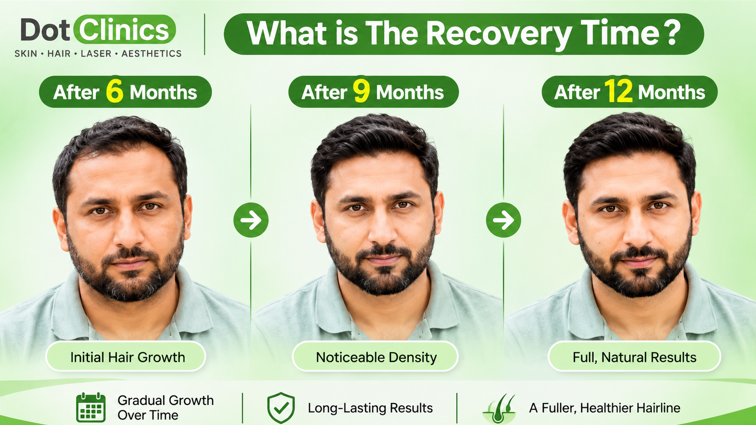
Hair Transplant Recovery Timeline
Recovery varies between patients. The following timeline provides a general overview.
First 24–48 Hours
The scalp may feel tender, swollen, or tight. Small scabs can begin forming around the implanted follicles.
Patients should follow the clinic's instructions and avoid touching or rubbing the treated area.
Days 3–7
Scabbing and redness may remain visible. Gentle washing may be introduced according to the surgeon's instructions.
Strenuous activity should be avoided until the medical team confirms it is appropriate.
Days 8–14
Many patients experience a reduction in visible scabbing and redness. The scalp gradually begins to look more settled.
Weeks 2–8
Transplanted hair shafts commonly shed during this stage. This is often called shock shedding and does not necessarily mean the follicles have failed.
Months 3–4
Early new hair growth may become visible. The hair can initially appear thin or uneven.
Months 5–6
Hair growth generally becomes more noticeable, although density is still developing.
Months 9–12
Many patients see substantial improvement during this period. Hair texture and density may continue to mature.
Months 12–18
Some patients, particularly those treated in the crown area, may continue to see improvement beyond the first year.
Essential Aftercare Tips Following a Hair Transplant
Proper aftercare helps protect the recipient area and supports recovery.
Follow Washing Instructions
Use the washing method recommended by the surgeon. Avoid forceful rubbing, scratching, or direct pressure on newly implanted grafts.
Sleep Carefully
Patients are often advised to sleep with their head elevated during the first few nights to help manage swelling.
Avoid Heavy Exercise Initially
Intense exercise, heavy lifting, and activities that cause excessive sweating should be avoided for the period recommended by the surgeon.
Protect the Scalp From Sun Exposure
Direct sunlight can irritate the healing scalp. Follow the clinic's advice about hats and other forms of protection.
Avoid Smoking During Recovery
Smoking can affect circulation and wound healing. Patients should discuss smoking cessation and recovery precautions with their medical team.
Do Not Pick Scabs
Removing scabs too early can irritate the scalp and potentially disturb healing grafts.
Attend Follow-Up Appointments
Follow-up visits allow the surgeon to assess healing and address concerns about shedding, redness, or hair growth.
Hair Transplant Cost
Hair transplant costs vary considerably between countries, clinics, surgeons, and treatment techniques.
The total price may depend on:
-
Number of grafts required
-
FUE, FUT, or DHI technique
-
Surgeon involvement
-
Clinic facilities
-
Anesthesia and medical support
-
Follow-up care
-
Additional treatments or medications
Hair Transplant Cost in Pakistan
Pakistan is a popular destination for people considering hair restoration because several clinics offer different treatment packages.
However, prices vary between cities and providers. A lower price does not necessarily represent better value.
Before accepting a quote, patients should ask:
-
Who will perform the extraction and implantation?
-
Is the surgeon qualified and experienced?
-
How many grafts are included?
-
Are the estimated graft numbers realistic?
-
What aftercare and follow-up services are included?
-
What happens if complications occur?
-
Are there additional charges?
A proper consultation is the best way to receive an accurate treatment estimate.
Non-Surgical Alternatives to Hair Transplantation
Not everyone needs surgery. Some patients may benefit from medical or non-surgical treatments, depending on the cause of their hair loss.
1. Minoxidil
Minoxidil is a topical medication used to treat certain types of hair loss. It may help slow shedding and improve hair growth in suitable patients.
Results usually require consistent use, and benefits may decline after treatment is discontinued.
2. Finasteride
Finasteride is an oral prescription medication used for male pattern hair loss in appropriate patients.
It can help slow hair loss and, in some cases, improve hair density. Potential side effects and suitability should be discussed with a healthcare professional.
3. Platelet-Rich Plasma (PRP)
PRP treatment involves processing a sample of the patient's blood to concentrate platelets and injecting the preparation into the scalp.
It may improve hair density in some patients, but results vary and evidence is not equally strong for all forms of hair loss.
4. Low-Level Laser Therapy
Low-level laser devices are used in some hair-loss treatment plans. Certain devices may provide modest benefits for selected patients.
5. Microneedling
Microneedling uses fine needles to create controlled micro-injuries in the skin. It is sometimes used alongside other hair-loss treatments.
It should be performed with appropriate hygiene and professional guidance because incorrect use can cause irritation or infection.
6. Nutritional Treatment
When hair loss is associated with a confirmed nutritional deficiency, correcting that deficiency may help improve hair health.
Supplements should not be taken indiscriminately. Testing and professional advice can help identify whether supplementation is necessary.
How to Choose the Right Hair Transplant Clinic
Selecting a clinic is one of the most important decisions in the hair restoration process.
A successful result depends on more than the equipment or technique advertised by a provider.
Consider the following factors:
Surgeon Qualifications
Check the surgeon's medical qualifications, relevant training, and experience in hair restoration surgery.
Before-and-After Results
Review photographs of previous patients with similar hair-loss patterns. Look for consistent, natural-looking results rather than only a few impressive examples.
Transparent Treatment Planning
A reputable clinic should explain the recommended graft number, expected coverage, limitations, and possible future hair loss.
Hygiene and Safety
The procedure should take place in an appropriately equipped medical setting with suitable infection-control practices.
Realistic Expectations
Be cautious of clinics promising guaranteed density, instant results, or permanent protection against all future hair loss.
Proper Follow-Up
Ask how the clinic monitors recovery and who you can contact if you experience complications.
Common Hair Transplant Myths and Facts
Myth 1: Hair transplant results are visible immediately.
Fact: Transplanted hair commonly sheds initially. New growth develops gradually over several months.
Myth 2: Every person with hair loss is suitable for surgery.
Fact: Candidacy depends on the cause of hair loss, donor supply, general health, and scalp condition.
Myth 3: Hair transplantation stops future hair loss.
Fact: The procedure moves selected follicles but does not prevent untreated native hair from thinning.
Myth 4: More grafts always mean better results.
Fact: Proper graft distribution and donor management are more important than simply increasing graft numbers.
Myth 5: FUE leaves no scars.
Fact: FUE usually leaves small dot-like scars, although they may be difficult to notice when healed.
Myth 6: Women cannot have hair transplants.
Fact: Some women are suitable candidates, depending on their diagnosis and donor-area characteristics.
Myth 7: Transplanted hair needs special lifelong care.
Fact: Once fully healed, transplanted hair can generally be cared for like other hair. However, ongoing hair-loss treatment may still be recommended.
Frequently Asked Questions About Hair Transplantation
1. Is a hair transplant permanent?
Transplanted follicles from suitable donor areas often provide long-lasting growth. However, natural aging and ongoing hair loss can affect the overall appearance over time.
2. Is hair transplantation painful?
Local anesthesia is generally used to reduce discomfort. Some patients experience mild pain, pressure, or tenderness during recovery.
3. How long does a hair transplant take?
The procedure may take several hours, depending on the number of grafts, technique, and complexity of the treatment.
4. When can I wash my hair after surgery?
Washing usually begins according to the surgeon's instructions. Patients should not use forceful water pressure or rub the grafts during early recovery.
5. When will transplanted hair start growing?
Early growth may become visible around three to four months after surgery. More noticeable results generally develop over the following months.
6. Does transplanted hair fall out?
The hair shafts commonly shed during the early weeks after surgery. This is a normal part of the process for many patients, while the follicles may remain in place.
7. Can I have a second hair transplant?
Some patients may be suitable for another procedure if they have sufficient donor hair and a clear treatment plan.
8. Can a hair transplant treat a receding hairline?
Yes. Hair transplantation is commonly used to restore receding hairlines, provided the patient has suitable donor hair and realistic expectations.
9. Can women undergo hair transplantation?
Yes. Selected women can benefit from surgery, but the cause and distribution of hair loss must be carefully assessed.
10. What is the difference between FUE and FUT?
FUE extracts individual follicular units, while FUT removes a strip of scalp that is divided into grafts.
11. Is DHI better than FUE?
Not necessarily. DHI is an implantation approach, while FUE describes a follicle-extraction technique. The appropriate method depends on the patient's needs and the surgeon's expertise.
12. Can transplanted hair turn grey?
Yes. Transplanted hair generally retains the characteristics of the donor hair, including its tendency to turn grey with age.
13. Can I wear a cap after a hair transplant?
The timing depends on the type of cap and the surgeon's instructions. Avoid anything that presses against or rubs the recipient area during early healing.
14. Can I exercise after a hair transplant?
Light activities may be resumed when approved by the surgeon. Strenuous exercise should be avoided during the initial recovery period.
15. Does a hair transplant leave scars?
Yes. FUE generally leaves small dot scars, while FUT leaves a linear donor-area scar.
16. How many grafts are required for a full head restoration?
The number varies according to the extent of hair loss, donor availability, hair characteristics, and desired coverage. Not every patient can safely receive a large number of grafts.
17. Can a hair transplant fail?
Poor graft survival or unsatisfactory cosmetic results can occur. Surgeon experience, patient selection, graft handling, and aftercare all influence outcomes.
18. Is hair transplantation safe?
It is generally considered a well-established procedure when performed on appropriately selected patients by qualified professionals. Nevertheless, it carries surgical risks.
19. Can I use hair products after surgery?
Patients should wait until the scalp has healed sufficiently and follow the surgeon's recommendations before using styling products.
20. Is a hair transplant worth it?
It may be worthwhile for suitable patients seeking long-term improvement in hair coverage. The decision should be based on realistic expectations, medical assessment, cost, and potential risks.
Conclusion
Hair transplantation is an established option for people experiencing permanent hair loss who have sufficient healthy donor hair. Techniques such as FUE, FUT, and DHI provide different approaches to extracting and implanting follicles.
The best treatment depends on the individual's hair-loss pattern, scalp condition, donor supply, medical history, and long-term goals. A successful procedure requires careful planning, an experienced surgical team, appropriate aftercare, and realistic expectations.
Before undergoing surgery, consult a qualified hair restoration specialist to understand your options and determine whether transplantation is suitable for your condition.
Medical Disclaimer: This article is intended for general educational purposes and does not replace professional medical advice, diagnosis, or treatment. Hair transplant suitability and treatment decisions should be assessed by a qualified medical professional.

 English
 Arabic
 French
 Spanish
 Portuguese
 Deutsch
 Turkish
 Italiano
 Russian
 Romaian
 Portuguese (Brazil)
 Greek