


Laptop Manufacturing Plant Setup Cost 2026: Feasibility Study, Demand Analysis and Business Plan Consultant
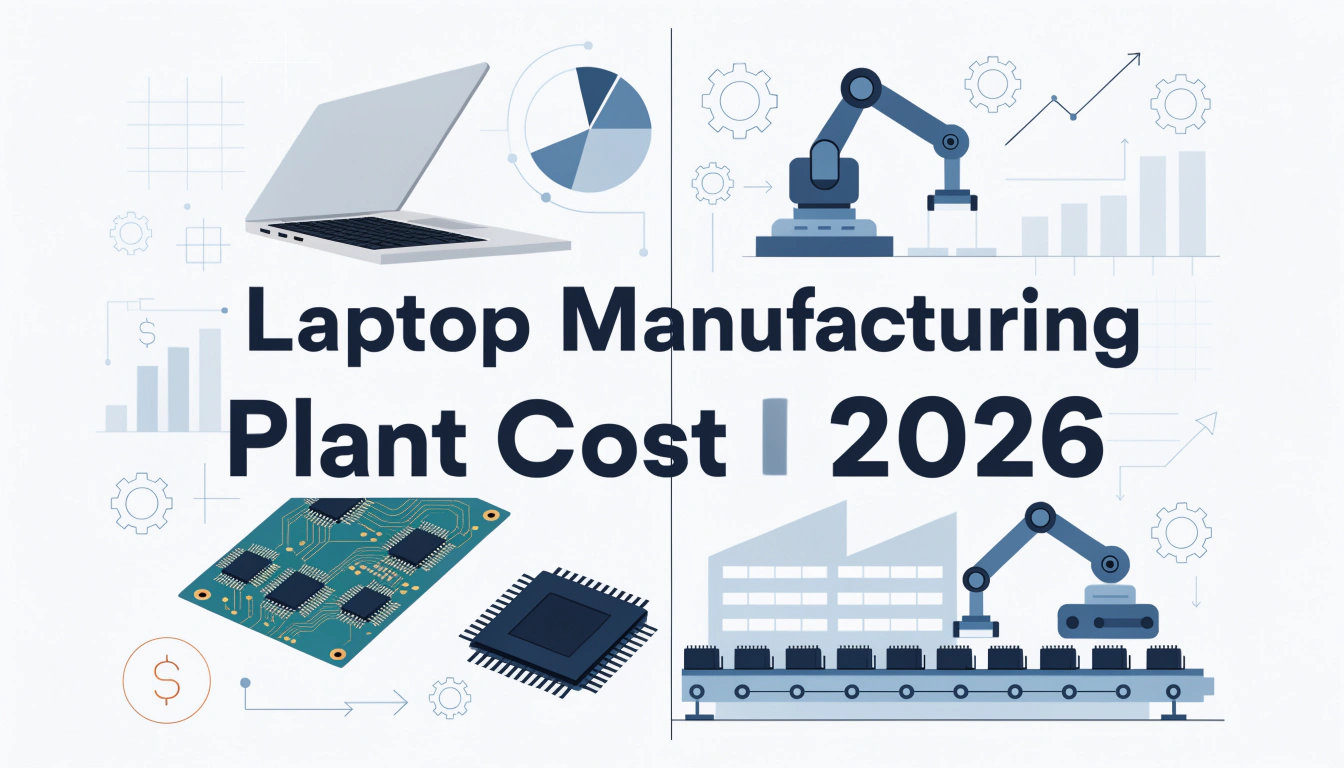
Setting up a laptop manufacturing plant involves multiple integrated production stages, beginning with the procurement and inspection of electronic components, followed by printed circuit board (PCB) assembly, motherboard integration, installation of memory and storage modules, display assembly, battery integration, cooling system installation, firmware configuration, and final quality testing. The manufacturing facility requires specialized equipment, including surface-mount technology (SMT) assembly lines, automated component placement machines, precision assembly stations, firmware programming systems, electrical testing equipment, quality inspection laboratories, thermal and burn-in testing systems, and automated packaging units. Since laptops are complex electronic devices, manufacturers must prioritize component reliability, assembly precision, thermal performance, and stringent quality control procedures to ensure consistent product functionality and durability. Additionally, evaluating the laptop manufacturing plant cost enables prospective investors to understand the initial capital investment, machinery requirements, production capacity, infrastructure expenses, operating costs, and expected returns, thereby supporting effective financial planning and investment decisions.
The laptop manufacturing industry is projected to maintain steady growth through 2026 and beyond, driven by rising demand for portable computing solutions across consumer, corporate, educational, and government sectors. Increasing digitalization, the expansion of remote and hybrid working arrangements, and the growing adoption of online learning platforms are further supporting market demand. Moreover, continuous technological innovations, including advanced processors, high-resolution displays, artificial intelligence (AI)-enabled computing capabilities, faster connectivity, enhanced storage solutions, and improved battery efficiency, are encouraging consumers and businesses to upgrade their devices. According to IMARC Group estimates, the global laptop market was valued at USD 155.74 billion in 2025 and is projected to reach USD 204.45 billion by 2034, exhibiting a compound annual growth rate (CAGR) of 3.07% during 2026–2034.
IMARC Group's report, titled "Laptop Manufacturing Plant Project Report 2026: Industry Trends, Plant Setup, Machinery, Raw Materials, Investment Opportunities, Cost and Revenue," provides a complete roadmap for laptop manufacturing plant cost. It covers a comprehensive market overview to micro-level information such as unit operations involved, raw material requirements, utility requirements, infrastructure requirements, machinery and technology requirements, manpower requirements, packaging requirements, transportation requirements, etc.
Laptop Industry Outlook 2026
The laptop market is largely driven by technological advancements and the increasing need for portable computing devices. Consumer demand for faster processors, longer battery life, and improved portability has led to continuous development of innovative laptop models. The shift towards remote working, online education, and digitalization across various sectors has created a surge in demand, with more than 1 in 4 paid workdays in the United States performed from home in 2024, up from just 1 in 14 in the pre-pandemic period, according to WFH Research data.
The growing reliance on laptops for both personal and professional use continues to expand the market, with increasing demand for gaming laptops and high-performance devices for content creation acting as key drivers. As internet penetration and access to digital services improve in emerging markets, the laptop market is expected to see consistent growth in the coming years. Government initiatives promoting electronics manufacturing, digital inclusion, and domestic assembly, including Make in India PLI schemes for IT hardware, localization mandates, and public procurement programs, are further accelerating local laptop production and ecosystem development.
However, challenges such as component price volatility, high initial capital investment for precision assembly and testing equipment, semiconductor supply constraints, and evolving quality and regulatory standards may influence production costs and strategic investment decisions for new plant setups.
Key Insights for Setting Up a Laptop Manufacturing Plant
Detailed Process Flow
· Product Overview
· Unit Operations Involved
· Mass Balance and Raw Material Requirements
· Quality Assurance Criteria
· Technical Tests
Project Details, Requirements and Costs Involved
· Land, Location and Site Development
· Plant Layout
· Machinery Requirements and Costs
· Raw Material Requirements and Costs
· Packaging Requirements and Costs
· Transportation Requirements and Costs
· Utility Requirements and Costs
· Human Resource Requirements and Costs
Request for a Sample Report: https://www.imarcgroup.com/laptop-manufacturing-plant-project-report/requestsample
Capital Expenditure (CapEx) and Operational Expenditure (OpEx) Analysis
Project Economics
· Capital Investments
· Operating Costs
· Expenditure Projections
· Revenue Projections
· Taxation and Depreciation
· Profit Projections
· Financial Analysis
Profitability Analysis
· Total Income
· Total Expenditure
· Gross Profit
· Gross Margin
· Net Profit
· Net Margin
Key Cost Components
· Raw Materials: The primary cost driver, accounting for approximately 80-85% of operating expenses, dominated by PCBs, processors, memory, storage devices, display panels, and batteries requiring consistent quality and specification compliance.
· Utility Costs: Electricity for precision assembly lines, testing stations, and climate-controlled clean areas, representing approximately 5-10% of operating expenses.
· Machinery and Equipment: Capital investment in surface-mount technology (SMT) lines, automated assembly robots, precision testing stations, software flashing bays, quality control labs, burn-in racks, and packaging systems, along with ongoing maintenance costs.
· Labor: Salaries, training, and benefits for skilled and unskilled workers involved in precision assembly, testing, and quality control operations.
· Packaging and Transportation: Expenses related to protective packaging, storing, and distributing finished laptops to distributors, retailers, and enterprise customers, including logistics infrastructure.
· Depreciation and Financing: Depreciation of fixed assets and interest or repayment obligations for loans or capital investment in plant setup.
· Compliance and Safety: Investment in electrostatic discharge (ESD) controls, safety certifications, environmental compliance, and e-waste management systems.
· Overheads: Administrative costs such as insurance, office operations, licensing, marketing, and general plant management.
Economic Trends Influencing Laptop Plant Setup Costs 2026
Component Price Volatility: As PCBs, processors, memory, and display panels are the primary inputs for laptop assembly, accounting for 80-85% of operating expenses, fluctuating global semiconductor and component prices directly impact both capital and operating costs. Higher material prices raise production expenses, making component sourcing efficiency and supplier diversification more critical.
Carbon Pricing & Environmental Policies: Growing regulatory focus on electronic waste management, energy efficiency standards, and hazardous substance restrictions increases costs related to compliance systems and sustainable material sourcing. Tighter environmental rules around e-waste recycling and battery disposal may elevate initial capital outlay for new plant setups.
Inflation & Interest Rates: Rising inflation inflates the cost of building materials, civil construction, labor, and machinery, while higher interest rates increase the cost of loans and financing needed for plant construction, equipment procurement, and commissioning of assembly and testing lines.
Government Subsidies & Stimulus: Policies supporting electronics manufacturing, domestic assembly, and digital inclusion, such as production-linked incentive (PLI) schemes for IT hardware, can reduce setup costs through grants, low-interest loans, or tax incentives aimed at laptop manufacturing plant investments.
Technological Advancements: Innovations in automated SMT placement, robotic assembly, and inline functional testing can increase upfront CapEx but offer significant productivity gains, reduced defect rates, and lower per-unit costs, enhancing long-term ROI.
Supply Chain Localization: Efforts to reshore laptop assembly and reduce dependence on imported components are incentivizing in-country investment in plant equipment and component sourcing. This may increase initial costs where domestic supply of chips, displays, and batteries is limited but improves supply chain resilience and delivery turnaround.
Labor Market Considerations: Shortages in skilled labor for operating precision SMT lines, robotic assembly systems, and firmware validation processes can drive up wages or necessitate investment in operator training and retention programs, raising both initial setup and ongoing operational expenses.
Speak to an Analyst for Customized Report: https://www.imarcgroup.com/request?type=report&id=7746&flag=C
Challenges and Considerations for Investors
· Feedstock Price Volatility: Laptop manufacturing heavily depends on semiconductor and electronic component supply chains. Fluctuations in global chip and display panel prices can significantly impact production costs and profit margins.
· High Capital Intensity: Establishing a laptop manufacturing plant requires substantial investment in SMT lines, robotic assembly systems, and precision testing infrastructure. Long payback periods can deter risk-averse investors.
· Environmental Compliance: Stringent environmental regulations on e-waste, hazardous substances, and battery disposal require additional investment in compliance systems and sustainable practices.
· Stringent Quality Specifications: End-use customers demand precise performance, durability, and safety standards, which may limit flexibility and restrict the ability to serve certain premium or enterprise segments without additional quality investment.
· Market Competition: The global laptop market is highly competitive, with several established multinational players and significant production capacity. Investors must focus on operational efficiency or niche differentiation, such as gaming or enterprise-grade devices, to remain viable.
· Logistics and Distribution: Distributing finished laptops requires reliable infrastructure and secure storage facilities. Poor logistics can lead to distribution bottlenecks and increased delivery costs.
· Technological Barriers: Staying competitive requires adopting advanced, precision assembly and testing technologies. Outdated systems lead to higher defect rates and greater operational costs.
· Policy and Regulatory Risks: Changes in government policies, such as import tariffs on components or shifts in manufacturing incentive programs, can alter market dynamics abruptly and affect investment outcomes.
About Us:
IMARC Group is a global management consulting firm that helps the world's most ambitious changemakers to create a lasting impact. The company excels in understanding its client's business priorities and delivering tailored solutions that drive meaningful outcomes. We provide a comprehensive suite of market entry and expansion services. Our offerings include thorough market assessment, feasibility studies, company incorporation assistance, factory setup support, regulatory approvals and licensing navigation, branding, marketing and sales strategies, competitive landscape, and benchmarking analyses, pricing and cost research, and procurement research.
Contact Us:
IMARC Group
134 N 4th St. Brooklyn, NY 11249, USA
Email: [email protected]
Tel No:(D) +91 120 433 0800, 7827100593
United States: (+1-201-971-6302)

 English
 Arabic
 French
 Spanish
 Portuguese
 Deutsch
 Turkish
 Dutch
 Italiano
 Russian
 Portuguese (Brazil)
 Greek