


Educational Tourism Market Growth Is Driven by Study Abroad and Experiential Learning
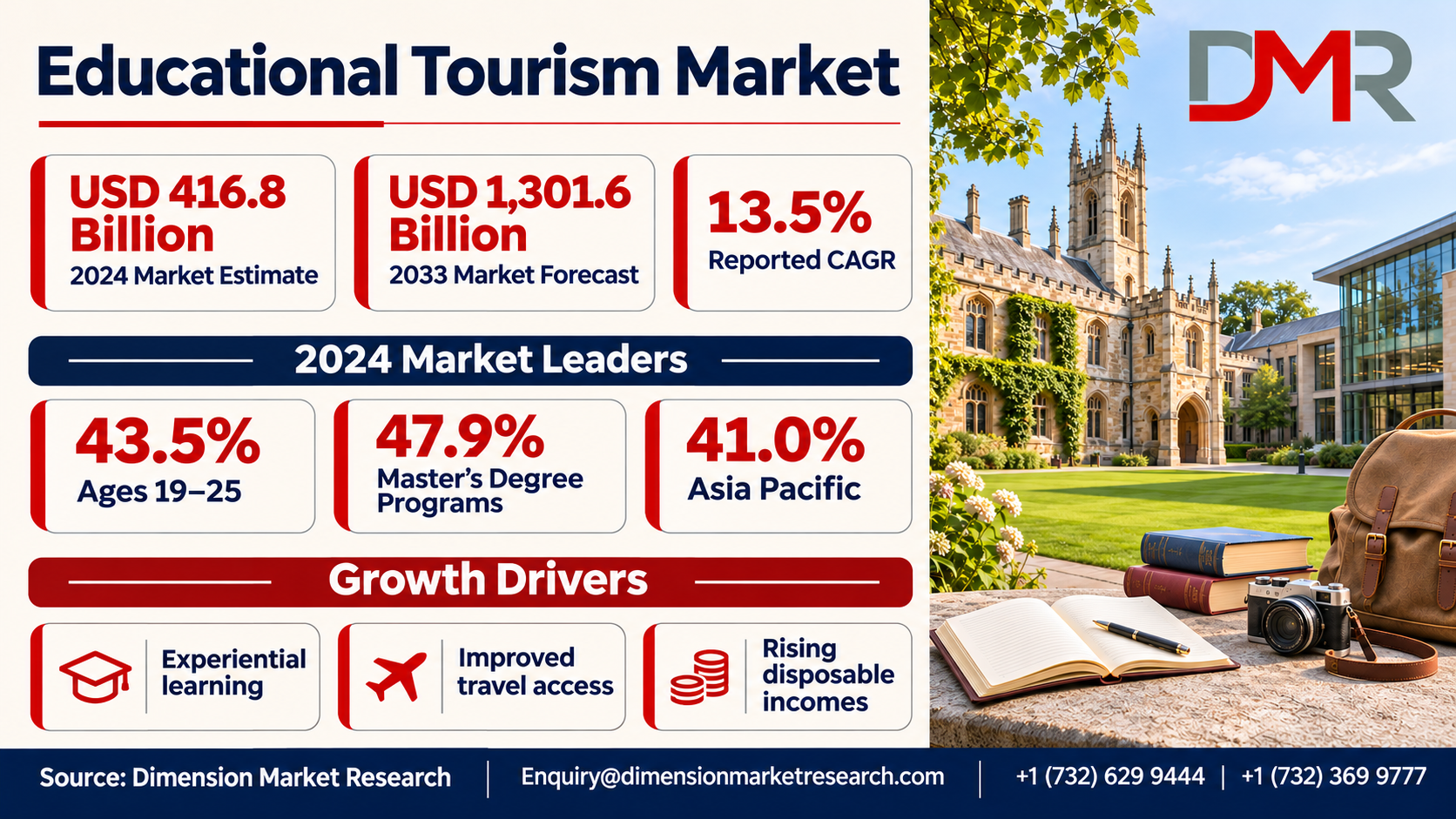
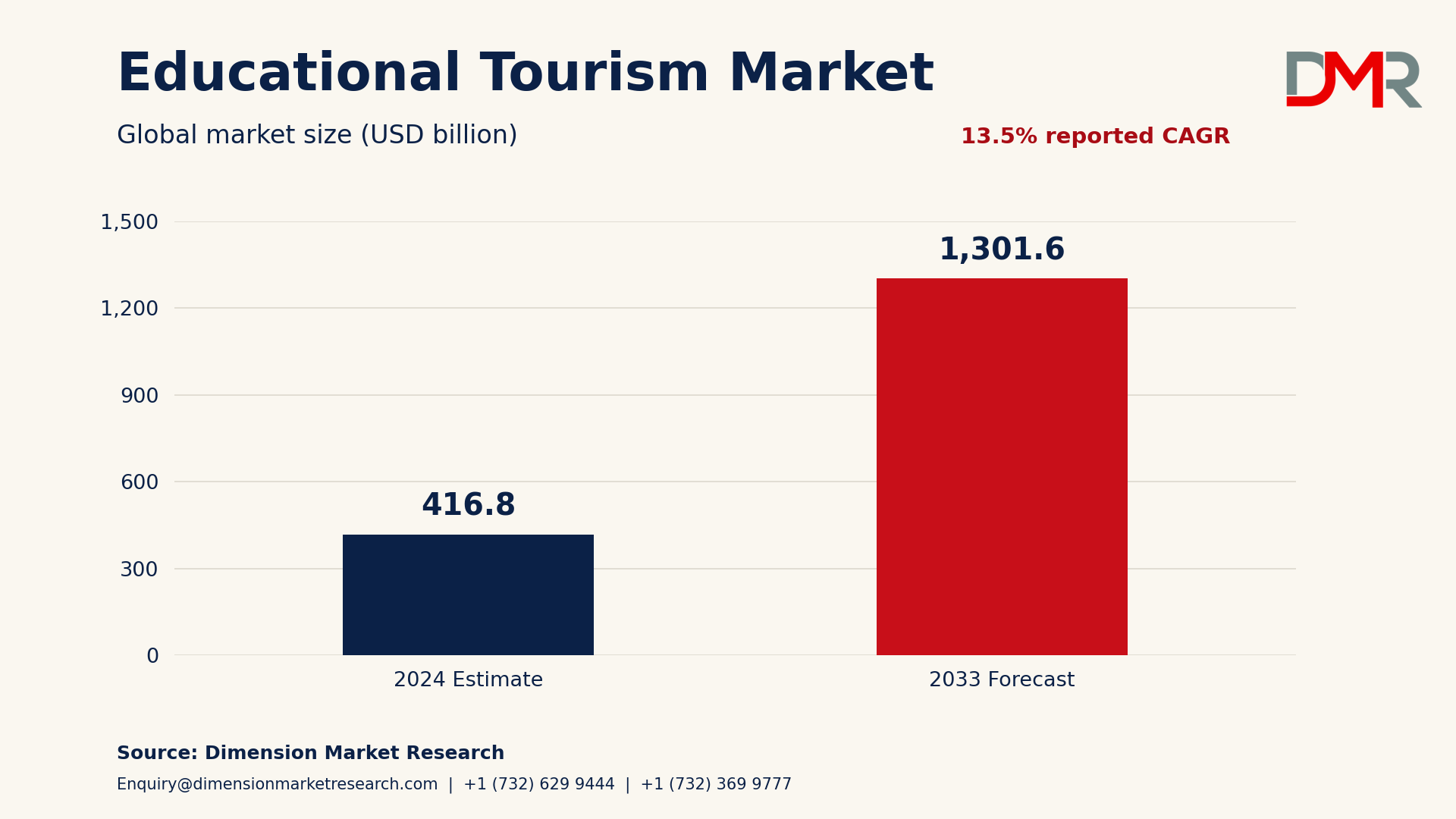
The Educational Tourism Market Growth outlook highlights the role of higher education in international travel demand. According to Dimension Market Research, the global market was estimated at USD 416.8 billion in 2024 and is projected to reach USD 1,301.6 billion by 2033, at a compound annual growth rate of 13.5% from 2024 to 2033. Students represented the largest occupational segment in the 2024 estimate, and master’s degree programs led by course type.
Demand also comes from language immersion, cultural exchange and environmental field trips. These programs involve different decisions about destination, duration and delivery. A university exchange depends on coordination between institutions, while a short immersion program may rely on local instructors and opportunities to practice outside the classroom. For operators, these differences shape which partners they need and which audiences they can serve.
What Is the Educational Tourism Market?
Educational tourism covers travel undertaken for a learning objective. Participants may study at an overseas university, build language skills through everyday conversations, explore history through guided visits or learn about conservation through fieldwork. The report also covers professional learning through international workshops, seminars and conferences.
An itinerary’s value depends on what participants can learn at the destination. A language program can build practice into visits and conversations with local speakers. An environmental program can give students direct access to habitats and conservation projects. For institutions evaluating travel providers, that connection between activities and learning objectives is a practical basis for comparing offers.
Get a Free Customized Sample of This or Any Other Market Research Report
https://dimensionmarketresearch.com/request-sample/educational-tourism-market/
Educational Tourism Market Segmentation and Student Travel Demand
DMR segments the market by age group, occupation and course type. Each category answers a different planning question, from who travels and why to what kind of instruction a program needs to provide. Three findings stand out in the report’s 2024 estimates.
● Travelers aged 19 to 25 led by age group, with a 43.5% share. The report connects demand in this age group to higher education, international internships and longer study abroad programs.
● Students led by occupation. Exchanges and overseas placements can form part of academic programs, while scholarships and student travel discounts can help participants cover costs.
● Master’s degree programs led by course type, with a 47.9% share. DMR associates demand with academic specialization, international exposure and professional networking.
For study abroad operators, these findings suggest looking at semester dates and institutional arrangements early in program design. A postgraduate program can also be assessed against the depth of its subject offering. A workshop, research visit or course has a clearer case for overseas delivery when it gives participants access to expertise connected to their academic or professional goals.
Asia Pacific Educational Tourism Market Share and Destination Demand
Asia Pacific led the global market with an estimated 41.0% share in 2024. DMR cites the region’s cultural heritage, established universities, environmental learning opportunities and investment in transport and lodging as factors supporting demand. The report highlights several destinations with offerings that suit different learning objectives.
● Academic study and research: Japan and Singapore stand out in the report for their educational institutions and research infrastructure.
● Environmental field learning: The report identifies Thailand, Indonesia and New Zealand as destinations for programs involving conservation, sustainable agriculture or marine biology.
The regional share gives operators a starting point for assessing where demand is concentrated. An academic exchange may require a host institution with a compatible calendar and relevant courses. A conservation itinerary may depend more on local experts and access to suitable field sites. Evaluating those requirements alongside regional demand helps identify which destinations can support a specific program.
Educational Travel Providers and Competitive Differentiation
The report covers EF Education First, National Geographic Expeditions, WorldStrides and Smithsonian Journeys. It describes a market where providers with broad program portfolios and institutional relationships compete alongside specialists in language immersion, environmental travel and hands-on learning. DMR also notes the use of virtual experiences and digital learning platforms to improve access.
For a specialist operator, digital preparation could introduce the destination, subject or basic vocabulary ahead of departure. That leaves more time on site for activities that depend on direct access, such as fieldwork or conversation. For a provider working with several partner institutions, shared preparatory materials can help give participants a consistent introduction across programs. The value of the digital component depends on how closely it supports the learning activities planned for the trip.
Explore the Complete Educational Tourism Market Analysis
https://dimensionmarketresearch.com/checkout/educational-tourism-market/
Frequently Asked Questions
How large is the Educational Tourism Market?
DMR estimated the global market at USD 416.8 billion in 2024 and projects it will reach USD 1,301.6 billion by 2033.
What is the projected growth rate of the Educational Tourism Market?
The market is projected to grow at a CAGR of 13.5% from 2024 to 2033.
Which age group leads the Educational Tourism Market?
Travelers aged 19 to 25 led by age group with an estimated 43.5% share in 2024.
Which region has the largest Educational Tourism Market share?
Asia Pacific led the global market with an estimated 41.0% share in 2024.
What is driving educational tourism demand?
DMR identifies interest in experiential learning and cultural exchange, rising disposable incomes and improved access to destinations as factors supporting demand.
Conclusion
DMR’s outlook through 2033 links educational tourism growth to study abroad, cultural exchange and hands-on learning. Postgraduate programs offer opportunities tied to academic specialization and career development, while environmental trips can build on access to local expertise and field sites. For institutions and operators, the practical next step in evaluating either opportunity is to define the learning objective and assess which destination and partner can deliver it.

 English
 Arabic
 French
 Spanish
 Portuguese
 Deutsch
 Turkish
 Dutch
 Italiano
 Russian
 Portuguese (Brazil)
 Greek