


Soil Treatment Market Size, Share, Growth Factors, Analysis and Forecast 2026-2034
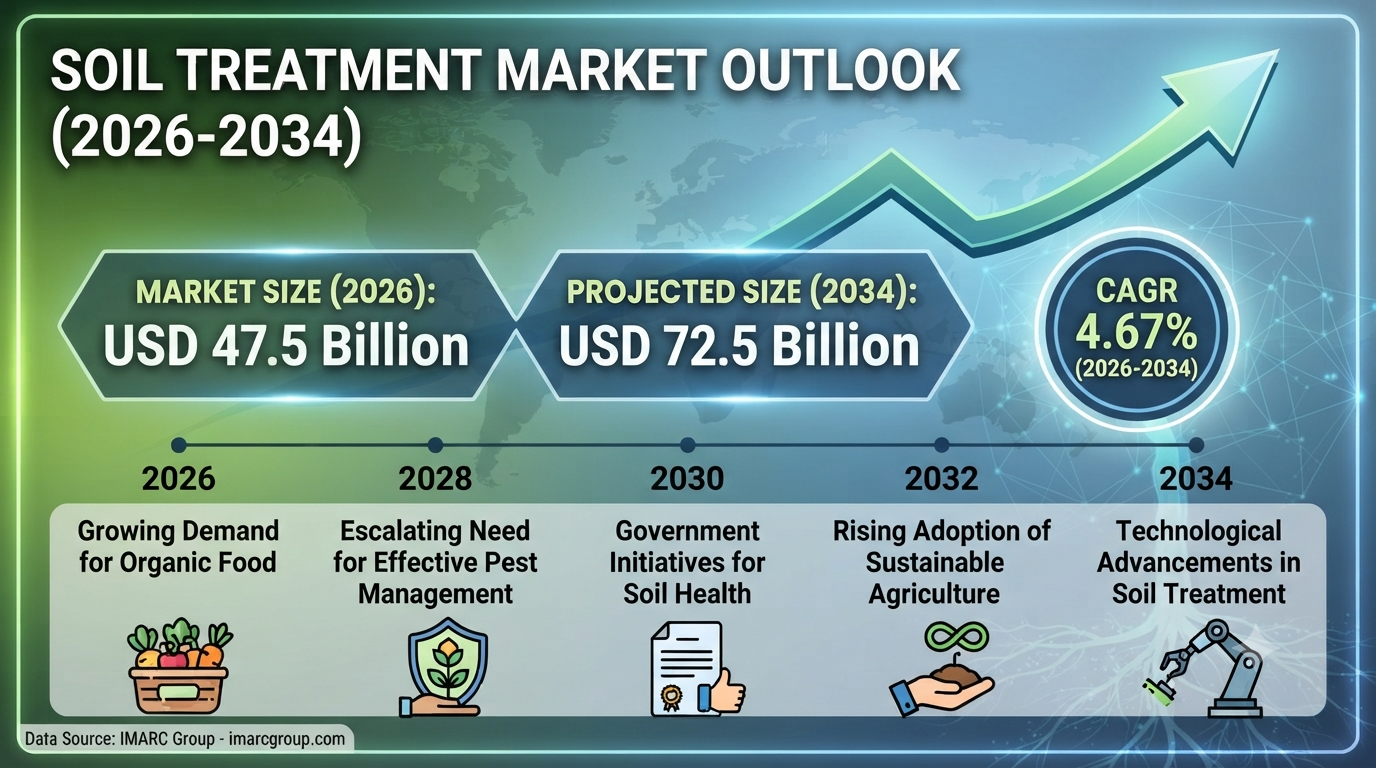
According to IMARC Group, the global soil treatment market size reached USD 47.5 Billion in 2025 and is projected to reach USD 72.5 Billion by 2034, expanding at a CAGR of 4.67% during 2026-2034. This steady soil treatment market growth is underpinned by the rising adoption of sustainable and organic soil treatment methods, growing integration of digital technologies for real-time soil monitoring, and the expanding footprint of precision agriculture across both developed and emerging economies.
Soil Treatment Industry Overview
Soil treatment refers to the physical, chemical, or biological processes used to improve soil quality, correct contamination, and restore fertility, thereby supporting healthier plant growth and more productive land use. By combining amendments, pH correction, and protective measures, soil treatment addresses a wide range of issues, including nutrient depletion, pest infestation, and soil degradation, while enabling compliance with increasingly strict environmental and agricultural standards.
Soil treatment solutions are deployed across a broad continuum of use cases:
- Agricultural productivity: Correcting soil pH, replenishing nutrients, and suppressing soil-borne pests such as nematodes, fungi, and bacteria that damage crop roots and reduce yields
- Organic and sustainable farming: Supporting the shift toward bio-based and organic amendments that meet rising consumer demand for quality, chemical-free food
- Land restoration and remediation: Addressing contamination from heavy metals, petroleum hydrocarbons, and other pollutants through physiochemical and thermal treatment technologies
- Construction and land development: Preparing and stabilizing soil for infrastructure and site-development projects
- Environmental compliance: Helping landowners and agribusinesses meet government and regulatory standards for soil health and conservation
Global Soil Treatment Market Size & Key Statistics
Below are the key statistics drawn from IMARC Group's comprehensive soil treatment market analysis:
|
Report Attribute |
Key Statistics |
|
Base Year |
2025 |
|
Historical Period |
2020-2025 |
|
Forecast Period |
2026-2034 |
|
Soil Treatment Market Size in 2025 |
USD 47.5 Billion |
|
Market Forecast in 2034 |
USD 72.5 Billion |
|
Market Growth Rate (2026-2034) |
4.67% CAGR |
|
Largest Region |
North America (over 38.5% share) |
|
Leading Type Segment |
pH Adjusters |
|
Leading Technology Segment |
Physiochemical Treatment |
|
Leading End-Use Segment |
Agricultural |
Request for a Sample Report for Detailed Soil Treatment Market Share Evaluation: https://www.imarcgroup.com/soil-treatment-market/requestsample
Key Market Drivers & Soil Treatment Market Trends
Several powerful forces are shaping soil treatment adoption and fuelling sustained growth expectations across global agricultural and environmental markets:
1. Escalating Need for Effective Pest Management
The rising prevalence of soil-borne pests such as nematodes, fungi, and bacteria is significantly damaging crop roots and reducing yields, creating strong demand for soil treatment techniques that rebalance the soil microbiome or suppress pest populations. White grub infestations, for instance, have been found to reduce the root system by close to a quarter in soybeans and well over half in maize, while nematode species cause substantial losses in fruit and vegetable crops. As these pests live within the soil, the use of nematicides and related treatments to protect crops is becoming essential, propelling soil treatment market share gains in the years ahead.
2. Growing Demand for Quality and Organic Food
Rising demand for organic and high-quality food is creating a positive outlook for the market, since quality food production depends on fertile soil that supplies essential nutrients to crops. A growing global population, higher disposable incomes, and improving living standards are driving up food and agricultural demand, while government programs promoting organic farming - such as India's National Program on Organic Farming and the Paramparagat Krishi Vikas Yojana - are further stimulating demand for soil treatment solutions.
3. Rapid Technological Advancements
The adoption of advanced soil treatment technologies, including bioremediation, thermal desorption, and electrokinetic methods, is creating lucrative growth opportunities. Research institutions and companies are increasingly investing in next-generation treatment methods - from converting agricultural waste into soil conditioners through accelerated composting processes to rapid high-temperature techniques that remove heavy metals and organic contaminants from soil - expanding the scope of soil treatment technologies to address diverse contaminants under tightening regulatory requirements.
4. Rising Adoption of Sustainable and Organic Amendments
Growing requirements to enhance agricultural productivity while combating soil degradation are prompting widespread adoption of organic and bio-based soil amendments. Diminishing arable land and rising global food demand are fuelling the use of soil treatments to improve fertility and structure, while the parallel growth of the organic food market, which IMARC Group expects to approach USD 528.9 Billion globally by 2032, is creating further avenues for eco-friendly soil treatment products.
5. Supportive Government Initiatives and Regulatory Frameworks
Government programs promoting soil health and conservation, along with regulatory frameworks addressing environmental concerns, are encouraging the adoption of advanced soil treatment methods. Growing use of soil treatment in landscaping and horticulture, supported by public initiatives that promote soil health, is further reinforcing overall industry growth across both developed and emerging markets.
Key Market Segmentation
By Type
- Organic Amendments
- pH Adjusters - Largest Segment
- Soil Protection
pH adjusters lead the type segment globally. These products, including lime to raise pH in acidic soils and sulfur to lower pH in alkaline soils, are vital for optimizing plant growth and remediating contaminated land. By regulating nutrient availability, enhancing microbial activity, and improving soil structure, pH adjusters play an essential role in sustainable soil management and in mitigating the adverse effects of soil contaminants.
By Technology
- Biological Treatment
- Thermal Treatment
- Physiochemical Treatment - Largest Segment (~58.8% share in 2025)
Physiochemical treatment leads the technology segment, accounting for around 58.8% of the market in 2025. This approach combines physical techniques such as soil washing, screening, and thermal desorption with chemical methods such as oxidation, precipitation, and stabilization to reduce the toxicity or mobility of contaminants, including heavy metals, petroleum hydrocarbons, and persistent organic pollutants. Its versatility across diverse contaminants and adaptability to site-specific conditions make it a preferred choice for effective, large-scale soil remediation.
By End User
- Agricultural - Largest Segment
- Construction
- Others
The agricultural sector leads end-use demand worldwide, driven by the need to manage soil-borne pests and diseases effectively to ensure food security and a stable food supply. Global food demand is projected to rise sharply over the coming decades, while increasing infestation of soil-borne pests and weeds is bolstering the need for effective soil treatment solutions. By optimizing soil health through fertilization, organic amendments, and pH adjustments, the agricultural sector is able to maximize productivity while minimizing environmental impact and supporting long-term soil sustainability.
Regional Soil Treatment Market Analysis
|
Region |
Key Highlights |
|
North America - Largest |
United States & Canada; diverse, fertile agricultural base, rising food demand, growing adoption of bio-based soil conditioners, and strong government-backed conservation programs |
|
Europe |
Germany, France, UK, Italy, Spain, Russia; tough soil-degradation challenges, Common Agricultural Policy funding, and rising demand for bio-based amendments and pH balancers |
|
Asia Pacific |
China, Japan, India, South Korea, Australia, Indonesia; severe land degradation, national soil-health programs, and rapidly growing organic amendment adoption |
|
Latin America |
Brazil, Mexico; soil erosion and nutrient depletion challenges, with rising investment in conservation and soil amendment practices |
|
Middle East & Africa |
Dry conditions and land degradation driving demand for water-saving soil conditioners and pH balancers, supported by national agricultural sustainability initiatives |
Connect for Detailed Soil Treatment Market Share Segmentation Analysis - Speak to an Analyst: https://www.imarcgroup.com/request?type=report&id=4643&flag=C
North America leads the global North America Soil Treatment Market, holding over 38.5% share in 2025 on the back of the region's highly diverse agriculture, fertile land base, and rising demand for high-quality food amid a growing population and widening farm-labour shortages. Several leading players are also partnering to introduce improved soil treatment solutions, further reinforcing the region's dominant position.
Asia Pacific represents one of the fastest-growing regional markets, driven by severe soil degradation affecting a large share of regional farmland, expanding national soil-health programs in China and India, and rising investment in precision agriculture technologies across Japan and South Korea.
United States Soil Treatment Market Analysis
The United States accounted for over 72.5% of the North America soil treatment market in 2025. Large-scale farming combined with tougher environmental regulations is driving demand, with more than 45% of arable land classified as degraded as of 2023 according to the USDA. Government programs such as the Conservation Reserve Program and Environmental Quality Incentives Program are investing heavily in soil health, while adoption of bio-based soil conditioners - including compost, biochar, and microbial amendments - grew by around 15% during 2023 as farmers increasingly pursued fertility- and water-retention-boosting products.
Europe Soil Treatment Market Analysis
Europe's soil treatment market is gaining momentum on the back of strict regulatory frameworks and sustainable agriculture priorities. Roughly 35% of EU agricultural land is affected by soil degradation, and the Common Agricultural Policy allocated around USD 58.8 Billion in 2023 toward sustainable farming and environmental conservation. Germany, France, and the Netherlands recorded a 16% rise in demand for bio-based soil amendments and pH balancers in 2023, supported by the European Green Deal's Farm to Fork strategy targeting sharp reductions in chemical pesticide and fertilizer use by 2030.
Asia Pacific Soil Treatment Market Analysis
Asia Pacific's soil treatment market is expanding rapidly amid rising food demand and declining soil fertility. According to the FAO, 62% of regional farmland suffers moderate to severe degradation from water erosion and desertification, prompting national programs such as China's Black Soil Protection Program and India's Soil Health Card Scheme, which has benefited more than 220 million farmers since 2023. Organic soil amendments and biofertilizers saw a 20% uptake in 2023 as awareness of sustainable practices grew, while Japan and South Korea continue to invest heavily in precision agriculture.
Latin America Soil Treatment Market Analysis
Latin America's soil treatment market is shaped by significant soil erosion and nutrient depletion, with an estimated 267 million people across the region facing food insecurity. Brazil is increasingly adopting soil amendment methods to improve crop yields, and global players such as Yara and Mosaic continue to expand their presence with solutions tailored to regional soil conditions.
Middle East & Africa Soil Treatment Market Analysis
The Middle East and Africa region faces dry conditions and land degradation affecting around 28% of its land area, according to the FAO. Saudi Arabia is channeling investment through Vision 2030 agricultural sustainability projects, boosting demand for soil conditioners and pH balancers, while companies such as FMC Corporation are developing water-saving soil treatment products suited to the region's needs.
Competitive Landscape
Key players in the global soil treatment market are driving growth through innovation and sustainability-focused strategies. Companies are investing heavily in research and development to introduce bio-based and eco-friendly soil treatment solutions, such as organic conditioners and microbial amendments, while forming partnerships with agricultural research institutions and farmers to accelerate adoption of advanced soil-health practices. Leading manufacturers are also expanding their global footprint through mergers, acquisitions, and regional partnerships, while integrating digital and precision-agriculture technologies into their product offerings to improve efficiency and performance.
Key companies covered in the IMARC Group report include:
- AMVAC Chemical Corporation (American Vanguard Corporation)
- Arkema S.A.
- BASF SE
- Bayer AG
- Compagnie de Saint-Gobain S.A.
- Corteva Inc.
- Novozymes A/S
- Solvay S.A.
- Swaroop Agrochemical Industries
- Syngenta Group (China National Chemical Corporation)
- Tata Chemicals Ltd.
- UPL Limited
Latest Soil Treatment Market Industry Developments
September 2024 - Bayer AG
Bayer launched its ForwardFarm initiative in India, emphasizing regenerative agriculture with a focus on improving soil health, conserving water, and reducing greenhouse gas emissions. Its Direct Seeded Rice system has reduced water usage and emissions while supporting thousands of Indian farmers, with plans to scale to a million smallholder farmers by 2030.
July 2024 - AMVAC GreenSolutions
AMVAC GreenSolutions partnered with Biome Makers to study the impact of biological products on soil and plant health using BeCrop technology, aiming to generate data-driven insights for sustainable agriculture and improved soil outcomes.
June 2024 - Government of Tamil Nadu
A state government scheme was launched to preserve soil fertility by distributing green manure seeds to farmers, with a budget outlay expected to benefit roughly two lakh farmers.
March 2024 - CSIR-Indian Institute of Chemical Technology
Researchers demonstrated a method for converting dry leaves into a soil conditioner through an accelerated anaerobic composting process that generates only bio-manure, advancing low-cost organic soil amendment options.
January 2024 - BioConsortia, Inc.
BioConsortia launched nitrogen-fixing microbial seed treatment products, with field trials confirming improved yields and reduced fertilizer use in vegetable crops such as potatoes, expanding its addressable market into new crop categories.
Frequently Asked Questions (FAQs)
What is the Soil Treatment Market Size in 2025?
The global soil treatment market reached USD 47.5 Billion in 2025, supported by rising demand for sustainable agriculture, growing soil degradation concerns, and increasing adoption of organic and bio-based treatment methods worldwide.
What is the Soil Treatment Market Growth forecast through 2034?
The market is projected to reach USD 72.5 Billion by 2034, growing at a CAGR of 4.67% during 2026-2034, driven by rising food demand, shrinking arable land, and expanding adoption of digital soil-monitoring technologies.
Which type segment leads the Soil Treatment Market?
pH Adjusters lead the type segment, owing to their widespread use in correcting soil acidity or alkalinity to optimize nutrient availability and support crop productivity.
Which technology leads the Soil Treatment Market?
Physiochemical Treatment leads the technology segment with close to 58.8% share in 2025, owing to its versatility in addressing diverse soil contaminants through combined physical and chemical remediation methods.
Which end-use segment has the highest soil treatment adoption?
The Agricultural sector accounts for the largest end-use share, reflecting its reliance on soil treatment to manage pests, replenish nutrients, and sustain crop productivity amid rising global food demand.
Which region dominates the Soil Treatment Market Share?
North America dominates the global market with more than 38.5% share in 2025, anchored by the region's diverse agricultural base, fertile land, and growing adoption of bio-based soil conditioners, led by the United States within the North America Soil Treatment Market.
Who are the top companies in the Soil Treatment Market?
Leading companies include AMVAC Chemical Corporation (American Vanguard Corporation), Arkema S.A., BASF SE, Bayer AG, Compagnie de Saint-Gobain S.A., Corteva Inc., Novozymes A/S, Solvay S.A., Swaroop Agrochemical Industries, Syngenta Group, Tata Chemicals Ltd., and UPL Limited.
What is the future outlook for the global Soil Treatment Market?
The market is expected to sustain steady growth through 2034, supported by rising adoption of bio-based and organic amendments, technological advancements in remediation methods, tightening environmental regulations, and expanding government initiatives promoting soil health and sustainable farming worldwide.
About Us
IMARC Group is a leading global market research company providing data-driven insights and expert consulting services to businesses seeking to achieve their strategic objectives. With a multi-disciplinary team of industry experts, IMARC delivers thorough, reliable market intelligence across sectors including Agriculture, Healthcare, Technology, Chemicals, Energy, Food & Beverages, and more.
Contact Us
IMARC Group
United States: +1-201-971-6302
India: +91-120-433-0800
United Kingdom: +44-753-714-6104

 English
 Arabic
 French
 Spanish
 Portuguese
 Deutsch
 Turkish
 Dutch
 Russian
 Romaian
 Portuguese (Brazil)
 Greek