


How Much Does Sign Installation Cost, and What Changes the Price?
Ask ten business owners what they paid to get a sign put up and the numbers will be all over the place. One says a couple hundred, another got stung for well over a thousand, and both of them are probably telling the truth. The reason is simple enough, sign installation isn't one fixed job, it's a pile of small variables that stack up differently on every building. The sign itself gets all the attention, the colours, the font, the logo. The fitting gets a shrug until the invoice lands, and that's usually when the questions start. So here's what actually moves the price, and why a cheap quote isn't always the bargain it looks like.
Size and Weight Come First
Obvious one, but worth saying. A small flat panel can be fitted by two people in an hour or so. A big box sign or a run of heavy dimensional letters is a different animal altogether. More weight means stronger brackets, more fixings, more hands, sometimes lifting gear just to get the thing up the wall without damaging it. The bigger the sign, the more wind it catches too, and that pushes the engineering side up, which costs real money. Nobody should be shocked that a three metre fascia costs more to fit than a hanging plaque by the door. Still, plenty of people are.
Height and Access Eat a Surprising Chunk of the Budget
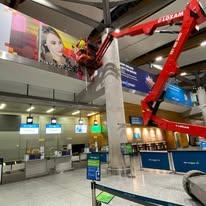
Truth is, where the sign goes matters nearly as much as what it is. Ground floor, easy reach, ladder job, fine. First floor or higher, over a busy footpath, above a doorway, that's a different story entirely. Scaffolding or a cherry picker might be needed, and hiring that gear isn't cheap, plus there's often a need to close off a bit of pavement or arrange traffic management if the site's on a main street. A lot of quotes look low because access hasn't been mentioned yet, and then it turns up later as an extra. Worth asking about it straight away.
The Wall Itself Decides the Fixings
Brick, render, stone, metal cladding, timber, glass. Each one needs different fixings and a different approach, and getting it wrong is how signs end up wobbling within a year. Old render can be hollow behind the surface. Brick with soft mortar doesn't hold well. Insulated cladding needs care so nobody drills straight through something they shouldn't. A decent installer checks all this before starting, sometimes with a quick test on the wall, rather than turning up and just hoping. That checking costs a little time, but it's cheaper than patching holes and starting over.
Electrics Change the Whole Conversation
Let's be real, a plain sign and an illuminated one aren't in the same league when it comes to fitting. Lit signs need cabling, drivers, weatherproof connections, and ideally a qualified electrician involved somewhere along the line, not just whoever's free that afternoon. Water and electrics get along badly, so sloppy work here goes wrong fast and can turn into a safety problem. It also means more time on site and more than one trade, which is why the fitting cost jumps. A lot of the gap between a cheap quote and a proper one sits right here, in the bits that can't be seen once it's finished.
Permissions, Removal and the Other Little Extras
Some signs need planning permission, depending on size, position, lighting and the type of building, and listed premises are stricter again. Applying takes time, and somebody has to do the paperwork. Then there's the old sign. Taking down a rusty bracket or a previous sign and making good the wall is its own bit of labour, and it gets forgotten in a lot of early estimates. Add in travel distance, out-of-hours work for shops that can't close during the day, and small repairs to the surface behind, and a tidy little quote can grow arms and legs pretty quickly.
Why the Cheapest Quote Often Isn't
Here's the problem with going purely on price. A low figure can mean thinner fixings, no wind consideration, no proper weatherproofing, a single fitter rushing through when two would've been safer. It works fine for a few months, then the sign sags, or the sealant fails and damp creeps in behind. Redoing a bad job costs the original fee again, plus removal, plus wall repairs. Compare what's actually included, not just the bottom number. A quote that lists fixings, access, electrics and making good is worth far more than a vague one-liner, even if it's dearer on paper.
Design and Fitting Belong Together
A sign designed with no thought for how it'll be mounted tends to cause grief later, depth that doesn't suit the wall, weight that needs reinforcement, lighting that can't be wired neatly. That's why custom signage Ireland projects tend to go smoother when the people designing it also do the fitting, or at least talk to the people who do before anything's made. Problems get spotted on paper, not on the day with a ladder up and the customer standing there watching. Fewer surprises means fewer extras, and fewer extras means the final bill lands close to the first quote.
So, what's the short answer on cost? It depends, and anyone who quotes without looking at the building is guessing. Size, height, wall type, electrics, permissions and removal all play a part, and the sensible move is to ask about every one of them before agreeing anything. Treating the fitting as an equal partner to the design, rather than an afterthought, saves money over the long run. For anyone planning something properly, looking at specialists in custom signage Ireland is a better starting point than shopping for the lowest price and hoping the details sort themselves out.

 English
 Arabic
 French
 Portuguese
 Deutsch
 Turkish
 Dutch
 Italiano
 Russian
 Romaian
 Portuguese (Brazil)
 Greek