


Electrochromic Materials Market Size, Share, Trends and Forecast 2034
Electrochromic Materials Market to Reach USD 5,838.7 Million by 2034, Driven by Smart Glass and Energy-Efficient Buildings
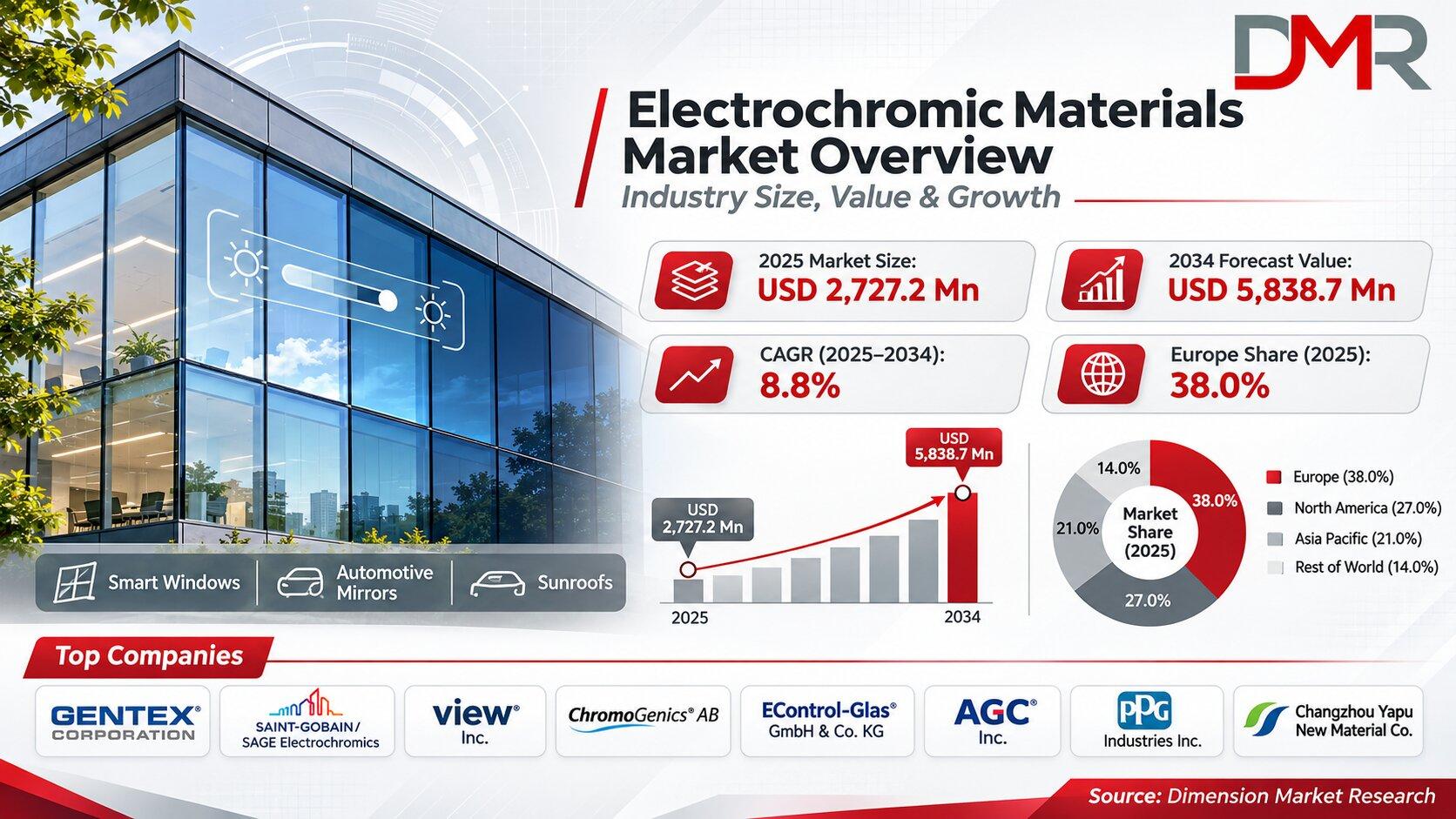
According to Dimension Market Research, the Electrochromic Materials Market is projected to reach USD 2,727.2 million in 2025 and grow at a compound annual growth rate (CAGR) of 8.8% from 2025 to 2034, reaching approximately USD 5,838.7 million by 2034. Increasing adoption of smart windows, energy-efficient architectural glazing, adaptive automotive glass, and advanced optical technologies is creating new growth opportunities across global industries.
What Is the Current Overview of the Electrochromic Materials Market?
The global electrochromic materials market is gaining momentum as construction, automotive, aerospace, and electronics manufacturers increasingly adopt technologies that provide dynamic control over light transmission, heat, glare, and transparency. Electrochromic materials change their optical properties when an electrical voltage is applied, making them valuable for smart windows, adaptive mirrors, electronic displays, and other intelligent glazing applications.
Metal oxides, conducting polymers, viologens, and hybrid composites are among the major materials supporting this technological evolution. Growing interest in sustainable construction, smart infrastructure, and passenger comfort is strengthening commercial demand. Additionally, improvements in solution processing, sputtering, sol-gel methods, and printing technologies are helping manufacturers develop more scalable electrochromic products.
Request Sample PDF of This Report: https://dimensionmarketresearch.com/request-sample/electrochromic-materials-market/
What Is the Expected Value of the Electrochromic Materials Market by 2034?
The electrochromic materials industry is expected to experience sustained expansion through 2034, supported by technological innovation and increasing demand for energy-efficient products.
- The global market is valued at USD 2,727.2 million in 2025.
- The market is projected to reach USD 5,838.7 million by 2034.
- The industry is forecast to grow at an 8.8% CAGR from 2025 to 2034.
- The US market is estimated at USD 550.5 million in 2025.
- The US market is expected to reach USD 1,124.9 million by 2034.
- The US market is projected to expand at an 8.3% CAGR.
- Europe is expected to account for 38.0% of global revenue in 2025.
- Europe is forecast to reach USD 752.0 million by 2034.
- Japan is projected to reach USD 316.3 million by 2034.
What Are the Latest Electrochromic Materials Market Research Findings?
The research identifies smart windows as a leading application segment, supported by increasing demand for adaptive architectural glazing and energy-efficient building envelopes. Metal oxides are expected to dominate material demand because of their durability, optical performance, and suitability for large-area applications. Solution processing is anticipated to lead manufacturing technology due to its scalability, production flexibility, and cost advantages. Construction and architecture remain the primary end-use industries, while automotive and aerospace applications are creating additional opportunities. Regionally, Europe is projected to maintain the largest revenue share, whereas Asia Pacific is expected to record the fastest growth. Advancements in AI-assisted material discovery, flexible coatings, and intelligent glazing systems are also influencing the industry's future development.
Why Is the Electrochromic Materials Market Growing?
Rising investments in sustainable infrastructure and smart building technologies are among the strongest contributors to market expansion. Electrochromic windows can regulate sunlight and solar heat gain, helping buildings manage cooling requirements, glare, and indoor comfort. Their integration with automated building management systems further improves energy management. Automotive manufacturers are also incorporating electrochromic mirrors, sunroofs, and windows to improve visibility, privacy, and passenger experience. Meanwhile, aerospace applications and advanced electronics are expanding the commercial scope of electrochromic materials. Supportive energy-efficiency initiatives, urbanization, and growing awareness of low-carbon construction are providing further momentum.
What Are the Key Growth Drivers of the Electrochromic Materials Market?
- Growing demand for energy-efficient smart windows and glazing.
- Increasing construction of sustainable commercial buildings.
- Rising automotive adoption of adaptive mirrors and sunroofs.
- Expanding smart city and intelligent infrastructure investments.
- Growing demand for advanced aerospace cabin window technologies.
- Technological progress in electrochromic coatings and materials.
- Increasing integration with automated and connected building systems.
Which Region Is Expected to Witness the Fastest Market Growth?
Asia Pacific is expected to witness the fastest growth in the global electrochromic materials market, supported by rapid urbanization, expanding construction activity, and increasing investments in smart infrastructure. China, India, Japan, and South Korea are important contributors to regional demand due to their established manufacturing ecosystems and growing automotive and electronics industries. The expansion of commercial buildings and smart city projects is creating opportunities for electrochromic smart windows and advanced glazing technologies.
Europe is expected to maintain its leading position, accounting for approximately 38.0% of global market revenue in 2025. The regional market is estimated at USD 409.0 million in 2025 and is projected to reach USD 752.0 million by 2034, registering a CAGR of 7.0%. Sustainability regulations, building renovation initiatives, and automotive innovation are supporting regional adoption.
North America represents another important market. The United States is projected to reach USD 550.5 million in 2025 and USD 1,124.9 million by 2034, growing at a CAGR of 8.3%. Energy-efficient building upgrades and automotive applications are supporting demand.
Japan is also an established market, with its value projected at USD 163.6 million in 2025 and USD 316.3 million by 2034, representing a CAGR of 7.6%.
Which Segment Shows the Highest Growth Potential Within the Electrochromic Materials Market, and Why?
Metal Oxides: Established Material Leadership
Metal oxides are projected to dominate the material type segment because of their proven performance, durability, and compatibility with large-area electrochromic applications. Tungsten oxide (WO3) is particularly important because of its optical modulation capabilities, coloration efficiency, and cycling stability. These properties make it suitable for architectural smart windows, automotive sunroofs, and other applications requiring reliable long-term performance. Established manufacturing processes, including sputtering and solution-based deposition, further support commercial adoption.
- Tungsten oxide offers strong optical modulation performance.
- Nickel oxide supports complementary electrochromic device designs.
- Metal oxides provide durability for large-area glazing applications.
Read More About This Market: https://dimensionmarketresearch.com/report/electrochromic-materials-market/
Smart Windows: A Leading Application Opportunity
Smart windows are expected to dominate the application segment as building owners and developers prioritize energy efficiency, natural daylight, and improved occupant comfort. Electrochromic glazing dynamically adjusts transparency to control solar heat and glare without requiring conventional mechanical blinds. Its compatibility with building automation systems also makes it suitable for intelligent commercial buildings, airports, hospitals, and educational institutions. Retrofit projects provide another opportunity as existing properties increasingly adopt energy-saving technologies.
- Architectural glazing supports energy-efficient building design.
- Commercial towers create demand for large-area smart windows.
- Automated glazing improves daylight and glare management.
Solution Processing: Manufacturing Technology Potential
Solution processing is anticipated to lead the technology segment because of its cost efficiency, scalability, and compatibility with different substrates. Techniques such as sol-gel processing, electrodeposition, and spin coating support the development of electrochromic films for rigid and flexible products. The technology also offers opportunities for roll-to-roll manufacturing and customized coatings, making it attractive for manufacturers targeting smart windows, displays, and emerging wearable applications.
Electrochromic Materials Market Dynamics
What Are the Major Trends Shaping the Market?
The growing integration of electrochromic materials into smart building ecosystems is one of the major industry trends. Manufacturers are developing intelligent glazing solutions that automatically adjust their tint according to sunlight intensity, temperature, and user preferences. Connectivity with Internet of Things platforms and building automation systems is improving product functionality. Another emerging trend is the development of flexible electrochromic films, printed devices, and hybrid material systems. These innovations could expand applications beyond conventional windows into wearable electronics, adaptive displays, and advanced automotive interiors. AI-assisted material discovery and predictive manufacturing are also supporting research efficiency and product optimization.
What Are the Future Growth Opportunities in the Electrochromic Materials Market?
Significant opportunities are emerging from the expansion of green buildings, smart cities, and energy-efficient transportation. Electrochromic materials can become an important component of next-generation architectural façades as developers seek to improve building performance and reduce operational energy requirements. Automotive manufacturers can expand adoption through panoramic sunroofs, adaptive side windows, and advanced rearview mirrors. Aerospace cabin glazing and flexible electronic displays represent additional opportunities. Research into electrochromic energy storage devices, hybrid composites, and printed materials could further diversify applications. Manufacturers investing in scalable production, improved durability, and cost-effective formulations are positioned to address broader commercial requirements.
What Challenges Are Affecting the Market?
High initial installation costs remain a major challenge for electrochromic glazing, particularly when compared with conventional low-emissivity glass and traditional shading systems. Long payback periods can discourage adoption among residential developers and cost-sensitive commercial building owners. Durability under extreme weather conditions, ultraviolet exposure, and repeated switching cycles also requires continued technological improvement. Furthermore, manufacturing consistency, material compatibility, and integration with electrical control systems can increase product development complexity. Limited awareness and the need for specialized installation capabilities may also slow adoption in emerging markets. Addressing these challenges through improved coatings, encapsulation, manufacturing efficiency, and lower production costs will be important for wider commercialization.
Which Country Is Expected to Witness the Fastest Market Growth?
Japan's market is projected to grow from USD 163.6 million in 2025 to USD 316.3 million by 2034, at a CAGR of 7.6%. The United States is projected to grow at 8.3% over the same forecast period. No unsupported country-level growth ranking is assigned.
Who Are the Leading Companies in the Electrochromic Materials Market?
The competitive landscape includes established glass manufacturers, automotive technology suppliers, smart glazing specialists, and emerging advanced materials companies. Competition is primarily influenced by product performance, manufacturing capabilities, technological innovation, strategic collaborations, and expansion into new applications.
- Gentex Corporation
- Saint-Gobain (SAGE Electrochromics)
- View, Inc.
- ChromoGenics AB
- EControl-Glas GmbH & Co. KG
- AGC Inc.
- PPG Industries
- Changzhou YAPU New Material Co., Ltd.
- Crown Electrokinetics Corp.
- KIBING Group
- Kinestral Technologies (Halio)
- Ningbo Miruo Electronic Technology Co., Ltd.
- Polytronix, Inc.
- Ricoh
- Zhuhai Kaivo Optoelectronic Technology Co., Ltd.
- RavenBrick LLC
- Guardian Industries Corporation
- Magna Glass & Window, Inc.
Get 10% instant discount on report purchase.
Related Reports:
Frequently Asked Questions (FAQs)
1. What is the projected size of the global electrochromic materials market by 2034?
2. What is the expected CAGR of the electrochromic materials market during 2025 to 2034?
3. Which material type is expected to dominate the electrochromic materials market?
4. Why are metal oxides widely used in electrochromic smart window applications?
5. Which application segment holds the leading position in the electrochromic materials market?
6. Why is Asia Pacific expected to witness the fastest electrochromic materials market growth?
7. What factors are driving electrochromic materials adoption in sustainable construction?
8. Who are the major companies operating in the global electrochromic materials market?
9. What are the major challenges affecting electrochromic materials commercialization worldwide?
10. How are AI and advanced manufacturing technologies transforming electrochromic materials?
About Us
Dimension Market Research (DMR) is a global market intelligence and consulting firm delivering data-driven insights that help organizations make informed strategic decisions. With expertise across 12+ industries and global markets, DMR provides syndicated reports, custom research, competitive analysis, white space analysis, and business strategy consulting.
Our research solutions combine analytical rigor, industry expertise, and forward-looking intelligence to identify opportunities, reduce risks, and support sustainable growth. Trusted by clients across diverse sectors, DMR is committed to delivering accurate, actionable insights that enable businesses to navigate evolving market landscapes with confidence.
Contact Us
Phone USA: +17323699777
Phone India: +919310023843
E-mail: [email protected]
Address USA: 957 Route 33, Suite 12 #308, Hamilton Square, NJ-08690
Address India: D44, Sector 6, Noida 201301, India

 English
 Arabic
 French
 Spanish
 Portuguese
 Deutsch
 Dutch
 Italiano
 Russian
 Romaian
 Portuguese (Brazil)
 Greek