


Canada Secondary Wood Products Market Size Projected to Reach USD 36.75 Billion by 2034 with a CAGR of 1.57%
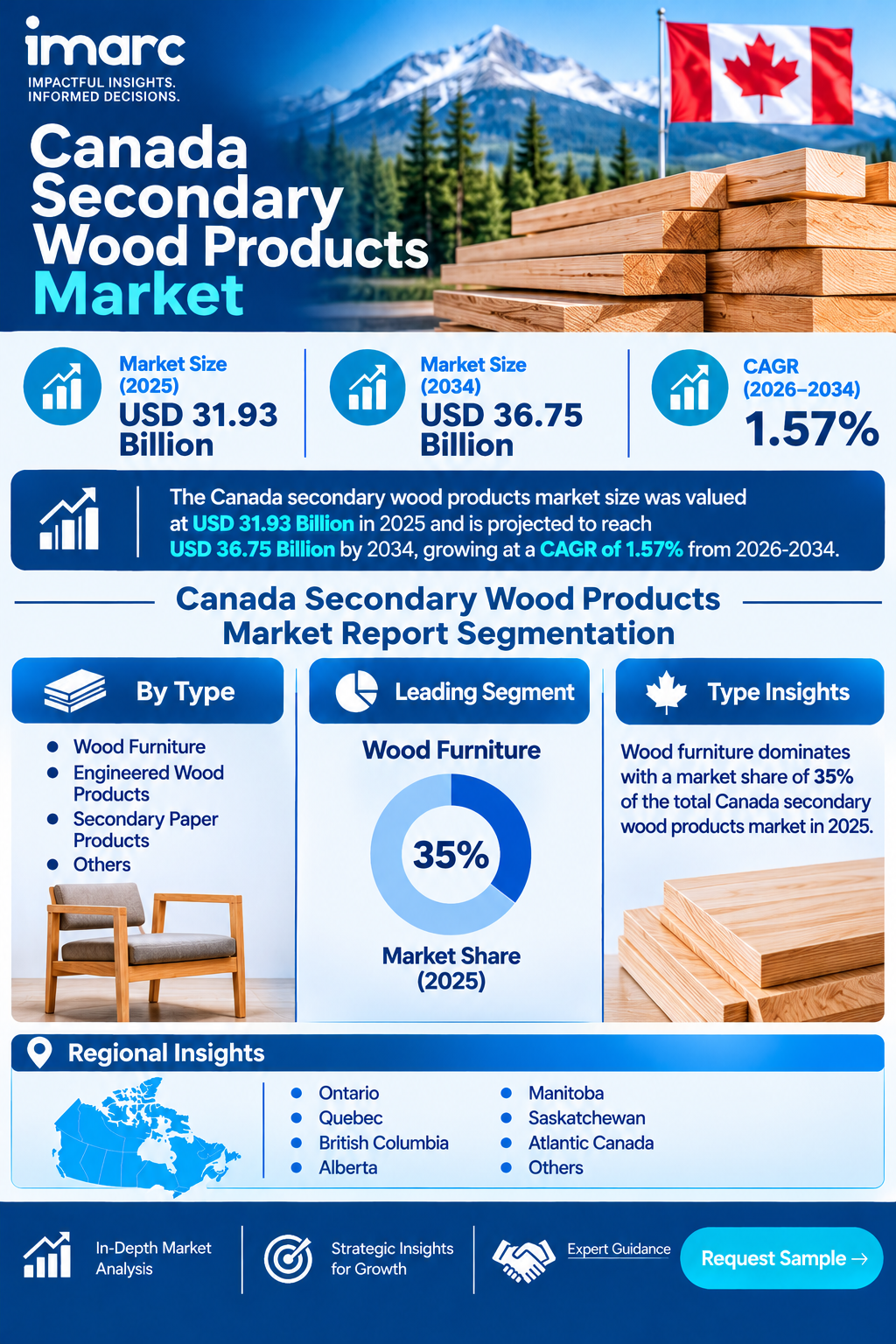
IMARC Group has recently released a new research study titled “Canada Secondary Wood Products Market Report by Type, 2026-2034,” offers a detailed analysis of the market drivers, segmentation, growth opportunities, trends and competitive landscape to understand the current and future market scenarios.
Canada Secondary Wood Products Market Size, Growth, and Forecast (2026-2034)
The canada secondary wood products market size reached USD 31.93 Billion in 2025 and is projected to reach USD 36.75 Billion by 2034, growing at a CAGR of 1.57% during 2026-2034. Rising preference for sustainable and eco-friendly materials, expanding residential and commercial construction, and growing adoption of circular economy principles are the primary factors driving the canada secondary wood products market.
Secondary wood products are value-added goods made from primary wood outputs such as lumber and panels. They include wood furniture, engineered wood products, and secondary paper products used across homes, offices, construction, and packaging.
Canada’s abundant forest resources and advanced manufacturing base support demand for customizable wood-based solutions. Engineered products such as plywood, OSB, and particle board also anchor the canada wood based panels market, which is closely tied to housing and renovation activity.
Explore Growth Opportunities in the Canada Secondary Wood Products Market - Grab Your Sample Report for Evaluation: https://www.imarcgroup.com/canada-secondary-wood-products-market/requestsample
Key Trends Driving the Canada Secondary Wood Products Market
- Rising demand for sustainable and eco-certified wood: Canadian consumers increasingly prefer FSC-certified timber and reclaimed wood for home furnishing. Manufacturers are responding with certified materials and zero-waste production aligned to a circular economy model.
- Growing popularity of multi-functional and modular furniture: Urbanization, compact condominiums, and hybrid work are boosting demand for efficient furniture designs and home office furnishings. This supports steady growth in wood furniture across Canadian cities.
- Advancements in mass timber construction: Updated building codes permit taller wood structures, and programs such as GCWood backed 35 initiatives nationwide between 2017 and 2025. This creates new demand for engineered wood and other secondary wood products.
Canada Secondary Wood Products Market Report Segmentation:
The Canada Secondary Wood Products Market report provides a detailed segmentation analysis to help businesses identify key growth segments and evolving industry dynamics. The market is categorized based on type, offering comprehensive insights across the canada secondary wood products market.
Type Insights:
- Wood Furniture: Wood furniture leads with a 35% share in 2025, covering office furniture, household and institutional furniture, and wooden kitchens, cabinets, and countertops. Its natural appeal, durability, and versatility drive demand across residential and commercial settings.
- Engineered Wood Products: Engineered wood products include plywood, OSB, particle board, and others, and are central to the canada wood based panels market. Mass timber adoption and prefabricated housing are supporting demand.
- Secondary Paper Products: This segment covers paper products and paperboard containers, and benefits from circular economy adoption and demand for lower-footprint alternatives.
- Others: Other secondary wood products complete the market’s product mix.
Canada Secondary Wood Products Market: Recent News and Developments
- March 2025: The federal government announced over USD 20 Million for 67 projects across British Columbia to boost forest industry competitiveness and expand wood product exports.
- August 2025: Prime Minister Mark Carney announced a USD 1.25 Billion aid package for the softwood lumber sector, including USD 700 Million in loan guarantees and USD 500 Million for product and market diversification.
Challenges Impacting the Canada Secondary Wood Products Market
Elevated United States tariffs and duties on Canadian softwood lumber weaken price competitiveness, pressure sawmill profitability, and disrupt supply chains for downstream manufacturers.
Rising log costs, fiber supply constraints, and competition from lower-cost imports, especially in economy-tier furniture, are compressing margins across the value chain.
Investment Opportunities in the Canada Secondary Wood Products Market
The canada secondary wood products market presents compelling investment opportunities supported by its projected growth from USD 31.93 Billion in 2025 to USD 36.75 Billion by 2034. Housing starts reached 259,028 units in 2025, up 5.6% from 2024, supporting demand for cabinets, flooring, doors, and interior fittings.
Mass timber and engineered products, including the canada wood based panels market, are high-value areas, while FSC-certified and reclaimed wood offer premium positioning. Companies that pair customization with sustainability credentials can build strong positions in the canada secondary wood products market.
Outlook of the Canada Secondary Wood Products Market (2026-2034)
The outlook for the canada secondary wood products market is positive, supported by sustained residential construction, government housing initiatives, and growing commercial infrastructure investment. The market is projected to grow from USD 31.93 Billion in 2025 to USD 36.75 Billion by 2034 at a CAGR of 1.57%.
Sustainability certification, mass timber adoption, and a growing preference for Canadian-sourced materials will be the defining trends shaping the canada secondary wood products market through 2034.
Key Players in the Canada Secondary Wood Products Market
The canada secondary wood products market is competitive, with established multinationals, mid-sized regional manufacturers, and specialized local producers. Companies compete through sustainable manufacturing, product portfolio expansion, and nationwide distribution networks.
- Weyerhaeuser Company: Weyerhaeuser is a major timberland owner and wood products manufacturer, with offerings that include engineered wood products used in residential construction.
- Herman Miller: Herman Miller is a global furniture company known for office and residential furniture, and is among the key players serving commercial and institutional demand.
Frequently Asked Questions (FAQs): Canada Secondary Wood Products Market
1. What is the current canada secondary wood products market size?
The canada secondary wood products market size reached USD 31.93 Billion in 2025 and is projected to reach USD 36.75 Billion by 2034, growing at a CAGR of 1.57% during 2026-2034.
2. What are secondary wood products?
Secondary wood products are value-added goods made from primary wood materials, including wood furniture, engineered wood products such as plywood and OSB, and secondary paper products.
3. What are the key drivers of the canada secondary wood products market?
Key drivers include expanding residential construction, consumer preference for sustainable and eco-certified products, government support programs, and mass timber adoption.
4. Which type leads the canada secondary wood products market?
Wood furniture leads the canada secondary wood products market with a 35% share in 2025, supported by its aesthetic appeal, durability, and sustainability credentials.
5. What are the best industry reports on canadian wood market trends?
Look for reports that combine segment forecasts, drivers, challenges, and competitive profiles. IMARC Group’s Canada Secondary Wood Products Market report covers these through 2034, and its US and North America secondary wood products reports offer regional context.
6. Who are the key players in the canada secondary wood products market?
Key players include G. Romano, Amisco Industries, BSG Inc., BG Furniture, Herman Miller, and Weyerhaeuser Company.
Author IMARC Group
IMARC Group is a global management consulting firm that helps the world's most ambitious changemakers to create a lasting impact. The company provide a comprehensive suite of market entry and expansion services. IMARC offerings include thorough market assessment, feasibility studies, company incorporation assistance, factory setup support, regulatory approvals and licensing navigation, branding, marketing and sales strategies, competitive landscape and benchmarking analyses, pricing and cost research, and procurement research.
Contact Us
IMARC Group,
134 N 4th St. Brooklyn, NY 11249, USA,
Email: [email protected],
United States: +1-201971-6302

 English
 Arabic
 French
 Spanish
 Portuguese
 Deutsch
 Turkish
 Dutch
 Italiano
 Russian
 Romaian
 Portuguese (Brazil)