


Pyrethroids Market Size, Share, Latest Trends, Analysis and Forecast 2026-2034
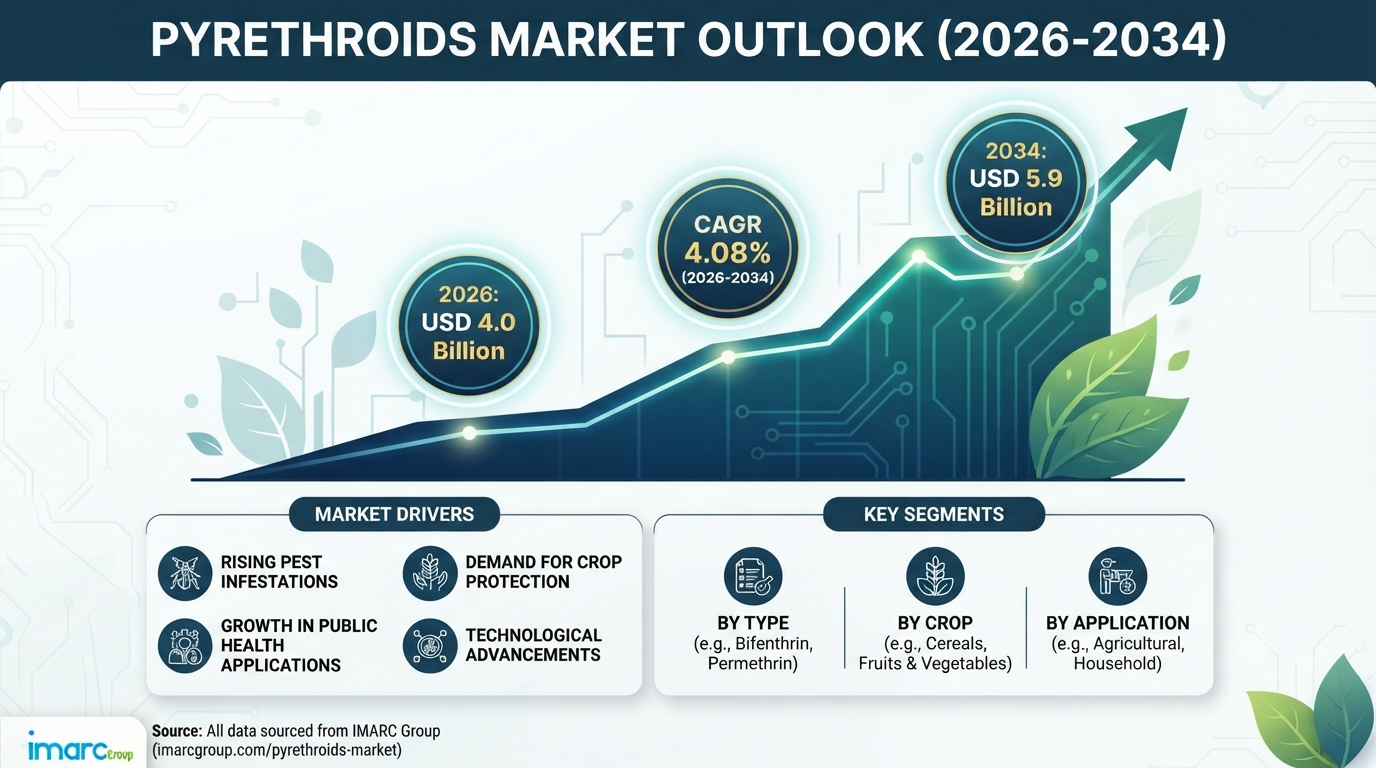
According to IMARC Group, the global pyrethroids market size reached USD 4.0 Billion in 2025 and is projected to reach USD 5.9 Billion by 2034, expanding at a CAGR of 4.08% during 2026-2034. This steady pyrethroids market growth reflects rising agricultural productivity demands, growing awareness of vector-borne diseases, supportive government regulations, continuous R&D in advanced formulations, and an accelerating consumer shift toward bio-based and organic pest-control products.
Pyrethroids Industry Overview
Pyrethroids are synthetic organic chemicals engineered to mimic the natural insecticidal properties of pyrethrins. Commercially manufactured via the esterification of acid and alcohol derivatives, they are extensively deployed across:
- Agricultural pest control: Protecting cereals & grains, oilseeds & pulses, and fruits & vegetables from yield-damaging insect infestations
- Vector control programmes: Combating mosquito-, tick-, and insect-borne diseases such as malaria and dengue through public health initiatives
- Household insecticides: Widely used in home and commercial pest-management formulations
- Timber and textile protection: Preventing insect damage to wood products and fabrics
- Integrated pest management (IPM): Compatible with other pesticides, enabling tailored, resistance-aware pest-control strategies
Global Pyrethroids Market Size & Key Statistics
Below are the key pyrethroids market statistics drawn from IMARC Group's comprehensive Pyrethroids Market Report:
|
Report Attribute |
Key Statistics |
|
Base Year |
2025 |
|
Historical Period |
2020-2025 |
|
Forecast Period |
2026-2034 |
|
Pyrethroids Market Size in 2025 |
USD 4.0 Billion |
|
Market Forecast in 2034 |
USD 5.9 Billion |
|
Market Growth Rate (2026-2034) |
4.08% CAGR |
|
Largest Region |
Asia Pacific |
|
Leading Product Segment |
Cypermethrin |
|
Leading Crop Type Segment |
Oilseeds & Pulses |
|
Leading Pest Type Segment |
Lepidoptera |
Request for a Sample Report for Detailed Pyrethroids Market Share Evaluation: https://www.imarcgroup.com/pyrethroids-market/requestsample
Key Market Drivers & Pyrethroids Market Trends in 2026
Several powerful forces are shaping pyrethroids market trends and fuelling sustained growth expectations across global agriculture and public health sectors:
1. Growing Product Demand in the Agriculture Industry
Rising emphasis on enhanced food production to meet the needs of an escalating global population is driving demand for efficient pest and insect control. Pyrethroids, with their efficacy and cost-effectiveness, provide a reliable solution for safeguarding crops and improving yield quality. The increasing adoption of modern farming techniques and integrated pest management practices, combined with compatibility across multiple pesticide formulations, is further propelling adoption.
2. Rising Awareness of Vector-Borne Diseases
Rapid urbanization is increasing population density, facilitating the spread of vector-borne diseases carried by mosquitoes, ticks, and other insects. Pyrethroids are extensively used in public health programs to control these vectors, with their quick action and long-lasting effects making them suitable for both indoor and outdoor use. Growing public health campaigns around diseases such as malaria and dengue continue to fuel demand.
3. Implementation of Supportive Government Regulations
Governments and international organizations are increasingly promoting environmentally friendly pesticides such as pyrethroids, which are biodegradable, generate minimal residue in soil and water, and exhibit low toxicity toward non-target organisms. Supportive policies, incentives, and alignment with global sustainability goals are favoring continued Pyrethroids Market Growth.
4. Continuous R&D in Advanced Formulations
Ongoing research and development is yielding innovative formulation techniques that enhance effectiveness, adaptability, and enable targeted, controlled release. The growing ability of pyrethroids to mix effectively with fertilizers enabling simultaneous pest control and crop nourishment is positively influencing adoption.
5. Consumer Shift Toward Bio-Based and Organic Products
The increasing consumer preference for bio-based and organic products is facilitating demand, as pyrethroids are considered more eco-friendly relative to other synthetic pesticides. This trend is reinforced by the widespread development of pest resistance to traditional insecticides, positioning pyrethroids as a vital alternative due to their distinct modes of action.
6. Expanding Application in Textile Protection
Increasing product application in textile protection preventing insect damage to fabrics is emerging as an additional growth avenue, broadening the addressable base for pyrethroid formulations beyond traditional agricultural and public health use cases.
Key Market Segmentation
By Product Type
- Bifenthrin
- Deltamethrin
- Permethrin
- Cypermethrin — Largest Segment
- Cyfluthrin
- Lambda-Cyhalothrin
- Others
Cypermethrin dominates the product segment, driven by its versatility across agriculture, public health, veterinary use, and household products. Its efficacy against a broad spectrum of pests — including aphids, fleas, ticks, and mites — combined with low mammalian toxicity and biodegradability, has made it the preferred choice across multiple applications and formulation types.
By Crop Type
- Cereals & Grains
- Oilseeds & Pulses — Largest Segment
- Fruits & Vegetables
- Others
Oilseeds & pulses represent the largest crop-type segment, reflecting their significant economic value and susceptibility to a wide range of insect pests. Rising global demand for vegetable oils and protein-rich food is driving increased cultivation, correlating directly with growing demand for effective pest-management solutions such as pyrethroids.
By Pest Type
- Lepidoptera — Largest Segment
- Sucking Pests
- Coleoptera
- Diptera
- Mites
- Others
Lepidoptera dominates the pest-type segment owing to the widespread damage this pest order causes across fruits, vegetables, grains, and ornamentals. Growing resistance among several Lepidoptera species to traditional insecticides has made pyrethroids a vital alternative given their distinct modes of action and favorable environmental profile.
Regional Pyrethroids Market Analysis
|
Region |
Key Highlights |
|
Asia Pacific — Largest |
China, India, Japan, South Korea, Australia, Indonesia; vast and diverse agricultural landscape, tropical and subtropical climate favoring pest proliferation, rising focus on agricultural productivity and cost-effective pest solutions |
|
Europe |
Germany, France, UK, Italy, Spain, Russia; mature regulatory frameworks promoting eco-friendly pesticide adoption |
|
North America |
United States & Canada; advanced agricultural infrastructure and established vector-control programmes |
|
Latin America |
Brazil, Mexico; expanding agricultural output and growing public health vector-management needs |
|
Middle East & Africa |
UAE, Saudi Arabia, South Africa; rising vector-borne disease control initiatives and agricultural modernization |
Asia Pacific exhibits a clear dominance in the global Pyrethroids Market Share, supported by a substantial agricultural base spanning rice, wheat, fruits, vegetables, oilseeds, and pulses. The region's climate conditions favor pest proliferation, necessitating extensive pyrethroid use, while cost-effectiveness continues to align with the budget considerations of small and medium-sized farmers across the region.
Connect for Detailed Pyrethroids Market Share Segmentation Analysis — Speak to an Analyst: https://www.imarcgroup.com/request?type=report&id=1591&flag=C
Leading Players in the Global Pyrethroids Industry
The global pyrethroids market features a mix of diversified agrochemical multinationals and specialized crop-protection players. Key companies covered in the IMARC Group Pyrethroids Market Report include:
|
Company |
Headquarters Focus |
Competitive Strength |
|
BASF |
Germany |
Broad crop-protection portfolio, global manufacturing footprint |
|
Bayer CropScience |
Germany |
Integrated pest-management solutions, strong R&D pipeline |
|
Corteva Agriscience |
United States |
Resistance-management innovation, seed-chemical integration |
|
Nufarm |
Australia |
Diversified insecticide portfolio, regional manufacturing |
|
SinoHarvest Corporation |
China |
Cost-competitive manufacturing, Asia-Pacific distribution |
|
Sumitomo Chemical |
Japan |
Technology-driven formulations, vector-control expertise |
|
Syngenta |
Switzerland |
Global distribution network, sustainability-focused R&D |
|
United Phosphorus |
India |
Generic agrochemical scale, emerging-market reach |
|
Arysta Lifescience |
France |
Specialty crop-protection formulations |
|
Cheminova |
Denmark |
Insecticide and fungicide manufacturing |
|
FMC |
United States |
Innovation in resistance-management chemistries |
|
Monsanto |
United States |
Agricultural input integration |
|
Shanghai Mingdou Agrochemical |
China |
Regional manufacturing and export capacity |
|
Adama Agricultural Solutions Ltd. |
Israel |
Differentiated and off-patent crop-protection solutions |
Latest Pyrethroids Market Industry Developments
December 2022 — BASF
BASF, together with MedAccess, announced the completed shipment of 35 million Interceptor G2 nets to support global malaria-control efforts. These nets are treated with pyrethroid and pyrrole compounds, reinforcing the role of pyrethroids in public-health vector management.
November 2021 — Corteva Agriscience
Corteva Agriscience launched Ridgeback, a new soybean insecticide designed to effectively target pyrethroid-resistant soybean aphids, addressing a growing resistance-management need in row-crop agriculture.
April 2021 — Nufarm
Nufarm launched Danitol, a Group 3 pyrethroid insecticide formulated to control pests from several different insect families, broadening its crop-protection portfolio.
Frequently Asked Questions (FAQs)
What is the Pyrethroids Market Size in 2025?
The global pyrethroids market reached USD 4.0 Billion in 2025, supported by growing agricultural pest-control demand, rising vector-borne disease awareness, and supportive government regulations promoting eco-friendly insecticides.
What are the key Pyrethroids Market Trends shaping the industry?
Key Pyrethroids Market Trends include continuous R&D into advanced, targeted-release formulations, a growing consumer shift toward bio-based and organic pest-control products, expanding use in textile protection, and increasing adoption of integrated pest-management practices worldwide.
What is the Pyrethroids Market Growth forecast through 2034?
The market is projected to reach USD 5.9 Billion by 2034, growing at a CAGR of 4.08% during 2026-2034, driven by rising agricultural productivity needs, expanding vector-control programmes, and increasing adoption of sustainable pest-management solutions.
Which product type leads the Pyrethroids Market?
Cypermethrin leads the product segment due to its versatility across agriculture, public health, veterinary, and household applications, along with its favorable toxicity and biodegradability profile.
Which crop type holds the largest Pyrethroids Market Share?
Oilseeds & pulses hold the largest crop-type share, reflecting their high economic value and vulnerability to a broad range of insect pests that necessitate consistent pest-management intervention.
Which pest type leads the Pyrethroids Market?
Lepidoptera leads pest-type demand, reflecting the significant crop damage this pest order causes across fruits, vegetables, grains, and ornamentals globally, along with growing resistance to traditional insecticides.
Which region dominates the Pyrethroids Market Share?
Asia Pacific dominates global Pyrethroids Market Share, anchored by its vast and diverse agricultural landscape, favorable climate conditions for pest proliferation, and cost-effective pest-control needs among small and medium-sized farmers.
Who are the top companies in the Pyrethroids Market?
Leading companies include BASF, Bayer CropScience, Corteva Agriscience, Nufarm, SinoHarvest Corporation, Sumitomo Chemical, Syngenta, United Phosphorus, Arysta Lifescience, Cheminova, FMC, Monsanto, Shanghai Mingdou Agrochemical, and Adama Agricultural Solutions Ltd.
What is the future outlook for the global Pyrethroids Market?
The market is expected to sustain consistent growth through 2034, driven by rising agricultural productivity demands, expanding vector-borne disease control programmes, continuous formulation innovation, and increasing global alignment with sustainable, bio-based pest-management practices.
About Us
IMARC Group is a leading global market research company providing data-driven insights and expert consulting services to businesses seeking to achieve their strategic objectives. With a multi-disciplinary team of industry experts, IMARC delivers thorough, reliable market intelligence across sectors including Agriculture, Chemicals, Healthcare, Technology, Energy, Food & Beverages, and more.
Contact Us
IMARC Group
United States: +1-201-971-6302
India: +91-120-433-0800
United Kingdom: +44-753-714-6104

 English
 Arabic
 French
 Spanish
 Portuguese
 Deutsch
 Turkish
 Dutch
 Russian
 Romaian
 Portuguese (Brazil)
 Greek