


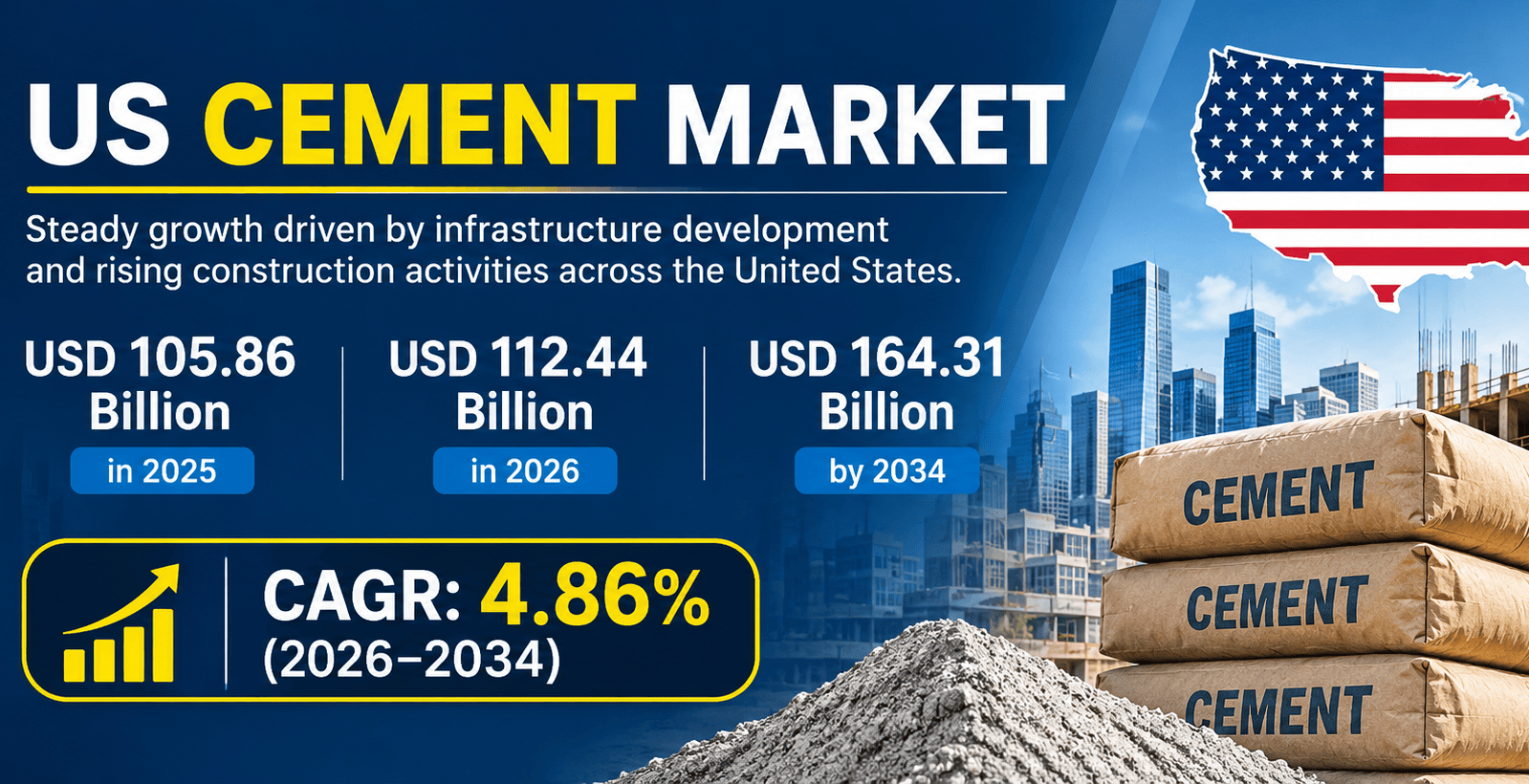
US Cement Market Size Projected to Reach USD 164.31 Billion by 2034 with a CAGR of 4.86%
IMARC Group has recently released a new research study titled “US Cement Market Report by Type, End-Use, and Region, 2026-2034,” offers a detailed analysis of the market drivers, segmentation, growth opportunities, trends and competitive landscape to understand the current and future market scenarios.
US Cement Market Size, Growth, and Forecast (2026-2034)
The us cement market size reached USD 105.86 Billion in 2025 and is projected to reach USD 164.31 Billion by 2034, growing at a CAGR of 4.86% during 2026-2034. Federal infrastructure investment under the IIJA, a structural housing deficit, and rising commercial and industrial construction are the primary factors driving the us cement market.
Cement is a hydraulic binder made by heating limestone and clay into clinker and grinding it with gypsum. It is the core input for concrete and mortar, and key product types include ordinary Portland cement, Portland-limestone cement, blended cement, and specialty variants.
Ready-mix concrete accounts for the majority of cement consumption, which ties the us ready mix concrete market closely to cement demand. Supplementary cementitious materials such as fly ash and slag are also gaining importance, linking the us cement and concrete additive market to the shift toward lower-carbon blended products.
Explore Growth Opportunities in the US Cement Market - Grab Your Sample Report for Evaluation: https://www.imarcgroup.com/us-cement-market/requestsample
Key Trends Driving the US Cement Market
- Federal infrastructure investment: The Infrastructure Investment and Jobs Act provides USD 1.2 trillion in total appropriations, with about USD 500 billion for roads, bridges, ports, and water systems. With only 40% disbursed as of September 2025, the multi-year pipeline supports steady cement shipments and demand for ready-mix concrete.
- Housing deficit and commercial construction: A 4.7 million-unit housing deficit sustains residential building, and each new single-family home needs roughly 20 tons of cement. Data centers, semiconductor fabs, and logistics hubs add a new high-intensity demand layer.
- Low-carbon and blended cement adoption: Portland-limestone cement is now approved in all 50 states, and Buy Clean mandates and state EPD requirements are pushing producers toward blended formulations. This is lifting demand for supplementary materials and concrete additives.
US Cement Market Report Segmentation:
The US Cement Market report provides a detailed segmentation analysis to help businesses identify key growth segments and evolving industry dynamics. The market is categorized based on type, end-use, and region, offering comprehensive insights across the us cement market.
Type Insights:
- Portland: Portland leads with a 52.6% share in 2025, supported by its universal specification under ASTM C150 for structural concrete, highways, and bridge decks.
- Blended: Blended cement holds a 31.8% share and is the fastest-growing type at about 5.1% CAGR, driven by Portland-limestone cement adoption and green public procurement.
- Others: Specialty cements such as oil well, masonry, rapid-hardening, and white cement account for 15.6% of the market.
End-Use Insights:
- Infrastructure: Infrastructure is the largest end-use at 44.3% in 2025, driven by IIJA-funded transportation, water, and energy projects with low cyclicality.
- Residential: Residential construction holds a 32.5% share, sustained by the national housing shortage and steady single-family completions.
- Commercial: Commercial construction accounts for 23.2%, increasingly shaped by data centers, semiconductor fabs, and logistics hubs.
Regional Insights:
- South: The South leads with a 36.7% share in 2025, anchored by Texas, Florida, and Georgia, where year-round construction and population inflows support demand.
- West: The West holds a 24.1% share, supported by California’s Buy Clean mandates and semiconductor and data center construction in Arizona and Nevada.
- Midwest: The Midwest accounts for 21.6%, backed by its industrial base, EV manufacturing retrofits, and bridge rehabilitation.
- Northeast: The Northeast holds a 17.6% share and acts as a regulatory bellwether through low embodied carbon procurement rules and urban infill projects.
US Cement Market: Recent News and Developments
- July 2025: CRH plc announced the acquisition of Eco Material Technologies to scale near-zero-carbon cementitious materials, securing supply of fly ash and other supplementary materials for lower-carbon blended cement.
- Late 2025: GCC, S.A.B. de C.V. invested USD 750 million to commission a new 3,000 t/day clinker line at its Odessa, Texas plant, expanding its West Texas footprint.
Challenges Impacting the US Cement Market
Cement production depends heavily on fuel, so energy price volatility can squeeze margins, and stricter emissions rules raise compliance costs and lengthen plant upgrade timelines.
Net imports accounted for 23% of US cement shipments in 2024, and lower-cost imports create pricing pressure, particularly in coastal regions.
Investment Opportunities in the US Cement Market
The us cement market presents compelling investment opportunities supported by its projected growth from USD 105.86 Billion in 2025 to USD 164.31 Billion by 2034. Blended and Portland-limestone cement is the fastest-growing segment, helped by corporate off-take agreements that reduce the risk of green production investment.
Semiconductor and data center projects create concentrated regional demand, while carbon capture, digital kiln operations, and digital logistics platforms offer premium upside. Companies that secure supplementary materials and low-carbon supply chains can strengthen positions across the us cement and concrete additive market and the us ready mix concrete market.
Outlook of the US Cement Market (2026-2034)
The outlook for the us cement market is positive, supported by sustained infrastructure spending, housing demand, and expanding commercial construction. The market is projected to grow from USD 105.86 Billion in 2025 to USD 164.31 Billion by 2034 at a CAGR of 4.86%.
Decarbonization, reduced import reliance through technologies such as carbon capture, and digital supply chain integration will be the defining trends shaping the us cement market through 2034.
Key Players in the US Cement Market
The us cement market is moderately consolidated, with a small group of large integrated producers controlling most production capacity, distribution terminals, and import gateway positions.
- Amrize Ltd: Amrize operates over 1,000 sites across North America and debuted as an independent publicly traded company in June 2025 following its spin-off from Holcim. Its portfolio includes ECOPlanet low-carbon cement and Portland-limestone cement.
- CRH plc: CRH is a building materials group with US operations through Ash Grove Cement and Americas Materials, spanning cement, ready-mix concrete, aggregates, and asphalt. Its July 2025 acquisition of Eco Material Technologies strengthened its low-carbon cementitious materials supply.
Frequently Asked Questions (FAQs): US Cement Market
1. What is the current US cement market size?
The us cement market size reached USD 105.86 Billion in 2025 and is projected to reach USD 164.31 Billion by 2034, growing at a CAGR of 4.86% during 2026-2034.
2. What is cement and how is it used?
Cement is a binding material made from limestone and clay that hardens with water. It is the core ingredient of concrete, with ready-mix concrete accounting for the majority of consumption in the us ready mix concrete market.
3. What are the key drivers of the us cement market?
Key drivers include IIJA infrastructure funding, the housing deficit, commercial and industrial construction such as data centers and semiconductor fabs, and wider adoption of Portland-limestone cement.
4. Which type leads the us cement market?
Portland leads the us cement market with a 52.6% share in 2025, while blended cement is the fastest-growing type at about 5.1% CAGR.
5. How do additives and supplementary materials fit into the market?
Supplementary cementitious materials such as fly ash and slag are central to blended and low-carbon cement, which supports growth in the us cement and concrete additive market.
6. Who are the key players in the us cement market?
Key players include Amrize Ltd, Heidelberg Materials AG, CEMEX, S.A.B. de C.V., CRH plc, Buzzi Unicem S.p.A., Eagle Materials Inc., and GCC, S.A.B. de C.V.
Author IMARC Group
IMARC Group is a global management consulting firm that helps the world's most ambitious changemakers to create a lasting impact. The company provide a comprehensive suite of market entry and expansion services. IMARC offerings include thorough market assessment, feasibility studies, company incorporation assistance, factory setup support, regulatory approvals and licensing navigation, branding, marketing and sales strategies, competitive landscape and benchmarking analyses, pricing and cost research, and procurement research.
Contact Us
IMARC Group,
134 N 4th St. Brooklyn, NY 11249, USA,
Email: [email protected],
United States: +1-201971-6302

 English
 Arabic
 French
 Spanish
 Portuguese
 Deutsch
 Dutch
 Italiano
 Russian
 Romaian
 Portuguese (Brazil)
 Greek