A diagnosis of low AMH can be worrying, especially when you are planning a pregnancy or considering fertility treatment. Many women who receive a low AMH result immediately ask, “Can I get pregnant with low AMH?” or assume that a low result means they cannot conceive.
The reality is more nuanced.
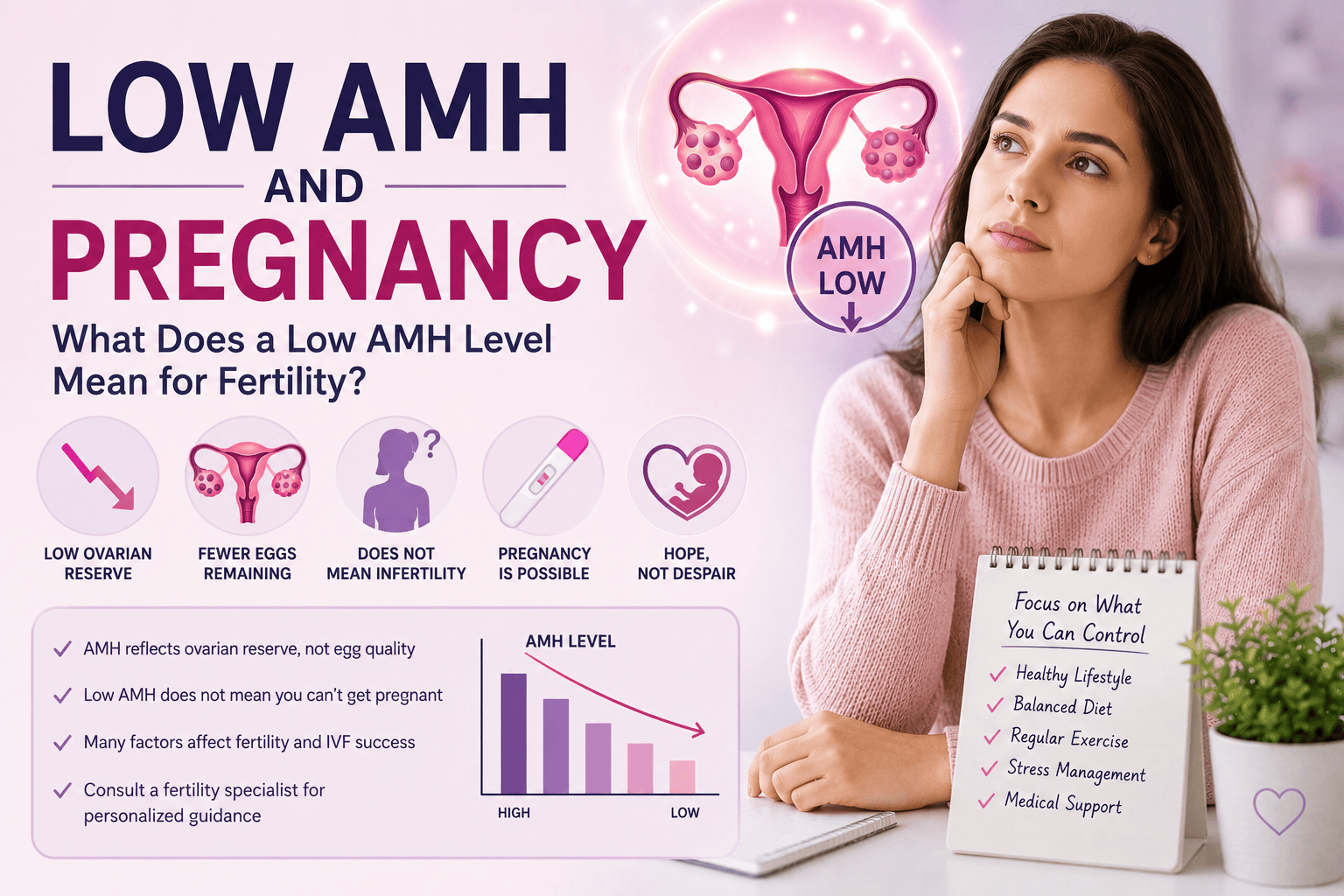
Low AMH and pregnancy are related, but AMH is not a direct test of whether you can become pregnant. Anti-Müllerian hormone (AMH) is primarily used as a marker of ovarian reserve, meaning the approximate quantity of eggs remaining in the ovaries. It can help fertility specialists predict how the ovaries may respond to stimulation during IVF, but it does not directly measure egg quality or guarantee whether pregnancy will occur.
Therefore, low AMH and pregnancy should always be evaluated in the context of age, menstrual history, ovarian reserve testing, sperm health, fallopian tube function, medical history, and other fertility factors.
What Is AMH?
AMH, or Anti-Müllerian hormone, is produced by cells associated with small ovarian follicles. Because AMH levels generally reflect the number of developing follicles, doctors commonly use AMH as one of the markers of ovarian reserve.
Ovarian reserve refers primarily to the number of eggs remaining in the ovaries, not the quality of those eggs. AMH can be measured at different points in the menstrual cycle and is considered one of the more sensitive markers of ovarian reserve.
However, AMH should not be interpreted in isolation.
A low AMH result can suggest that the ovaries may have fewer recruitable follicles than expected for a particular age. It may also indicate that fewer eggs could be retrieved during an IVF stimulation cycle.
Importantly, low AMH and pregnancy are not synonymous with infertility.
What Does Low AMH Mean?
Low AMH generally indicates reduced ovarian reserve. In other words, it may suggest a lower quantity of eggs remaining in the ovaries.
It does not necessarily mean:
- You cannot become pregnant naturally.
- Your eggs are poor quality.
- You are infertile.
- IVF will not work.
- Pregnancy is impossible.
- You are close to menopause.
ASRM specifically states that ovarian reserve testing is useful for predicting ovarian response to stimulation but is a poor independent predictor of reproductive potential.
This distinction is extremely important when discussing low AMH and pregnancy.
Can I Get Pregnant With Low AMH?
Yes, pregnancy can occur with low AMH.
Research reviewed by ASRM has found that women with low AMH levels can have similar cumulative pregnancy rates to women with normal AMH in certain populations attempting natural conception. ASRM therefore emphasizes that ovarian reserve markers should not be treated as a standalone fertility test.
For someone asking, “Can I get pregnant with low AMH?”, the answer depends on much more than the AMH number.
Important factors include:
- Your age
- Whether you are ovulating
- Egg quality
- Sperm quality
- Fallopian tube health
- Uterine health
- Duration of trying to conceive
- Previous pregnancies
- Other reproductive conditions
Age is particularly important because it has a stronger relationship with reproductive potential than AMH alone.
Low AMH and Natural Pregnancy
One of the biggest misconceptions about low AMH and pregnancy is that a low result automatically rules out natural conception.
That is not the case.
AMH mainly provides information about egg quantity. A woman with a low AMH level may still ovulate and release an egg capable of being fertilized.
If ovulation occurs and there are no significant problems involving the sperm, fallopian tubes, uterus, or other fertility factors, natural conception may still be possible.
However, low AMH can sometimes be a sign that there is less reproductive time available, particularly when combined with increasing age. This is why discussing the result with a fertility specialist can be important rather than simply repeating AMH tests without a treatment plan.
Does Low AMH Mean Poor Egg Quality?
No.
AMH does not directly measure egg quality.
This is an important distinction between low AMH and pregnancy.
Egg quantity and egg quality are different concepts. A woman may have a lower ovarian reserve but still have eggs with reproductive potential.
At the same time, egg quality generally becomes more strongly influenced by age as reproductive aging progresses. ASRM identifies age as a much stronger predictor of reproductive success than ovarian reserve testing alone.
Therefore, a low AMH result should not be interpreted as a statement that all remaining eggs are poor quality.
What Is Considered a Low AMH Level?
There is no single AMH number that can be universally labelled "low" for every woman.
Laboratory methods, units, reference ranges, age, medications, and individual circumstances can influence interpretation.
For this reason, it is better not to interpret a result based solely on an internet chart.
For example, a value that may be considered low in one laboratory or clinical context may have a different significance in another. Your fertility specialist will usually consider AMH alongside:
- Age
- Antral follicle count (AFC)
- FSH and estradiol when appropriate
- Menstrual history
- Previous ovarian response
- Fertility goals
- Medical history
AMH and AFC are currently among the most useful markers for assessing ovarian reserve.
Low AMH and IVF Success
Patients considering IVF often search for information about low AMH IVF success.
Low AMH can be useful for predicting how many eggs might be retrieved during ovarian stimulation. Women with lower AMH may have a greater likelihood of producing fewer eggs following stimulation.
However, AMH is much less reliable for predicting whether those eggs will ultimately lead to a pregnancy or live birth.
ASRM notes that AMH and antral follicle count are good predictors of ovarian response and egg yield, but their association with egg quality, clinical pregnancy, and live birth is weak.
This means low AMH IVF success cannot be predicted from AMH alone.
For example, two women with the same AMH level can have very different IVF outcomes because they may differ in age, egg quality, sperm quality, embryo development, uterine factors, and laboratory or treatment factors.
Can IVF Work With Very Low AMH?
Yes, IVF may still be considered even when AMH is very low.
ASRM specifically states that extremely low AMH should not be used by itself to refuse IVF treatment. Very low AMH can indicate a higher likelihood of a suboptimal ovarian response, but it does not mean treatment is automatically futile.
In an ASRM-cited analysis of more than 5,000 fresh IVF cycles, extremely low AMH below 0.16 ng/mL was associated with higher cancellation rates and fewer retrieved eggs. However, live births still occurred, demonstrating that very low AMH does not equal zero chance of success.
This is why low AMH IVF success should be discussed as an individualized probability rather than a fixed percentage.
Low Ovarian Reserve and Pregnancy
Low ovarian reserve means that the number of eggs remaining in the ovaries is lower than expected for a woman's age.
It can be associated with:
- Increasing age
- Previous ovarian surgery
- Certain medical treatments
- Some genetic conditions
- Endometriosis
- Other individual factors
Sometimes the cause is not immediately obvious.
A diagnosis of low ovarian reserve does not automatically mean that pregnancy cannot occur.
ASRM states that evidence of diminished ovarian reserve does not necessarily equate with an inability to conceive or infertility.
Therefore, low AMH and pregnancy should be approached with realistic expectations rather than unnecessary fear.
What Other Tests Are Important?
AMH is only one part of a fertility evaluation.
Your doctor may recommend other assessments depending on your age and medical history.
Antral Follicle Count
Antral follicle count, or AFC, is performed using transvaginal ultrasound. It estimates the number of small follicles visible in the ovaries.
AFC and AMH are considered useful measures of ovarian reserve and can help predict ovarian response during IVF.
FSH and Estradiol
In some situations, doctors may measure FSH and estradiol during the early part of the menstrual cycle.
These tests can provide additional information, particularly when AMH is very low.
Ovulation Assessment
If periods are irregular, your doctor may evaluate whether ovulation is occurring.
Semen Analysis
Fertility is a shared consideration. A semen analysis can identify male-factor infertility that may also affect the chance of pregnancy.
Tubal Evaluation
Depending on your history, your doctor may recommend testing to determine whether the fallopian tubes are open.
Looking at these factors together provides a more useful picture than focusing only on low AMH and pregnancy.
Does Low AMH Affect IVF Egg Retrieval?
Low AMH can be associated with a lower number of eggs retrieved during IVF.
This is one of the areas where AMH is clinically useful.
A fertility specialist can use AMH, AFC, age, and previous treatment information to help design an ovarian stimulation protocol.
However, the number of eggs is not the same as the number of healthy embryos.
A cycle that produces fewer eggs can still result in a viable embryo and pregnancy.
Conversely, retrieving many eggs does not guarantee a successful pregnancy.
Age and Low AMH
Age is particularly important when interpreting low AMH and pregnancy.
AMH provides information about ovarian reserve, while age is strongly associated with egg quality and reproductive potential.
For example, a younger woman with low AMH may have a different fertility outlook from an older woman with the same AMH level.
This is why doctors should not interpret AMH without considering age.
ASRM emphasizes that age is a stronger predictor of reproductive success than ovarian reserve measurements.
If you are older and have a low AMH result, discussing fertility plans promptly may be particularly important.
Can AMH Levels Be Increased Naturally?
Many products and online programs claim to increase AMH naturally.
However, there is no established diet, exercise routine, supplement, or natural therapy proven to restore depleted ovarian reserve.
A healthy lifestyle can support general health, but it should not be presented as a way to regenerate ovarian follicles.
If you are considering supplements marketed for low AMH fertility, speak with your fertility specialist first.
Supplements may have side effects or interact with medications, and evidence for many fertility supplements remains limited.
Does Low AMH Mean Early Menopause?
Not necessarily.
Low AMH indicates lower ovarian reserve, but AMH alone cannot accurately predict exactly when menopause will occur.
Menopause timing depends on multiple biological factors.
Therefore, a low AMH result should not automatically be interpreted as meaning that menopause is imminent.
If you have irregular periods, hot flashes, or other symptoms that concern you, discuss them with your doctor rather than relying on AMH alone.
How Can You Improve Your Chances of Pregnancy With Low AMH?
If you have received a low AMH result and want to conceive, consider taking a proactive approach.
1. Discuss Your Result With a Fertility Specialist
Do not interpret the AMH number alone. Ask how the result fits with your age, AFC, menstrual cycle, and reproductive goals.
2. Consider Your Timeline
Because age is an important predictor of reproductive success, delaying evaluation may not always be advisable when low ovarian reserve has been identified.
3. Check Other Fertility Factors
Evaluate ovulation, sperm health, fallopian tubes, and uterine health where appropriate.
4. Maintain Healthy Habits
Avoid smoking, maintain a balanced diet, exercise regularly, sleep adequately, and manage existing medical conditions.
Healthy habits support overall reproductive health, although they cannot restore lost ovarian reserve.
5. Discuss Treatment Options Early
Depending on your circumstances, your doctor may discuss natural conception, ovulation treatment, IUI, IVF, or other options.
When Should You See a Fertility Specialist?
Consider speaking with a fertility specialist if:
- You have a low AMH result and want to conceive.
- You have been trying to conceive without success.
- Your periods are irregular or absent.
- You have a history of ovarian surgery.
- You have endometriosis or another fertility-related condition.
- You are concerned about age-related fertility decline.
- You have previously had a poor response to IVF.
- You want to discuss fertility preservation.
ASRM recommends that ovarian reserve testing be interpreted alongside age, diagnosis, risk factors, and previous treatment response rather than used as an isolated measure.
Common Myths About Low AMH and Pregnancy
Myth 1: Low AMH Means You Cannot Get Pregnant
False. Low AMH does not automatically mean infertility.
Myth 2: Low AMH Means Your Eggs Are Poor Quality
False. AMH primarily reflects ovarian reserve rather than egg quality.
Myth 3: A Normal AMH Guarantees Fertility
False. A normal AMH does not guarantee natural pregnancy or successful IVF.
Myth 4: Low AMH Means IVF Cannot Work
False. Low AMH may predict fewer eggs during stimulation, but IVF can still result in pregnancy.
Myth 5: Increasing AMH Will Guarantee Pregnancy
False. There is no proven method for artificially increasing AMH that guarantees improved fertility.
Low AMH and Pregnancy: What Patients Should Remember
If you have been told that you have low AMH, try not to view the result as a definitive prediction of your fertility.
Remember these key points:
- AMH is primarily a marker of ovarian reserve.
- Low AMH does not automatically mean infertility.
- AMH does not directly measure egg quality.
- Age is a major factor in reproductive potential.
- Low AMH may predict fewer eggs during IVF stimulation.
- Low AMH alone does not determine IVF success.
- Other fertility factors should be evaluated.
- Extremely low AMH should not automatically exclude someone from IVF.
- Treatment decisions should be individualized.
Conclusion
Understanding low AMH and pregnancy requires looking beyond a single laboratory number. AMH is a useful marker of ovarian reserve and can help fertility specialists estimate how the ovaries may respond to stimulation. However, it is not a direct measure of egg quality and cannot independently determine whether a woman can become pregnant.
For women concerned about low AMH fertility, natural pregnancy may still be possible, depending on age, ovulation, sperm health, fallopian tube function, uterine health, and other factors. A low AMH result should therefore be interpreted as one piece of the fertility picture rather than a final diagnosis.
When considering low AMH IVF success, remember that AMH is better at predicting the potential number of eggs retrieved than predicting pregnancy or live birth. Even women with extremely low AMH may still be considered for IVF, depending on their individual circumstances.
If you are asking “Can I get pregnant with low AMH?”, the most accurate answer is that it is possible, but your individual chances cannot be determined from AMH alone.
A fertility specialist can evaluate your AMH level and fertility alongside your age, ovarian reserve, reproductive history, partner's fertility, and other relevant factors. This comprehensive approach can help determine whether trying naturally, pursuing fertility treatment, or considering IVF is the most appropriate next step.




 English
 Arabic
 French
 Spanish
 Deutsch
 Turkish
 Dutch
Dutch
 Italiano
 Russian
 Romaian
 Portuguese (Brazil)
 Greek
Greek