


₹10,000 Loan EMI: Interest Rate, Tenure and Repayment Explained
A ₹10,000 personal loan can help manage a small and unexpected financial requirement, such as an urgent repair, medical expense, education cost, utility bill, or temporary cash-flow gap. However, before borrowing, it is important to understand how much you will need to repay each month and what the loan will cost in total.
The 10000 loan EMI depends mainly on the loan amount, interest rate, and repayment tenure. A shorter tenure can result in a higher monthly EMI but may reduce the total interest paid. A longer tenure can lower the monthly EMI but may increase the overall repayment cost.
Understanding these factors before applying can help you choose a repayment schedule that fits your budget. This guide explains the 10000 loan EMI, interest rates, 6-month and 12-month repayment options, and how a ₹10,000 loan calculator can help you compare different scenarios.
What Is a ₹10,000 Loan EMI?
EMI stands for Equated Monthly Instalment. It is the amount a borrower generally pays to the lender every month until the loan is fully repaid.
The 10000 loan EMI is determined by three primary factors:
-
Loan amount
-
Interest rate
-
Loan tenure
If you borrow ₹10,000, the EMI will not simply be ₹10,000 divided by the number of months because interest is also included in the repayment.
For example, a six-month loan generally has a higher monthly EMI than a 12-month loan at the same interest rate. However, the six-month option may have a lower overall interest cost because the loan is repaid sooner.
Therefore, when evaluating a 10000 loan EMI, look at both the monthly payment and the total repayment amount.
How Is a ₹10,000 Loan EMI Calculated?
Lenders generally calculate EMI based on the principal amount, monthly interest rate, and number of instalments.
The commonly used EMI formula is:
EMI = P × R × (1 + R)^N / [(1 + R)^N – 1]
Here:
-
P = Principal loan amount
-
R = Monthly interest rate
-
N = Number of monthly instalments
For a ₹10,000 loan, the interest rate is converted into a monthly rate for the calculation. The tenure determines how many instalments you make.
A ₹10,000 loan calculator can perform this calculation automatically. You can enter the loan amount, interest rate, and tenure to estimate your monthly EMI and total repayment.
Remember that calculator results may not include processing fees, taxes, or other lender-specific charges. The final loan agreement should always be checked for the actual repayment obligation.
₹10,000 Loan EMI for 6 Months
A six-month repayment period allows you to clear a ₹10,000 loan relatively quickly. However, because the principal must be repaid over only six instalments, the monthly EMI is generally higher.
For illustration, suppose a lender offers a hypothetical annual interest rate of 12% on a ₹10,000 loan.
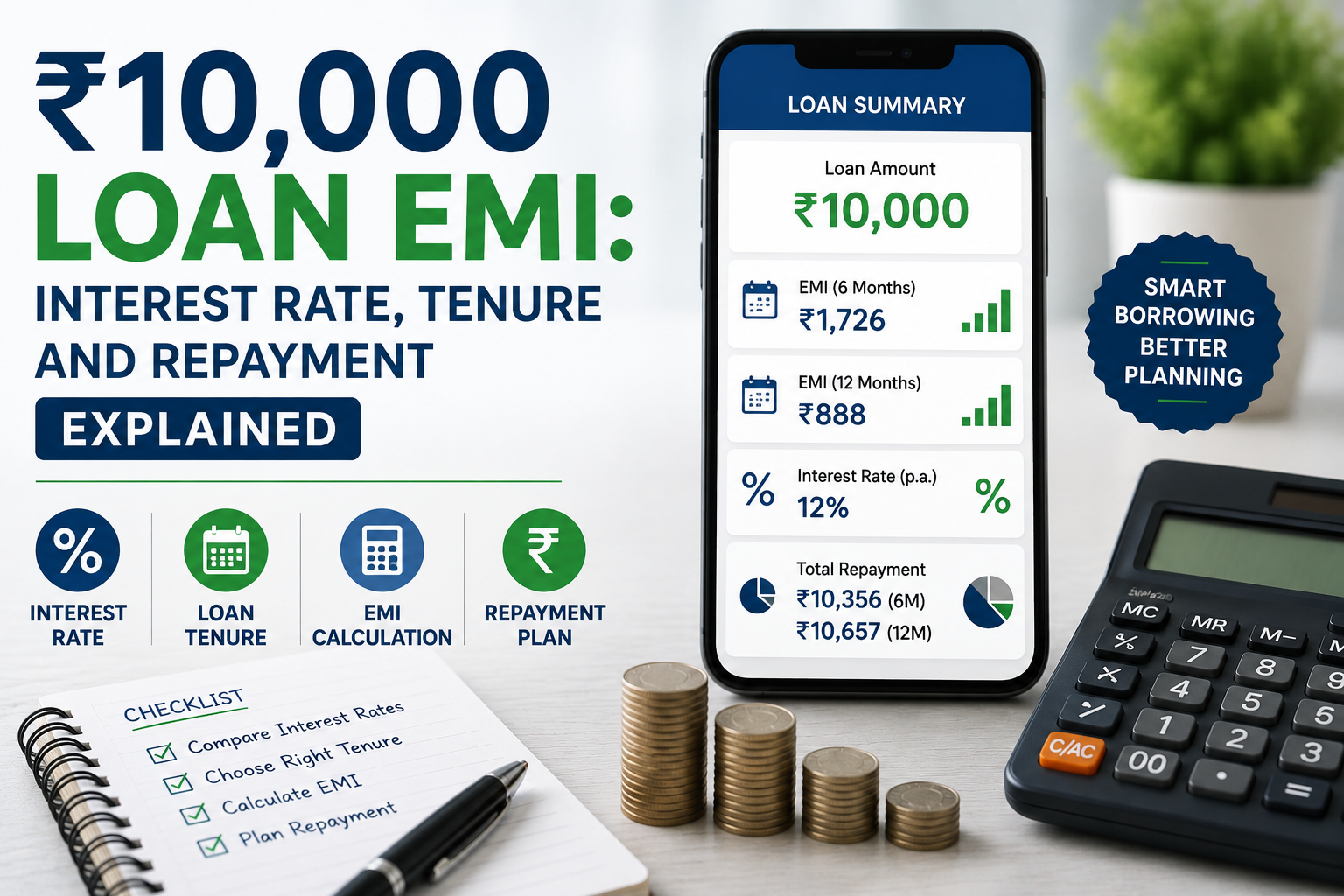
Using the standard reducing-balance EMI formula, the estimated ₹10,000 loan EMI for 6 months would be approximately ₹1,726 per month.
The estimated total repayment would be approximately ₹10,356, before considering any processing fee, taxes, or other applicable charges.
These figures are illustrative and actual loan terms can vary between lenders.
Advantages of a 6-Month Tenure
A six-month tenure may suit borrowers who can comfortably manage a higher monthly payment.
Potential benefits include:
-
Faster repayment
-
Lower total interest compared with a longer tenure at the same rate
-
Earlier completion of the loan
-
Less time carrying the additional debt
However, the higher EMI can put pressure on your monthly budget. Before selecting a ₹10,000 loan EMI for 6 months, make sure you can comfortably make each payment while managing your other expenses.
₹10,000 Loan EMI for 12 Months
A 12-month tenure spreads the repayment of ₹10,000 across a longer period. As a result, the monthly EMI is generally lower than the six-month option at the same interest rate.
Using the same hypothetical annual interest rate of 12%, the estimated ₹10,000 loan EMI for 12 months would be approximately ₹888 per month.
The estimated total repayment would be approximately ₹10,657, before processing fees, taxes, and other applicable charges.
The lower EMI may make the loan easier to manage each month. However, because the loan remains outstanding for a longer period, the total interest can be higher.
₹10,000 Loan EMI Comparison: 6 Months vs 12 Months
The following example assumes a hypothetical annual interest rate of 12% and uses the standard reducing-balance EMI calculation.
| Loan Amount | Interest Rate | Tenure | Approx. EMI | Approx. Total Repayment |
|---|---|---|---|---|
| ₹10,000 | 12% p.a. | 6 months | ₹1,726 | ₹10,356 |
| ₹10,000 | 12% p.a. | 12 months | ₹888 | ₹10,657 |
The figures are rounded and provided only for illustration.
The comparison shows an important difference. The six-month option requires a higher monthly payment but has a lower approximate total repayment. The 12-month option reduces the monthly burden but increases the approximate interest cost.
Therefore, the right 10000 loan EMI option depends on your repayment capacity and financial priorities.
How the ₹10,000 Loan Interest Rate Affects EMI
The ₹10,000 loan interest rate directly influences the amount you pay over the loan tenure.
If the loan amount and tenure remain the same, a higher interest rate generally results in a higher EMI and greater total repayment.
For example, if two lenders offer ₹10,000 for 12 months but one charges a higher interest rate, the monthly EMI and total interest may be higher with that lender.
When comparing the ₹10,000 loan interest rate, do not focus only on the advertised percentage. Check the complete cost of the loan, including applicable processing fees and other charges.
Also understand whether the quoted rate is annual or monthly and how the lender calculates interest.
Why Loan Tenure Matters
Loan tenure determines how long you take to repay the borrowed money.
For a ₹10,000 personal loan repayment, the choice between six and 12 months can significantly affect your monthly budget.
A shorter tenure generally means:
-
Higher EMI
-
Faster repayment
-
Potentially lower total interest
A longer tenure generally means:
-
Lower EMI
-
More time to repay
-
Potentially higher total interest
Neither option is automatically better. You should choose a tenure based on your income, existing financial commitments, and ability to manage the EMI.
What Is Reducing-Balance Interest?
Many personal loans use a reducing-balance method of calculating interest. Under this approach, interest is generally calculated on the outstanding principal.
As you make repayments, the outstanding loan balance decreases. The interest component can therefore change during the repayment period.
The exact method and calculation depend on the lender and loan agreement.
When evaluating the ₹10,000 loan interest rate, read the loan documentation carefully so you understand how interest is calculated.
What Is Included in ₹10,000 Personal Loan Repayment?
The ₹10,000 personal loan repayment can include more than the principal amount.
Depending on the lender and loan agreement, the overall cost may include:
-
Principal
-
Interest
-
Processing fee
-
Applicable taxes
-
Late-payment charges, if applicable
-
Other applicable fees
For this reason, the ₹10,000 you borrow and the total amount you repay will generally be different.
For example, a lender may sanction ₹10,000 but charge an applicable processing fee. The amount credited to your account could therefore be lower than the sanctioned amount if the fee is deducted from disbursal.
Always check the sanctioned amount, net disbursal, EMI, and total repayment before accepting a loan.
How a ₹10,000 Loan Calculator Can Help
A ₹10,000 loan calculator is a useful tool for comparing different repayment scenarios.
You can generally enter:
-
Loan amount
-
Interest rate
-
Tenure
The calculator can then provide an estimated EMI and, depending on the tool, total interest and total repayment.
For example, you can use a ₹10,000 loan calculator to compare a six-month tenure with a 12-month tenure. You can also change the interest rate to understand how it affects your monthly payment.
This can help you decide whether a higher EMI over a shorter period or a lower EMI over a longer period is more suitable for your budget.
Calculator results are estimates. Always confirm the final figures in the lender's official loan agreement.
Factors That Can Affect Your Loan Terms
The interest rate and loan terms offered to a borrower can vary depending on the lender's policies and assessment.
Factors that may be considered include:
-
Credit history
-
Income
-
Employment or occupation
-
Existing financial obligations
-
Previous repayment behaviour
-
Loan tenure
-
Lender-specific eligibility criteria
Therefore, an advertised ₹10,000 loan interest rate may not necessarily be the rate offered to every applicant.
Before applying, check the lender's eligibility requirements and review the final offer carefully.
Processing Fees and Other Charges
When calculating your 10000 loan EMI, remember that the EMI itself may not represent the complete cost of borrowing.
A lender may charge a processing fee along with applicable taxes or other charges.
For a ₹10,000 loan, even a relatively small fee can have a noticeable impact on the overall borrowing cost.
Before accepting a loan, check:
-
Processing fee
-
Applicable taxes
-
Late-payment charges
-
Bounce charges, where applicable
-
Prepayment or foreclosure charges
-
Other lender-specific costs
Comparing these charges alongside the interest rate gives you a more accurate picture of the loan's actual cost.
What Happens If You Miss an EMI?
Missing a ₹10,000 personal loan repayment can lead to additional charges according to the lender's terms. Depending on the lender's reporting practices, missed or delayed payments may also affect your credit profile.
Before taking the loan, make sure you know:
-
EMI due date
-
Number of instalments
-
Payment method
-
Late-payment consequences
-
Applicable charges
You can set reminders around the due date to help manage repayments.
If you believe you may have difficulty making an upcoming payment, contact the lender promptly and understand what options may be available.
Can You Repay a ₹10,000 Loan Early?
Some lenders may allow borrowers to make an early repayment or close the loan before the scheduled maturity date. However, the terms and applicable charges vary.
Before taking a ₹10,000 loan, check whether prepayment or foreclosure is allowed and whether any charges apply.
Early repayment can potentially reduce future interest in certain loan structures, but you should compare the interest savings against any applicable prepayment charges.
The relevant conditions should be available in the loan agreement.
How to Choose the Right Tenure for a ₹10,000 Loan
Choosing between a six-month and 12-month tenure depends mainly on your monthly repayment capacity.
A 6-Month Tenure May Suit You If:
-
You can afford a higher monthly EMI.
-
You want to clear the loan quickly.
-
You want to potentially reduce the overall interest cost.
-
You expect your income to remain stable during the repayment period.
A 12-Month Tenure May Suit You If:
-
You prefer a lower monthly EMI.
-
Your monthly budget is relatively tight.
-
You need more time to repay.
-
You want to keep the monthly financial obligation more manageable.
However, do not select a longer tenure only because the EMI appears lower. Always compare the total repayment.
Example of ₹10,000 Loan Repayment
Consider a hypothetical ₹10,000 loan at an annual interest rate of 12%.
If you select a six-month tenure, the estimated EMI is around ₹1,726 and the estimated total repayment is around ₹10,356.
With a 12-month tenure, the estimated EMI is around ₹888 and the estimated total repayment is around ₹10,657.
This example demonstrates the basic trade-off between EMI and tenure.
The six-month option requires approximately ₹838 more per month but results in a lower total repayment in this example. The 12-month option reduces the monthly payment but costs more in total interest.
Your actual 10000 loan EMI will depend on the rate and terms offered by the lender.
Questions to Ask Before Taking a ₹10,000 Loan
Before accepting an offer, ask yourself:
-
How much money do I actually need?
-
What is the ₹10,000 loan interest rate?
-
What is the monthly EMI?
-
What is the loan tenure?
-
How much will I repay in total?
-
Is there a processing fee?
-
Are taxes or other charges applicable?
-
What is the net amount I will receive?
-
Are there late-payment charges?
-
Are there prepayment charges?
-
Can I comfortably afford the EMI?
-
Have I read the complete loan agreement?
Answering these questions can help you understand the full cost before borrowing.
Final Checklist for ₹10,000 Loan EMI
Before applying for a ₹10,000 loan, check the following:
-
Loan amount: Borrow only what you need.
-
Interest rate: Compare the offered rates.
-
EMI: Make sure the monthly payment fits your budget.
-
Tenure: Compare six-month and 12-month options.
-
Total repayment: Check the overall amount payable.
-
Processing fee: Understand all applicable charges.
-
Repayment schedule: Know the exact due dates.
-
Prepayment terms: Check whether early repayment is allowed.
-
Eligibility: Make sure you meet the lender's requirements.
-
Loan agreement: Read the terms before accepting.
A ₹10,000 loan calculator can help with the initial comparison, but the lender's final agreement should be used to confirm the actual EMI and repayment schedule.
Conclusion
Understanding the 10000 loan EMI is an important step before applying for a ₹10,000 personal loan. The EMI depends on the loan amount, interest rate, and tenure, while processing fees and other charges can increase the overall cost.
A ₹10,000 loan EMI for 6 months is generally higher each month but may result in a lower total interest cost. A ₹10,000 loan EMI for 12 months can make monthly payments more manageable, but the longer tenure may increase the total repayment.
Before choosing a loan, compare the ₹10,000 loan interest rate, processing fees, tenure, EMI, and total repayment. Use a ₹10,000 loan calculator to estimate different scenarios and understand how changing the tenure or rate affects your payments.
Most importantly, choose a repayment schedule that fits comfortably within your budget. Understanding the ₹10,000 personal loan repayment structure in advance can help you avoid unnecessary financial pressure and make a more informed borrowing decision.

 English
 Arabic
 French
 Spanish
 Deutsch
 Turkish
 Dutch
Dutch
 Italiano
 Russian
 Romaian
 Portuguese (Brazil)
 Greek
Greek