


Reading Homework Help: How to Read Faster, Understand More, Take Notes
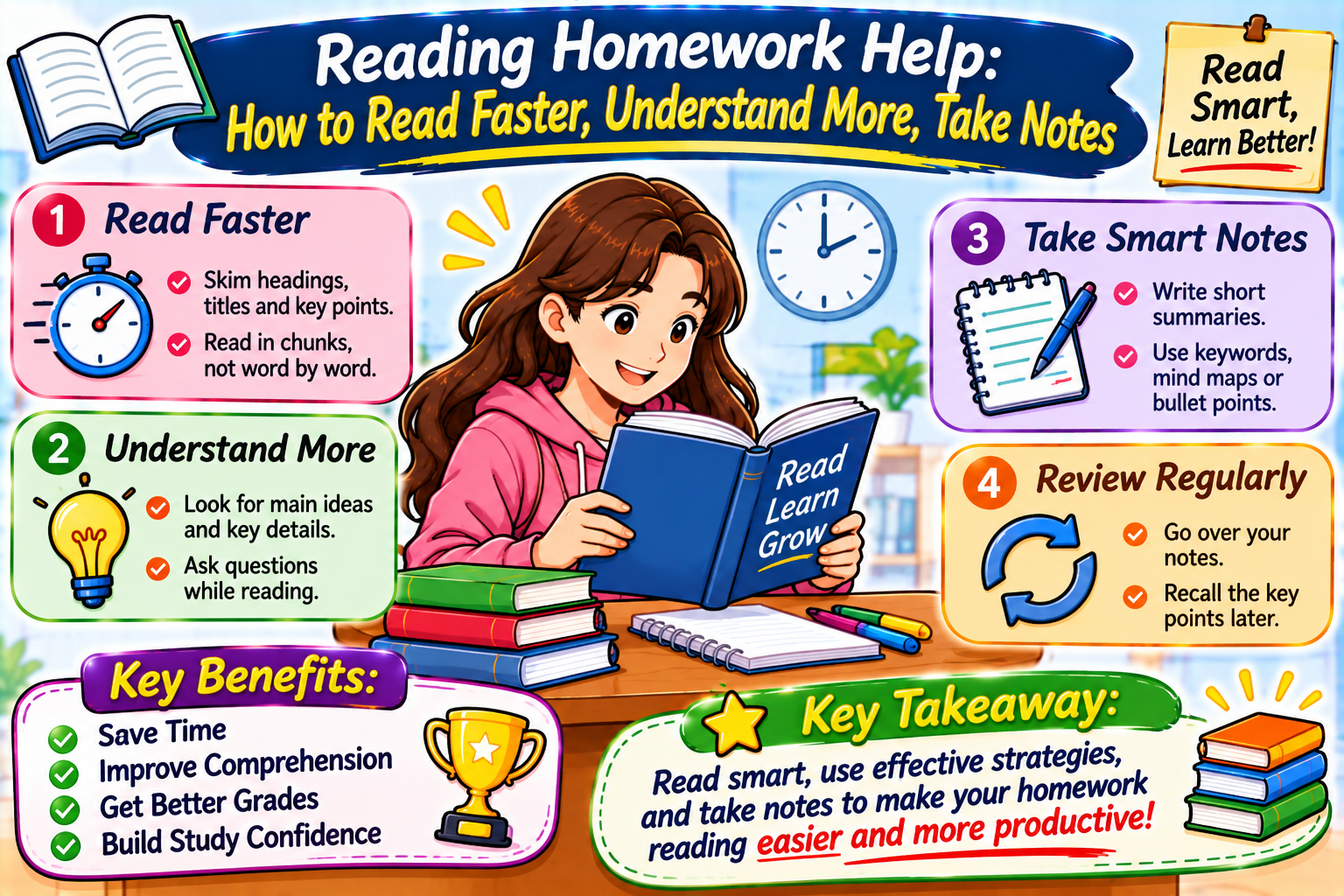
Reading homework can feel endless. Pages of dense text. Long articles. Chapters that seem to say nothing. You read a paragraph, then realise you remember none of it.
You are not alone. Most students were never taught how to read for study. The good news is that it can be learned. This guide offers reading homework help with simple methods to read faster, understand more, and take notes that actually help in 2026.
Reading for Homework Is Different
Reading a story for fun is relaxed. Reading for homework has a goal. You need to find ideas, understand arguments, and remember key points.
That means you should not read every word at the same speed. Some parts matter more. Some parts you can skim. A smart reader decides what to focus on before starting.
Once you accept this, reading becomes less tiring. You stop treating every page as equally important.
Preview Before You Read
Spend two or three minutes looking at the text before you begin. This gives your brain a map.
- Read the title and headings
- Look at charts, images, and captions
- Read the introduction and the conclusion
- Check any summary box or key terms
- Write down two or three questions you hope the text will answer
With this map, you read with direction. You know what to expect, and new information has a place to land.
Read With a Purpose
Always ask why you are reading. Is it to prepare for a discussion? To find evidence for an essay? To learn a method for homework?
Your purpose decides how you read. For an essay, you may hunt for quotes and statistics. For a lesson, you may need to understand the main steps. Keep your purpose written at the top of the page.
Read in small chunks. After each section, pause and say the main idea in one sentence. If you cannot, read that part again. This simple habit stops you from reading on autopilot.
Take Notes That Help
Good notes are short, clear, and in your own words. Copying whole sentences wastes time.
- Summary notes: write the main idea of each section in one or two lines
- Question notes: turn headings into questions and answer them
- Mind maps: draw ideas as a web with links
- Cornell notes: split the page into notes, cues, and a short summary
- Highlight less than you think: only mark the most important lines
Choose the method that feels natural. You can mix them.
Active Reading Habits
Active readers stay engaged. They do not simply move their eyes across the page.
- Underline key terms and write a short definition beside each
- Write questions in the margin
- Link new ideas to something you already know
- Put the text away and explain it out loud
- Note any parts you disagree with or do not understand
Review Notes Within a Day
Memory fades fast. Review your notes within twenty four hours to lock in what you learned.
Spend five minutes reading your summary. Test yourself by covering the notes and recalling the main points. Review again after a week. This spaced review is far more effective than reading everything again the night before an exam.
When the Text Is Too Hard
Some texts are simply difficult. Academic articles use long sentences and special words.
Do not panic. Read the abstract and conclusion first. Look up unfamiliar terms. Find a simpler explanation or a short video on the same topic. Then return to the original text.
If you are still stuck, ask for reading homework help. A teacher can explain key ideas. A study group can discuss the meaning together. A trusted homework help service can offer clear summaries and examples to guide your understanding.
A Simple Reading Plan for Long Chapters
- Break the chapter into sections of five or six pages
- Set a timer for twenty five minutes
- Read one section, then write a short summary
- Take a three minute break after each section
- Finish with a five line chapter summary
- Review it the next day
Tips to Stay Focused While Reading
- Read in a quiet, well lit place
- Keep a pen in your hand
- Put your phone out of reach
- Read aloud when a part feels hard
- Stand up and stretch between sections
- Reward yourself after each chapter
Reading in a Second Language
If English is not your first language, reading can take longer. That is normal. Read the title and headings first. Look up key words, but do not stop for every unknown word. Try to guess the meaning from the sentence. Keep a small word list. Over time, your speed and understanding will improve.
Conclusion
Reading for homework becomes easier when you preview, read with purpose, and take active notes. Review within a day, and use simpler sources when a text is too hard. Ask for reading homework help when you need it. With these habits, pages that once felt endless will feel manageable, and you will remember far more in 2026.

 English
 Arabic
 French
 Spanish
 Portuguese
 Deutsch
 Dutch
 Italiano
 Russian
 Romaian
 Portuguese (Brazil)
 Greek