


United States Smart Ticketing Market Size Projected to Reach USD 14,086.3 Million by 2034 with a CAGR of 9.70%
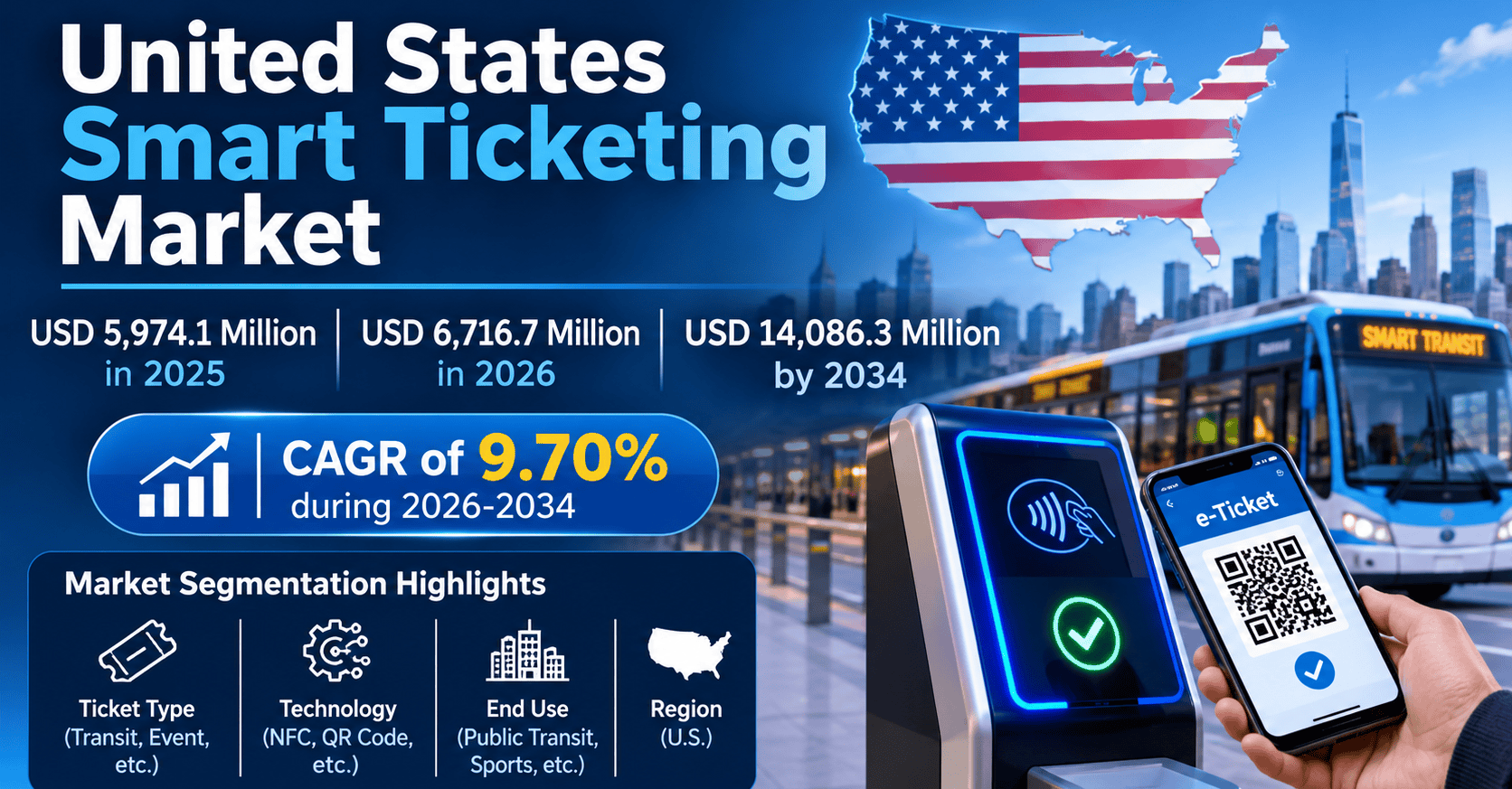
IMARC Group has recently released a new research study titled “United States Smart Ticketing Market Report by Product, Component, System, Application, and Region, 2026-2034,” which offers a detailed analysis of the market drivers, segmentation, growth opportunities, trends and competitive landscape to understand the current and future market scenarios.
United States Smart Ticketing Market Size, Growth, and Forecast (2026-2034)
The united states smart ticketing market size reached USD 5,974.1 Million in 2025 and is projected to reach USD 14,086.3 Million by 2034, growing at a CAGR of 9.70% during 2026-2034. Rising smartphone usage, growing demand for contactless payments, and technological advances in mobile communication and data analytics are the primary factors driving the us smart ticketing market.
Smart ticketing refers to a modernized approach to accessing transportation, events, and services through digital means. Instead of paper tickets, these systems use technologies such as RFID and NFC to store ticket information electronically on smartphones or contactless cards, enabling faster boarding, shorter queues, and a more sustainable, paperless experience for riders and service providers.
The market reached USD 6,716.7 Million in 2026 as transit agencies, event organizers, and service providers shift toward mobile-first, contactless experiences. Wider 4G and 5G coverage across urban and semi-urban areas is making it easier for riders to buy, store, and validate tickets on their phones, and the us mobile ticketing market is gaining momentum alongside it.
Explore Growth Opportunities in the United States Smart Ticketing Market - Grab Your Sample Report for Evaluation: https://www.imarcgroup.com/united-states-smart-ticketing-market/requestsample
Key Trends Driving the United States Smart Ticketing Market
- Mobile integration and contactless solutions: Demand for frictionless and hygienic interactions is pushing transit agencies, event planners, and service providers toward mobile-first experiences. QR codes, NFC cards, and mobile wallets are increasingly built into ticketing systems, which is strengthening the us mobile ticketing market. For instance, in October 2024, Valley Metro in Phoenix rolled out Smart Fare, retiring paper passes in favor of reloadable Copper Cards and a mobile app with fare-capping and contactless payment.
- Multi-modal transportation ticketing: Metropolitan areas are moving toward unified systems that let passengers use one payment method or digital ticket across buses, subways, trains, and micromobility options such as bike-sharing and e-scooters. Transport agencies are partnering with technology companies on interoperable platforms and journey planning apps, which also generate real-time data to improve transit planning.
- AI and analytics for personalization and efficiency: Artificial intelligence and big data analytics are enabling dynamic pricing, predictive maintenance, and customized rider experiences. Service providers are using these tools to plan capacity, reduce operating costs, detect fraud, and respond to shifting commuter patterns such as those created by hybrid work.
United States Smart Ticketing Market Report Segmentation:
The United States Smart Ticketing Market report provides a detailed segmentation analysis to help businesses identify key growth segments and evolving industry dynamics. The market is categorized based on product, component, system, application, and region, offering comprehensive insights across the united states smart ticketing market.
Product Insights:
- Ticket Machine: Ticket machines provide self-service points for fare purchase and reloading, now accepting contactless cards, smart cards, mobile devices, and wearables.
- E-Ticket: E-tickets replace paper with digital passes stored on smartphones or cards, supporting easy purchase, storage, and validation through mobile apps.
- E-Kiosk: E-kiosks give riders and event visitors a convenient channel to buy tickets, check balances, and access service information.
- Request Tracker: Request trackers help operators log and manage service queries and ticketing requests, supporting smoother customer service.
- Others: Other products include supporting devices and solutions that complete end-to-end smart ticketing deployments.
Component Insights:
- Software: Software covers account management, mobile apps, cloud platforms, and analytics that power fare policy, personalization, and real-time updates.
- Hardware: Hardware includes validators, readers, ticket machines, and kiosks that capture payments and verify tickets at the point of use.
System Insights:
- Open Payment System: Open payment systems let riders pay with bank cards and mobile wallets, removing the need to buy a ticket or load a separate fare card.
- Smart Card: Smart cards offer reloadable, contactless fare media that speed up boarding and support fare products for regular riders.
- Near-Field Communication: NFC enables tap-based ticketing on smartphones and wearables, laying the groundwork for mobile ticketing and wallet-based payments.
Application Insights:
- Sports and Entertainment: Stadiums, venues, and event organizers use digital tickets to speed up entry, reduce fraud, and personalize the fan experience.
- Transportation: Public transit agencies deploy smart ticketing across buses, subways, and commuter trains to improve ridership convenience and operational efficiency.
- Others: Other applications extend smart ticketing to services and attractions that benefit from faster, paperless access.
Regional Insights:
- Northeast: The Northeast is home to some of the nation’s largest transit networks, where heavy daily ridership supports adoption of account-based and contactless fare systems.
- Midwest: The Midwest, anchored by large systems such as Chicago’s, continues to add open-loop contactless acceptance alongside existing fare media.
- South: The South is seeing new fare system rollouts in major metropolitan areas, including Atlanta and Houston, as agencies modernize fare collection.
- West: The West is active in contactless fare programs, with agencies in Phoenix, San Diego, and Denver introducing tap-to-pay options for riders.
United States Smart Ticketing Market: Recent News and Developments
- July 2025: HID acquired Spain-based Calmell Group to expand its global presence in public transportation and strengthen its smart ticketing portfolio. The acquisition adds smart paper and magnetic ticket technologies to HID’s offerings and will support broader mobility solutions within its Identification Technologies Business Area.
- February 2026: Denver’s Regional Transportation District reported strong early adoption of its Tap-n-Ride contactless fare system and set a goal of having 15% of all individual customer fare payments made through Tap-n-Ride by the end of 2026.
Challenges Impacting the United States Smart Ticketing Market
Data privacy concerns and cybersecurity threats remain key challenges, as smart ticketing systems handle large volumes of rider and payment data that must be protected across mobile, cloud, and card-based platforms.
Large upfront capital requirements for new infrastructure and difficulties integrating with legacy fare systems can slow adoption, particularly for smaller agencies and venues with limited budgets.
Investment Opportunities in the United States Smart Ticketing Market
The united states smart ticketing market presents compelling investment opportunities supported by its projected growth from USD 5,974.1 Million in 2025 to USD 14,086.3 Million by 2034. Expansion into rural and mid-tier cities offers room for growth as smaller agencies look to modernize fare collection with scalable, cloud-based solutions.
Integration with Mobility-as-a-Service platforms, along with biometric authentication and AI-based ticketing innovations, represents another growing frontier. Companies that combine interoperable technology with strong implementation and support capabilities can build strong competitive positions in the us mobile ticketing market and the wider industry.
Outlook of the United States Smart Ticketing Market (2026-2034)
The outlook for the united states smart ticketing market is positive, supported by growing smartphone usage, the shift to contactless payments, and government backing for digital transport systems. The market is projected to grow from USD 5,974.1 Million in 2025 to USD 14,086.3 Million by 2034 at a CAGR of 9.70%.
Mobile ticketing apps, NFC and QR code integration, multi-modal fare platforms, and AI-driven analytics will be the defining trends shaping the united states smart ticketing market through 2034.
Key Players in the United States Smart Ticketing Market
The united states smart ticketing market is served by a mix of global ticketing technology providers and systems integrators competing on the basis of product innovation, open architecture, and regional implementation experience.
- INIT: A provider of integrated transit ticketing and planning systems, INIT was contracted by the Metropolitan Atlanta Rapid Transit Authority to deliver its AFC 2.0 automated fare collection system, combining ticketing with contactless payments across buses, trains, and streetcars, and including more than 275 ticket vending machines. The project is the thirteenth major ticketing project awarded to INIT in the United States.
- Indra Group: A global technology and defense company with a growing footprint in U.S. transportation, Indra Group USA showcased its next-generation transit ticketing solutions at APTAtech 2026 in St. Louis, highlighting accessible ticketing interfaces and an open, modular architecture that helps transit agencies modernize fare systems.
Frequently Asked Questions (FAQs): United States Smart Ticketing Market
1. What is the current United States smart ticketing market size?
The United States smart ticketing market size reached USD 5,974.1 Million in 2025 and is projected to reach USD 14,086.3 Million by 2034, growing at a CAGR of 9.70% during 2026-2034.
2. What is smart ticketing?
Smart ticketing is a digital approach to managing and accessing transportation or event tickets using technologies like RFID, NFC, and mobile apps. It replaces paper tickets with electronic versions stored on smartphones or contactless cards, enabling faster boarding, reduced queues, and more efficient operations.
3. What are the key drivers of the us smart ticketing market?
Key drivers include increasing smartphone usage, the need for contactless payments, government backing for digital transport systems, and advances in AI and analytics. Wider 4G and 5G connectivity and the integration of multi-modal networks are also supporting the us mobile ticketing market.
4. Which segments are covered in the United States smart ticketing market report?
The report covers product (ticket machine, e-ticket, e-kiosk, request tracker, and others), component (software and hardware), system (open payment system, smart card, and near-field communication), application (sports and entertainment, transportation, and others), and region (Northeast, Midwest, South, and West).
5. Who are the key players in the united states smart ticketing market?
Key players in the united states smart ticketing market include INIT and Indra Group, alongside other global ticketing technology providers and systems integrators serving transit agencies, venues, and event organizers.
Author IMARC Group
IMARC Group is a global management consulting firm that helps the world's most ambitious changemakers to create a lasting impact. The company provide a comprehensive suite of market entry and expansion services. IMARC offerings include thorough market assessment, feasibility studies, company incorporation assistance, factory setup support, regulatory approvals and licensing navigation, branding, marketing and sales strategies, competitive landscape and benchmarking analyses, pricing and cost research, and procurement research.
Contact Us
IMARC Group,
134 N 4th St. Brooklyn, NY 11249, USA,
Email: [email protected],
United States: +1-201971-6302

 English
 Arabic
 French
 Portuguese
 Deutsch
 Turkish
 Dutch
 Italiano
 Russian
 Romaian
 Portuguese (Brazil)
 Greek