


What Does AR Mean in Firearms? Understanding AR-15 Terminology
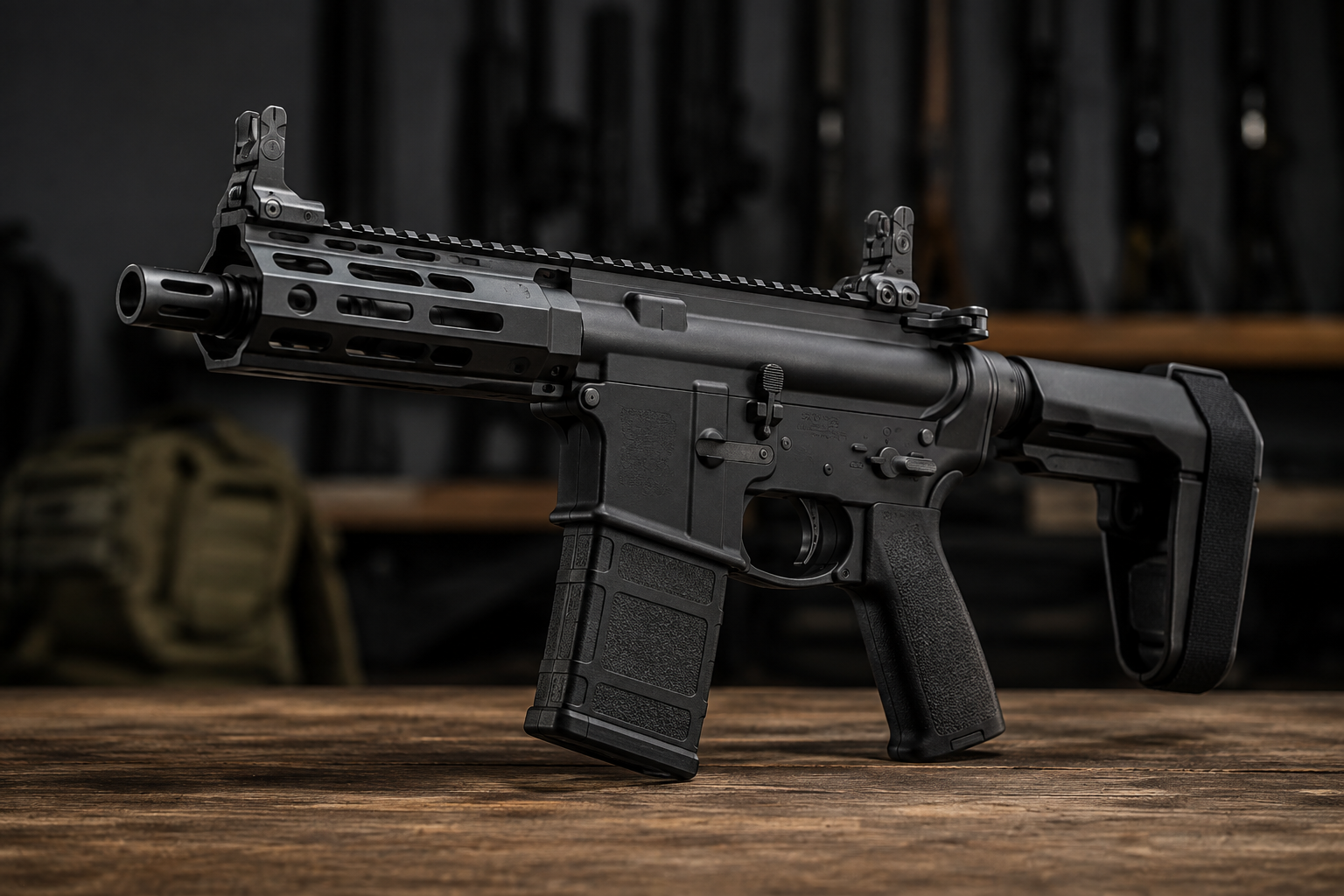
The letters AR appear frequently in firearm articles, product descriptions, shooting discussions, and news reports. Many readers recognize AR-15 as a firearm name but are less certain about what the abbreviation means. The confusion is understandable because AR terminology is used both as a historical reference and as a broader description of modern firearm designs.
The AR platform has developed into a large family of civilian firearms with different configurations, chamberings, barrel lengths, furniture, sights, and other components. Terms such as AR-15, AR pistol, AR rifle, AR platform, and ARP can therefore appear together while referring to related but not identical concepts.
If you have searched for what does ARP mean in guns, the phrase usually refers to the informal abbreviation ARP, meaning AR pistol. That term describes an AR-pattern firearm configured as a pistol. The abbreviation itself is not a universal legal classification, and its meaning should be understood separately from the historical origin of the letters AR.
What Does AR Stand For?
In the original AR-15 name, AR is associated with ArmaLite, the American company that developed the rifle design during the 1950s. The name was connected with ArmaLite's product naming rather than the phrase “assault rifle.”
This distinction is important because the letters AR are sometimes incorrectly expanded as “assault rifle.” That interpretation is common in casual conversations, but it does not explain the historical name of the AR-15.
ArmaLite developed the original AR-15 design as a lightweight rifle. The design later became associated with Colt, and a related military development became the M16 family. Modern civilian AR-pattern firearms share design heritage with these earlier firearms but are not automatically identical to military models.
What Is the AR-15?
The AR-15 began as a specific rifle design, but the name is now widely used for a broad family of civilian firearms based on the AR pattern.
Modern AR-15-pattern firearms can differ in several ways. Manufacturers may offer different chamberings, barrel lengths, handguards, stocks, sights, receivers, and other factory components. As a result, two firearms described as AR-15s may look similar while having different specifications.
The term can therefore describe a platform or family of related firearms rather than one standardized model produced in exactly the same configuration.
Why AR-15 Terminology Can Be Confusing
Online firearm discussions often mix historical names, manufacturer terminology, informal abbreviations, and legal definitions. A reader may see “AR,” “AR-15,” “AR-style,” and “AR pistol” used in the same discussion.
These terms should not automatically be treated as interchangeable. The surrounding context matters, particularly when the discussion involves technical specifications or legal requirements.
What Is the AR Platform?
The AR platform is a broader term used to describe firearms based on the AR design pattern. It can include rifles and other configurations that share important design characteristics.
One reason the platform became widely recognized is its modular approach. Manufacturers produce many models and configurations using familiar design concepts. However, modularity does not mean that every component from one firearm will automatically fit another.
When researching parts or accessories, readers should verify the exact model and manufacturer specifications rather than relying on the phrase “AR platform” alone.
What Is an AR Pistol?
An AR pistol is generally an AR-pattern firearm configured as a pistol rather than a traditional rifle. It may share many recognizable features with an AR-style rifle, including familiar controls and a modular receiver arrangement.
AR pistols are not one standardized product. Different manufacturers can produce models with different chamberings, barrel specifications, handguards, sights, and other factory features.
The phrase AR pistol is useful for understanding general configuration, but it should not automatically be treated as a legal definition. Firearm laws can establish their own categories and requirements.
AR Pistol and AR-15 Rifle Differences
An AR pistol and an AR-15 rifle can share substantial design similarities, but their configurations can be different. A traditional rifle is designed for shoulder firing and normally includes a shoulder stock. An AR pistol is configured differently.
Barrel length is often discussed when comparing the two, but it should not be treated as the only factor determining classification. The complete firearm configuration and applicable regulations matter.
For readers, the most useful distinction is simple: AR-15 generally describes the platform or family, while AR pistol describes a particular configuration.
Common AR Terms
Understanding a few additional terms can make firearm articles easier to follow.
Upper Receiver
The upper receiver is the upper portion of many AR-pattern firearms. It is associated with the barrel and other operating components. Designs can vary by manufacturer and model.
Lower Receiver
The lower receiver is the lower portion and is generally associated with the trigger group, magazine well, grip interface, and other controls. Because receivers can be addressed specifically in regulations, readers should use current official sources for legal questions.
Barrel
The barrel is the tube through which a projectile travels after firing. Product descriptions commonly list barrel length and chambering as important specifications.
Chambering
Chambering identifies the cartridge for which a firearm is designed. It is important to follow manufacturer specifications and use compatible ammunition.
Handguard
The handguard surrounds the forward barrel area and provides a protected surface for handling. Modern designs can include mounting interfaces for accessories.
Stock
A stock provides shoulder support and is traditionally associated with rifle configurations. The type and presence of a stock can be relevant to legal classification.
Brace
A brace is a component associated with certain compact firearm configurations. Its legal treatment has changed over time, so current official rules should be checked before making configuration changes.
Magazine
A magazine stores and feeds cartridges into a firearm. Different AR-pattern firearms can use different magazine designs depending on chambering and configuration.
Why Accurate Terminology Matters
Correct terminology helps readers understand product descriptions, technical articles, and regulations. It also prevents assumptions based only on appearance.
For example, two firearms may look nearly identical but have different configurations, specifications, or legal treatment. A general abbreviation cannot provide all of that information.
This is especially important when researching ownership, transportation, storage, transfers, or modifications. Laws can vary between jurisdictions and may change over time.
Legal Considerations
Firearm regulations are jurisdiction-specific. Federal rules may differ from state or local requirements, and definitions can depend on the complete configuration of a firearm.
Readers should not use an informal term such as ARP or AR pistol as proof that a particular configuration is lawful. When legal status matters, consult current official regulations or a qualified firearms attorney.
Older online articles may also contain outdated information, particularly regarding firearm configurations and accessories. Verify current requirements before making decisions based on information found online.
Safety Basics for New Readers
Anyone learning about firearms should also understand basic safety principles. Terminology is useful, but safe handling is more important.
Important practices include:
-
Treat every firearm as if it is loaded.
-
Keep the muzzle pointed in a safe direction.
-
Keep your finger outside the trigger guard until ready to fire.
-
Know your target and what is beyond it.
-
Use appropriate eye and hearing protection.
-
Store firearms securely and prevent unauthorized access.
-
Follow manufacturer instructions and range rules.
-
Seek qualified instruction when learning safe handling.
These principles apply regardless of whether a firearm is described as an AR-15, AR pistol, or another configuration.
Final Thoughts
The meaning of AR becomes clearer when its historical origin is separated from modern usage. AR in AR-15 is associated with ArmaLite, while modern expressions such as AR platform, AR pistol, and AR-style firearm describe broader or different configurations.
Learning these distinctions helps readers understand firearm articles without confusing informal language with technical or legal definitions. When researching a specific firearm, always look at its complete specifications rather than relying on an abbreviation or photograph.
Frequently Asked Questions
Does AR stand for assault rifle?
No. In the historical AR-15 name, AR is associated with ArmaLite. It does not mean assault rifle.
What does AR mean in AR-15?
AR refers to ArmaLite in the historical naming of the design. The AR-15 was developed by ArmaLite during the 1950s.
Is an AR pistol the same as an AR-15?
Not necessarily. An AR pistol is a configuration, while AR-15 is commonly used as a platform or family description. A civilian firearm can be based on the AR-15 pattern while being configured as a pistol.
Is ARP an official firearm category?
ARP is generally an informal abbreviation for AR pistol. It should not automatically be treated as a legal category.
Does barrel length alone determine classification?
No. Barrel length can be relevant, but classification may depend on several characteristics and applicable laws.
Why do websites use AR terminology differently?
Sources may use historical terminology, manufacturer language, informal expressions, or legal definitions. Context is important when interpreting the terms.

 English
 Arabic
 French
 Spanish
 Portuguese
 Deutsch
 Turkish
 Italiano
 Russian
 Romaian
 Portuguese (Brazil)
 Greek
Greek