


Invention Patent Attorney: When to Get Patent Risk Advice Before You Launch a Technology Product
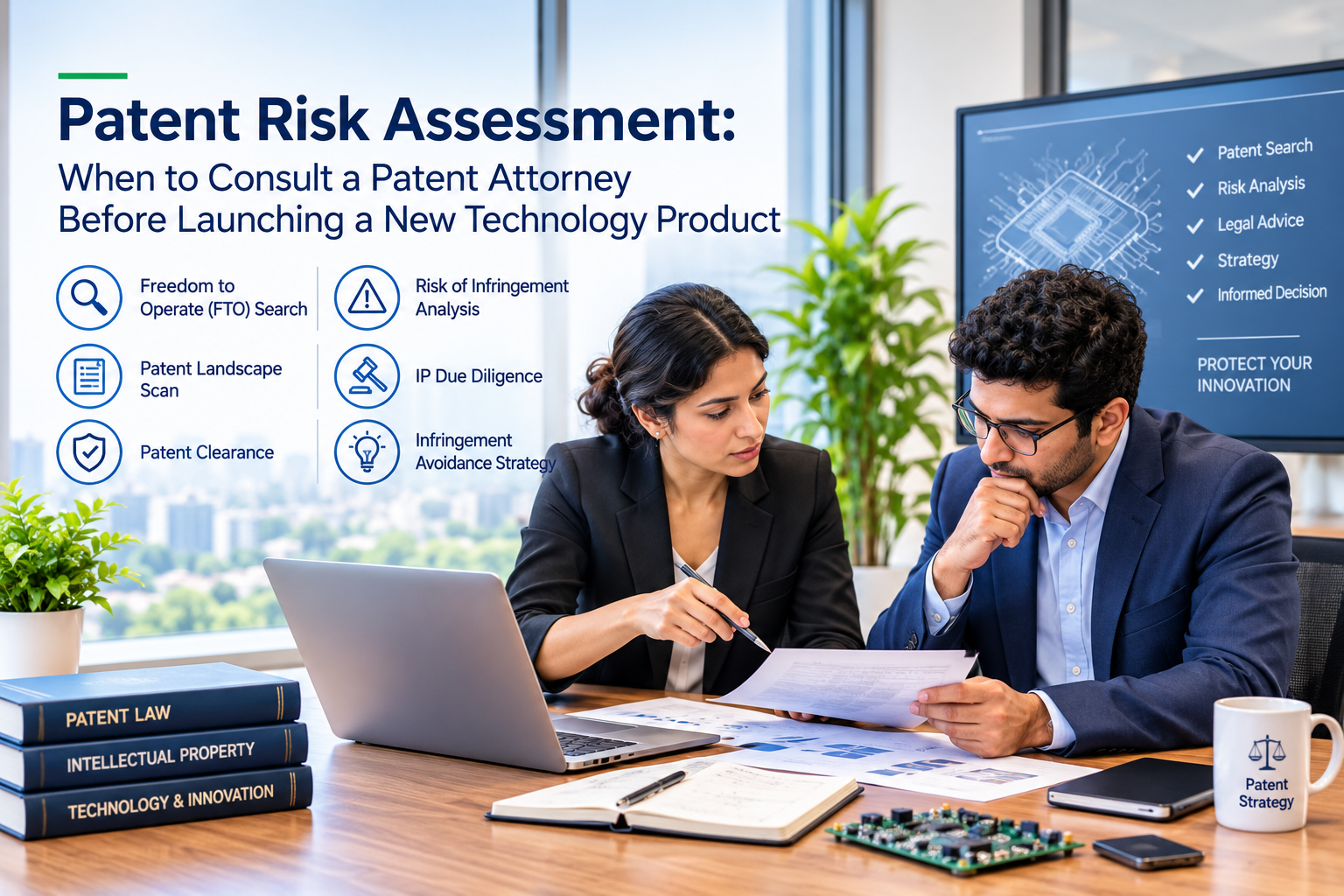
The best time to bring in an invention patent attorney is after your product's key features are set but before you commit serious money to manufacturing, marketing, and launch. At that stage, a patent risk assessment can flag third-party patents that matter while you can still redesign, license, or change your plans.
Most founders think of a patent attorney as the person who files patents on their inventions. That is half the job. The other half is making sure the product you are about to sell does not run into patents someone else already owns. Plenty of teams do the first and skip the second, and the second is where the expensive surprises live.
What Is a Patent Risk Assessment?
A patent risk assessment reviews whether a planned product could infringe patents owned by someone else. It starts with the product itself: what it does, how it works, which features are essential, and which components are built in-house versus bought from suppliers.
An invention patent attorney then reviews relevant patents and published applications, focusing on claims, legal status, and ownership. The goal is not a pile of every patent that mentions similar technology. It is a short list of specific rights that could create real risk for your product and timeline. The assessment can include a freedom to operate (FTO) search, a broader patent landscape study, and a close read of the claims that look relevant.
When Should You Consult a Patent Attorney?
Earlier than most companies do. Waiting until the product is ready to ship leaves fewer options, and they cost more. It is worth calling an invention patent attorney when:
-
A new technology product is in development or a major launch is coming up
-
You are entering a new technology market or a new country
-
You are significantly redesigning an existing product
-
A competitor has obtained patents in your field
-
An investor, partner, or acquirer asks for IP due diligence
-
You plan to license in or acquire outside technology
Each of these moments has something in common. Engineering and business decisions are still open, so your attorney's advice can actually change what you build.
What Is a Freedom to Operate Search?
A freedom to operate (FTO) search looks for third-party patents that could affect your ability to make, use, sell, offer for sale, or import a specific product. It is tied to one product and specific markets. A company launching only in the United States focuses on U.S. patents, while a company selling abroad has to check patents in each target country.
Claims drive the analysis, not a patent's general description. Two products can do the same thing in very different ways, and only one may fall inside a given claim. Status matters too. Expired patents cannot be infringed, and a pending application only becomes a concern if it issues with claims that reach your product.
For more on timing and scope, see our earlier article, "Freedom to Operate Search: What Businesses Should Know Before Launching a New Product."
How Is an FTO Search Different From a Patent Landscape Study?
An FTO search asks a narrow question: could this product infringe someone else's patents in these markets? A patent landscape study asks a wider one: what does patent activity in this technology area look like?
A landscape study can show which companies hold large portfolios, where competitors are filing, and where your own protection may have room to grow. Many companies use both. The landscape study helps early, when you are choosing a technical direction. The FTO search helps later, when a specific product is close to launch.
Can You Own a Patent and Still Infringe Someone Else's?
Yes, and this catches people off guard. A patent gives you the right to stop others from using your invention. It does not give you permission to use everything inside your own product.
Most technology products combine many technologies. You might hold a patent on your product's architecture while another company holds patents on a communication protocol, a component, or a manufacturing step your product also uses. That is why a complete patent portfolio strategy covers both sides: protecting what you invented and checking the third-party rights you will meet on the way to market.
What Does Patent Clearance Involve?
Patent clearance is the review of third-party patents against a specific product before it goes to market. People often use the term interchangeably with FTO analysis. It generally runs in four steps:
-
Define the product. Pin down the architecture, key features, hardware and software components, and manufacturing processes.
-
Find relevant patent rights. Search for issued patents, published applications, and patent families.
-
Review the claims. Compare each relevant patent's claims against the product's actual features. Most search hits turn out not to matter.
-
Rank the risk. Sort what remains by relevance, status, and jurisdiction, so you know what needs deeper legal review.
Supplier components deserve extra attention. If your product uses a chip, module, or software library from another company, check what IP protection or indemnity the supplier agreement gives you.
What Happens If You Skip a Pre-Launch Patent Assessment?
Skipping it does not guarantee trouble. It means you will not know about a problem until someone else raises it, and that tends to happen at the worst time: a competitor sends a letter, an investor's due diligence turns something up, or the product gets successful enough to attract attention.
By then you have already paid for engineering, tooling, inventory, and marketing. A real issue could mean redesigning a product that is already in customers' hands, negotiating a license from a weak position, or delaying a market entry. An earlier assessment will not remove every uncertainty, but it lets you decide with your eyes open. If one patent does raise concern, your attorney can discuss next steps, such as a non-infringement opinion.
An FTO search also goes stale. Revisit it when the design changes, you enter a new country, a key supplier changes, or new patents are granted in your field. A product assessed two years ago may look quite different from the one shipping today.
Why Does This Matter for Silicon Valley Technology Companies?
Silicon Valley companies often work in fields with dense, fast-moving patent activity, including AI, semiconductors, robotics, medical technology, and consumer electronics. Many large patent holders compete in these same markets.
Working with a patent attorney in Silicon Valley who understands these technologies lets you build risk assessment into product development instead of treating it as a last-minute legal hurdle. For startups the stakes are sharper. When most of your resources ride on one product, finding a patent issue before launch gives you time to redesign or negotiate while you still have money and options.
Read More: Patent Risk Assessment: When to Consult a Patent Attorney Before Launching a New Technology Product
Frequently Asked Questions
What does an invention patent attorney do?
An invention patent attorney helps you protect your own inventions through patent filings and strategy, and helps you assess whether your product could infringe patents held by others. Before a launch, that often means an FTO search, a claim review, and advice on design changes, licensing, or formal legal opinions.
When should I consult a patent attorney before launching a product?
Once the product's key features are defined, but before major investment in manufacturing, marketing, or launch. Also consult one before entering a competitive market, making significant design changes, or expanding internationally.
Does having a patent mean I have freedom to operate?
No. A patent lets you stop others from using your invention. It does not protect you from patents held by others that cover other parts of the same product.
What can I do if an FTO search finds a problem patent?
Common options include designing around the patent's claims, seeking a license, challenging the patent's validity, or obtaining a formal opinion from counsel. The right choice depends on the patent, the product, and your business timeline.
Does every new technology product need an FTO search?
Not necessarily. The right level of review depends on the technology, its commercial importance, the target markets, and how crowded the field is. An attorney can help you decide how much review your product needs.

 English
 Arabic
 French
 Spanish
 Portuguese
 Deutsch
 Turkish
 Dutch
 Italiano
 Romaian
 Portuguese (Brazil)
 Greek