


Phosphorus Mobilization Expands Biofertilizer Application Potential
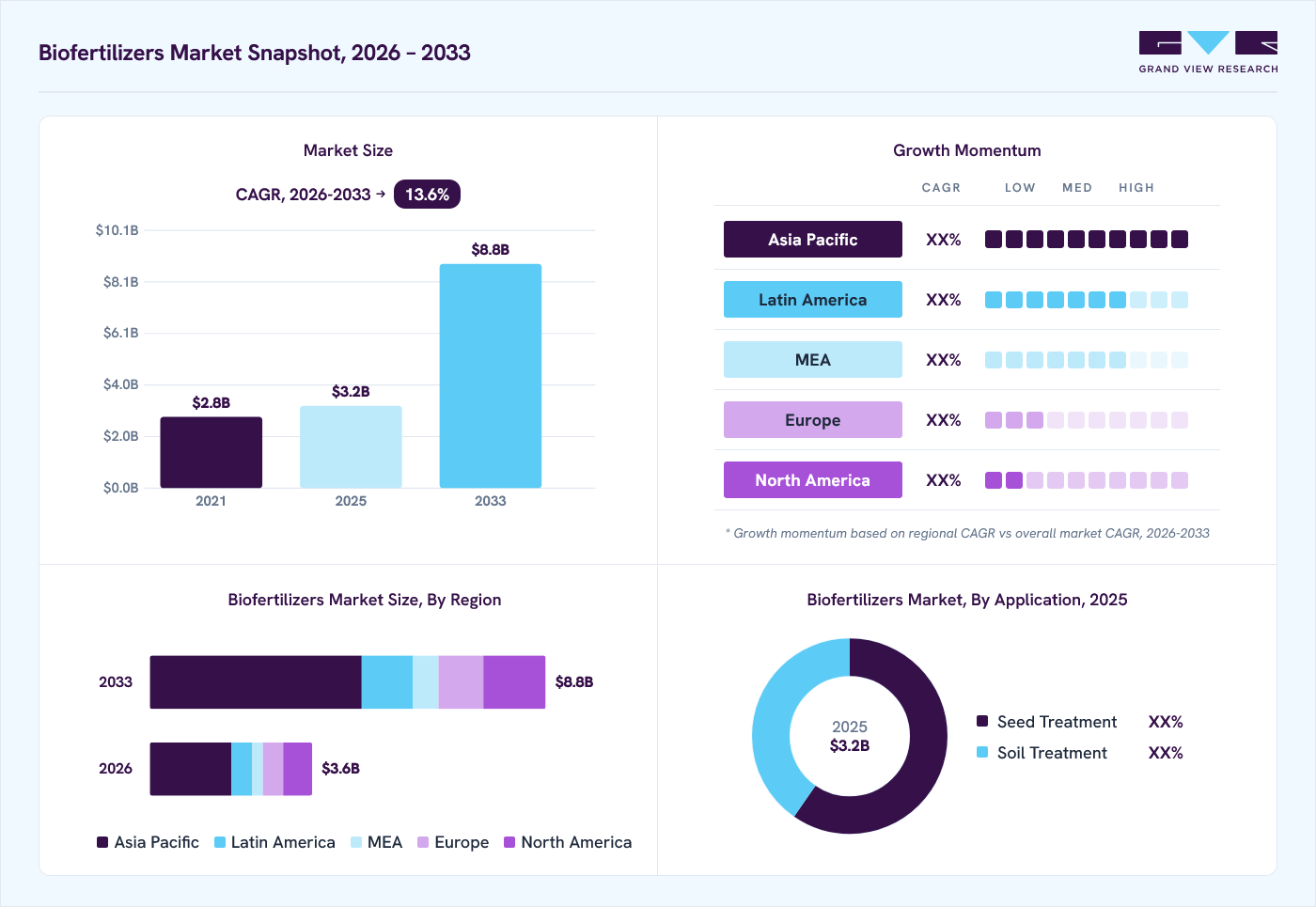
Agriculture is increasingly incorporating biological inputs into crop nutrition strategies as growers seek to improve soil fertility, nutrient efficiency, and productivity while reducing dependence on conventional fertilizers. Biofertilizers use beneficial microorganisms to facilitate nutrient availability, biological nitrogen fixation, and phosphorus mobilization, supporting plant development across different farming systems. Growing interest in regenerative agriculture, soil health, and environmentally conscious cultivation is strengthening adoption. The biofertilizers market was valued at USD 3.2 billion in 2025 and is projected to reach USD 8.8 billion by 2033, growing at a CAGR of 13.6% from 2026 to 2033.
Go Deeper! Ask Prism AI about the Biofertilizers Market.
Microbial Nutrient Management Drives Market Adoption
The growing use of microbial solutions in agriculture is a key contributor to market expansion. Nitrogen-fixing microorganisms, including Rhizobium, Azotobacter, and Azospirillum, support the conversion of atmospheric nitrogen into plant-available forms. Phosphate-solubilizing microorganisms help mobilize phosphorus from soil compounds, improving nutrient accessibility for plants.
Biofertilizers are increasingly incorporated into nutrient management programs alongside conventional fertilizers. Their use can support soil microbial activity, nutrient cycling, and root development, although results depend on crop type, soil characteristics, microbial strains, environmental conditions, and application practices. Farmers are increasingly exploring these products as part of integrated approaches to crop nutrition and soil fertility management.
Request a Sample Report to Explore Detailed Market Insights and Industry Analysis.
Nitrogen Fixation Dominates Product Demand
Nitrogen fixation accounted for 73.8% of market revenue in 2025, making it the largest product segment. The widespread requirement for nitrogen across agricultural production and the use of microbial inoculants in leguminous crops contribute to its leading position. Nitrogen-fixing biofertilizers are also applied across various crop systems to support nutrient availability and complement existing fertilizer programs.
Phosphate-solubilizing biofertilizers are projected to register the fastest growth, with a CAGR of 15.7% from 2026 to 2033. These products address challenges associated with phosphorus availability in soils, where nutrients may remain in forms that plants cannot readily absorb. Their ability to support phosphorus mobilization, root growth, and nutrient uptake is creating opportunities across different cultivation systems.
Cereals and Grains Represent a Major Crop Segment
Cereals and grains accounted for 43.0% of market revenue in 2025. Extensive cultivation of rice, wheat, maize, and other staple crops creates significant demand for agricultural nutrient inputs. Biofertilizers are increasingly incorporated into cereal production to support nutrient management, maintain soil fertility, and improve the efficiency of agricultural practices.
Fruits and vegetables are expected to grow at a CAGR of 15.3% over the forecast period. High-value horticultural crops require careful nutrient management throughout cultivation. Growing interest in biological inputs, improved soil conditions, root development, and sustainable crop production is supporting adoption in fruit and vegetable farming.
Seed Treatment Strengthens Application Demand
Seed treatment represented 59.6% of market revenue in 2025, reflecting its suitability for introducing beneficial microorganisms during early crop development. Applying biofertilizers directly to seeds helps establish microbial activity close to developing roots, supporting nutrient acquisition and plant establishment.
Soil treatment is expected to grow at a CAGR of 14.6% from 2026 to 2033. Direct soil application enables microbial products to be incorporated into the root-zone environment through different methods, including broadcasting, drenching, and fertigation. Adoption is supported by growing attention to soil microbial activity, nutrient cycling, and fertility improvement. Product selection depends on microbial compatibility, soil conditions, moisture availability, and crop requirements.
Regional Demand and Agricultural Opportunities
Asia Pacific accounted for 49.7% of market revenue in 2025, supported by its extensive agricultural activity, large crop production base, and increasing interest in biological nutrient management. China held the largest country share in 2025. The region's diverse cultivation systems and growing emphasis on soil health and efficient fertilizer utilization are supporting demand for microbial agricultural inputs.
North America accounted for 18.1% of revenue in 2025, while Europe represented 12.6%. Latin America held 12.9% of revenue, reflecting opportunities across large-scale crop production and biological input adoption. The Middle East & Africa region is projected to grow at a CAGR of 13.4% from 2026 to 2033, with growing interest in soil improvement and nutrient efficiency.
Adoption Challenges and Product Innovation
Biofertilizer performance can vary with temperature, soil pH, moisture, salinity, native microbial populations, and crop conditions. Product viability, storage requirements, formulation stability, and compatibility with other agricultural inputs also influence adoption. Limited awareness and inconsistent technical support can further affect usage among farmers.
Continued improvements in microbial strain selection, carrier materials, formulation technologies, shelf life, and crop-specific products can help address these challenges. As growers increasingly integrate biological inputs into nutrient management programs, biofertilizers are gaining importance across modern agricultural production.
Frequently Asked Questions
1. What is driving the biofertilizers market?
The market is driven by increasing demand for sustainable agricultural inputs, soil fertility improvement, nutrient-use efficiency, microbial crop nutrition, and reduced reliance on synthetic fertilizers.
2. Which segment dominates the biofertilizers market?
Nitrogen fixation was the largest product segment, accounting for 73.8% of revenue in 2025. Cereals and grains led crop types with 43.0%, while seed treatment was the largest application with 59.6%.
Key Biofertilizers Companies:
· Fertinagro Biotech
· Novonesis
· Rizobacter Argentina SA (Parent company Bioceres Crop Solutions)
· Corteva Agriscience
· Koppert
· Lallemand Inc.
· Groundwork BioAg
· Andermatt Group AG
About us:
Grand View Research, a market research and consulting company, provides syndicated research reports, customized research reports, and consulting services. Grand View Research database is used by the world's renowned academic institutions and Fortune 500 companies to understand the global and regional business environment. Our database features thousands of statistics and in-depth analysis on 46 industries in 25 major countries worldwide.

 Arabic
 French
 Spanish
 Portuguese
 Deutsch
 Turkish
 Dutch
 Italiano
 Russian
 Romaian
 Portuguese (Brazil)
 Greek