


Smart Helmet Market Size, Share, Latest Insights and Forecast 2026-2034
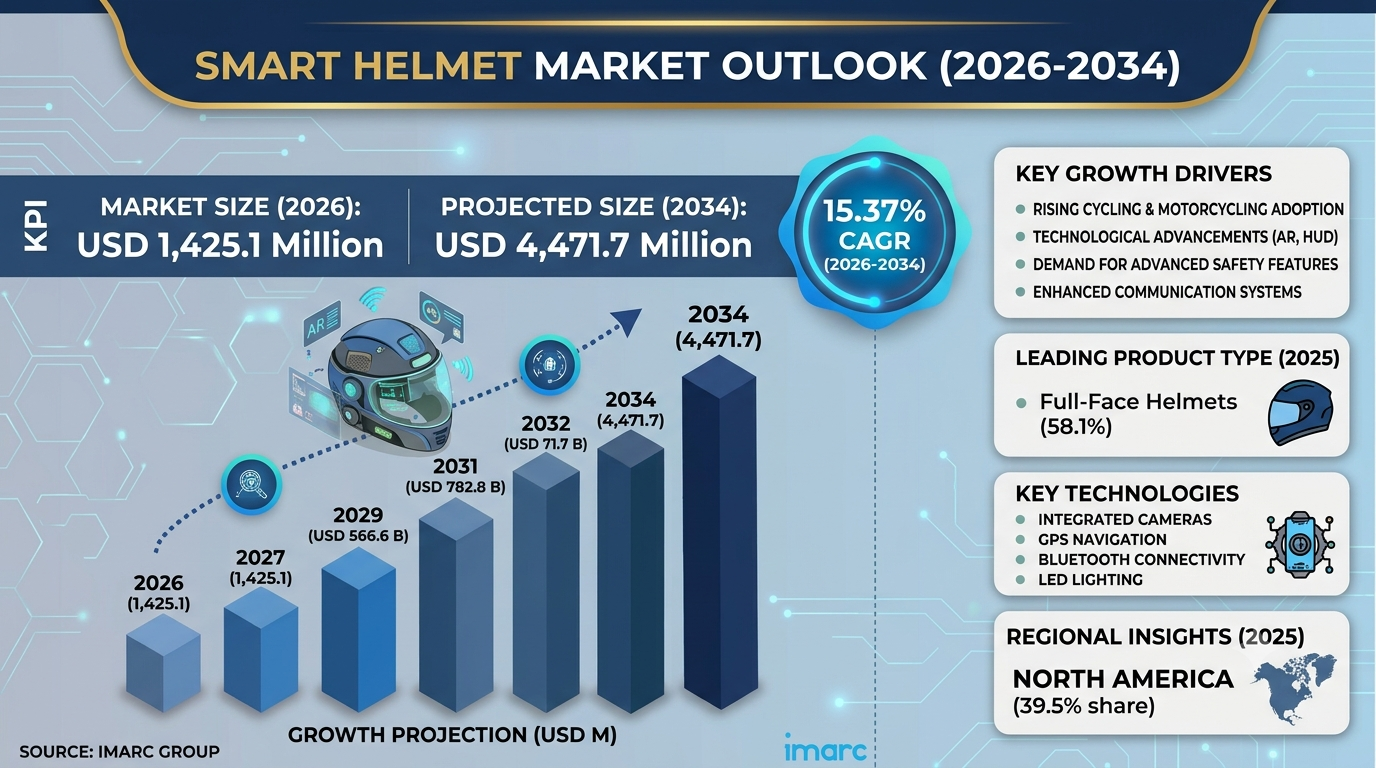
According to IMARC Group, the global smart helmet market size increased from USD 1,190.4 Million in 2025 to USD 1,425.1 Million in 2026 and is projected to reach USD 4,471.7 Million by 2034, exhibiting a CAGR of 15.37% during 2026-2034. North America currently dominates the smart helmet market share, holding over 42.2% of the market in 2025. This strong smart helmet market growth is being driven by rising road-accident awareness, tightening workplace-safety regulations, rapid technological advancements, and the increasing integration of connected devices across consumer, industrial, healthcare, and construction applications.
Smart Helmet Industry Overview
A smart helmet is a technologically advanced form of protective headgear engineered to combine conventional impact protection with digital functionality. Built-in sensors, communication modules, and display technologies allow smart helmets to deliver crash detection, hands-free connectivity, navigation guidance, and performance tracking, extending their utility far beyond basic head protection.
Smart helmets are deployed across a broad range of use cases, including:
- Motorcycling and cycling: Bluetooth connectivity, turn-signal integration, music and call management, and rider-to-rider intercom
- Industrial and construction safety: Impact sensors, hands-free communication, and real-time hazard alerts for workers in high-risk environments
- Military and defense: Augmented-reality interfaces, soldier-to-soldier communication, and ruggedized protective systems
- Adventure and action sports: Built-in cameras, performance tracking, and live-recording capability for skiing, biking, and similar activities
- Healthcare and emergency response: Contactless temperature measurement and connected monitoring for frontline and field personnel
Global Smart Helmet Market Size & Key Statistics
Below are the key smart helmet market statistics drawn from IMARC Group's comprehensive market analysis:
|
Report Attribute |
Key Statistics |
|
Base Year |
2025 |
|
Historical Period |
2020-2025 |
|
Forecast Period |
2026-2034 |
|
Smart Helmet Market Size in 2025 |
USD 1,190.4 Million |
|
Market Size in 2026 |
USD 1,425.1 Million |
|
Market Forecast in 2034 |
USD 4,471.7 Million |
|
Market Growth Rate (2026-2034) |
15.37% CAGR |
|
Largest Region |
North America (42.2% Share in 2025) |
|
Leading Component Segment |
Communication (34.5% Share) |
|
Leading Type Segment |
Full Face (58.6% Share) |
|
Leading Technology Segment |
Integrated Communication System |
|
Leading End-Use Segment |
Consumer (77.8% Share) |
Request for a Sample Report for Detailed Smart Helmet Market Share Evaluation: https://www.imarcgroup.com/smart-helmet-market/requestsample
Key Market Drivers & Smart Helmet Market Trends in 2026
Several powerful forces are shaping Smart Helmet Market Trends and fuelling sustained growth expectations across global safety-equipment and wearable-technology markets:
1. Rising Focus on Rider and Worker Safety
Growing awareness among riders, workers, and regulatory authorities about the importance of road and workplace safety is bolstering demand for smart helmets. Riders increasingly expect innovative safety features in their gear, prompting manufacturers to launch helmets with top safety certifications, protective shells, and advanced internal padding alongside connected functionality. In April 2024, Ather Energy launched its Ather Halo smart helmet series, combining top safety certifications with Bluetooth connectivity for pairing, music or call management, and rider-pillion intercom.
2. Increasing Need for Hands-Free Communication
Hands-free communication is becoming a core expectation for motorcyclists and industrial workers alike, reducing distractions and keeping users focused on the road or task at hand. In May 2024, Steelbird Helmets launched its Fighter line, featuring a Pin Lock-70 anti-fog shield, integrated Bluetooth, a 5.2 smart Bluetooth headset offering 48 hours of talk time, voice-activated navigation, and an LED light blinker for enhanced visibility during night rides or poor-visibility conditions.
3. Growing Cases of Road Accidents
Road accidents involving motorcycles and bicycles continue to result in serious injuries and fatalities due to the vulnerability of riders. According to the US Department of Transportation, the United States recorded an estimated 40,990 road accidents in 2023. Impact sensors, airbags, and enhanced visibility tools such as LED lighting and reflective materials are helping smart helmets improve rider visibility and reduce injury severity, supporting a positive Smart Helmet Market outlook.
4. Integration of IoT, AR, and Wearable Technology
Innovations in the Internet of Things (IoT), augmented reality (AR), and wearable technology are enabling the integration of advanced features such as heads-up displays, noise-canceling microphones, and real-time navigation into smart helmets. These capabilities are making smart helmets highly functional and appealing to tech-savvy users across motorcycling, sports, and industrial applications.
5. Tightening Safety Regulations Across Industries
Governing bodies across the globe are enforcing stringent safety regulations for motorcycling, construction, and other hazardous industries, encouraging the adoption of helmets with advanced protective features. This regulatory push is a key factor supporting Smart Helmet Market Growth across both consumer and industrial end-use segments.
6. Focus on Sustainable and Lightweight Materials
Manufacturers are increasingly exploring eco-friendly materials and energy-efficient components in smart helmets, aligning with sustainability goals while attracting environmentally conscious consumers. This focus on lightweight, sustainable design is complementing the ongoing push toward smarter, more connected safety gear.
Key Market Segmentation
By Component
Communication leads the market, accounting for 34.5% of Smart Helmet Market Share in 2025. The segment's dominance is driven by its critical role in enabling seamless hands-free interaction through Bluetooth and Wi-Fi connectivity, supporting motorcyclists, construction workers, and outdoor sports enthusiasts who require efficient communication in dynamic environments. Advanced microphones and noise-canceling speakers ensure clarity in high-noise settings, while multi-device pairing and voice-command capabilities continue to expand the segment's utility.
- Communication
- Navigation
- Camera
- Others
By Type
Full Face dominates the market with 58.6% of market share in 2025, owing to its superior safety and functionality. Full-face smart helmets provide comprehensive head and face protection and often incorporate advanced features such as crash detection, built-in cameras, heads-up displays, and communication systems. Their enclosed design supports better integration of technology, improved aerodynamics, and protection from adverse weather conditions and debris.
- Full Face
- Half Face
- Hard Hat
By Technology
Integrated Communication System leads the technology segment due to its critical role in ensuring seamless connectivity and enhanced functionality through Bluetooth and Wi-Fi. This technology is particularly popular among motorcyclists, construction workers, and adventure enthusiasts, enabling hands-free calls, coordination, and instant messaging while supporting multi-device pairing with smartphones, GPS devices, and other gadgets.
- Integrated Communication System
- Integrated Video Camera
- Contactless Temperature Measurement
- Bluetooth Connectivity
- Signal Indicator and Brake Function
- Others
By End User
Consumer leads the market with 77.8% of market share in 2025, driven by widespread application in recreational activities such as motorcycling, cycling, and adventure sports. Smart helmets designed for this segment integrate Bluetooth connectivity, built-in cameras, heads-up displays, and crash-detection systems, while growing adoption for fitness tracking through integrated heart-rate and speed sensors continues to broaden the segment's appeal.
- Consumer
- Industrial
- Healthcare
- Construction
Regional Smart Helmet Market Analysis
|
Region |
Key Highlights |
Share (2025) |
|
North America — Largest |
United States & Canada; rising road-safety awareness, advanced technology adoption, stringent motorcycle and bicycle safety regulations, strong presence of leading smart helmet brands |
42.2% |
|
Europe |
Germany, France, UK, Italy, Spain; industrial, military, and sports-driven growth of ~12% YoY, AR-enabled industrial helmets, rising defense-sector investment |
— |
|
Asia Pacific — Fastest Growing |
China, Japan, India, South Korea, Australia, Indonesia; rising industrial activity, growing construction sector, increasing military modernization and consumer adoption |
— |
|
Latin America |
Brazil, Mexico; industrialization, construction growth, and tightening occupational-safety regulations driving adoption |
— |
|
Middle East & Africa |
UAE, Saudi Arabia, South Africa; healthcare and construction modernization, rising military and security-driven demand |
— |
North America leads the global Smart Helmet Market Share, anchored by the United States, which accounted for 83.60% of the total North American market. According to Forbes, more than 44,000 lives were lost in traffic accidents across the United States in 2023, intensifying the urgency around rider-safety technology. Lumos alone has sold over 300,000 smart helmets worldwide, a large share of them in the US through Amazon Global Selling, underscoring strong early adoption of connected safety gear in the region.
Asia Pacific represents the fastest-growing regional market, driven by rising industrial activity, increasing construction, and growing defense-related technology spend across the region — with China's People's Liberation Army military budget surpassing USD 250 Billion, where smart helmets play a growing role in advanced soldier systems. Japan and South Korea are also making prominent contributions as local manufacturers partner with global technology firms on augmented-reality and health-monitoring features. Industry estimates point to a regional CAGR of around 15%, supported by rising demand across both military and civilian sectors.
Connect for Detailed Smart Helmet Market Share Segmentation Analysis — Speak to an Analyst: https://www.imarcgroup.com/request?type=report&id=6967&flag=C
Leading Players in the Global Smart Helmet Industry
The global smart helmet market features a mix of specialized wearable-technology innovators and established protective-gear manufacturers. Top players are investing heavily in research activities to advance integrated communication systems, AR and VR features, sensor-based safety monitoring, and improved comfort and usability, while collaborating with technology firms and software developers to integrate cutting-edge capabilities into their helmets. In 2024, GoPro, Inc. revealed a deal to acquire Forcite Helmet Systems, aiming to accelerate the delivery of tech-enhanced, safer motorcycling experiences and expand tech-enabled helmet categories in the future.
Key companies covered in the IMARC Group report include:
- Babaali
- Forcite Helmet System Pty Ltd.
- Jarvish Inc.
- Livall Tech Co Ltd.
- Lumos Helmet
- Nexsys. Co., Ltd.
- Sena Technologies Inc.
Latest Smart Helmet Market Industry Developments
October 2024 — Royal Enfield & SENA
Royal Enfield and SENA launched the co-branded 50S Mesh Communicator, enhancing rider connectivity with Bluetooth 5, nine Wave-tech channels, and seamless smartphone and helmet-retrofitting integration, priced at INR 35,990 (approximately USD 425.01).
March 2024 — Mod Bikes & Lumos
Mod Bikes partnered with Lumos to enhance rider safety through smart helmets featuring synchronized turn signals, brake lights, and auto-off functionality, integrated into the 2024 Mod Bikes lineup and now available as accessories in stores.
January 2024 — GoPro & Forcite
GoPro announced its acquisition of Forcite Helmet Systems, aiming to enhance motorcycling safety through tech-enabled helmets, with the deal advancing GoPro's long-term growth strategy in the connected-safety-gear space.
About Us
IMARC Group is a leading global market research company providing data-driven insights and expert consulting services to businesses seeking to achieve their strategic objectives. With a multi-disciplinary team of industry experts, IMARC delivers thorough, reliable market intelligence across sectors including Healthcare, Technology, Chemicals, Energy, Food & Beverages, and more.
Contact Us
IMARC Group
United States: +1-201-971-6302
India: +91-120-433-0800
United Kingdom: +44-753-714-6104

 English
 Arabic
 French
 Spanish
 Deutsch
 Turkish
 Dutch
 Italiano
 Russian
 Romaian
 Portuguese (Brazil)
 Greek