


Residential Solar Growth Encourages Innovation in Hybrid Inverters
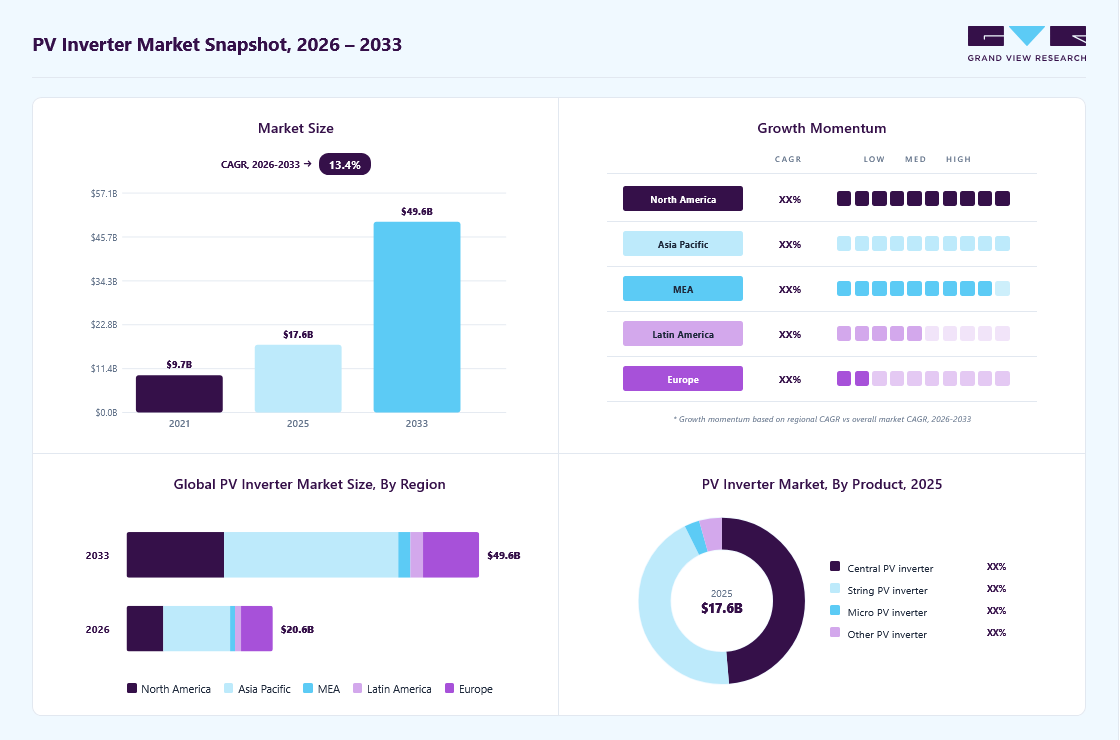
Photovoltaic (PV) inverters are essential components of solar power systems. They convert the direct current (DC) electricity generated by solar panels into alternating current (AC), which can be used by households, businesses, and electricity grids. Beyond power conversion, modern inverters increasingly support system monitoring, grid interaction, energy management, and battery storage integration.
The global PV inverter market was valued at USD 17.6 billion in 2025 and is projected to reach USD 49.6 billion by 2033, growing at a CAGR of 13.4% from 2026 to 2033. Increasing solar installations across utility-scale projects and distributed generation systems are creating demand for inverter technologies with higher efficiency, flexible configurations, and advanced operating capabilities.
Go Deeper! Ask Prism AI about the PV Inverter Market.
Central Inverters Maintain a Strong Position in Large Solar Projects
Central PV inverters accounted for 48.6% of market revenue in 2025. These systems are widely used in utility-scale solar installations because they can process electricity from large arrays of photovoltaic modules through centralized power conversion equipment. Their high-capacity design makes them suitable for large solar farms, where managing substantial electricity output and simplifying system architecture are important considerations.
String inverters serve residential, commercial, and utility applications by converting electricity generated by groups of solar panels. Their modular configuration allows system designers to accommodate different installation layouts and manage individual sections of a solar array.
Microinverters are gaining attention for their module-level operation. Each unit converts electricity at the individual solar panel, allowing more detailed monitoring and reducing the effect of underperforming modules on the entire system. The micro PV inverter segment is projected to grow at the fastest CAGR of 15.0% during the forecast period. Residential rooftop installations and demand for module-level optimization are supporting this expansion.
Utility-Scale Installations Drive End-Use Demand
The utilities segment represented 44.4% of market revenue in 2025, making it the largest end-use category. Large solar power plants require high-capacity inverter systems to convert electricity for grid transmission. Renewable energy targets, investments in solar parks, and the need to diversify electricity generation sources are supporting procurement across utility-scale projects.
The residential segment is expected to record the fastest growth, with a projected CAGR of 14.5% from 2026 to 2033. Rising household electricity costs, government incentives, and interest in energy independence are encouraging homeowners to adopt rooftop solar systems. Hybrid inverters that coordinate solar generation with battery storage are also becoming relevant for households seeking backup power and greater control over electricity consumption.
Commercial and industrial installations represent another important demand area. Businesses can use rooftop and ground-mounted solar systems to manage electricity expenses, reduce dependence on conventional power sources, and support sustainability objectives. Warehouses, manufacturing facilities, offices, and retail properties offer varied opportunities for inverter deployment.
Battery Integration Changes Inverter Capabilities
The growing adoption of battery energy storage systems is influencing inverter development. Hybrid inverters coordinate solar generation, battery charging, and electricity consumption within an integrated system. They can direct excess solar power into storage and make stored energy available when generation falls or electricity demand rises.
This capability is particularly useful for installations operating under time-of-use electricity tariffs or facing inconsistent grid supply. Advanced energy management features can also help optimize power flows between solar panels, batteries, and connected loads.
Digital monitoring is another area of product advancement. Modern inverter platforms can track generation, identify performance irregularities, and provide operational information to installers and system owners. Remote diagnostics and predictive maintenance capabilities can help reduce downtime and improve the management of large solar installations.
Regional Solar Deployment Creates Diverse Opportunities
Asia Pacific accounted for 45.2% of global PV inverter market revenue in 2025. Large solar capacity additions, expanding rooftop installations, and renewable energy initiatives are supporting demand across the region. Utility-scale projects create opportunities for central inverters, while residential and commercial installations support demand for string, micro, and hybrid systems.
North America is projected to be the fastest-growing regional market, with a CAGR of 15.0% from 2026 to 2033. Utility-scale solar development, residential rooftop adoption, and increasing integration of battery storage are contributing to demand. Grid requirements and interest in energy resilience are also influencing product selection.
Request a Sample Report to Explore Detailed Market Insights and Industry Analysis.
FAQs
1. What is driving growth in the PV inverter market?
Increasing solar power installations, renewable energy policies, rooftop solar adoption, utility-scale projects, and the integration of battery storage systems are driving demand for PV inverters.
2. Which product and end-use segments are growing rapidly?
Micro PV inverters are projected to grow at a CAGR of 15.0% from 2026 to 2033, while the residential end-use segment is expected to register a CAGR of 14.5% during the same period.
Key PV Inverter Companies:
· AISWEI (Solplanet)
· Enphase Energy, Inc.
· Fronius International GmbH
· Ginlong Technologies (Solis)
· GoodWe Technologies Co., Ltd.
· Huawei
· SMA Solar Technology AG
· SolarEdge Technologies, Inc.
· Sungrow Power Supply Co., Ltd.
· TMEIC
About us:
Grand View Research, a market research and consulting company, provides syndicated research reports, customized research reports, and consulting services. Grand View Research database is used by the world's renowned academic institutions and Fortune 500 companies to understand the global and regional business environment. Our database features thousands of statistics and in-depth analysis on 46 industries in 25 major countries worldwide.

 English
 Arabic
 French
 Spanish
 Portuguese
 Deutsch
 Turkish
 Italiano
 Russian
 Romaian
 Portuguese (Brazil)
 Greek