


Offshore Energy Development Creates New Cable Infrastructure Requirements
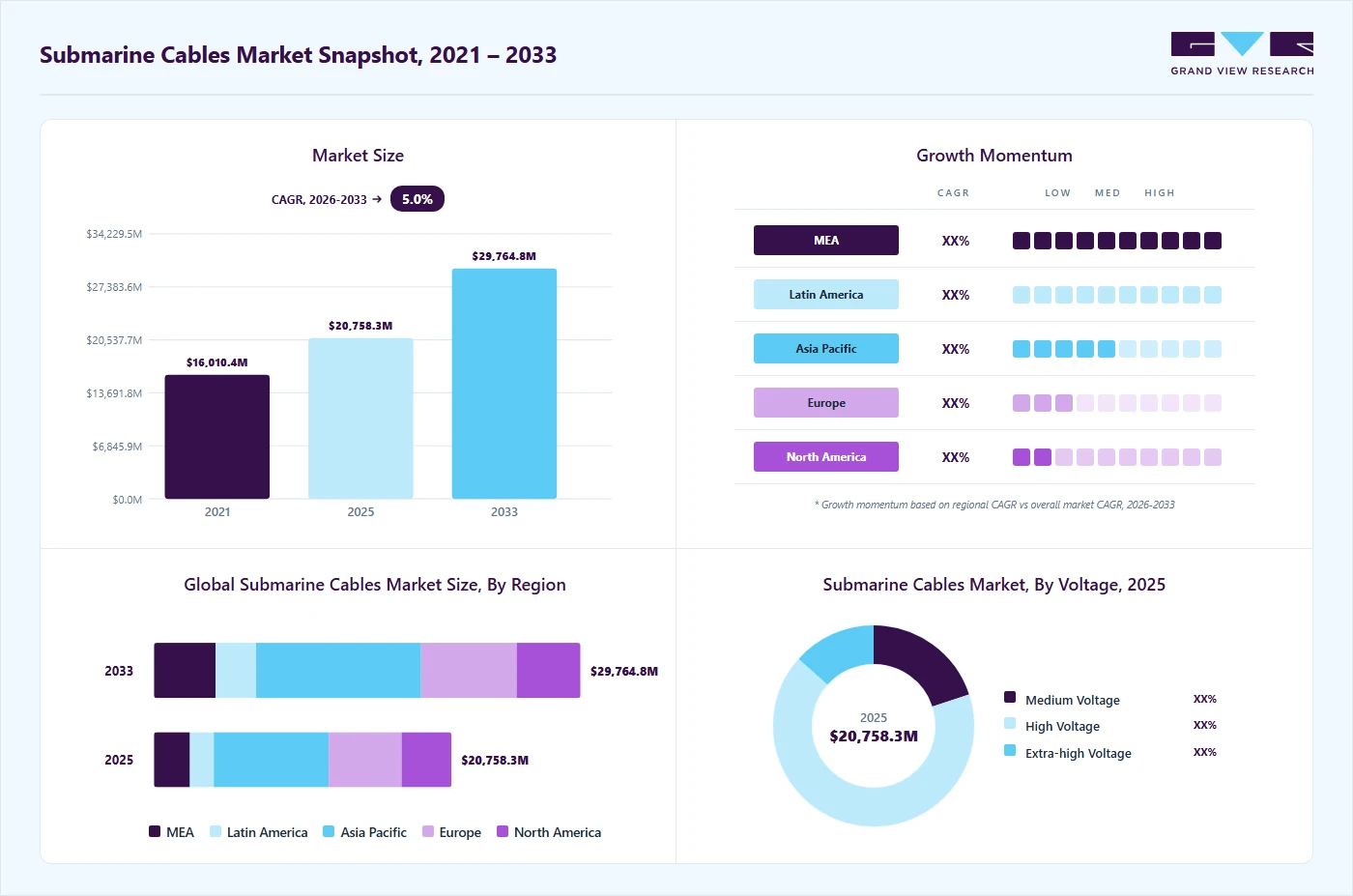
Submarine cables are essential infrastructure for transmitting electricity and digital information across seas and oceans. They connect offshore energy installations with onshore grids, link neighboring countries, and carry international internet traffic between continents. As economies become more dependent on digital services and renewable electricity, investment in these underwater networks is gaining importance.
The global submarine cables market was valued at USD 33.8 billion in 2025 and is projected to reach USD 50.6 billion by 2033, growing at a CAGR of 5.0% from 2026 to 2033. Demand is being shaped by two major infrastructure requirements: expanding offshore power generation and increasing capacity for international data transmission.
Power Cables Lead as Offshore Energy Projects Expand
Submarine power cables accounted for 61.5% of market revenue in 2025, making them the leading application segment. These cables transmit electricity from offshore wind farms to onshore power grids and support connections between countries and islands. Their importance is increasing as governments and utilities invest in renewable energy capacity and seek more flexible electricity transmission networks.
Offshore wind installations are a particularly important source of demand. Array cables connect individual turbines within a wind farm, while export cables transport generated electricity to land-based infrastructure. The development of larger offshore projects and installations farther from shore increases the need for cables engineered to withstand demanding marine conditions and transmit electricity efficiently over long distances.
Submarine communication cables are expected to register the fastest growth among application segments. These fiber-optic systems carry international data traffic supporting cloud computing, streaming platforms, enterprise networks, and artificial intelligence applications. Growing demand for bandwidth and lower-latency connections is encouraging telecommunications operators and large technology companies to invest in additional routes and capacity.
Go Deeper! Ask Prism AI about the Submarine Cables Market.
High-Voltage Systems Support Long-Distance Transmission
High-voltage cables held 66.6% of market revenue in 2025. They are widely used in offshore power generation and cross-border electricity transmission because they can transport substantial amounts of electricity while reducing transmission losses. High-voltage direct current (HVDC) technology is particularly relevant for long-distance underwater connections and projects that link power grids operating under different conditions.
Medium-voltage cables are projected to record the fastest growth during the forecast period. They are used in offshore infrastructure, including connections within wind farms and power systems supporting offshore oil and gas operations. Their role in connecting equipment and different sections of marine installations creates opportunities as offshore energy projects become more extensive.
Offshore Wind and Island Connections Shape End-Use Demand
Offshore wind power generation represented the largest end-use segment in 2025. The expansion of wind farms is increasing requirements for both array and export cables, as developers need dependable links between turbines, offshore substations, and onshore grids.
Inter-country and island connections are expected to grow at the fastest rate. Submarine infrastructure helps geographically separated regions access electricity and communication services without relying entirely on land-based routes. These connections can strengthen energy security, improve network reliability, and support economic activity in remote island communities.
Offshore oil and gas installations also require submarine cables for power transmission and operational connectivity. As offshore facilities extend into deeper waters, cable performance, durability, and installation expertise become increasingly important.
Cable Components Extend Beyond the Seabed
Dry plant products accounted for the largest component share in 2025. These products include onshore equipment such as power-feeding systems, monitoring equipment, and transmission terminals. They help operators manage cable networks, monitor performance, and maintain reliable communication transmission.
Wet plant products are projected to register the fastest growth, with a CAGR of 6.1% from 2026 to 2033. These components include undersea fiber-optic cables, optical repeaters, and branching units. Installed on the seabed, they support signal transmission, amplification, and network routing across long distances.
Installation and Upgrades Influence Network Performance
Installation and commissioning represented the largest offerings segment in 2025. Submarine cable deployment requires marine surveys, specialized vessels, seabed preparation, cable laying, and system testing. The complexity of these activities makes installation expertise an important part of project execution.
Upgrade services are expected to grow at the fastest rate. Operators can improve the capacity of existing communication systems through technologies such as coherent optical transmission and advanced repeaters. Upgrading established infrastructure can increase data throughput and extend system usefulness without requiring complete cable replacement.
Deployment Risks and Technical Complexity
Submarine cable projects involve substantial capital investment and challenging operating conditions. Cable manufacturing, marine installation, landing stations, and maintenance require specialized equipment and technical expertise. Physical damage caused by ship anchors, fishing activities, earthquakes, or underwater landslides can disrupt service and require expensive repairs.
Regulatory approvals and coordination across national jurisdictions can also extend project timelines. As dependence on undersea infrastructure increases, route diversity, monitoring, maintenance planning, and network resilience remain essential considerations for project developers and operators.
Request a Sample Report to Explore Detailed Market Insights and Industry Analysis.
FAQs
1. What is driving growth in the submarine cables market?
Offshore wind development, cross-border electricity connections, rising international internet traffic, cloud computing, and demand for higher-capacity communication networks are supporting market growth.
2. Which segments lead the submarine cables market?
Submarine power cables led the application segment with a 61.5% revenue share in 2025. High-voltage cables held 66.6% of the voltage segment, while offshore wind power generation was the largest end-use category.
Key Submarine Cables Companies:
· ASN (Alcatel Submarine Networks)
· SubCom, LLC
· NEC Corporation
· Prysmian S.p.A
· Nexans
· Google LLC
· Amazon.com, Inc.
· Microsoft
· NKT A/S
· ZTT
About us:
Grand View Research, a market research and consulting company, provides syndicated research reports, customized research reports, and consulting services. Grand View Research database is used by the world's renowned academic institutions and Fortune 500 companies to understand the global and regional business environment. Our database features thousands of statistics and in-depth analysis on 46 industries in 25 major countries worldwide.

 English
 Arabic
 French
 Spanish
 Portuguese
 Deutsch
 Dutch
 Italiano
 Russian
 Romaian
 Portuguese (Brazil)
 Greek