


Autonomous AI Agents Market Size, Share & Forecast 2034
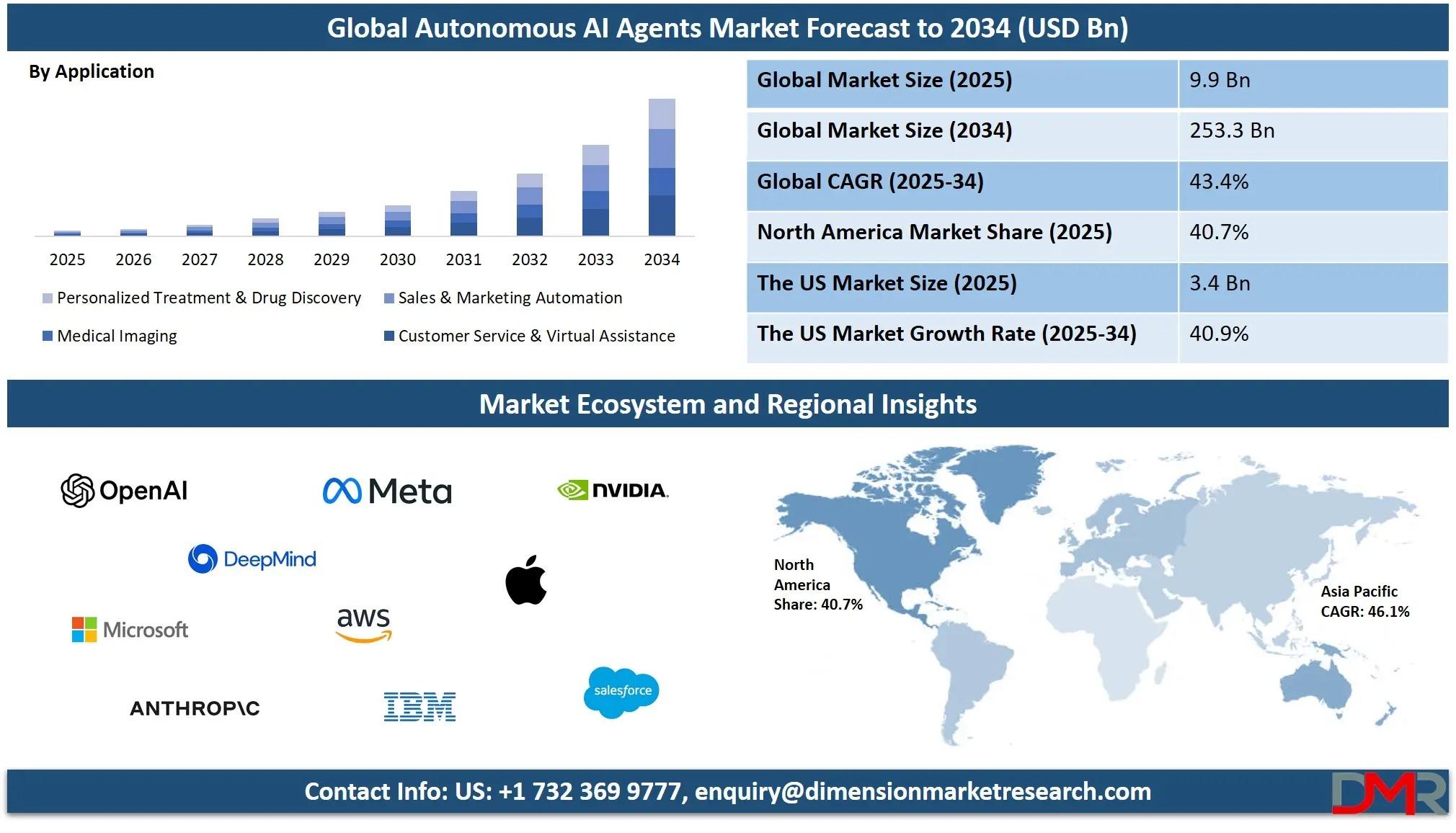
The Autonomous AI Agents Market is entering a new phase of development as businesses move beyond conventional automation toward intelligent systems capable of making decisions, managing workflows, and completing tasks with minimal human intervention. Growing adoption across banking, healthcare, retail, manufacturing, and technology services is creating opportunities for autonomous software platforms and AI-powered enterprise applications.
According to Dimension Market Research, the global market is projected to reach USD 9.9 billion in 2025 and expand to USD 253.3 billion by 2034, registering a CAGR of 43.4%. Increasing investment in machine learning, large language models, intelligent decision-making systems, and cloud-based automation is supporting this expansion.
Organizations are increasingly exploring autonomous AI agents to improve productivity, manage complex operations, reduce repetitive work, and deliver more responsive customer experiences. Their ability to adapt to changing conditions distinguishes them from traditional rule-based automation.
What Is the Autonomous AI Agents Market?
The Autonomous AI Agents Market includes intelligent software, hardware, and services that enable AI systems to independently understand objectives, process information, make decisions, and execute actions.
Unlike traditional automation systems that follow predefined instructions, autonomous agents can analyze changing situations, learn from interactions, and adjust their behavior to achieve specific goals.
These systems combine machine learning, natural language processing, large language models, reinforcement learning, and contextual intelligence. Applications include virtual assistants, fraud detection, medical decision support, business process automation, and intelligent robotics.
Why Is the Autonomous AI Agents Market Growing?
Enterprise demand for intelligent automation is a major factor supporting market expansion. Businesses are seeking technologies that can manage increasingly complex digital operations while maintaining efficiency and flexibility.
The development of advanced language models has also improved the ability of autonomous agents to understand instructions, analyze information, and interact with enterprise systems.
Cloud computing and edge AI provide another growth opportunity. Cloud platforms support scalable deployment, while edge-based systems enable faster decision-making in applications requiring real-time responses.
Growing interest in multi-agent collaboration is further expanding potential applications. Multiple AI agents can coordinate activities, exchange information, and execute interconnected tasks within business environments.
Get a Free Sample of the Autonomous AI Agents Market Report
Explore detailed market forecasts, segment performance, regional opportunities, competitive developments, and industry growth factors through Dimension Market Research's comprehensive analysis.
https://dimensionmarketresearch.com/request-sample/autonomous-ai-agents-market/
Autonomous AI Agents Market Size, Share, and Key Statistics
The DMR report identifies the following market indicators:
● 2025 Market Size: USD 9.9 Billion
● 2034 Market Forecast: USD 253.3 Billion
● Forecast CAGR: 43.4%
● Leading Component: Software, 55.7% share in 2025
● Leading Deployment Mode: Cloud, 45.2% share in 2025
● Leading Technology: Machine Learning, 40.9% share in 2025
● Leading Agent System: Single Agent Systems, 65.4% share in 2025
● Leading Application: Customer Service & Virtual Assistance, 30.3% share in 2025
● Leading End-User Industry: BFSI, 35.8% share in 2025
● Leading Region: North America, 40.7% share in 2025
These figures highlight the importance of software-led innovation, cloud infrastructure, and enterprise applications in shaping market development.
Market Segmentation and Technology Trends
Software dominates the component segment because algorithms, reasoning engines, orchestration frameworks, and contextual intelligence platforms form the operational foundation of autonomous agents. Hardware and integration services support deployment across digital and physical environments.
Cloud deployment leads the market as organizations prioritize scalable infrastructure, flexible computing capacity, and integration with existing enterprise applications. On-premise and edge deployments remain relevant where data control, security, and low-latency processing are important.
Machine learning holds the leading technology position, while natural language processing and large language models are expanding conversational and analytical capabilities.
The BFSI industry represents the largest end-user segment. Financial institutions are applying autonomous systems in fraud detection, risk assessment, customer assistance, and operational decision-making.
Healthcare, retail, and telecommunications also present important opportunities through diagnostic support, personalized customer engagement, network optimization, and automated service delivery.
Regional Outlook and Growth Opportunities
North America leads the global market, supported by established AI infrastructure, cloud computing capabilities, enterprise technology investment, and the presence of major AI developers.
The United States remains an important center for autonomous AI research, software development, and commercial adoption.
Asia-Pacific is expected to be the fastest-growing regional market, with China, India, Japan, and South Korea strengthening investments in artificial intelligence and digital infrastructure.
Expanding technology ecosystems, demand for productivity improvements, and adoption of intelligent enterprise solutions are expected to support regional opportunities.
Competitive Landscape
Competition includes established technology companies and specialized AI developers working on agent reasoning, enterprise integration, cloud infrastructure, and autonomous decision-making.
Prominent companies identified in the DMR report include OpenAI, Google DeepMind, Microsoft, Anthropic, Meta, Amazon Web Services, IBM, NVIDIA, Apple, Salesforce, Oracle, SAP, and Adobe.
Competitive strategies focus on improving AI model capabilities, developing scalable agent platforms, strengthening cybersecurity, and enabling collaboration between multiple autonomous systems.
However, data privacy, model reliability, governance requirements, and integration complexity remain important considerations for enterprise adoption.
Explore the Complete Autonomous AI Agents Market Analysis
Access comprehensive research covering market segmentation, revenue forecasts, emerging technology opportunities, regional performance, and competitive positioning to support strategic planning and investment decisions.
https://dimensionmarketresearch.com/checkout/autonomous-ai-agents-market/
Frequently Asked Questions
1. What is the size of the Autonomous AI Agents Market?
The global market is projected to reach USD 9.9 billion in 2025 and USD 253.3 billion by 2034.
2. What is the expected CAGR of the Autonomous AI Agents Market?
The market is forecast to grow at a CAGR of 43.4% during 2025 to 2034.
3. Which segment leads the Autonomous AI Agents Market?
Software leads the component segment with a projected 55.7% market share in 2025.
4. Which region dominates the Autonomous AI Agents Market?
North America leads with an anticipated 40.7% share of global revenue in 2025.
5. What is the future outlook for the Autonomous AI Agents Market?
Increasing enterprise automation, advances in language models, cloud adoption, and multi-agent collaboration are expected to create substantial growth opportunities.
Conclusion
The Autonomous AI Agents Market is positioned for significant expansion as intelligent systems become increasingly integrated into enterprise operations. Demand for automated decision-making, scalable AI infrastructure, and adaptable digital workflows is reshaping technology investment priorities.
With applications expanding across industries and continued advancements in machine learning and autonomous coordination, AI agents are expected to play an increasingly important role in enterprise digital transformation.
Related Artificial Intelligence Market Insights
AI Agents Market Size
The AI Agents Market Size analysis projects growth from USD 7.5 billion in 2025 to USD 231.9 billion by 2034, at a CAGR of 46.3%. Growth reflects increasing applications in customer service, financial operations, healthcare, and enterprise productivity.
Automotive AI Agents Market Share
The Automotive AI Agents Market Share report estimates USD 4.30 billion in market revenue for 2026, reaching USD 13.01 billion by 2035 at a CAGR of 13.1%. Autonomous Driving AI Agents lead the agent type segment with a 41.2% share in 2026.
AI Agent Orchestration Market Growth
The AI Agent Orchestration Market Growth analysis forecasts expansion from USD 11.0 billion in 2026 to USD 115.1 billion by 2035, registering a CAGR of 29.8%. Growth is supported by multi-agent coordination, enterprise workflow automation, and interoperable AI platforms.

 English
 Arabic
 French
 Spanish
 Portuguese
 Deutsch
 Turkish
 Italiano
 Russian
 Romaian
 Portuguese (Brazil)
 Greek