


What Should German Businesses Expect During the Discovery Phase of a Software Project?
Many software projects that go over budget were already in trouble before a line of code was written. The usual cause is a gap between what the business believed it was asking for and what the development team understood. The discovery phase exists to close that gap, and it is also where a company first learns whether a project is realistic, how large it is and what it depends on.
For a business commissioning software for the first time, discovery can feel like a delay between signing and seeing results. This article explains what actually happens in that period, what the business is expected to contribute, and what you should have in your hands at the end.
What the discovery phase is for
Discovery is a structured period of investigation that comes before design and development. Its purpose is to establish what problem the software must solve, for whom, under which constraints, and what a sensible first version looks like. It is not a formality, and it is not simply a sales exercise with a different label.
The most useful way to think about it is as a way of making expensive mistakes cheap. A misunderstanding found in a workshop costs an afternoon. The same misunderstanding found after three months of development can cost a redesign. Discovery also gives both sides a chance to decide whether to proceed at all, which is a legitimate outcome. Sometimes the finding is that an existing product would do the job, or that the project should start smaller than first planned.
How long it takes depends on the size and complexity of the project. A focused internal tool might need a couple of weeks. A system touching several departments and legacy applications may need considerably longer. Be wary of a supplier who gives a fixed duration before having asked a single question about your situation.
What happens during discovery
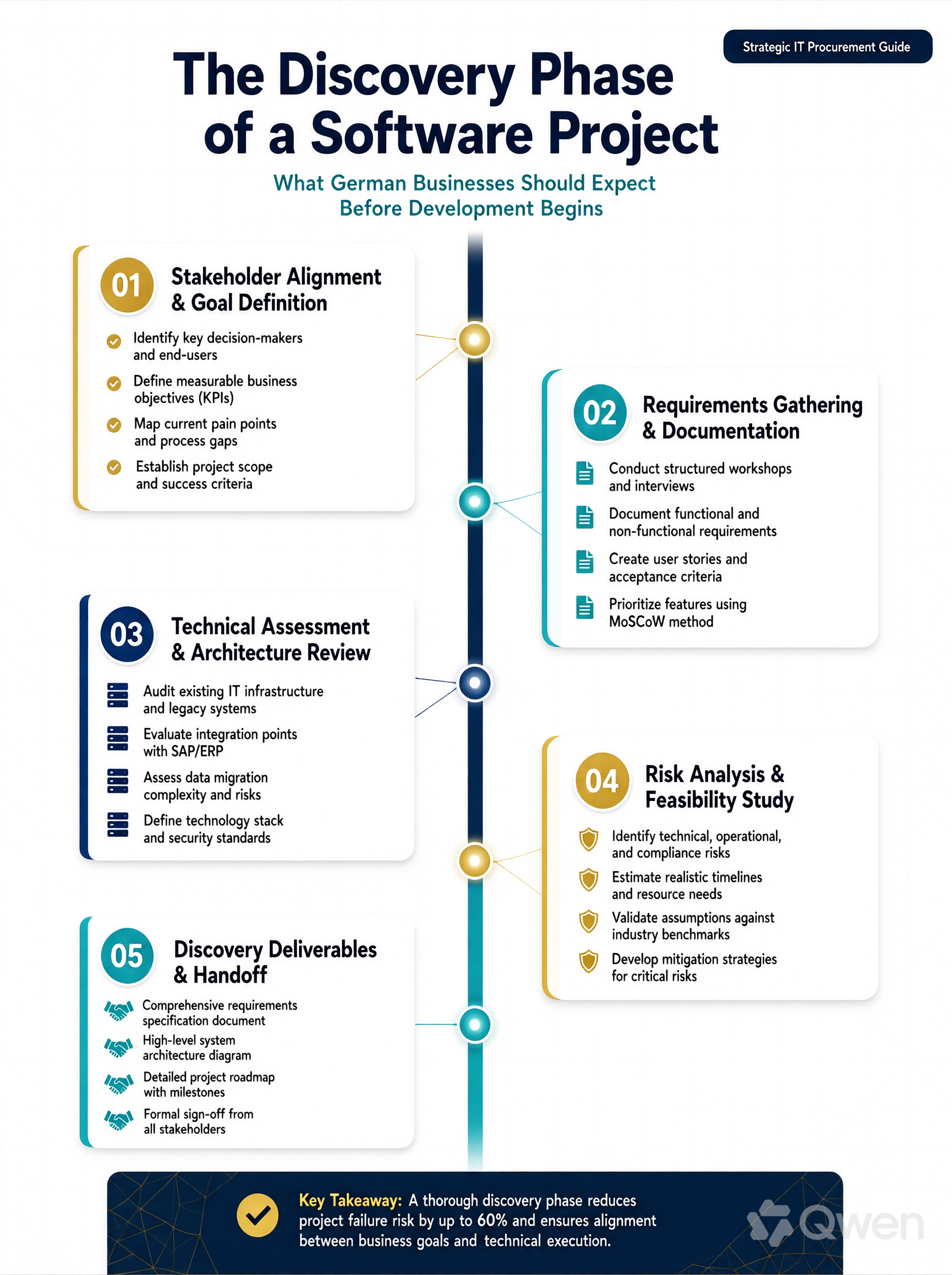
The activities differ between suppliers, but most discovery phases include the same core elements.
Stakeholder interviews and workshops
The team will talk to the people who run, use and depend on the process in question. These are not only the project sponsor. A warehouse supervisor, an accounts clerk or a field engineer will often describe how work really happens, including the workarounds that never appear in official process documents.
Expect questions that feel basic. Why is this approved twice? What happens when a customer changes an order after dispatch? Who fixes the data when it is wrong? Those answers frequently uncover rules and exceptions that nobody thought to mention, and these exceptions are where software projects tend to become complicated.
Review of existing processes and systems
The team will want to see how things work now: current software, spreadsheets, forms, reports and the connections between them. For German companies, this often includes an ERP or accounting system that cannot easily be replaced, plus several departmental tools that grew up independently. The aim is to understand which data lives where, who owns it, and how reliable it is.
Data quality deserves attention at this stage. If customer records are duplicated or product data is inconsistent, the new software will inherit the problem unless someone plans to deal with it. Better to learn that now than during migration.
Defining scope and priorities
Raw requirements usually exceed what any budget can cover. Discovery turns a long wish list into a prioritised one. A helpful distinction is between what the business cannot operate without, what would clearly add value, and what is merely pleasant to have. The first group typically defines the initial release.
This is also the point to agree what is not included. A written list of exclusions prevents many later disagreements, because it makes the boundaries of the project visible to everyone who signed off on it.
Technical and architectural assessment
The development team will consider how the software could be built: which technologies fit, how it connects to existing systems, what the hosting options are, and where the technical risks lie. Integration is a common source of uncertainty. A system that must exchange data with an ERP that has no documented interface is a very different project from one with a well-maintained API, and the difference should be visible in the estimate.
For projects that need connections to existing applications, some companies look to individuelle Softwarelösungen Berliner development teams and other external specialists build, in order to link new software with systems that must remain in place. Whoever does this work, the assessment should name the integrations explicitly and say how each will be handled.
Compliance, security and data protection
For German businesses, regulatory questions belong in discovery, not in the final week before launch. The team should ask what personal data the software will handle, where it will be stored, who will process it and under which agreements. If external services or hosting providers are involved, a data processing agreement (Auftragsverarbeitungsvertrag) will usually be required, and any questions about data protection under the GDPR are worth putting to your data protection officer early.
Industry-specific obligations vary. Software that handles financial records, health information or regulated industrial data may carry requirements that others do not, and a good discovery phase identifies these rather than assuming them away. Your own legal or compliance advisers remain the authority on what applies to your case.
What the business needs to contribute
Discovery is not something a supplier can complete alone, and projects stall when companies treat it as a service they simply receive. Three contributions matter most.
The first is access to people. Interviews and workshops need decision makers and daily users, and their time must be genuinely available. A discovery phase where key staff cancel repeatedly produces a thin understanding of the problem.
The second is a single point of accountability. Someone on the client side should be able to resolve conflicting views, for example when sales and finance describe the same process differently. Without that person, disagreements surface later, usually in the middle of development.
The third is honesty about constraints: budget range, deadlines, internal skills, systems that cannot change and decisions already made. Hiding a constraint does not remove it, it only delays the moment it becomes visible.
What you should have at the end
A discovery phase should leave behind documents and decisions you can use, whether or not you continue with the same supplier. Typical outputs include:
- A written summary of the problem, the users and the goals of the project
- Prioritised requirements, with a clear first release and a list of items deliberately left out
- A technical proposal covering architecture, integrations, hosting and security considerations
- Early designs or prototypes where the interface matters, so that users can react to something concrete
- A risk list with realistic mitigations
- A revised estimate of effort and cost, with the assumptions behind it stated
On that last point, treat any estimate with appropriate scepticism if it is presented as exact. Software estimates carry uncertainty, and a credible one shows ranges, assumptions and what could change them. Estimates tend to be more reliable after discovery than before it, which is a strong reason to pay for the phase properly rather than skipping it.
Ownership of these documents should be settled in the contract. Ask whether you receive them in full and whether you are free to use them to obtain quotes from other providers. A discovery phase that produces material only the original supplier can use is not really a neutral assessment.
Choosing a partner for discovery
How a supplier conducts discovery says a good deal about how it will run the rest of the project. Notice whether they ask about your business before talking about technology, whether they challenge your assumptions politely and whether they are willing to say that something should be left out or done differently.
Some companies prefer a partner they can meet regularly, which is one reason regional providers offering professionelle Softwareentwicklung Hamburg businesses can visit in person remain relevant, even though much of the later work happens remotely. Proximity helps with workshops, but it does not replace evidence of relevant experience, so ask for references from projects of comparable size and complexity.
If you are comparing suppliers, many companies shortlist those offering individuelle Softwareentwicklung in Deutschland, partly for shared language and partly because of data protection expectations. Whichever provider you consider, ask who will actually take part in discovery, since the people in the sales meeting are not always the ones doing the work.
Conclusion
Discovery is the part of a software project where assumptions are tested against reality, and where a business learns what it is really buying before committing the larger budget. The strongest outcomes come from companies that treat it as a joint investigation: they make the right people available, state their constraints plainly and insist on usable deliverables at the end.
A practical next step is to prepare before the first workshop. List the processes the software must support, the systems it must connect to, the data protection questions you already know about and the three outcomes that would make the project a success. Handing that list to a prospective partner on day one will shorten the discovery phase and show quickly how well they listen.

 English
 French
 Spanish
 Portuguese
 Deutsch
 Turkish
 Dutch
 Italiano
 Russian
 Romaian
 Portuguese (Brazil)
 Greek