


Canada Biometrics Market Size Projected to Reach USD 3,529.0 Million by 2034 with a CAGR of 14.21%
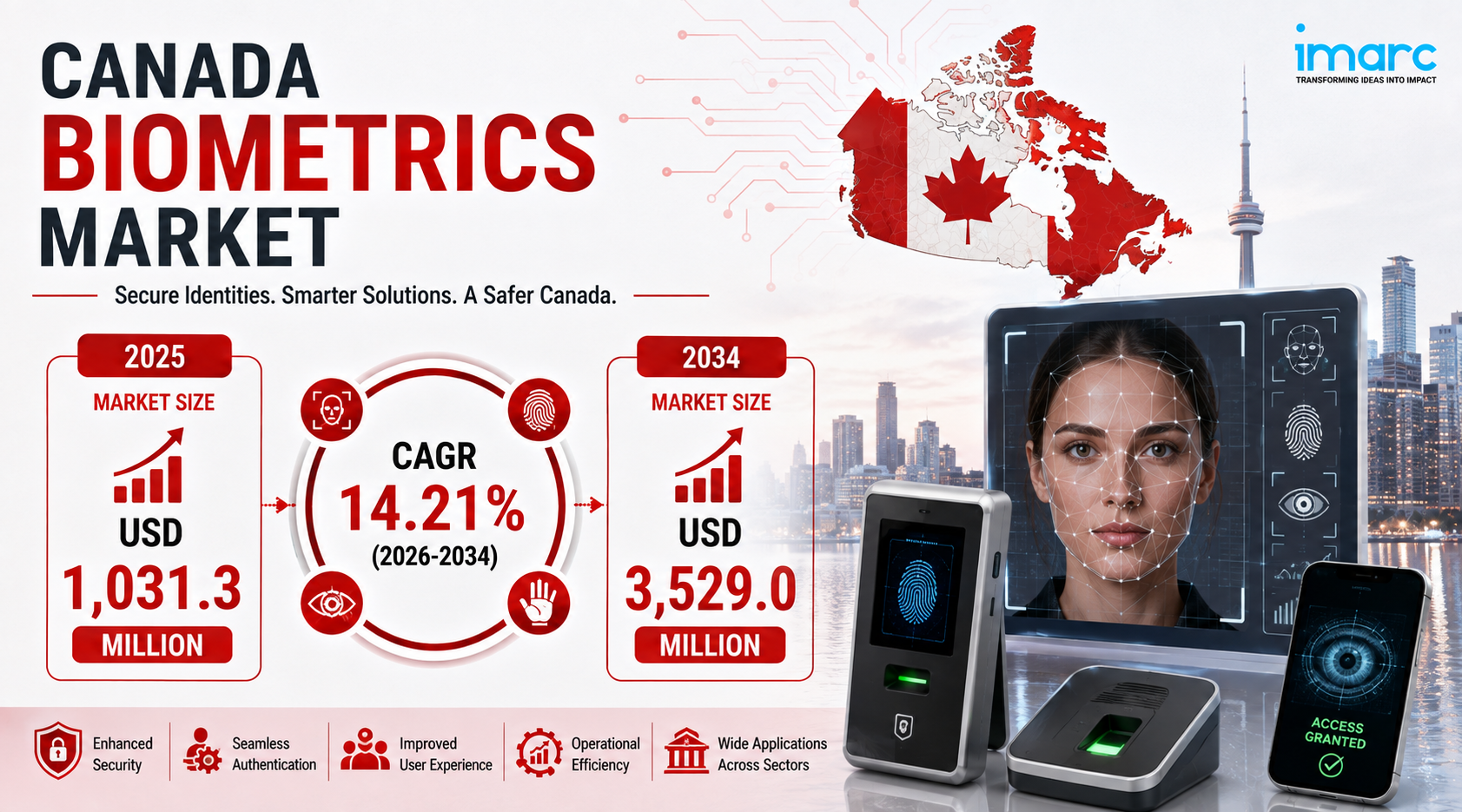
IMARC Group has recently released a new research study titled “Canada Biometrics Market Report by Technology, Functionality, Component, Authentication, End User, and Region, 2026-2034,” offers a detailed analysis of the market drivers, segmentation, growth opportunities, trends and competitive landscape to understand the current and future market scenarios.
Canada Biometrics Market Size, Growth, and Forecast (2026-2034)
The canada biometrics market size reached USD 1,031.3 Million in 2025 and is projected to reach USD 3,529.0 Million by 2034, growing at a CAGR of 14.21% during 2026-2034. Increasing adoption of advanced identification technologies in sectors such as banking, government, and security, along with rising concerns over data security and identity fraud, are the primary factors driving the canada biometrics market.
Biometrics refers to technologies that identify and authenticate individuals based on unique physical or behavioral characteristics, including face, iris, voice, and fingerprint biometrics. These systems are widely deployed across government, defense, banking and finance, healthcare, and commercial safety and security applications, supporting both single-factor and multifactor authentication.
Demand for the canada fingerprint biometrics market and related recognition technologies is rising as organizations seek reliable, tamper-resistant methods of identity verification. Technological innovations and deeper integration with digital services are further supporting market expansion, with a growing focus on secure authentication methods strengthening the market's growth trajectory.
Get Insights on the Canada Biometrics Market - Access the IMARC Sample Report: https://www.imarcgroup.com/canada-biometrics-market/requestsample
Key Trends Driving the Canada Biometrics Market
- Contactless biometric solutions: Growing awareness around hygiene is driving adoption of touchless authentication methods like facial recognition, iris scanning, and voice recognition. For instance, in November 2024, Air Canada introduced facial recognition technology at Vancouver International Airport, allowing domestic passengers to board without physical ID through a voluntary program using an uploaded photo and passport scan.
- Integration with digital identity programs: Government organizations are increasingly incorporating fingerprint, facial recognition, and iris scanning into e-passports, national ID systems, and border control applications. In August 2024, the Canada Border Services Agency announced plans to launch a facial recognition app, ReportIn, for tracking individuals ordered to leave the country, replacing outdated voice biometrics with Amazon Web Services-powered technology.
- Growing demand for fingerprint-based authentication: The canada fingerprint biometrics market continues to expand as banking, healthcare, and workforce management applications increasingly rely on fingerprint recognition for secure, cost-effective identity verification compared to other modalities.
- Rising use of biometrics in law enforcement and public safety: Police services and public safety agencies are adopting facial recognition and other biometric tools to aid investigations, subject to increasing scrutiny from privacy regulators regarding transparency and appropriate use.
Canada Biometrics Market Report Segmentation:
The Canada Biometrics Market report provides a detailed segmentation analysis to help businesses identify key growth segments and evolving industry dynamics. The market is categorized based on technology, functionality, component, authentication, and end user, offering comprehensive insights across the canada biometrics market.
Technology Insights:
- Face Recognition: Face recognition continues to see rapid adoption across airports, border control, and law enforcement applications.
- Hand Geometry: Hand geometry systems remain in use for physical access control in commercial and industrial facilities.
- Voice Recognition: Voice recognition is gaining traction in call centers and remote authentication applications.
- Signature Recognition: Signature recognition supports document verification and financial transaction authentication.
- Iris Recognition: Iris recognition offers high-accuracy identification for high-security government and border applications.
- AFIS: Automated Fingerprint Identification Systems (AFIS) support large-scale law enforcement and civil identification databases.
- Non-AFIS: Non-AFIS fingerprint systems serve smaller-scale commercial and enterprise access control needs, supporting the canada fingerprint biometrics market.
- Others: Other emerging technologies continue to expand the range of biometric identification options available.
Functionality Insights:
- Contact: Contact-based systems, including traditional fingerprint scanners, remain widely used in enterprise and government settings.
- Non-contact: Non-contact systems are gaining preference for their hygiene benefits and convenience in high-traffic environments.
- Combined: Combined systems offer flexibility by supporting both contact and non-contact authentication modes.
Component Insights:
- Hardware: Hardware components, including scanners and sensors, form the core infrastructure of biometric deployments.
- Software: Software solutions enable data processing, matching algorithms, and integration with broader identity management systems.
Authentication Insights:
- Single-Factor Authentication: Single-factor authentication remains common for lower-risk applications requiring quick verification.
- Multifactor Authentication: Multifactor authentication is increasingly adopted for high-security applications requiring layered identity verification.
End User Insights:
- Government: Government agencies are major adopters of biometrics for national ID and public service applications.
- Defense Services: Defense services rely on biometrics for secure personnel identification and access control.
- Banking and Finance: Banking and finance institutions use biometrics to reduce fraud and streamline customer authentication.
- Consumer Electronics: Consumer electronics manufacturers integrate biometric sensors for device security and personalization.
- Healthcare: Healthcare providers use biometrics for patient identification and secure access to medical records.
- Commercial Safety and Security: Commercial safety and security applications use biometrics for facility access control and surveillance.
- Transport/Visa/Logistics: Transport, visa, and logistics applications rely on biometrics to streamline border crossings and travel processes.
- Others: Other end users continue to expand biometric adoption across diverse commercial applications.
Regional Insights:
- Ontario: Ontario leads adoption given its concentration of financial institutions, government agencies, and technology firms.
- Quebec: Quebec shows growing demand for biometric applications across public services and enterprise security.
- Alberta: Alberta sees steady adoption tied to energy sector security and workforce management needs.
- British Columbia: British Columbia benefits from strong technology sector presence driving biometric innovation.
- Others: Other regions continue to see expanding biometric adoption as national security initiatives extend coverage.
Canada Biometrics Market: Recent News and Developments
- July 2025: Staffy Health became the first healthcare staffing platform in Canada to implement biometric shift authentication and a one-device-per-worker policy, enhancing shift accuracy, preventing identity fraud, and ensuring secure record-keeping.
- July 2025: Canada announced plans to continue biometric collection services in Sudan through a partnership with the International Organization for Migration, aiding individuals unable to safely leave Sudan in completing applications for permanent residence and resettlement.
Challenges Impacting the Canada Biometrics Market
Concerns over algorithm transparency and potential bias in facial recognition systems have prompted increased scrutiny from privacy regulators, requiring vendors to demonstrate accuracy and fairness across diverse populations.
High implementation and integration costs associated with advanced biometric systems can be a barrier for smaller organizations seeking to upgrade legacy identification methods.
Investment Opportunities in the Canada Biometrics Market
The canada biometrics market presents compelling investment opportunities supported by its projected growth from USD 1,031.3 Million in 2025 to USD 3,529.0 Million by 2034. Contactless and multimodal biometric solutions represent a high-value opportunity as organizations prioritize hygiene, speed, and accuracy in identity verification.
The canada fingerprint biometrics market offers a durable investment frontier given its cost-effectiveness and broad applicability across banking, healthcare, and workforce management. Companies that combine advanced recognition technologies with strong compliance and privacy safeguards can build strong competitive positions in this expanding market.
Outlook of the Canada Biometrics Market (2026-2034)
The outlook for the canada biometrics market is positive, supported by rising demand for secure authentication, expanding digital identity programs, and continuous technological innovation. The market is projected to grow from USD 1,031.3 Million in 2025 to USD 3,529.0 Million by 2034 at a CAGR of 14.21%.
Continued expansion of contactless recognition technologies, deeper integration with government digital identity systems, and growing adoption across banking and healthcare will be the defining trends shaping the canada biometrics market through 2034.
Key Players in the Canada Biometrics Market
The canada biometrics market is served by a mix of global technology providers and specialized biometric solution companies competing on the basis of accuracy, integration capabilities, and regulatory compliance.
- Air Canada: A leading Canadian airline that introduced facial recognition boarding technology at Vancouver International Airport to streamline the passenger experience.
- Canada Border Services Agency (CBSA): A federal agency deploying facial recognition applications, including ReportIn, for immigration enforcement and border management.
- NEC Corporation: A global leader in biometric identification technologies, including facial and fingerprint recognition systems used across government and enterprise applications.
- Thales Group: A global technology company providing biometric identity and border security solutions, including e-passport and national ID systems.
- IDEMIA: A global leader in identity technologies offering biometric authentication solutions for government, banking, and commercial applications.
Frequently Asked Questions (FAQs): Canada Biometrics Market
- What is the current Canada biometrics market size?
The Canada biometrics market size reached USD 1,031.3 Million in 2025 and is projected to reach USD 3,529.0 Million by 2034, growing at a CAGR of 14.21% during 2026-2034.
- What are biometrics?
Biometrics are technologies that identify and authenticate individuals based on unique physical or behavioral characteristics, including face, iris, voice, and fingerprint recognition, deployed across government, banking, healthcare, and security applications.
- What are the key drivers of the canada biometrics market?
Key drivers include increasing adoption of advanced identification technologies in banking, government, and security sectors, along with rising concerns over data security and identity fraud.
- Which technology leads the Canada biometrics market?
Face recognition and fingerprint-based technologies, including the canada fingerprint biometrics market, lead adoption given their widespread use in border control, banking, and enterprise access control applications.
- Who are the key players in the Canada biometrics market?
Key players in the canada biometrics market include NEC Corporation, Thales Group, and IDEMIA, alongside organizations such as Air Canada and the Canada Border Services Agency driving biometric technology adoption.
Author IMARC Group
IMARC Group is a global management consulting firm that helps the world's most ambitious changemakers to create a lasting impact. The company provide a comprehensive suite of market entry and expansion services. IMARC offerings include thorough market assessment, feasibility studies, company incorporation assistance, factory setup support, regulatory approvals and licensing navigation, branding, marketing and sales strategies, competitive landscape and benchmarking analyses, pricing and cost research, and procurement research.
Contact Us
IMARC Group,
134 N 4th St. Brooklyn, NY 11249, USA,
Email: [email protected],
United States: +1-201971-6302

 English
 Arabic
 French
 Portuguese
 Deutsch
 Turkish
 Dutch
Dutch
 Italiano
 Russian
 Romaian
 Portuguese (Brazil)
 Greek
Greek