


IUI vs IVF: Which Fertility Treatment May Be Right for You?
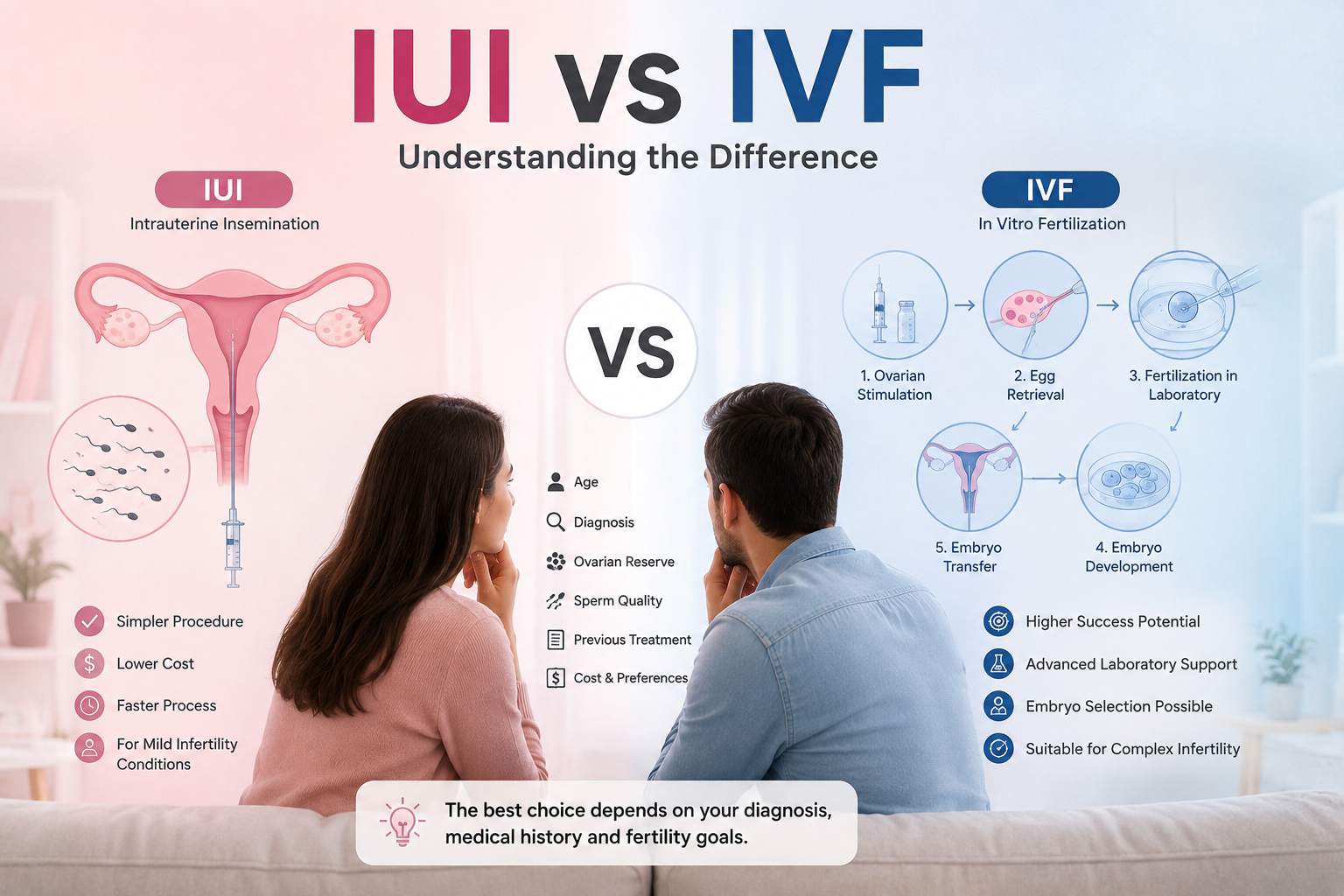
Understanding IUI vs IVF is important for couples exploring fertility treatment. Although both treatments are designed to help achieve pregnancy, they work in very different ways.
IUI is generally less invasive and involves placing prepared sperm directly into the uterus. IVF involves stimulating the ovaries, retrieving eggs, fertilising them in a laboratory and transferring an embryo into the uterus.
The right option depends on the cause of infertility, age, ovarian reserve, sperm quality and previous treatment history.
Quick Answer
IUI places prepared sperm into the uterus around ovulation, while IVF involves egg retrieval and fertilisation outside the body. IUI is generally simpler and less expensive, while IVF provides more control over fertilisation and embryo development.
What Is IUI?
IUI stands for intrauterine insemination.
During IUI, sperm is collected and processed in a laboratory. The prepared sperm sample is then placed directly into the uterus around the time of ovulation.
The goal is to increase the number of healthy sperm reaching the fallopian tubes.
IUI may be considered for:
- Mild male-factor infertility
- Ovulation problems
- Unexplained infertility
- Donor sperm treatment
- Selected fertility cases where the fallopian tubes are functional
What Is IVF?
IVF stands for in vitro fertilisation.
Unlike IUI, IVF involves retrieving eggs from the ovaries.
A typical IVF process includes:
Ovarian stimulation → Egg retrieval → Fertilisation → Embryo development → Embryo transfer → Pregnancy test
IVF allows fertilisation to occur in a controlled laboratory environment.
IUI vs IVF: Key Differences
|
Factor |
IUI |
IVF |
|
Egg retrieval |
No |
Yes |
|
Fertilisation |
Inside body |
Laboratory |
|
Embryo created in laboratory |
No |
Yes |
|
Procedure complexity |
Lower |
Higher |
|
Typical cost |
Lower |
Higher |
|
Laboratory involvement |
Limited |
Extensive |
|
Blocked tubes |
Usually unsuitable |
Can bypass tubes |
|
Severe male factor |
Limited suitability |
Often appropriate |
|
Embryo selection |
No |
Yes |
This comparison is central to understanding IUI vs IVF.
When Is IUI Recommended?
IUI may be considered when sperm can potentially reach the egg through the fallopian tube.
For example, mild male-factor infertility may sometimes be treated with IUI.
IUI may also be used with ovulation-inducing medication.
However, IUI is not appropriate for every fertility problem.
If both fallopian tubes are blocked, sperm cannot reach the egg naturally, so IUI generally cannot overcome the problem.
When Is IVF Recommended?
IVF may be recommended when there are factors that make natural fertilisation difficult.
These can include:
- Blocked fallopian tubes
- Severe male-factor infertility
- Certain cases of endometriosis
- Reduced ovarian reserve
- Advanced reproductive age
- Repeated unsuccessful fertility treatment
- Some cases of unexplained infertility
Ferti.Health's condition library includes blocked fallopian tubes, male-factor infertility and diminished ovarian reserve among conditions where treatment selection may involve IUI or IVF depending on severity.
IUI vs IVF Success Rates
Success rates should always be interpreted carefully.
Ferti.Health currently reports indicative IUI live birth rates of around 10–18% per cycle for women under 38, compared with approximately 40–45% for fresh IVF + ICSI in the same broad age group. However, these figures vary according to diagnosis, age, treatment protocol and clinic.
This illustrates why comparing IUI vs IVF requires more than looking at a single percentage.
The number of treatment cycles and cumulative outcomes are also important.
What Is ICSI?
ICSI stands for intracytoplasmic sperm injection.
It is performed as part of IVF.
During ICSI, an embryologist injects a single sperm directly into a mature egg.
ICSI may be considered when:
- Sperm count is very low
- Sperm motility is poor
- Sperm morphology is significantly abnormal
- Previous fertilisation has failed
- Surgically retrieved sperm is being used
Ferti.Health's specialist Q&A notes that ICSI is not automatically necessary for every couple and depends on the severity of male-factor infertility and other clinical factors.
IUI vs IVF Cost
IUI generally costs less because the procedure does not involve egg retrieval or embryo culture.
Ferti.Health's India-focused cost guide lists indicative IUI costs of approximately ₹8,000–₹25,000 per cycle, while IVF costs vary substantially depending on the protocol and additional services.
Additional IVF expenses may include:
- Medications
- ICSI
- Embryo freezing
- Frozen embryo transfer
- Genetic testing
- Additional laboratory procedures
Which Is Better: IUI vs IVF?
There is no universal winner.
The appropriate treatment depends on:
- Age
- Diagnosis
- Ovarian reserve
- Sperm parameters
- Tubal health
- Previous treatment
- Duration of infertility
For mild fertility problems, IUI may be a reasonable first-line option.
For more significant reproductive problems, IVF may offer a more effective pathway.
Frequently Asked Questions
Is IUI easier than IVF?
Yes. IUI generally involves fewer procedures and does not require egg retrieval.
Is IVF more successful than IUI?
IVF generally has higher success rates per treatment cycle, but individual outcomes vary.
Can IUI work with blocked fallopian tubes?
IUI generally requires at least one functioning fallopian tube.
Is ICSI part of IVF?
Yes. ICSI is a fertilisation technique that can be performed during an IVF cycle.
How many IUI cycles should be attempted?
The appropriate number depends on age, diagnosis and treatment response. Some couples may move to IVF after several unsuccessful IUI cycles.
Conclusion
Understanding IUI vs IVF helps couples make more informed fertility decisions.
IUI is simpler and less invasive, while IVF provides greater control over fertilisation and embryo development.
Neither treatment is automatically better for every patient. The appropriate option should be selected after evaluating the underlying cause of infertility and discussing the expected benefits, risks and costs with a qualified fertility specialist.

 English
 Arabic
 French
 Spanish
 Portuguese
 Turkish
 Dutch
Dutch
 Italiano
 Russian
 Romaian
 Portuguese (Brazil)
 Greek
Greek