


What Does Voltage Mean in a Power Supply?
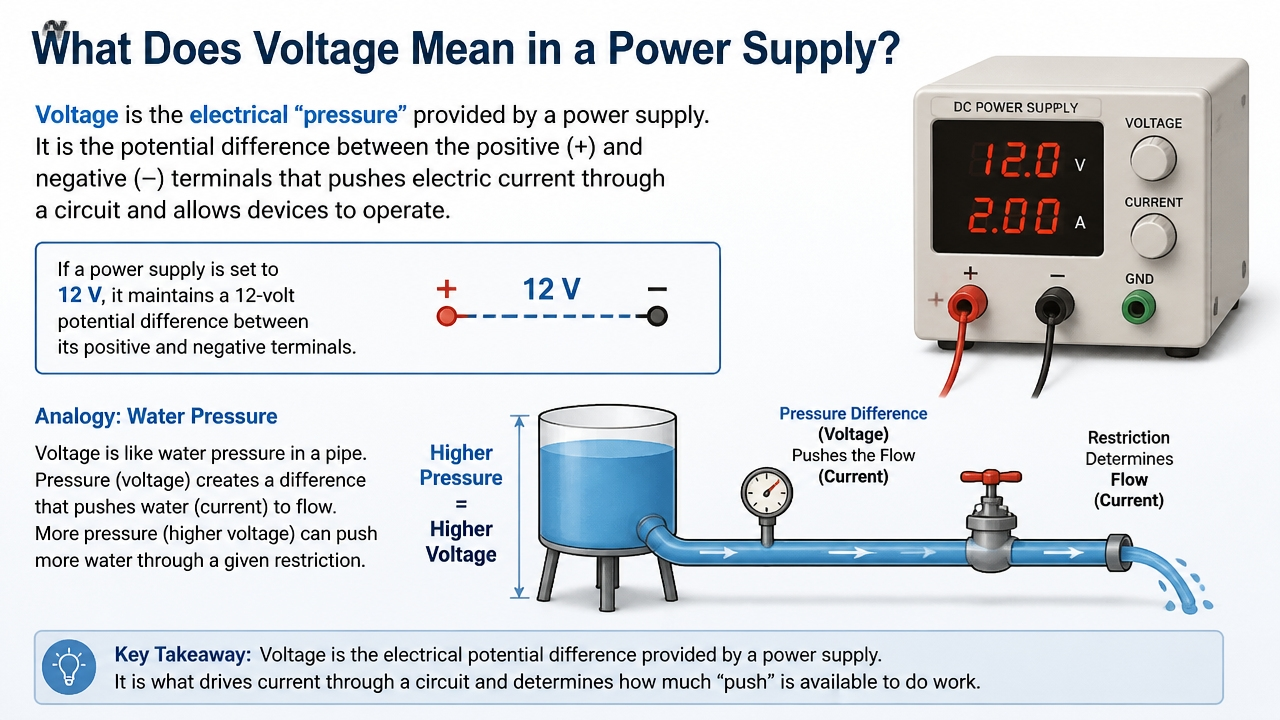
When shopping for a power supply, voltage is one of the first specifications you will encounter. It is printed on every adapter, plug pack and bench supply, yet many people are unsure what it actually means or why it matters so much. In simple terms, voltage is the electrical pressure that pushes current through a circuit. Getting it right is essential for the safe and reliable operation of any electronic device.
This article explains what voltage means in a power supply, why matching voltage is critical, what happens when voltage is wrong and which common voltages you will encounter in everyday equipment.
Understanding Voltage: The Water Analogy
To understand voltage, it helps to think of electricity like water flowing through a pipe.
-
Voltage is the water pressure. It determines how forcefully the water is pushed through the pipe.
-
Current is the amount of water flowing through the pipe per second.
-
Resistance is the size of the pipe. A narrower pipe resists flow more than a wider one.
In a power supply, voltage is the force that pushes electrical current around a circuit. A higher voltage means more pressure behind the electrons. A lower voltage means less pressure.
The unit of measurement for voltage is the volt (V) . When a power supply is labelled as a 12V supply, it means it provides 12 volts of electrical pressure at its output terminals.
What Voltage Does a Power Supply Actually Do?
A power supply converts mains alternating current (AC) from a wall outlet into direct current (DC) at a specific voltage. The output voltage is the level of electrical pressure delivered to the connected device.
Most electronic devices are designed to operate at a specific voltage. The voltage rating tells you the electrical pressure the device expects to receive. For example:
-
A device labelled 12V expects 12 volts of electrical pressure.
-
A device labelled 5V expects 5 volts of electrical pressure.
The power supply must deliver the voltage the device is designed for, not more and not less.
Why Voltage Matching Is Critical
Voltage matching is one of the most important rules when connecting a power supply to a device. The voltage of the power supply must match the voltage required by the device. This is not a suggestion. It is a requirement for safe operation.
Using a power supply with the wrong voltage can cause damage, malfunction or even create a safety hazard. Voltage mismatch is one of the most common causes of electronics failures.
What Happens with Over-Voltage?
Over-voltage occurs when the power supply delivers more voltage than the device is designed to handle.
The result is that too much electrical pressure is applied to the circuit. Components receive more energy than they were built to tolerate. This can cause:
-
Excessive heat generation
-
Damage to integrated circuits and microchips
-
Premature failure of capacitors
-
Burning out of components
-
In severe cases, smoke or fire
Even a small over-voltage can shorten the life of a device. A significant over-voltage can destroy it instantly. For example, connecting a 12V power supply to a device designed for 5V will almost certainly cause damage.
What Happens with Under-Voltage?
Under-voltage occurs when the power supply delivers less voltage than the device requires.
The result is that the device does not receive enough electrical pressure to operate correctly. Symptoms can include:
-
The device fails to turn on
-
The device powers on but behaves erratically
-
Motors run slowly or fail to start
-
Displays flicker or dim
-
The device repeatedly resets or shuts down
In some cases, under-voltage does not cause permanent damage. However, it can cause a device to draw excessive current as it tries to compensate for the lack of voltage, which can overheat the power supply or the device itself. Prolonged under-voltage is not advisable.
The General Rule
The general rule is simple: use a power supply with the same voltage as the device requires and with a current rating equal to or greater than the device demands.
Current rating is a separate issue from voltage. A power supply with a higher current rating than needed is generally safe, because the device only draws the current it requires. The same rule does not apply to voltage. Voltage must match. The article Understanding Amps in Power Supplies: Do Higher Amps Push More Power Into Devices has more information current requirements you need to consider when selecting a power supply.
What About Polarity?
Voltage is not the only thing to check. Polarity is also critical, particularly with DC power supplies.
Most plug packs have a centre pin and an outer barrel. The polarity indicates which part is positive and which is negative. A common configuration is centre-positive, meaning the centre pin is positive and the outer barrel is negative. However, centre-negative configurations also exist.
Connecting a power supply with the wrong polarity can damage a device, even if the voltage is correct. Always check the polarity markings on both the device and the power supply before connecting. For more information see the following article: Selecting the Right Plug Size for Your DC Power Supply
Common Voltage Examples
Different devices require different voltages depending on their design and power needs. Here are some of the most common voltages found in power supplies and the types of devices they typically serve.
5 Volt (5V)
5V is one of the most common voltages in electronics. It is the standard for USB power and is widely used in digital logic circuits.
Common devices that use 5V include:
-
Smartphones and tablets (via USB)
-
Raspberry Pi and other single-board computers
-
Arduino boards
-
USB-powered peripherals
-
Small LED lighting
9 Volt (9V)
9V is commonly used in audio equipment, musical instruments and some consumer electronics.
Common devices that use 9V include:
-
Guitar effect pedals
-
Some audio mixers
-
Certain radios and small appliances
-
Some smoke detectors and security devices
12 Volt (12V)
12V is a versatile voltage used across many applications, from automotive to computing to lighting. This article Top 12V Power Supplies In Australia looks at 12V power supplies in Australia.
Common devices that use 12V include:
-
LED strip lighting
-
CCTV cameras and security systems
-
Computer peripherals and fans
-
Car accessories and dash cameras
-
Routers, modems and network switches
-
Some portable monitors and displays
24 Volt (24V)
24V is commonly found in industrial and commercial equipment, as well as some higher-power consumer devices.
Common devices that use 24V include:
-
Industrial sensors and controllers
-
Commercial LED lighting
-
Some printers and office equipment
-
Electric actuators and valves
-
Certain audio amplifiers
48 Volt (48V)
48V is increasingly common in networking, telecommunications and power-over-ethernet (PoE) applications.
Common devices that use 48V include:
-
PoE switches and powered devices
-
Telecom equipment
-
Some electric bike and mobility devices
-
High-power LED lighting
-
Data centre equipment
Voltage and Switchmode Power Supplies
Switchmode power supplies are the most common type of DC power supply used today. They convert AC mains electricity to DC electricity at specific voltages. They use transistors to rapidly switch the incoming voltage on and off, producing a stable DC output without generating significant heat.
Switchmode power supplies are smaller, lighter and more efficient than older linear power supplies. They are widely used in computers, consumer electronics and industrial equipment. Many switchmode supplies also include built-in protection against short circuits and overvoltage conditions.
Because switchmode supplies are efficient and compact, they are the preferred choice for most applications. A wide range of switchmode plug packs and power supplies is available to suit different voltage and current requirements.
How to Choose the Right Voltage
Choosing the right voltage for a power supply involves a few straightforward steps.
-
Check the device label. Most devices list their required input voltage and current. This information is usually printed on a label on the device or on the original power supply.
-
Match the voltage exactly. Use a power supply with the same output voltage as the device requires.
-
Check the current rating. The power supply should have a current rating equal to or greater than the device requires. A higher current rating is fine.
-
Verify the polarity. Confirm that the polarity of the plug matches the device.
-
Check the plug size. The connector must fit the device securely.
If a device label is missing, check the device manual or contact the manufacturer. Do not guess. Guessing can lead to damage or unsafe operation.
Voltage Regulation and Stability
A quality power supply does more than just provide a nominal voltage. It regulates the output to keep it stable, even when the load changes. This is called voltage regulation.
Switchmode power supplies typically provide good voltage regulation. They maintain a steady output voltage across a range of load conditions. This stability is important because some devices are sensitive to voltage fluctuations. A stable voltage helps ensure consistent performance and protects sensitive electronics.
Cheaper or poorly designed power supplies may not regulate voltage well. Output voltage can sag under load or spike when the load drops. This can cause problems for sensitive equipment. Choosing a reputable power supply from a reliable supplier reduces this risk.
Safety Considerations
In Australia, electrical equipment must meet relevant safety standards. Power supplies sold through reputable Australian suppliers should comply with applicable requirements for electrical safety and electromagnetic compatibility.
When using power supplies, observe the following safety practices:
-
Only use power supplies that are in good physical condition
-
Do not use damaged cables or connectors
-
Do not overload a power supply beyond its rated current
-
Keep power supplies in well-ventilated areas
-
Do not cover power supplies while they are in operation
-
Unplug power supplies during thunderstorms or when not in use
If a power supply becomes hot to the touch, smells unusual or makes strange noises, disconnect it immediately and stop using it.
Why Voltage Matching Is Not Negotiable
Some people assume that a slightly higher voltage will simply make a device run faster or brighter. This is a misunderstanding. Most electronic devices are designed to operate within a narrow voltage range. Exceeding that range can cause immediate damage or reduce the device's lifespan.
Similarly, some people assume that a lower voltage is harmless because it is safer. This is also incorrect. Under-voltage can prevent a device from functioning correctly and may cause it to draw excessive current, which creates its own problems.
Voltage matching is not a recommendation. It is a requirement for safe and reliable operation.
Summary
Voltage is the electrical pressure that a power supply delivers to a connected device. It is measured in volts and must match the voltage that the device is designed to receive. Using the wrong voltage, whether too high or too low, can damage equipment, cause malfunction or create safety hazards.
Common voltages such as 5V, 9V, 12V, 24V and 48V are used across a wide range of consumer, commercial and industrial devices. Understanding which voltage a device requires and selecting a power supply that delivers that voltage, is the foundation of safe electronics use.
When choosing a power supply, always match the voltage exactly, ensure the current rating is sufficient, check polarity and confirm the connector fits. A wide selection of reliable DC power supplies is available from Campad Electronics to suit different voltage and current requirements. Taking the time to choose correctly protects both the equipment and the user.
Frequently Asked Questions
What is voltage in a power supply?
Voltage is the electrical pressure, measured in volts (V), that pushes current through a circuit. It determines how forcefully electricity is delivered to a connected device.
Can I use a power supply with a higher voltage than my device needs?
No. Over-voltage can overheat components, damage integrated circuits, shorten device lifespan or cause immediate failure, smoke or fire. Voltage must match exactly.
Can I use a power supply with a lower voltage than my device needs?
No. Under-voltage may prevent the device from turning on, cause erratic behaviour or lead to excessive current draw that overheats the power supply or device.
What happens if I use a power supply with the correct voltage but higher current rating?
This is safe. The device only draws the current it needs. A higher current rating simply means the supply can deliver more if required.
What happens if the current rating is too low?
The power supply may overheat, shut down or be damaged because it cannot meet the device’s demand. Always use a supply with a current rating equal to or greater than required.
What is polarity and why does it matter?
Polarity indicates which connector part is positive and which is negative. Wrong polarity can damage the device even if voltage is correct. Always check centre-positive or centre-negative markings.
How do I find the correct voltage for my device?
Check the label on the device or its original power supply. It usually lists input voltage and current. If missing, consult the manual or manufacturer.
Is a 5V power supply the same as a 5V USB charger?
Yes, in terms of output voltage. However, ensure the current rating is sufficient and the connector is compatible with your device.
Why do different devices use different voltages?
Device design dictates voltage based on component requirements. Digital logic often uses 5V, automotive and lighting commonly use 12V, industrial equipment may use 24V and networking uses 48V.
Can voltage fluctuations harm my device?
Yes. Poorly regulated power supplies can cause voltage spikes or sags, which may damage sensitive electronics. Use a quality, regulated switchmode supply for stable output.
What is voltage regulation?
Voltage regulation is the ability of a power supply to maintain a steady output voltage despite changes in load. Good regulation protects devices from fluctuations.
Can I replace a linear power supply with a switchmode supply of the same voltage?
Yes, if the voltage matches, current rating is sufficient, polarity is correct and the connector fits. Switchmode supplies are more efficient and compact.
What are the most common voltages in consumer electronics?
5V (USB devices), 9V (audio gear), 12V (LED lighting, routers), 24V (industrial equipment) and 48V (PoE and telecom).
What should I do if my power supply gets hot?
Disconnect it immediately and stop using it. Overheating can indicate overloading, poor ventilation or a fault. Replace it with a properly rated supply.
Is it safe to use a power supply with a different plug size?
No. A loose or forced connection can cause arcing, short circuits or intermittent power. Use the correct plug size for a secure fit.
Do Australian power supplies need safety certifications?
Yes. Reputable Australian suppliers should comply with relevant electrical safety and electromagnetic compatibility standards. Always purchase from trusted sources.
What is the difference between AC and DC voltage in a power supply?
A power supply converts mains AC to DC at a specified voltage. Most electronic devices require DC voltage. The output is labelled as DC with a voltage rating.
Can I use a 12V power supply on a 9V device if it’s only for a short time?
No. Even short-term over-voltage can cause damage. Always match the voltage exactly for safe operation.
What does “regulated” mean on a power supply?
It means the output voltage stays constant despite changes in load or input voltage. Regulated supplies are safer for sensitive electronics.
Where can I find reliable power supplies with correct voltage ratings?
Campad Electronics offers a wide range of DC power supplies and plug packs in common voltages (5V, 9V, 12V, 24V, 48V) with appropriate current ratings and safety compliance.

 English
 Arabic
 French
 Portuguese
 Deutsch
 Turkish
 Dutch
 Italiano
 Russian
 Romaian
 Portuguese (Brazil)
 Greek